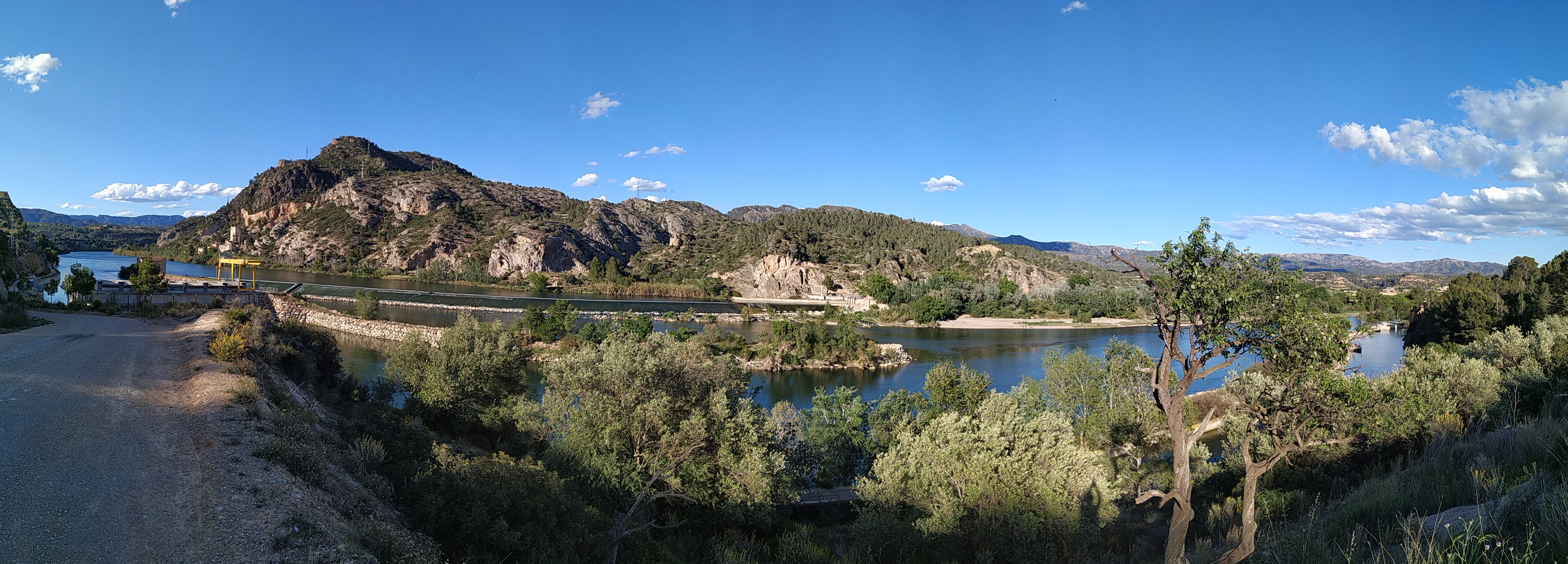
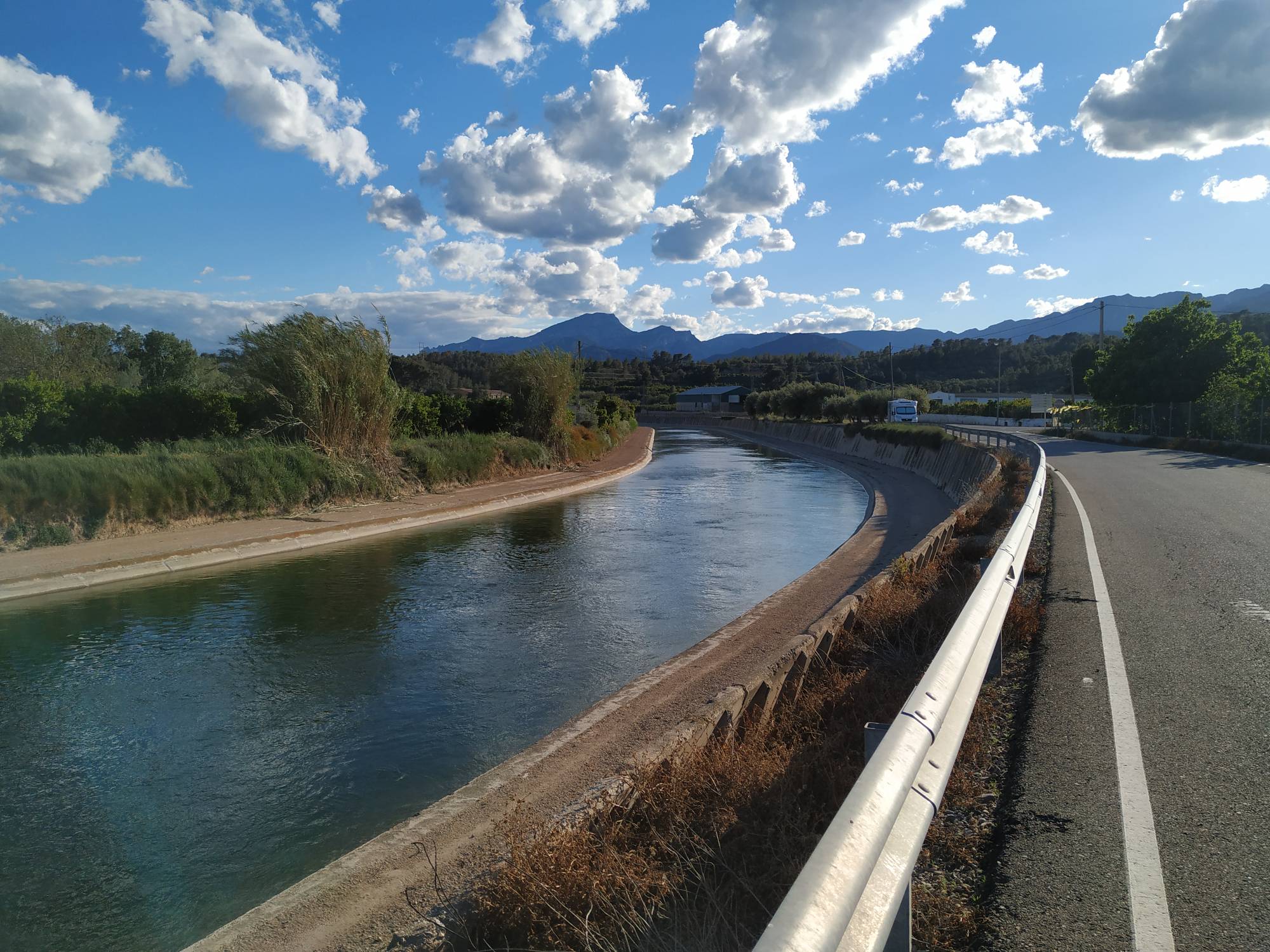
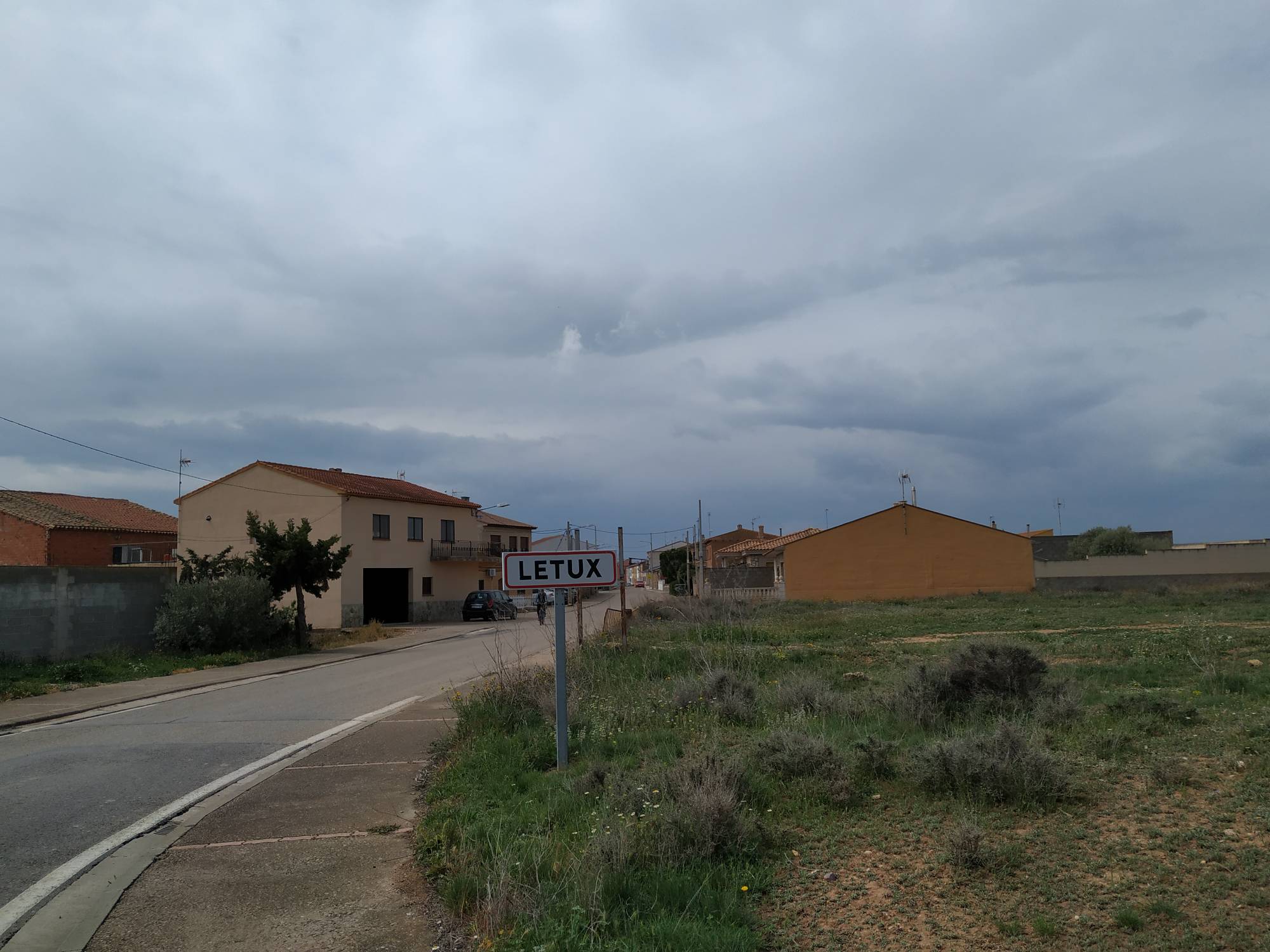
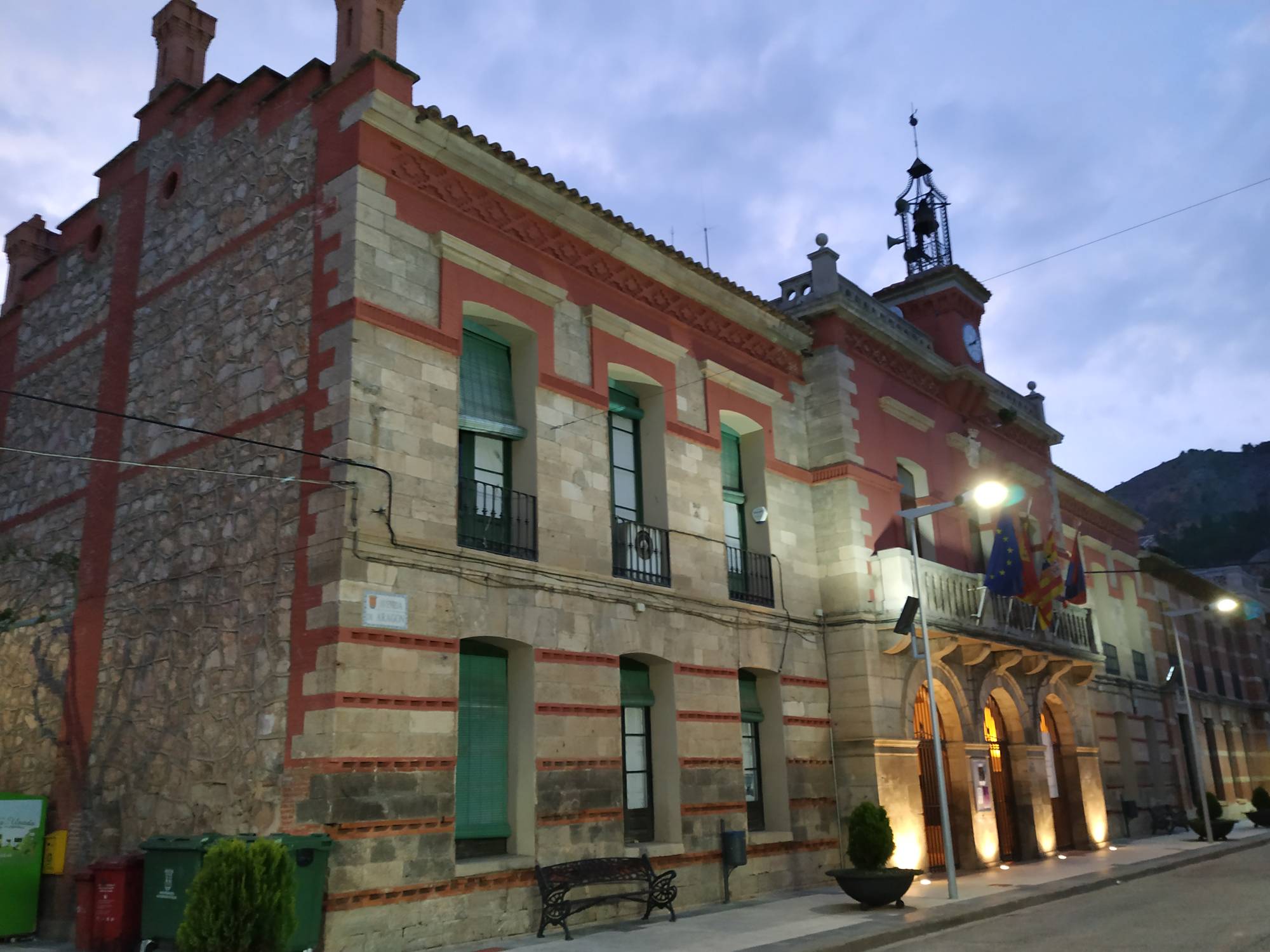
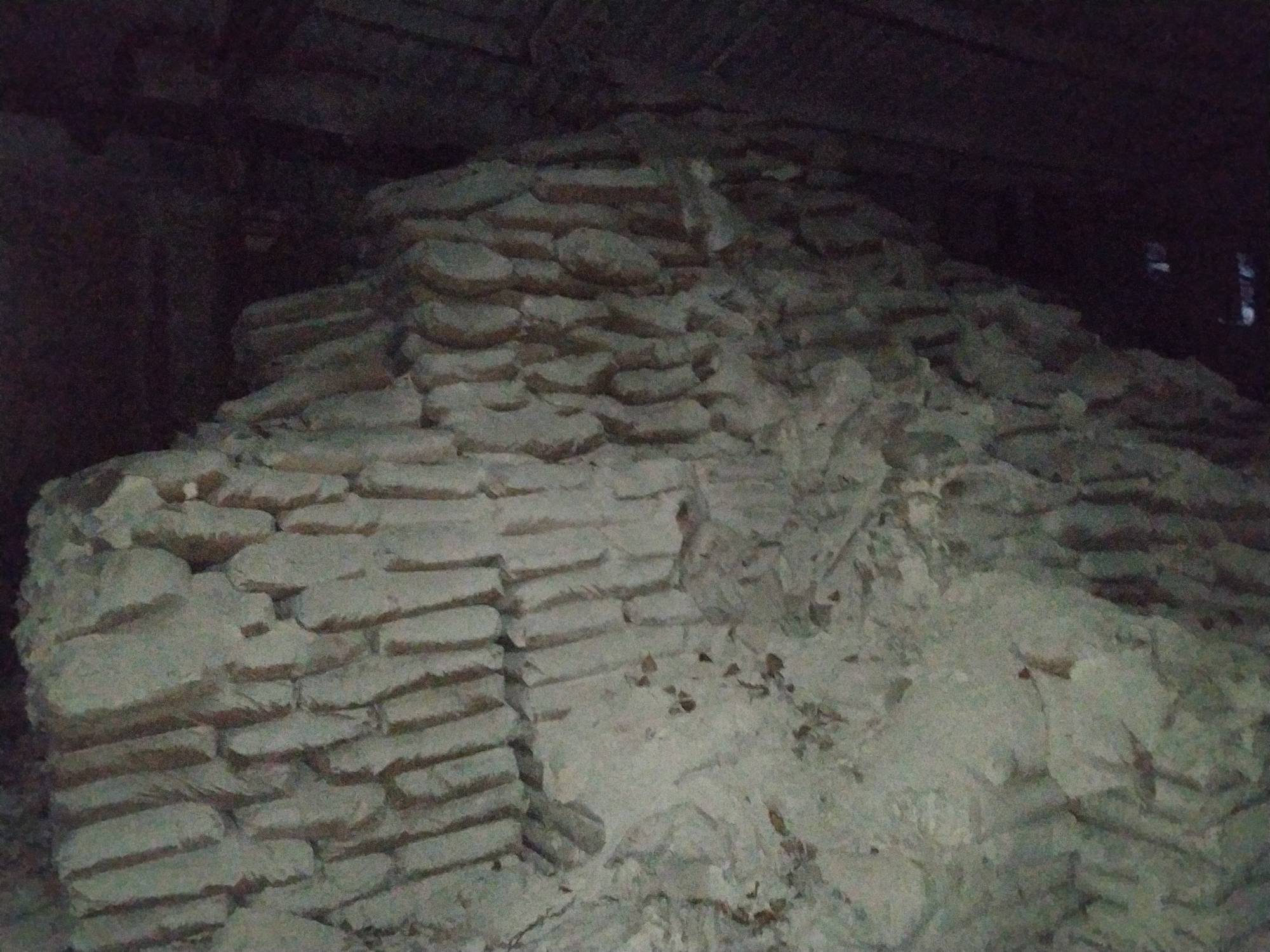
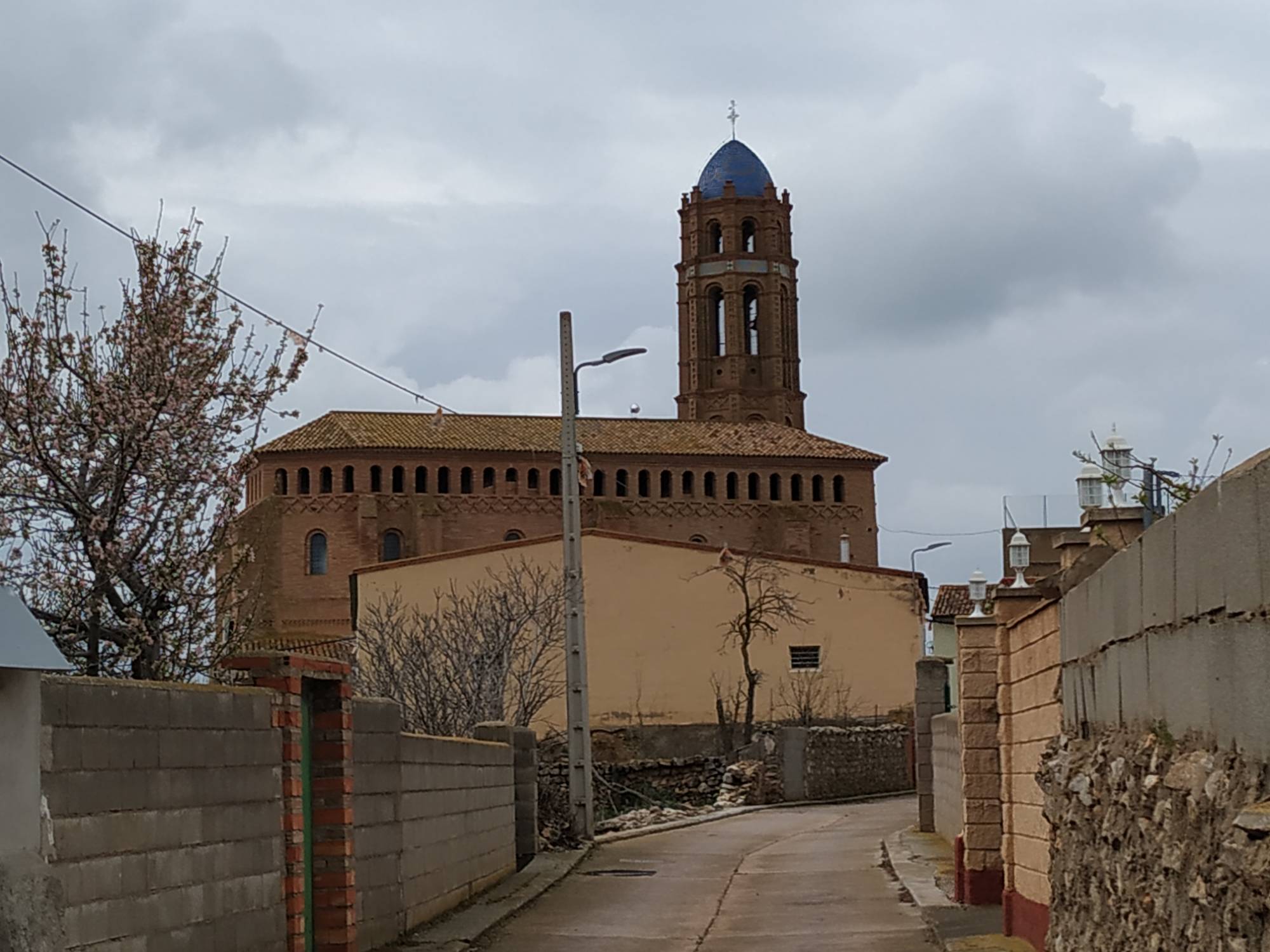
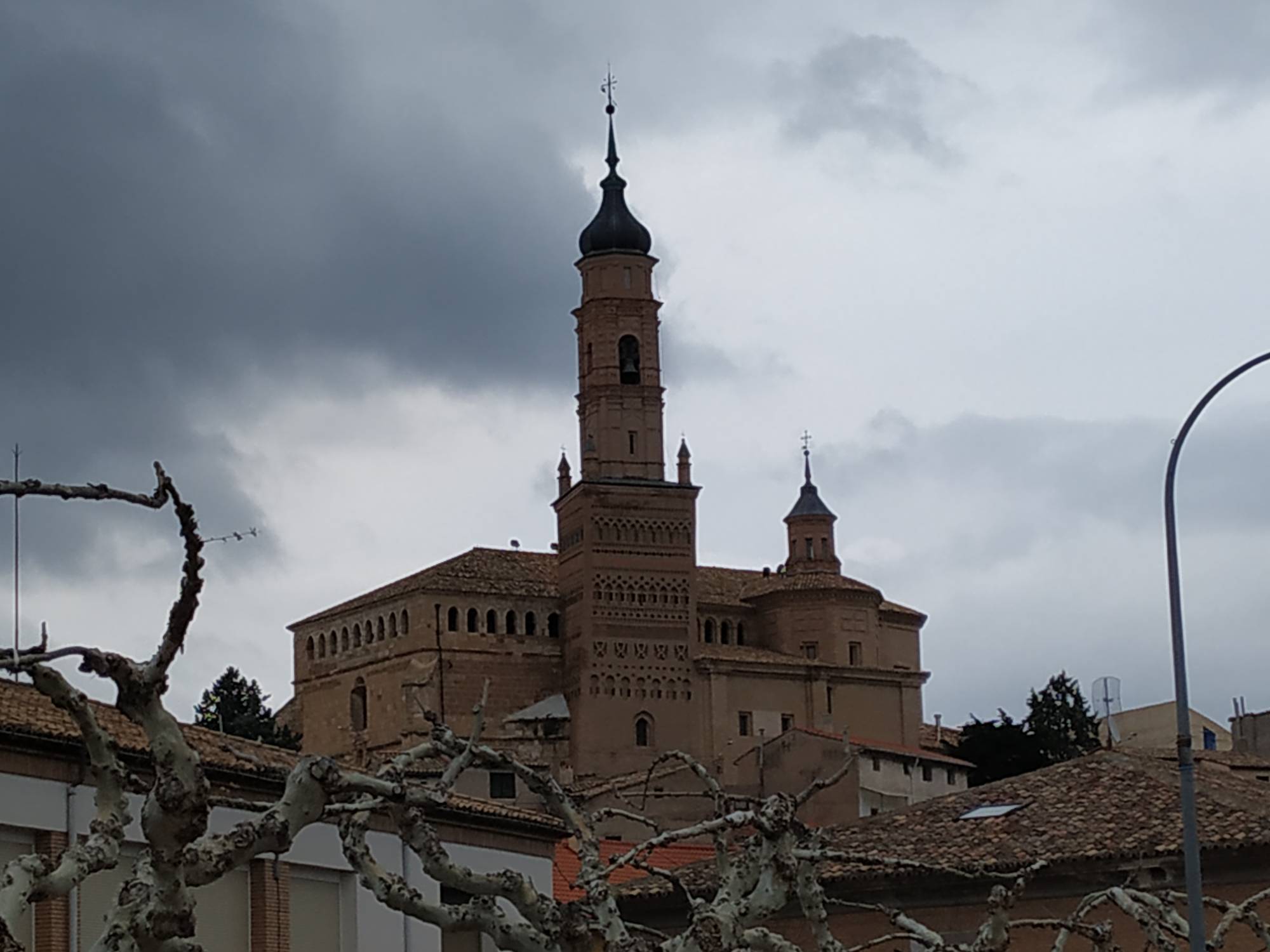
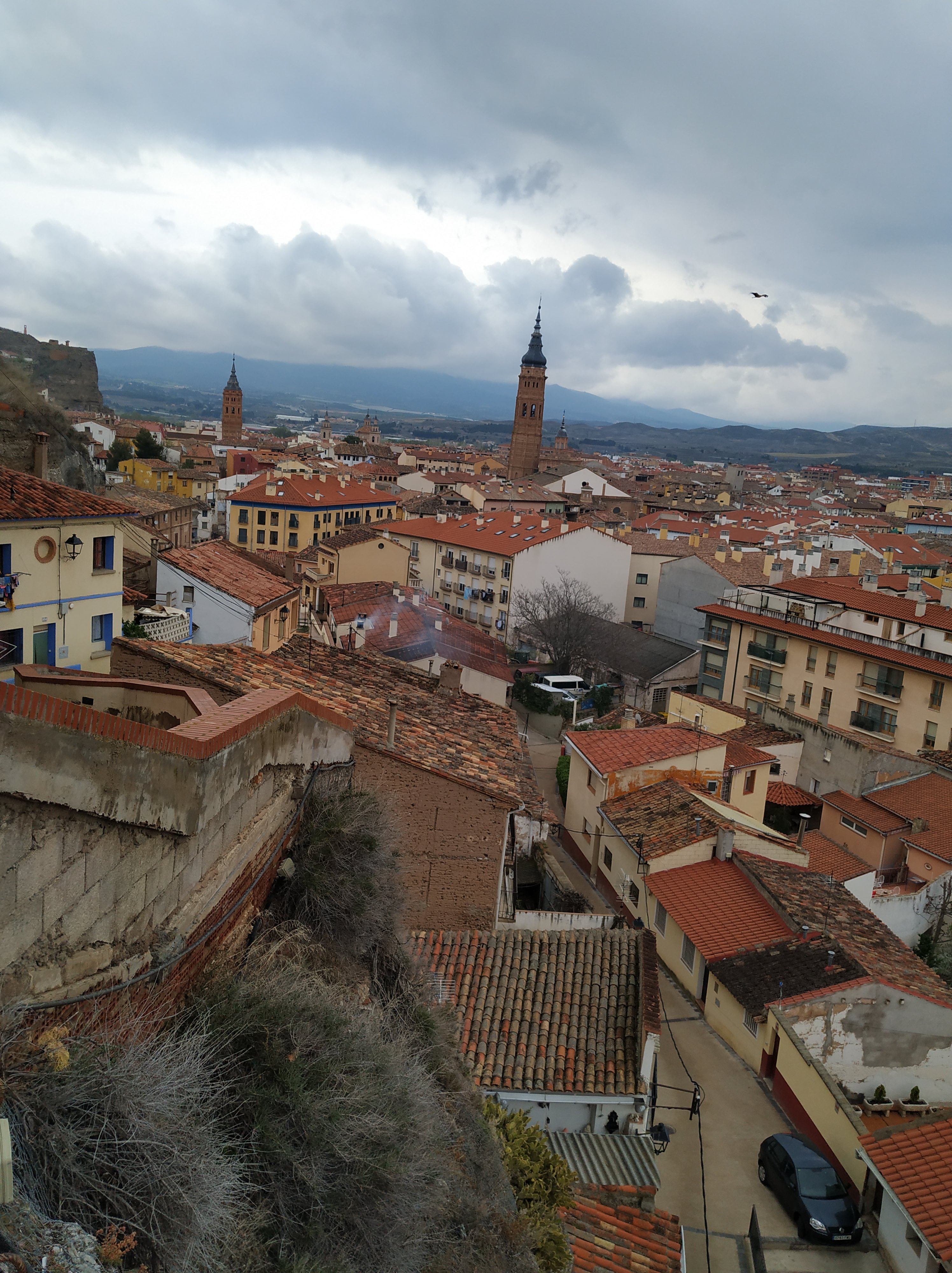
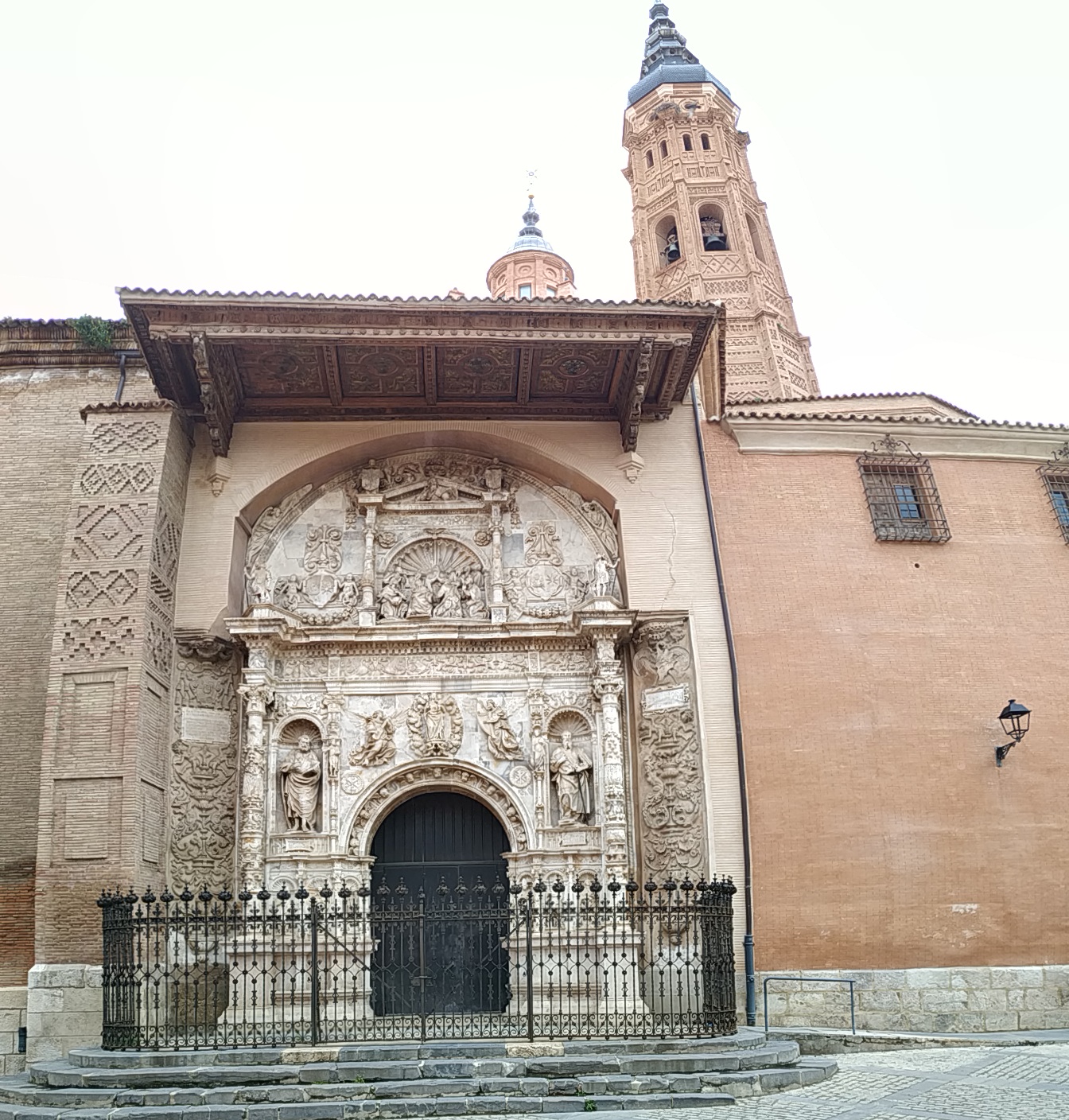
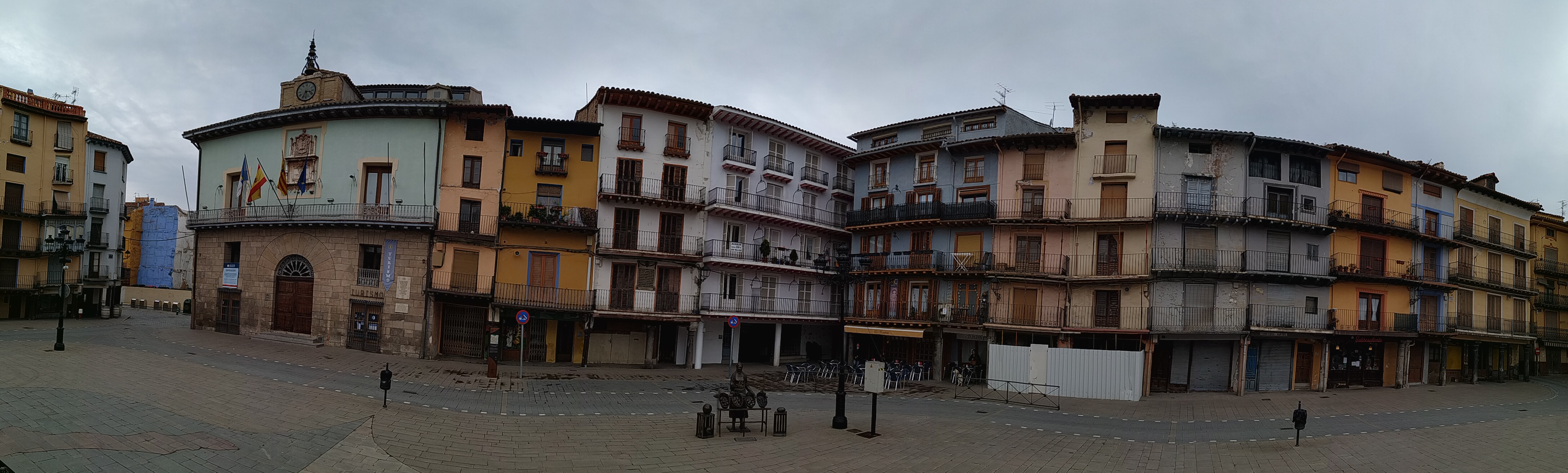
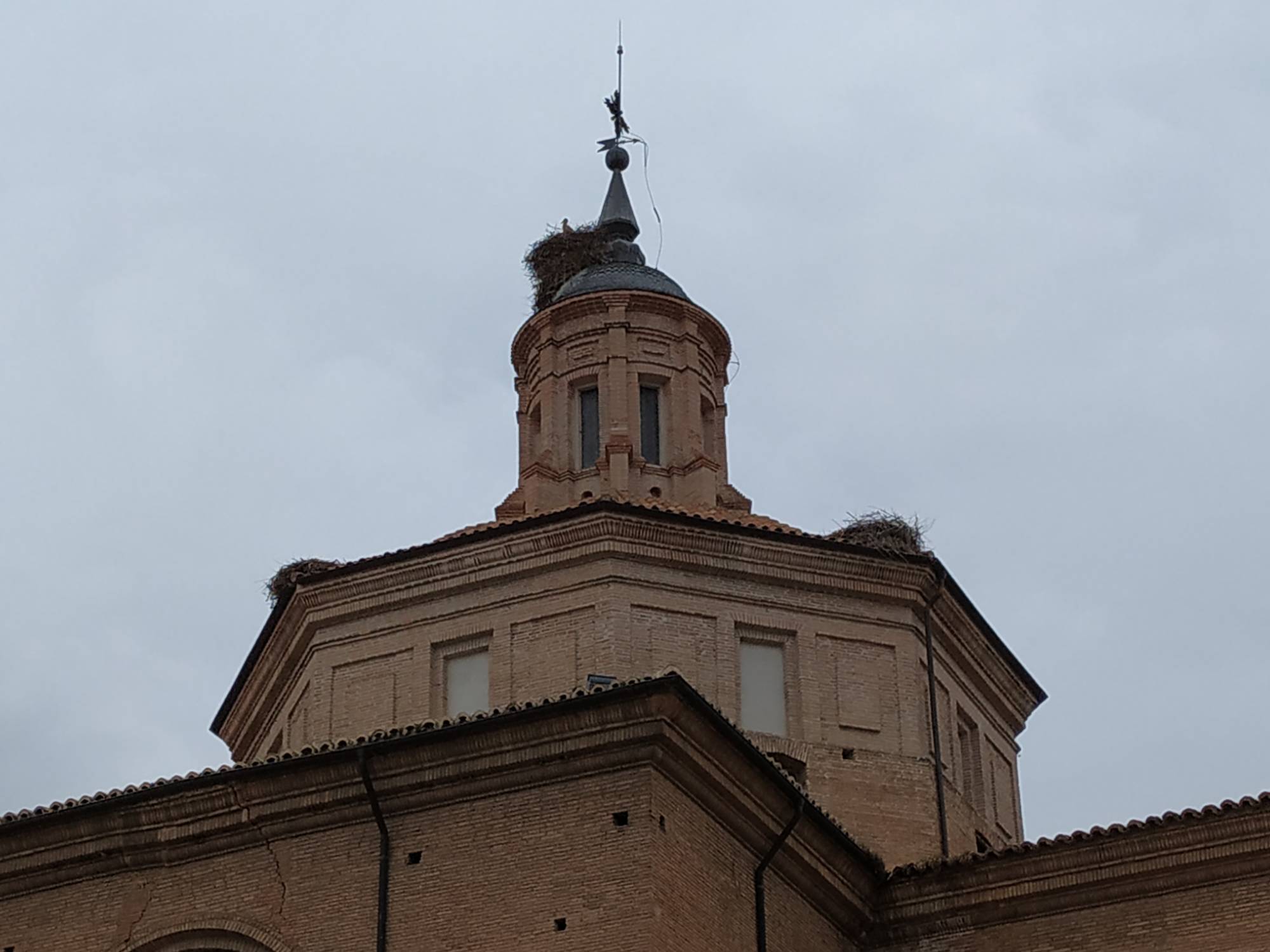
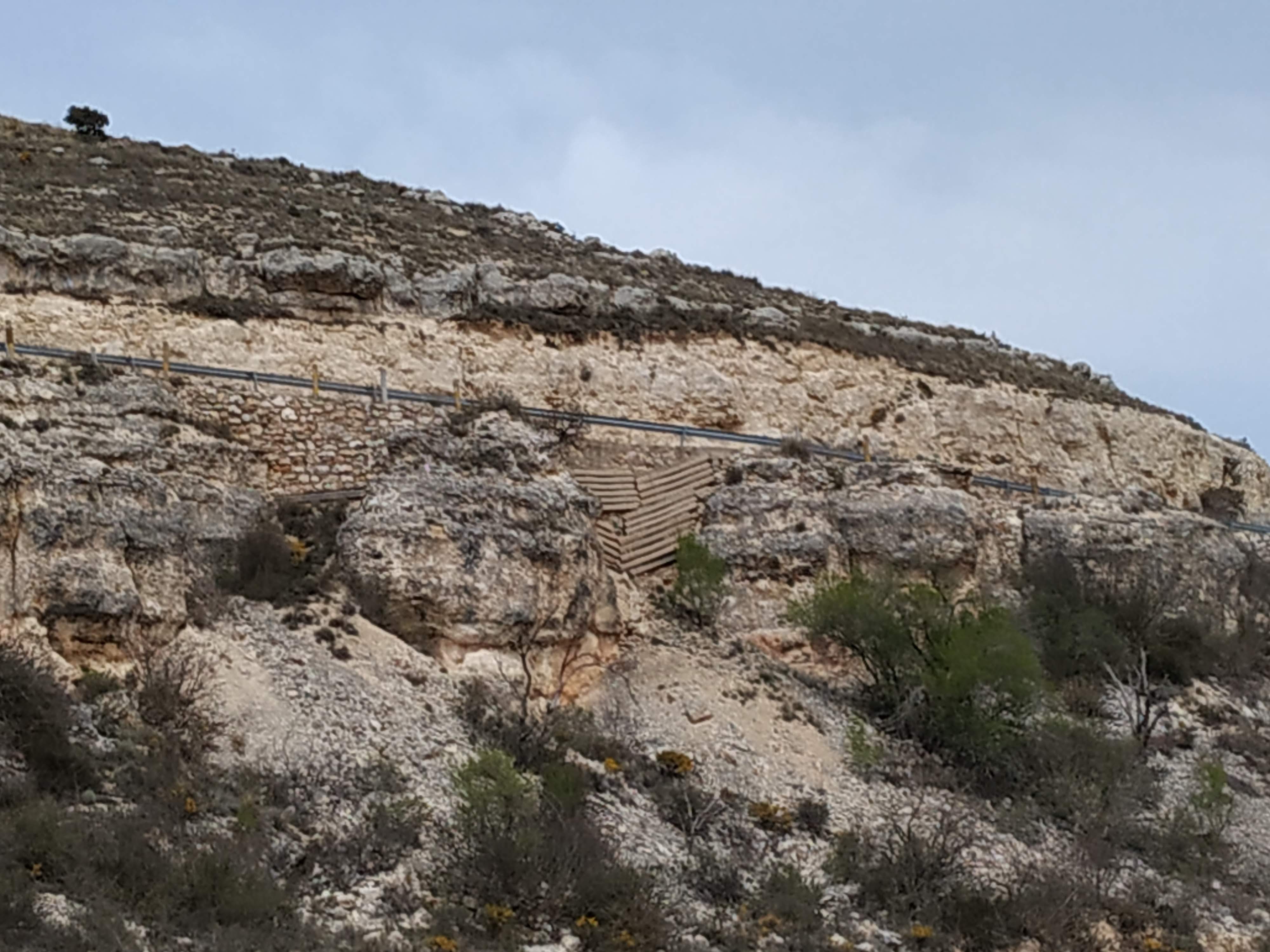
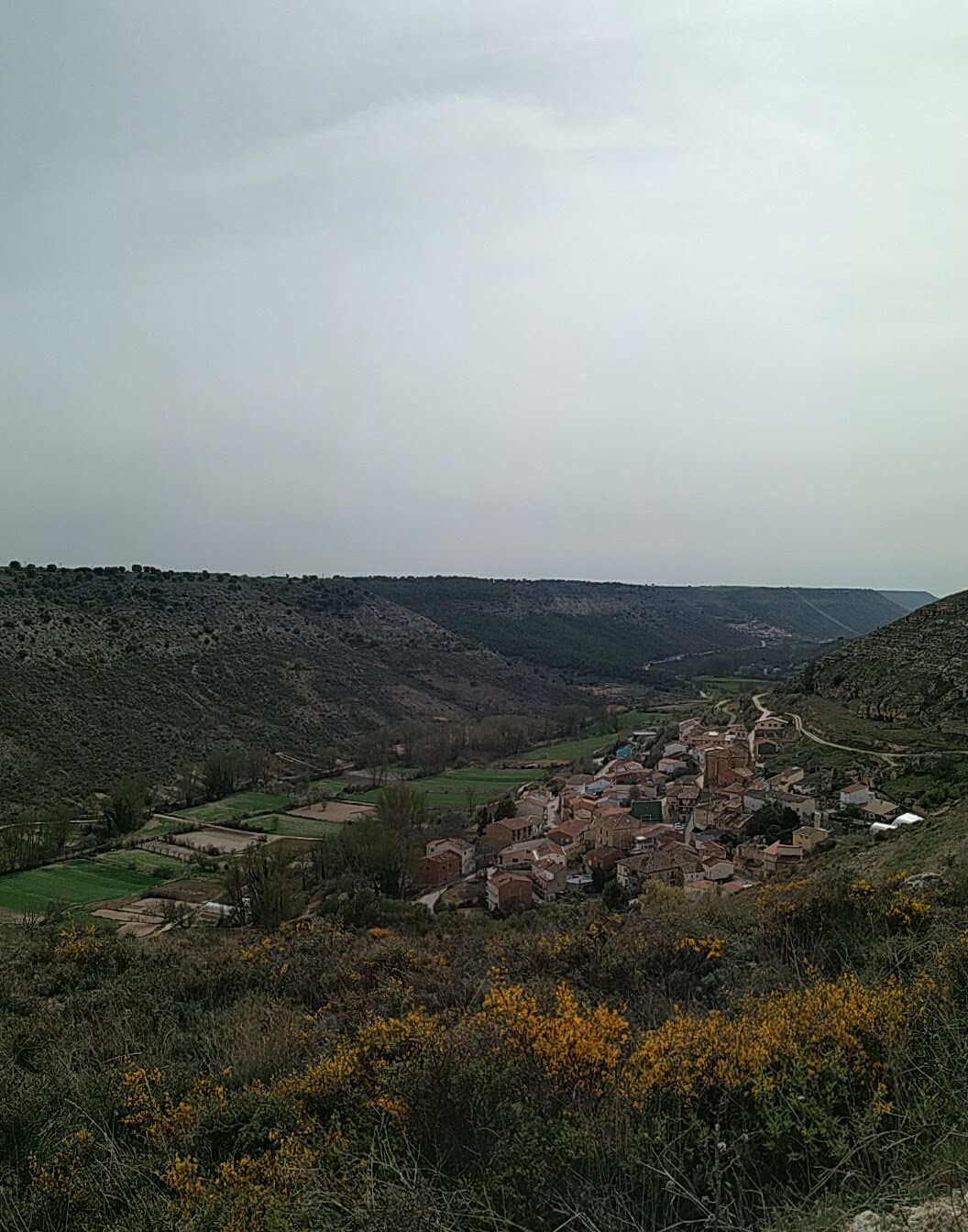
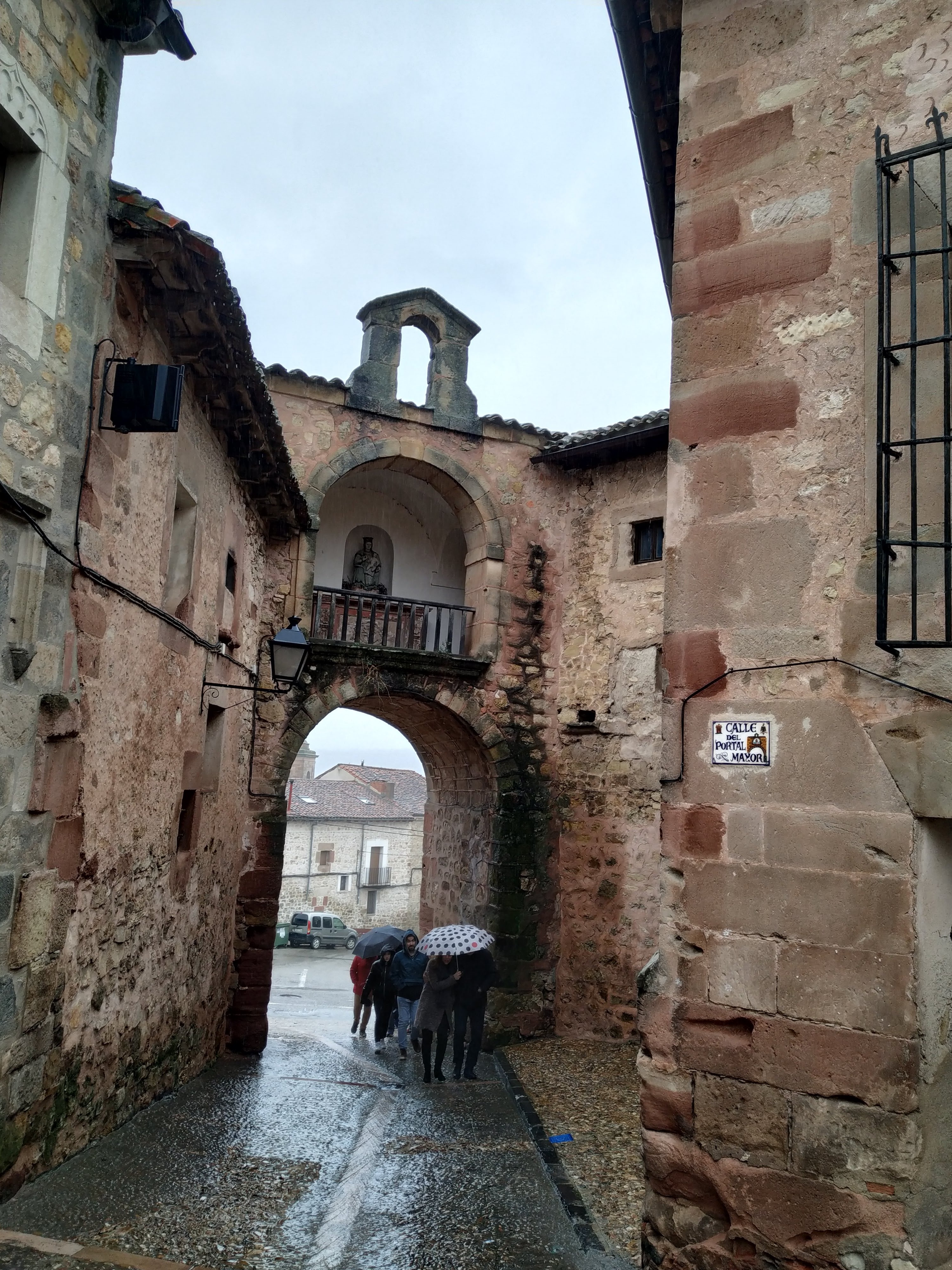
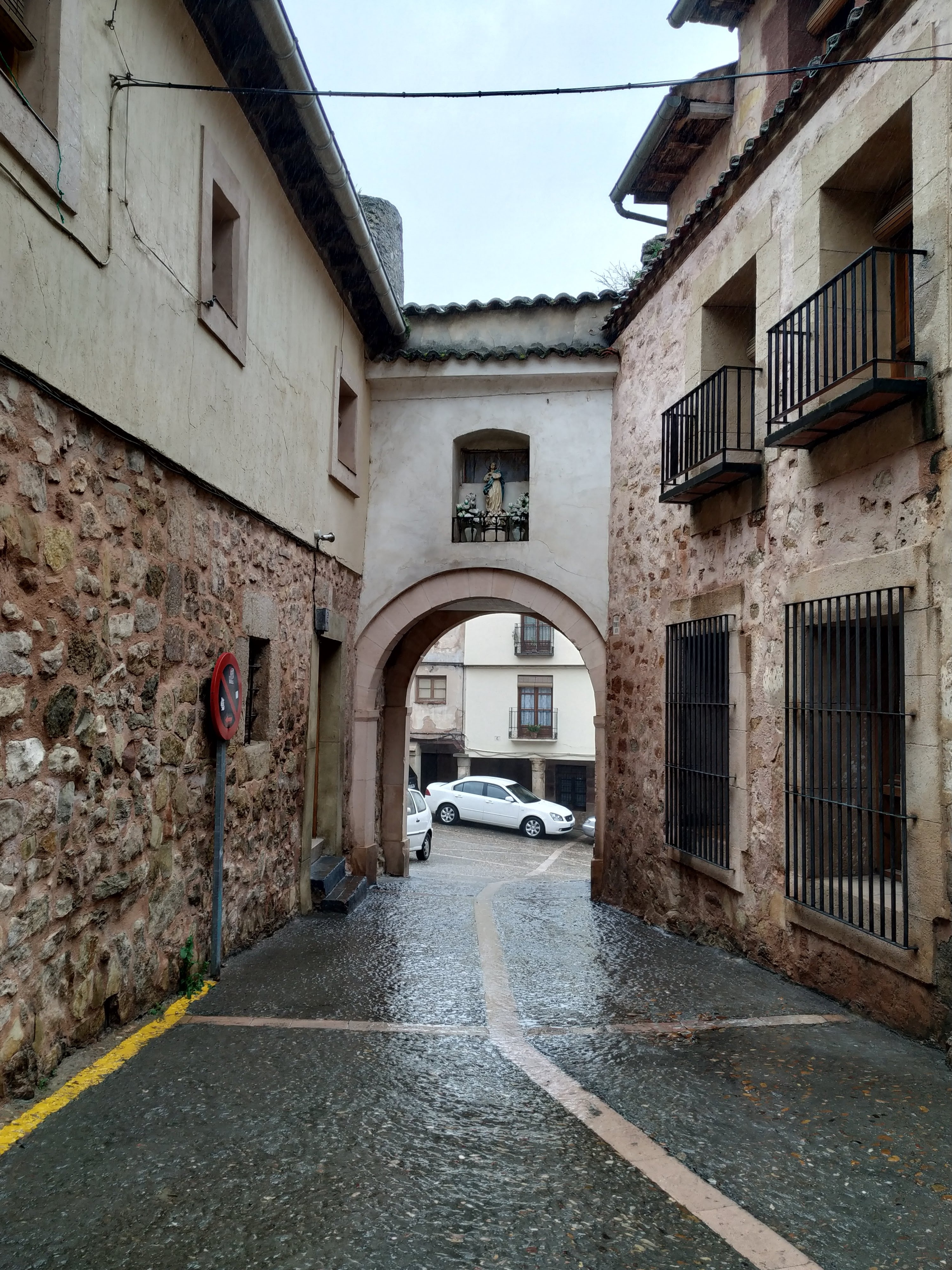
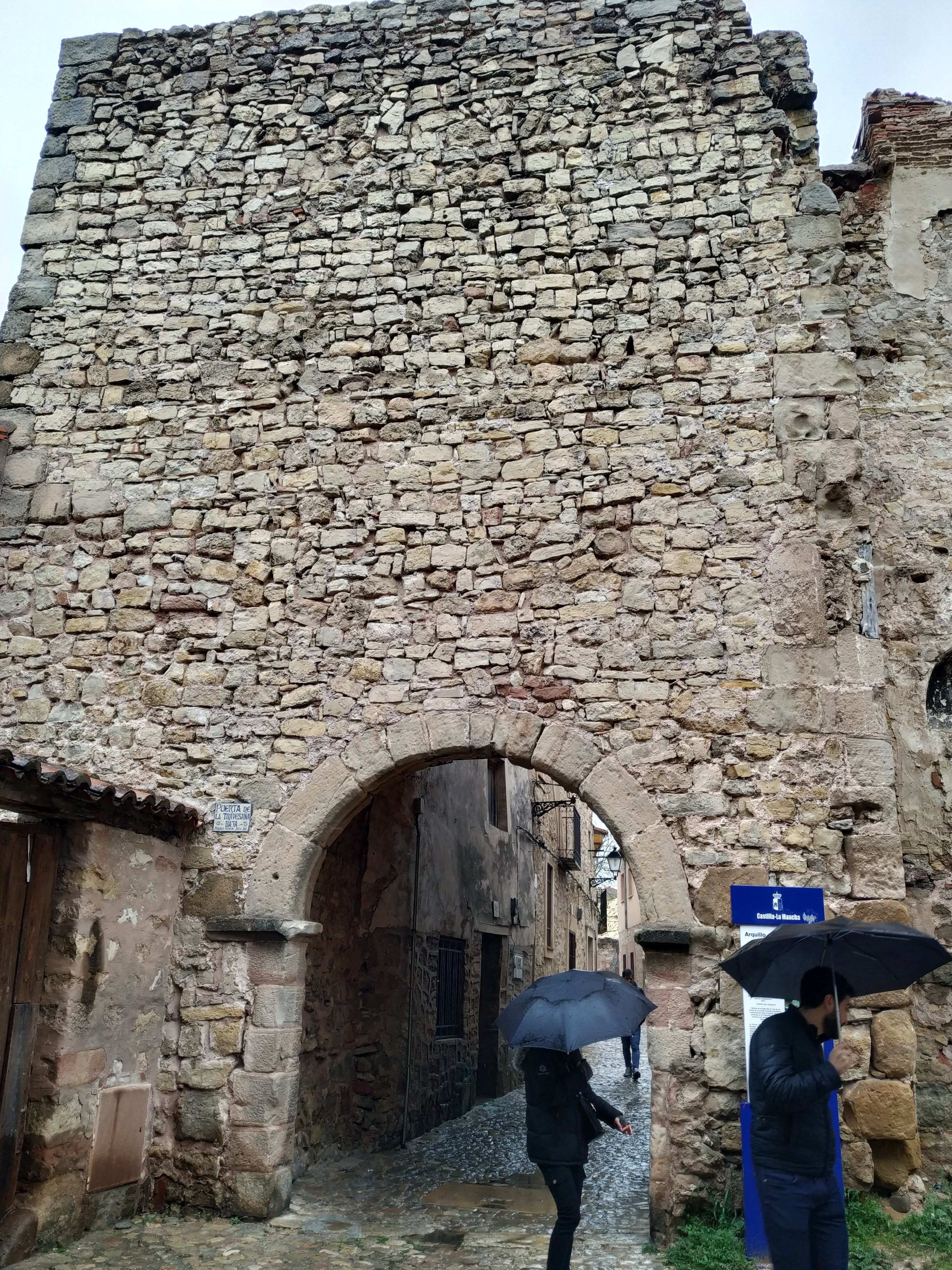
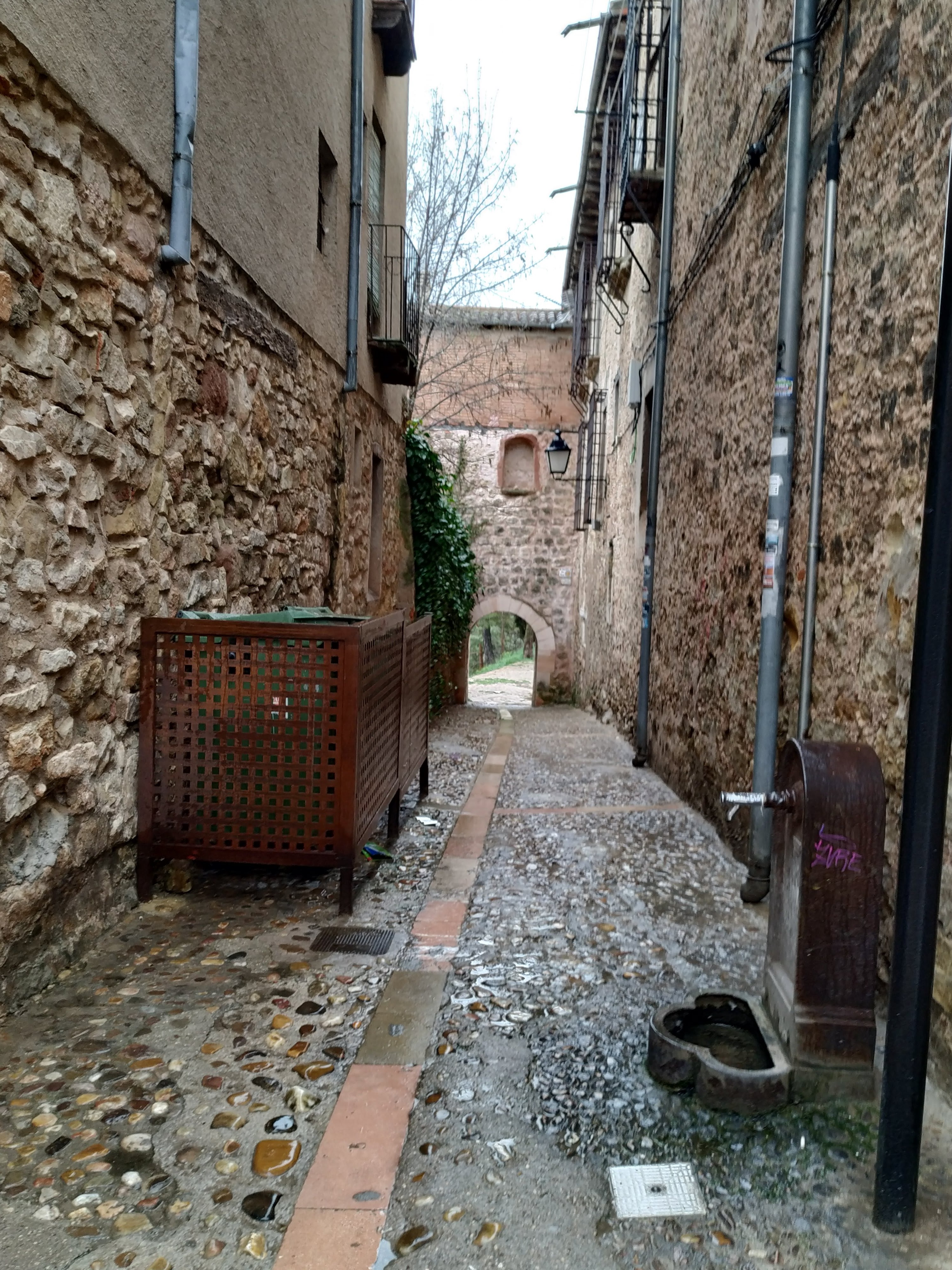
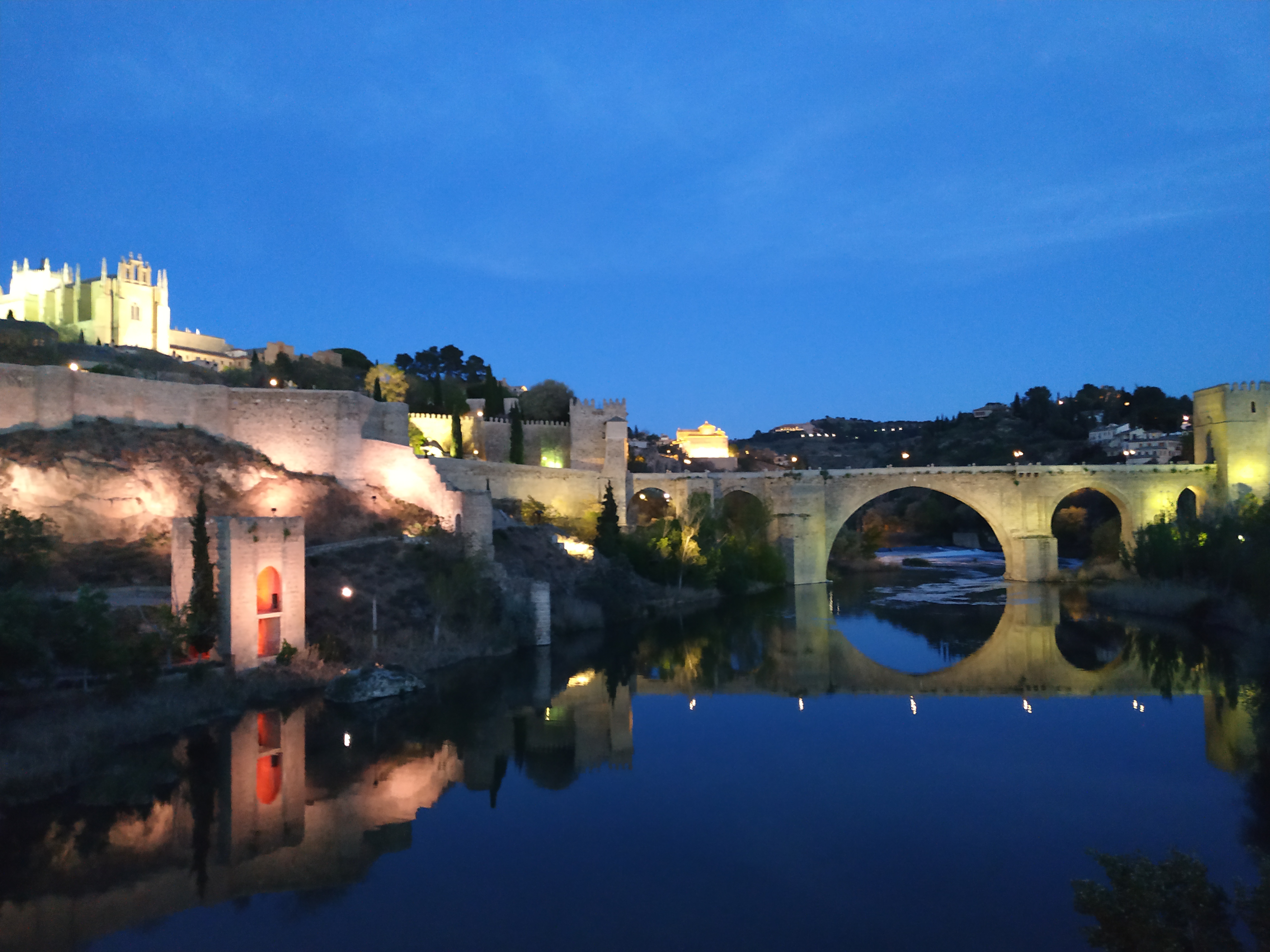
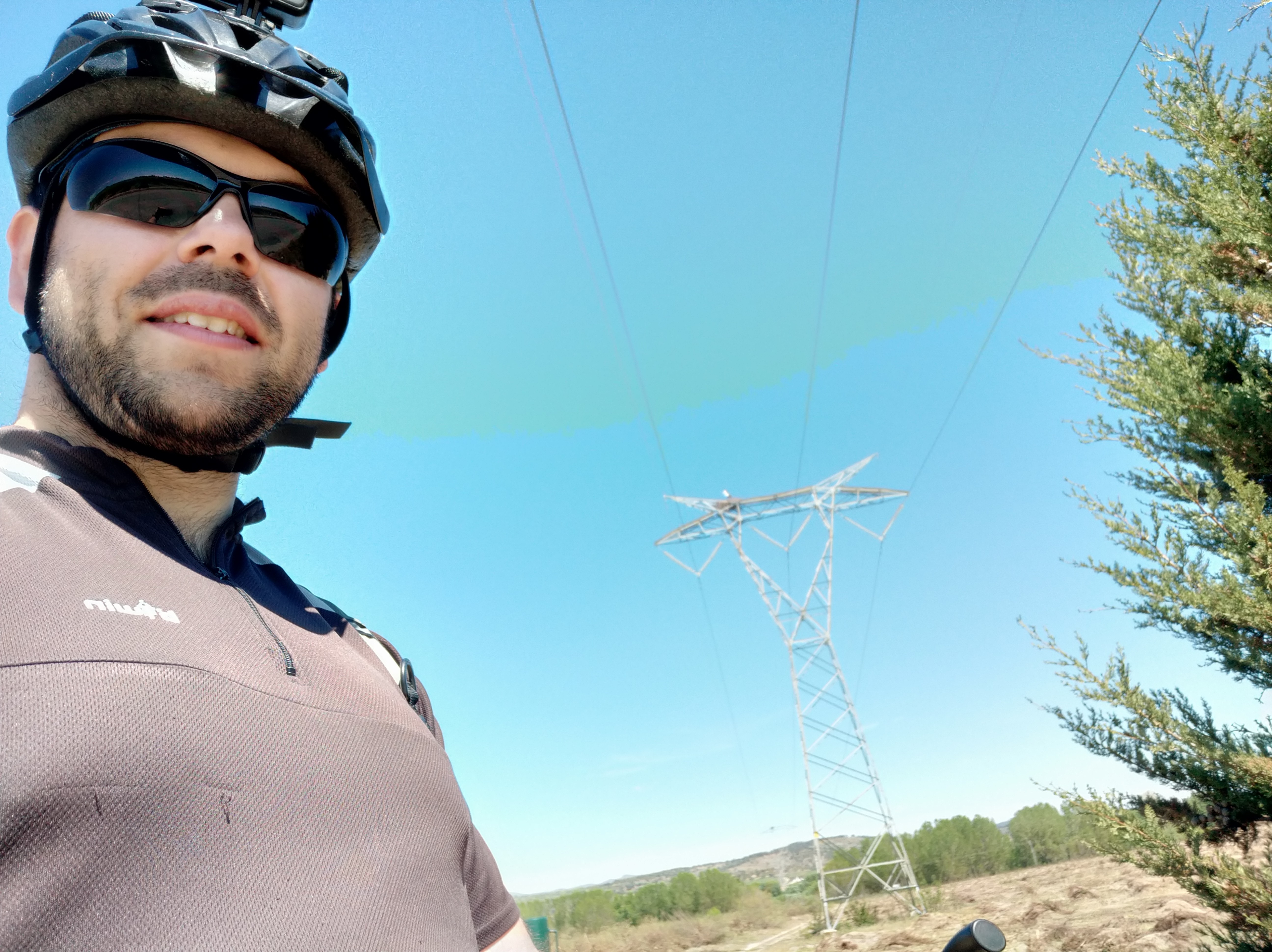
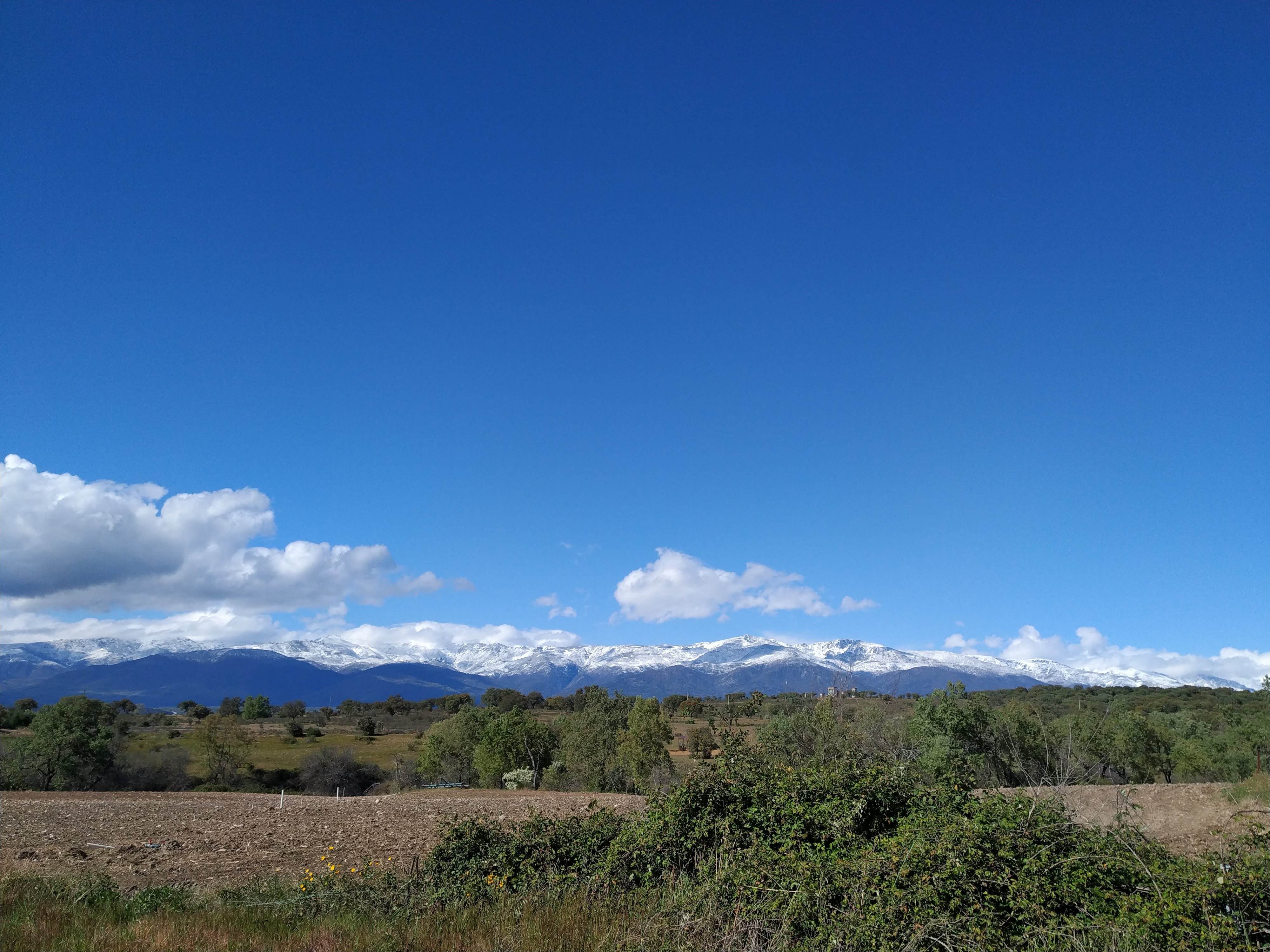
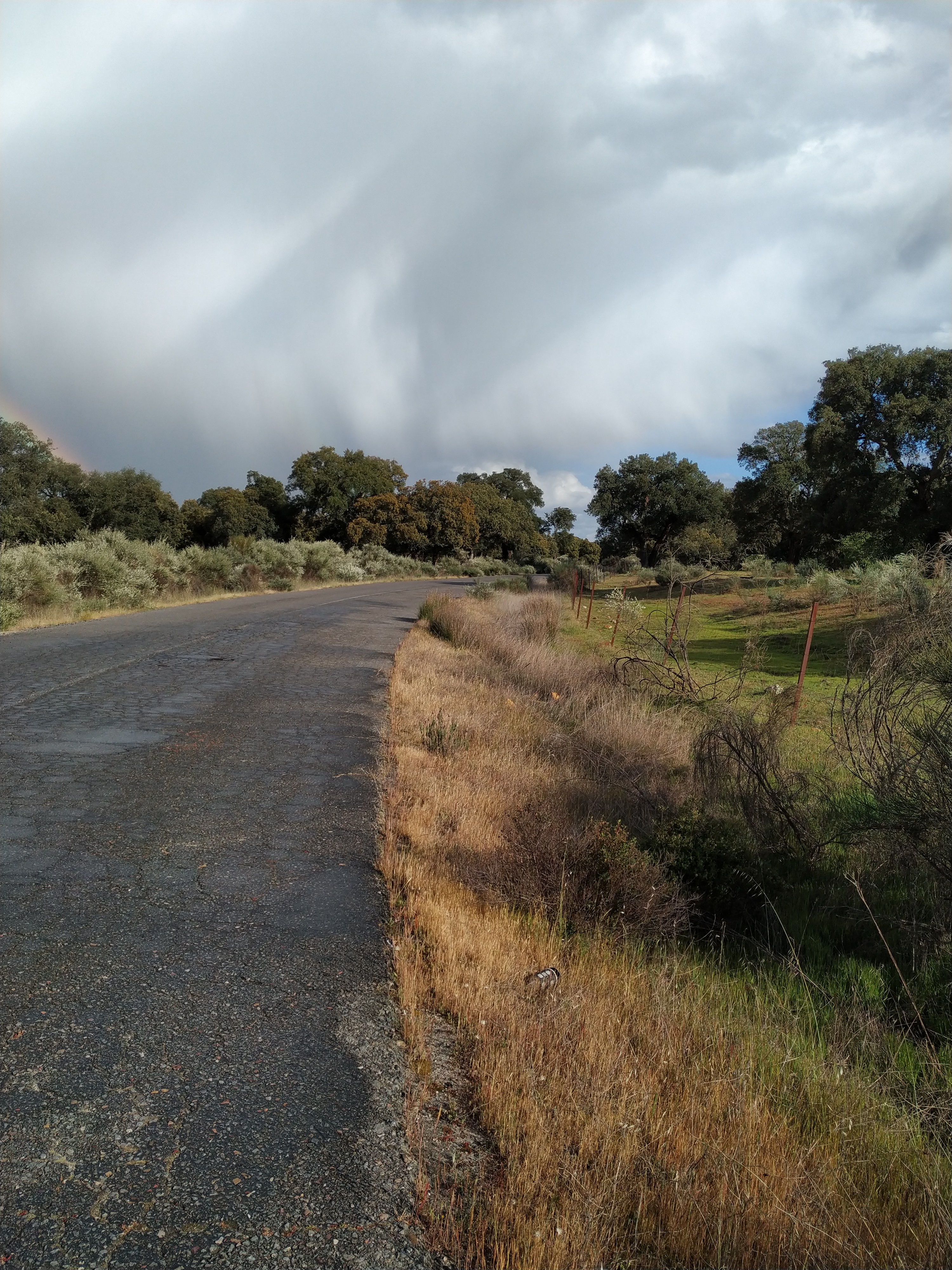
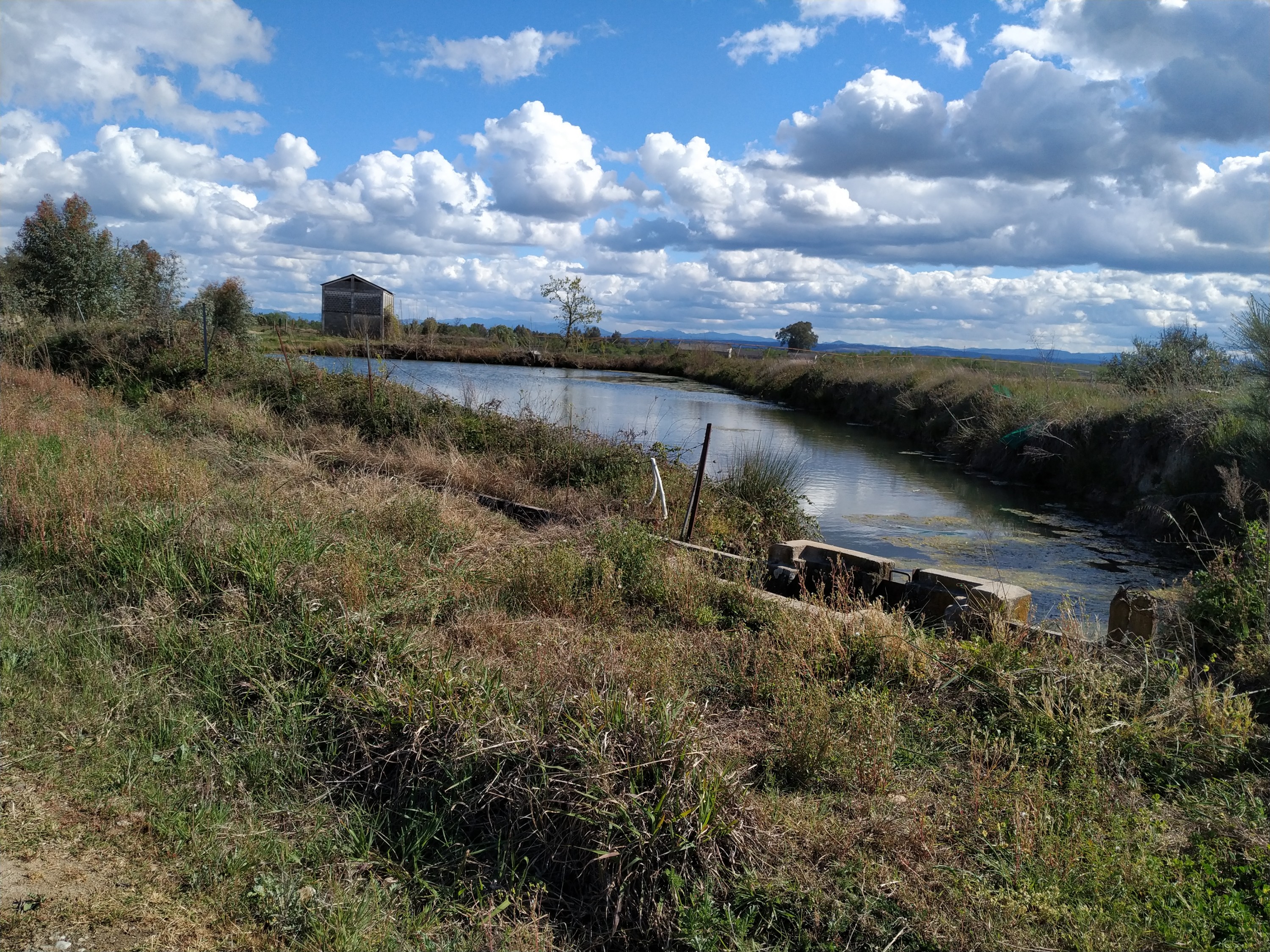
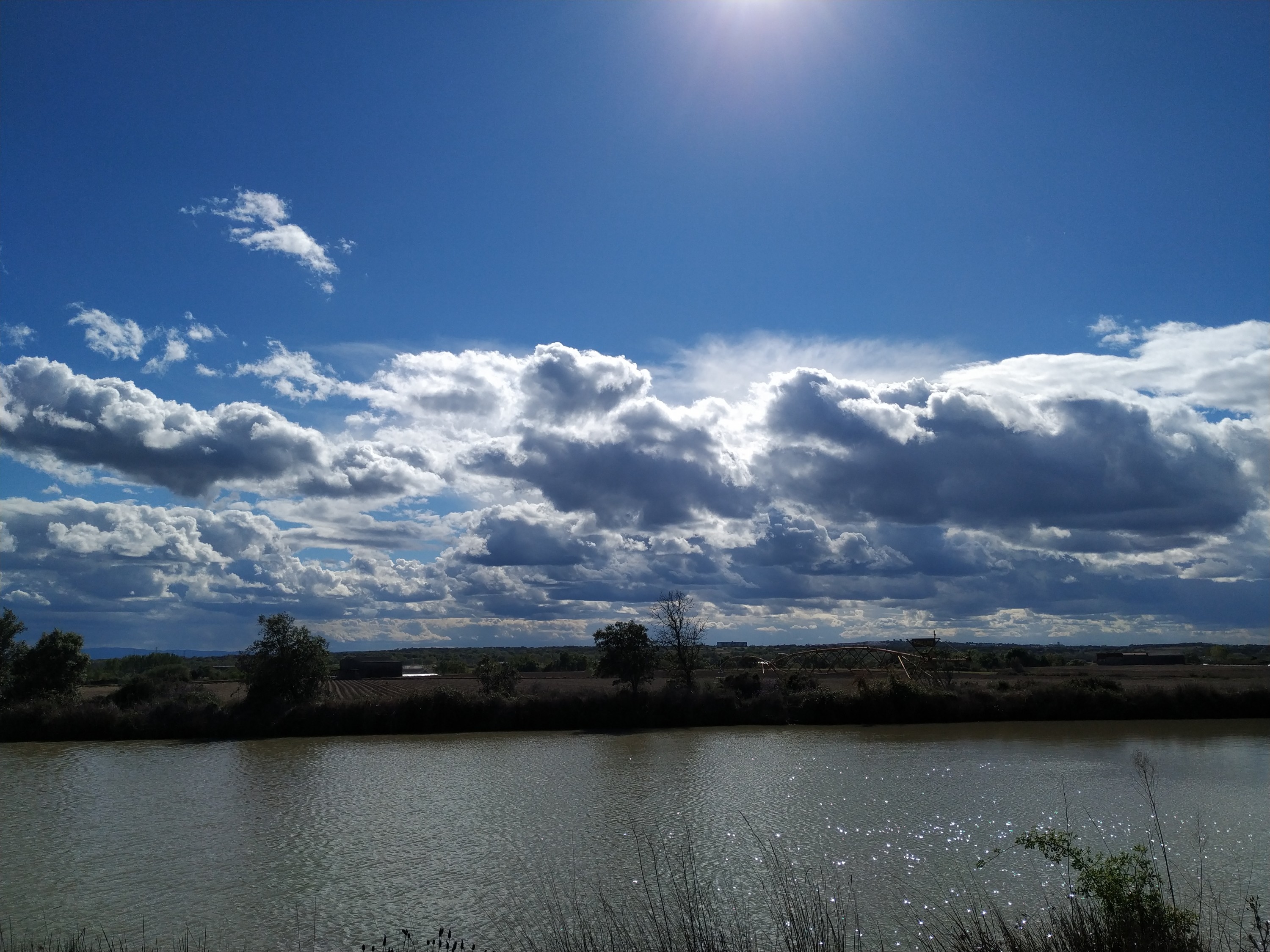
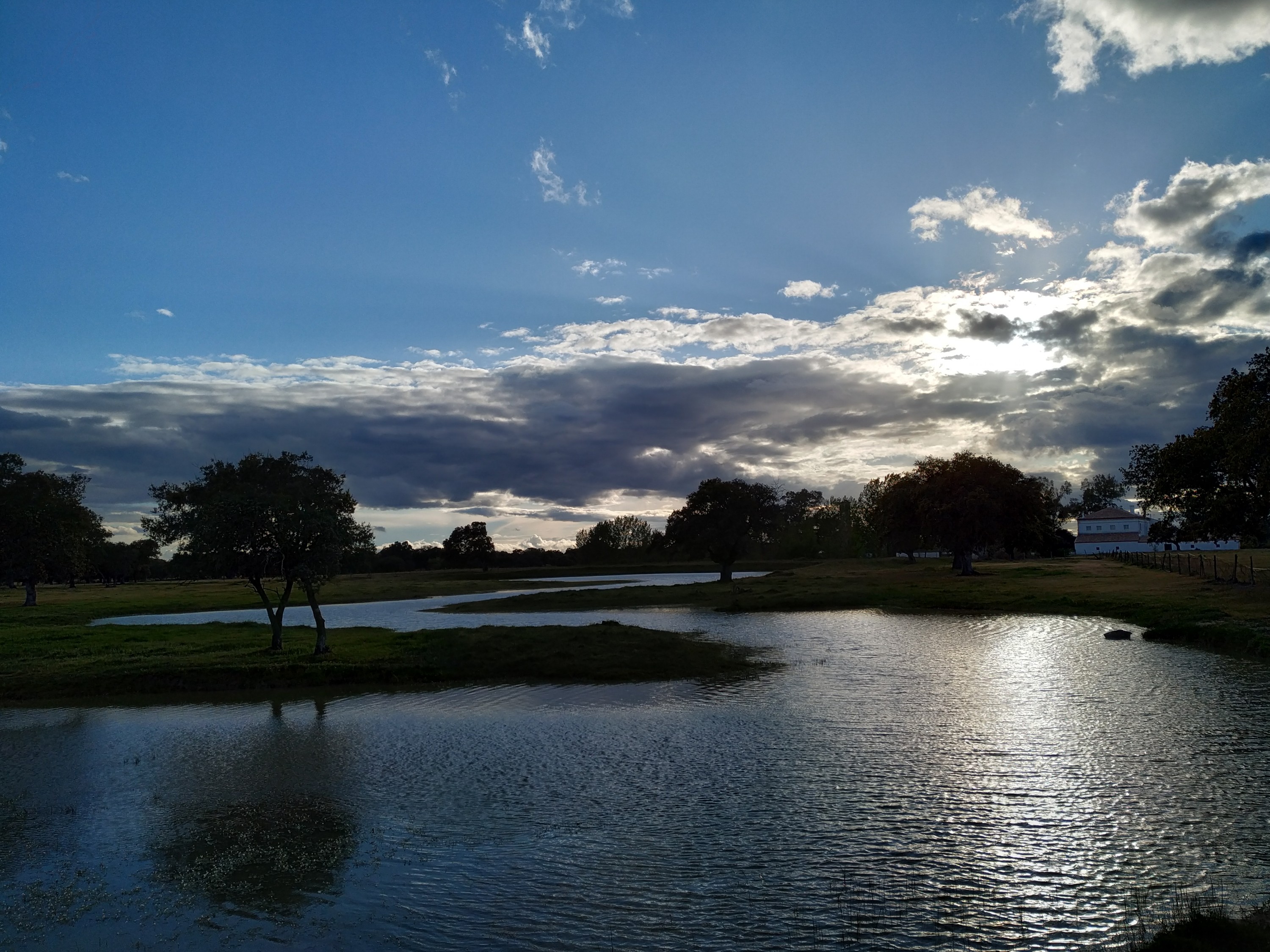
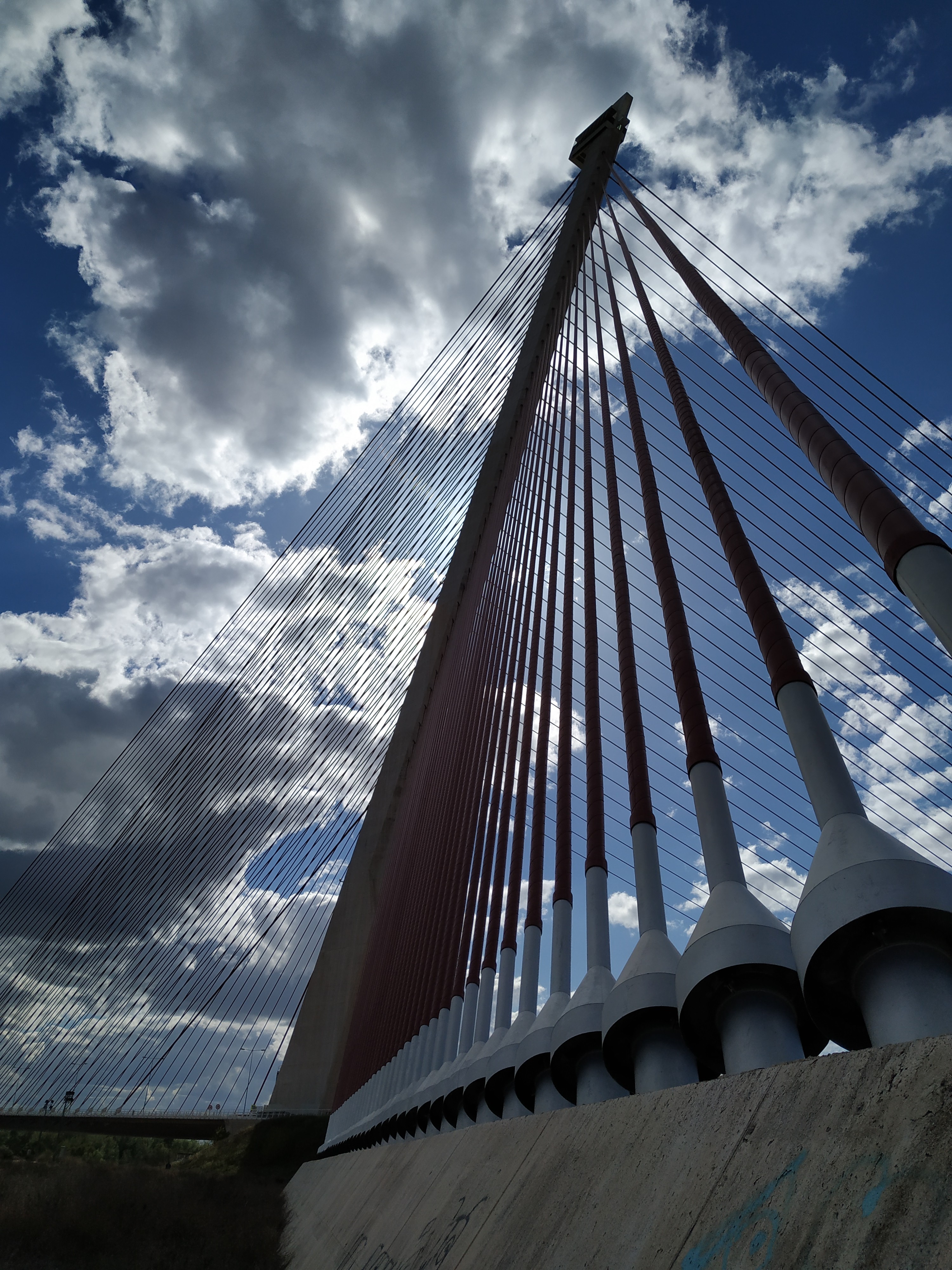
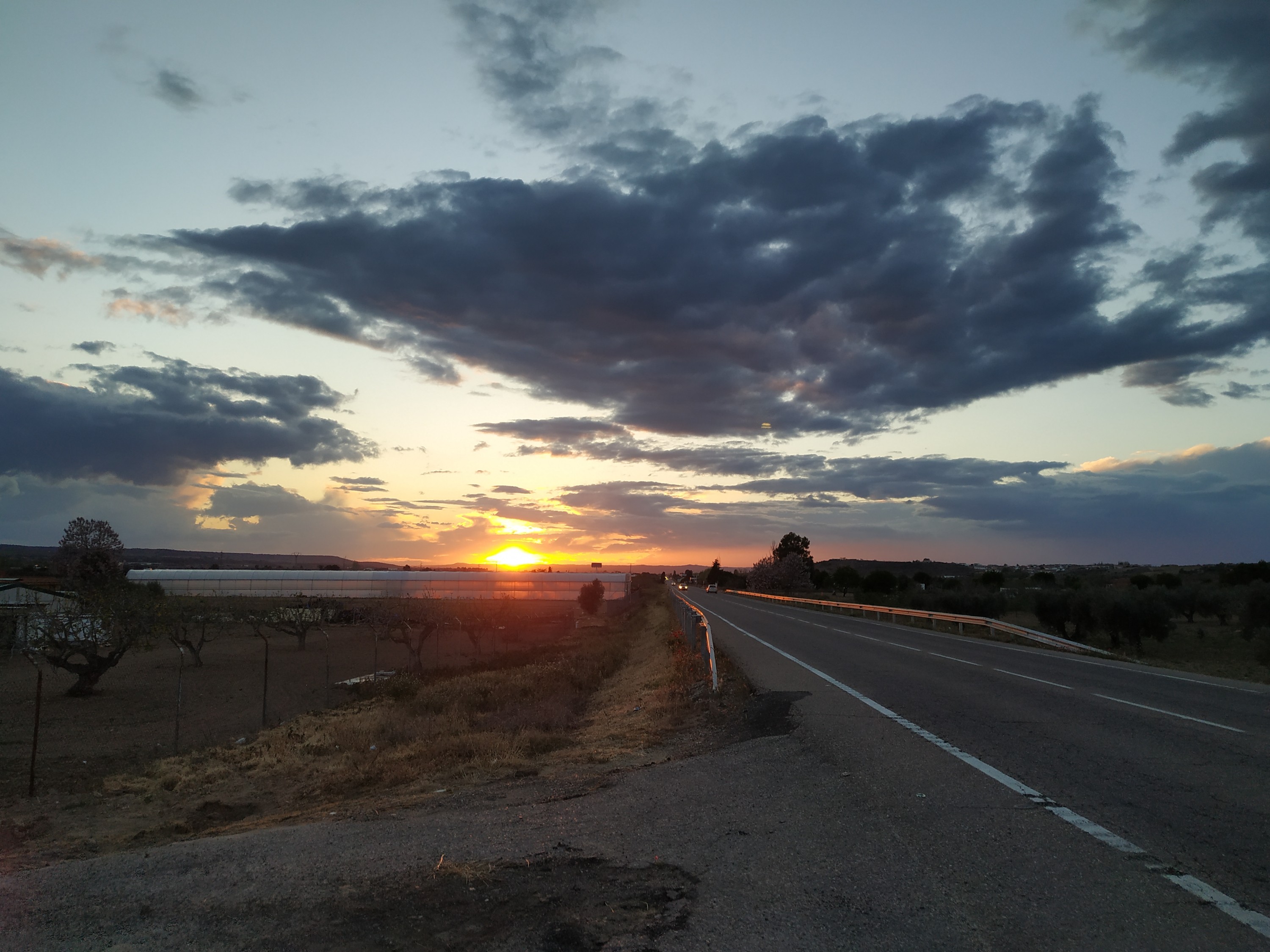
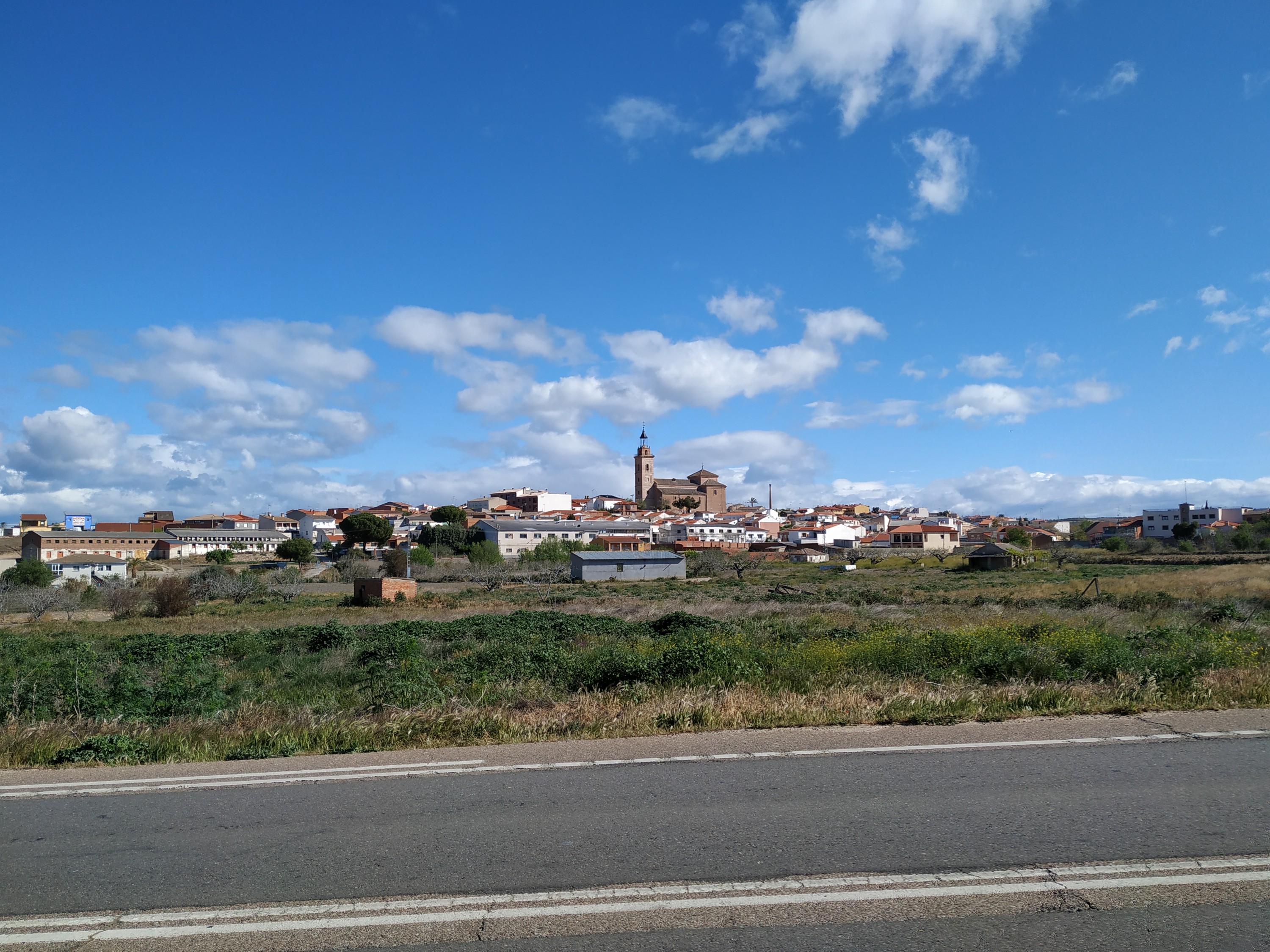
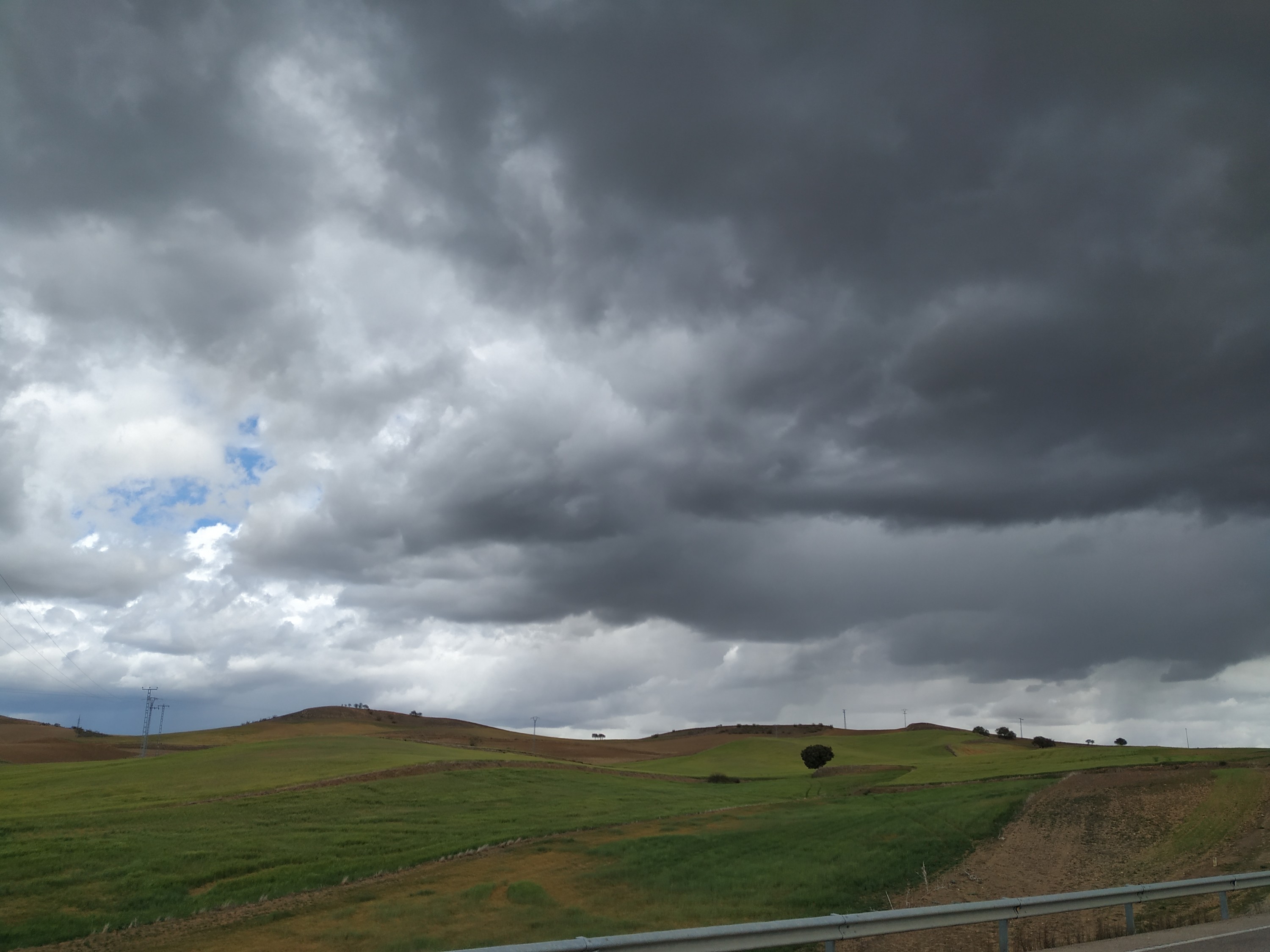
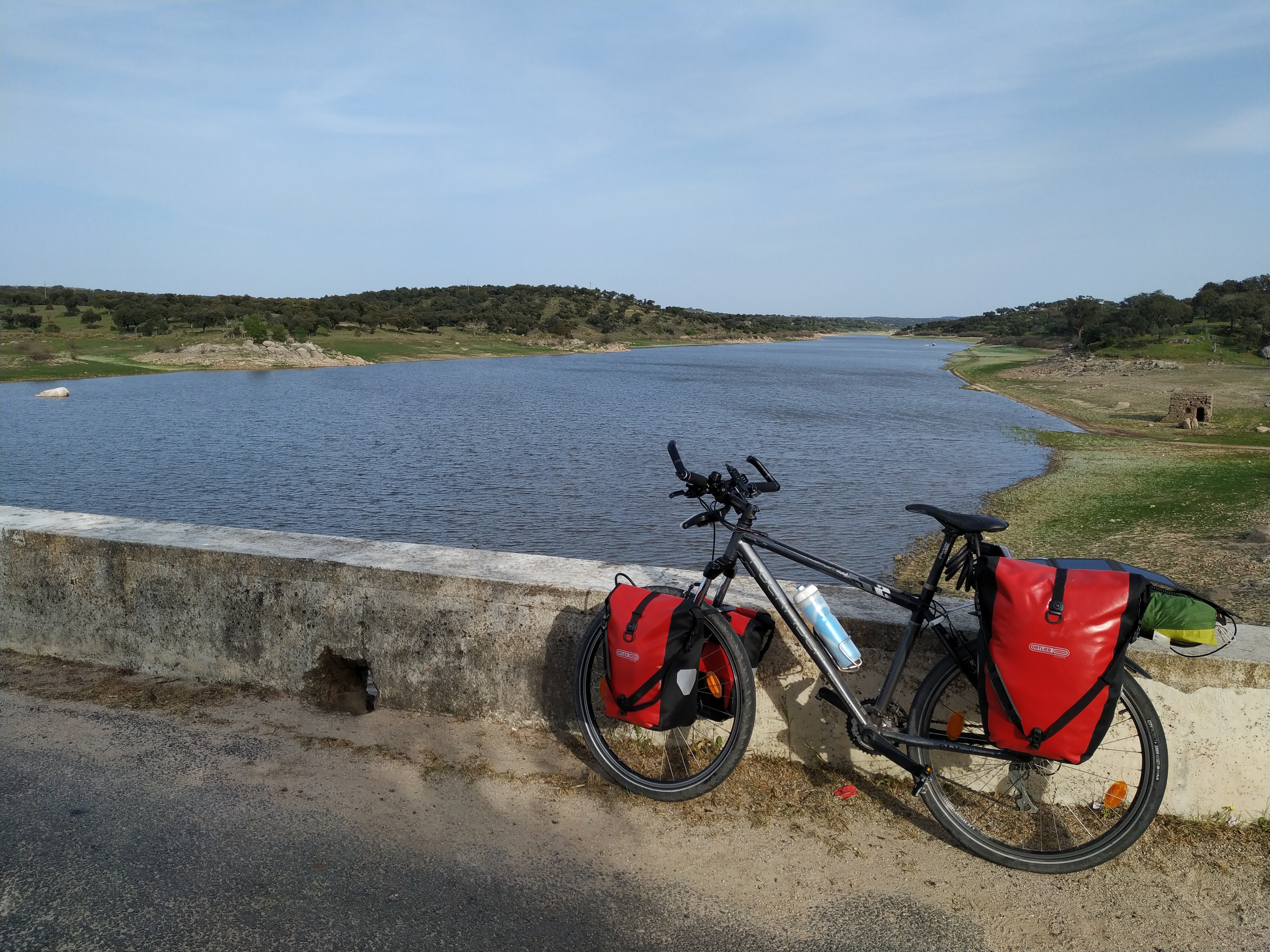
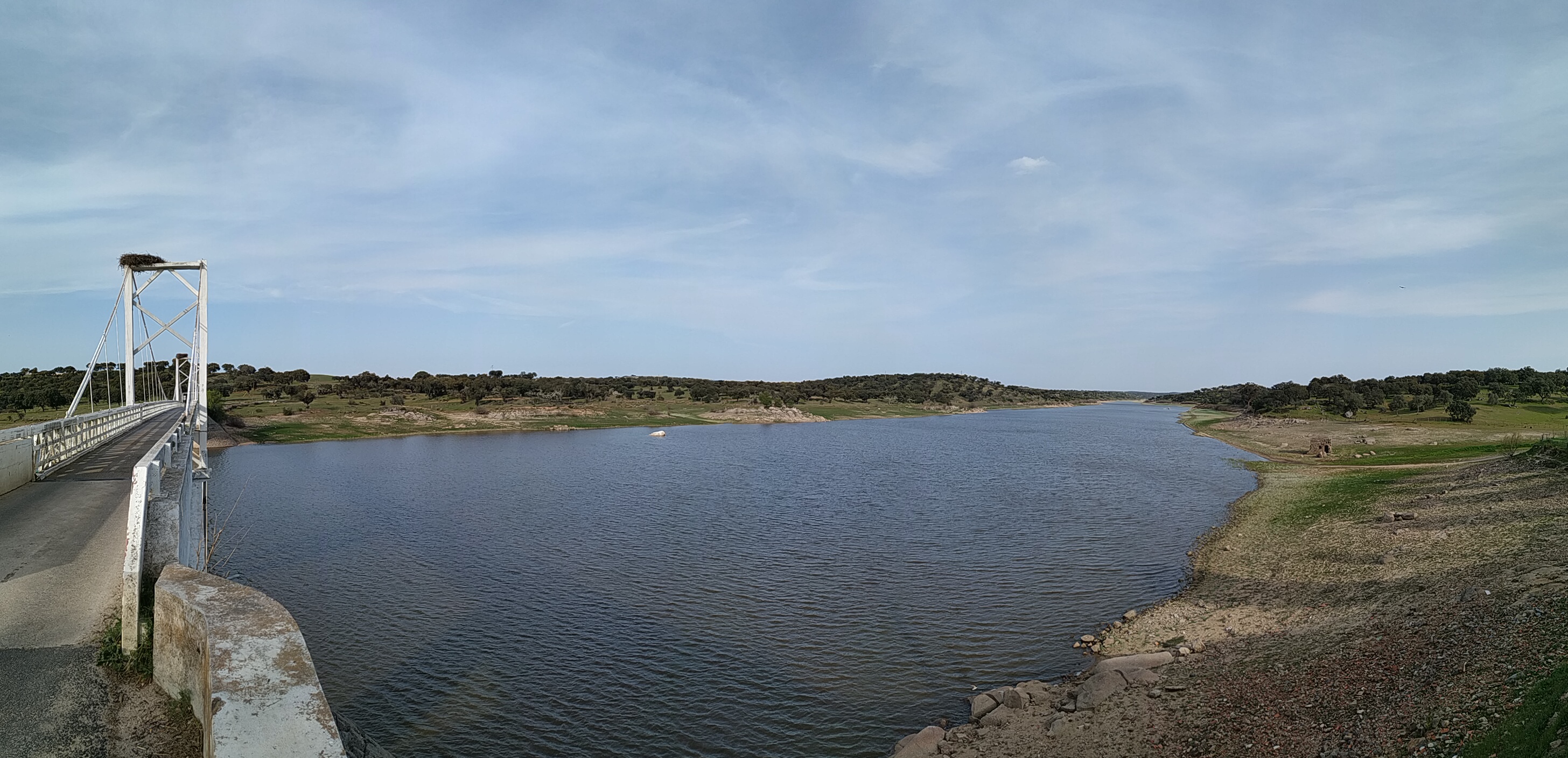
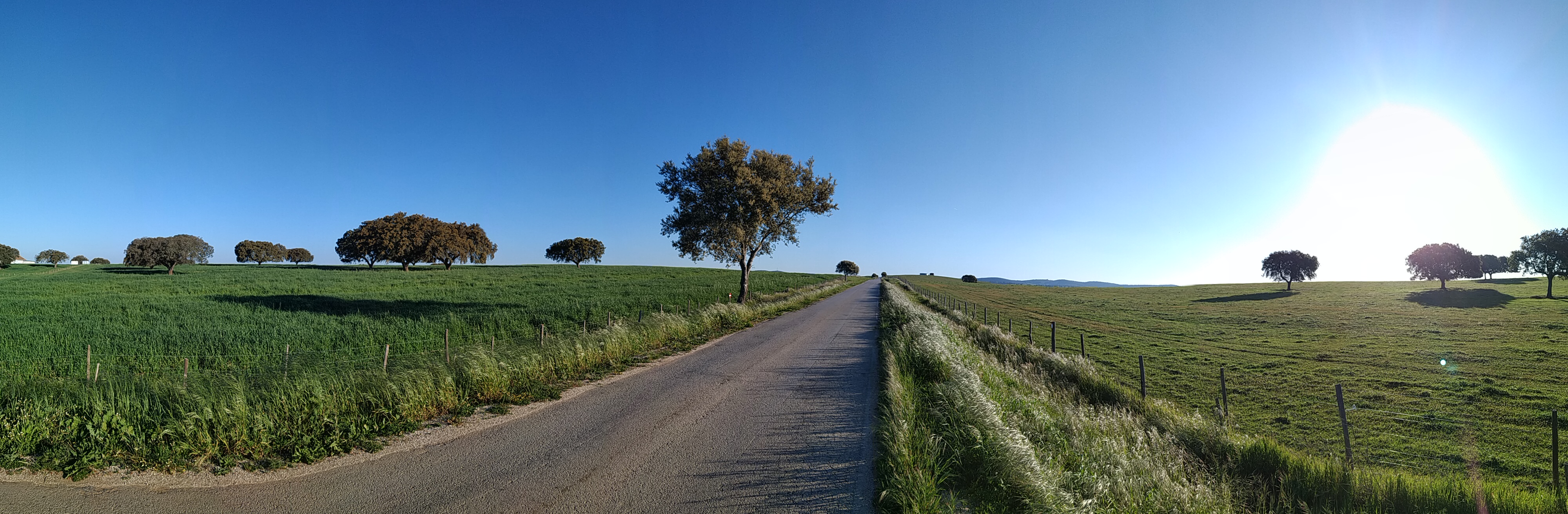
Vía Verde de la Val de Zafán

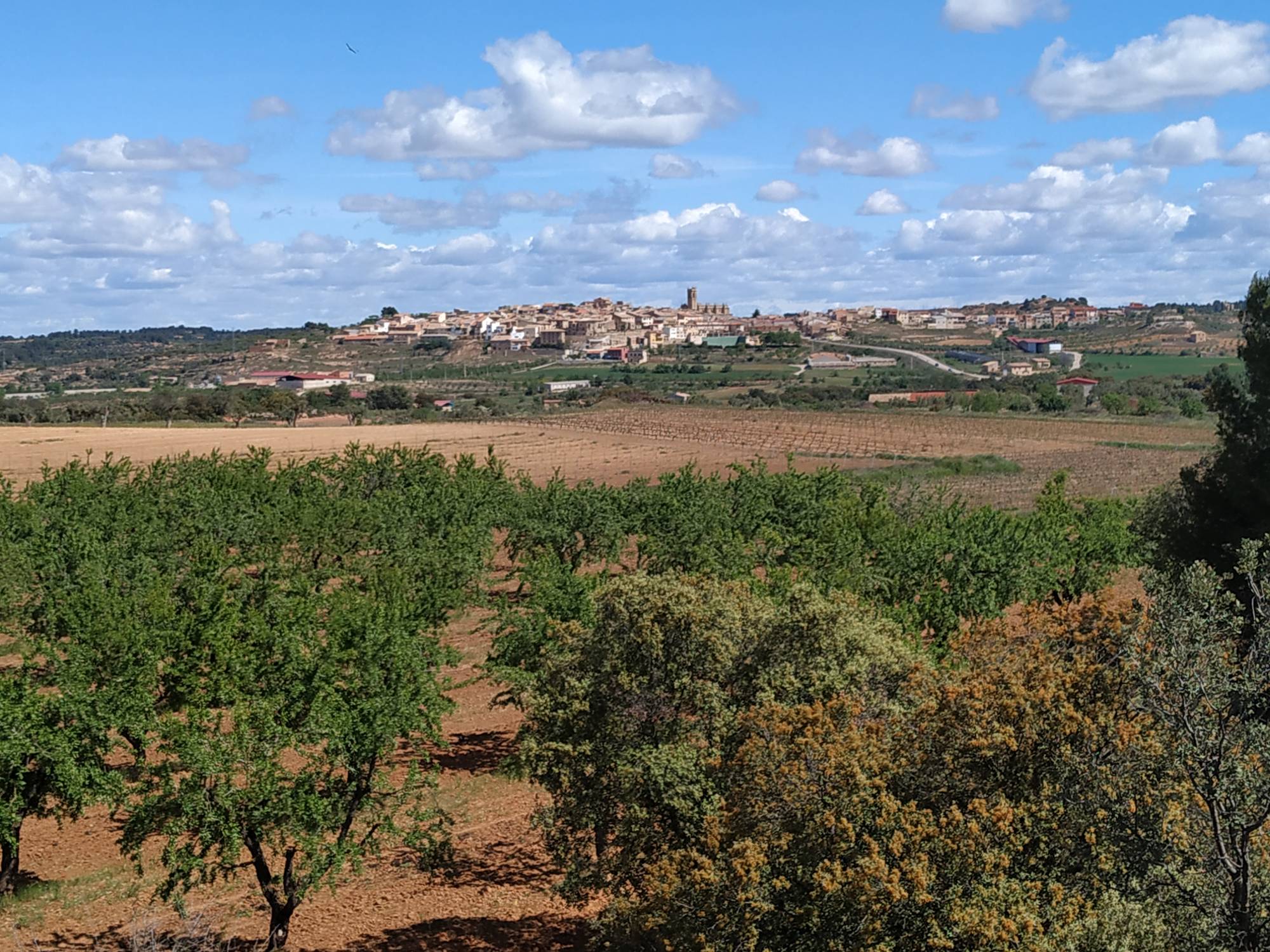
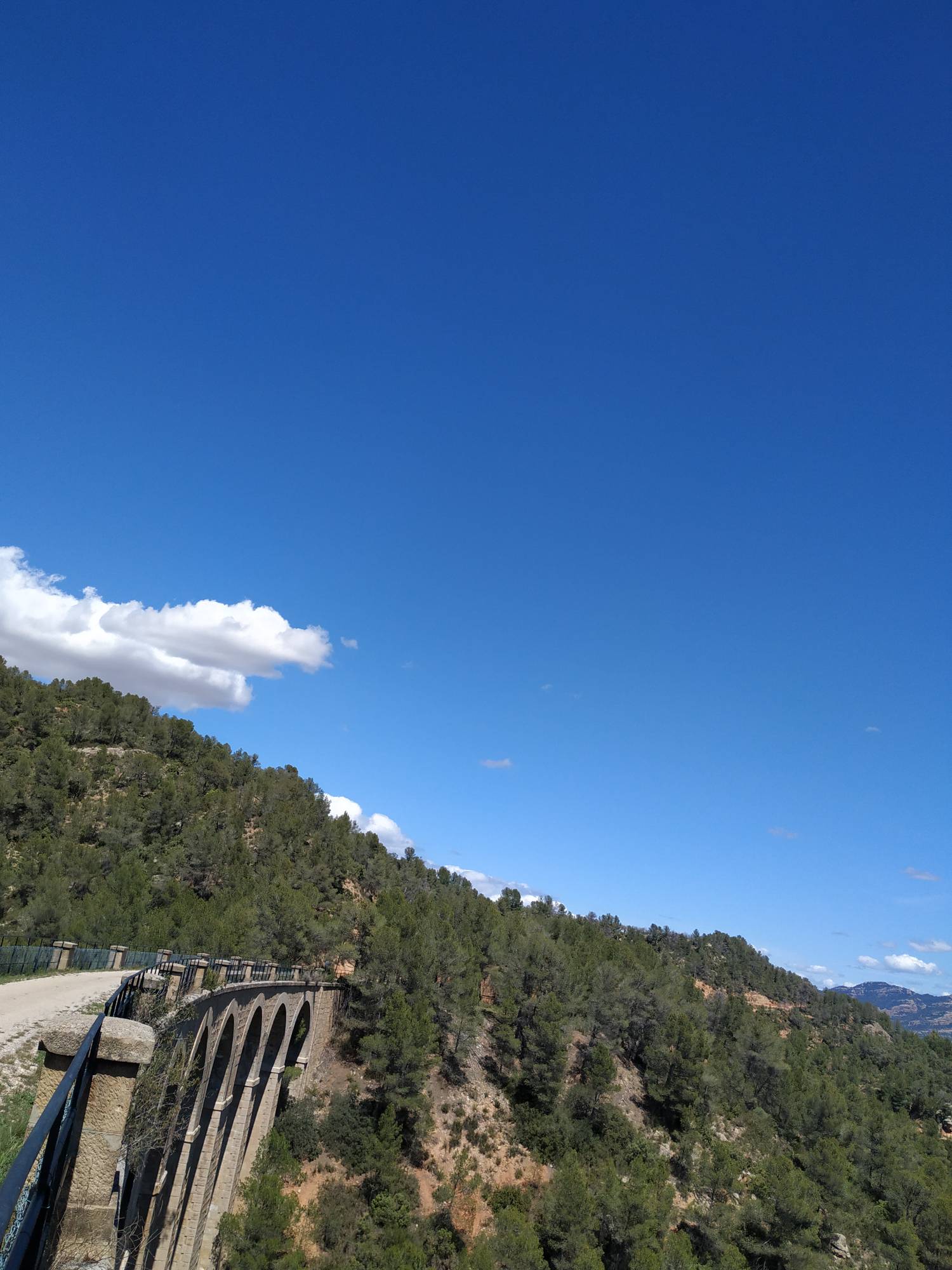
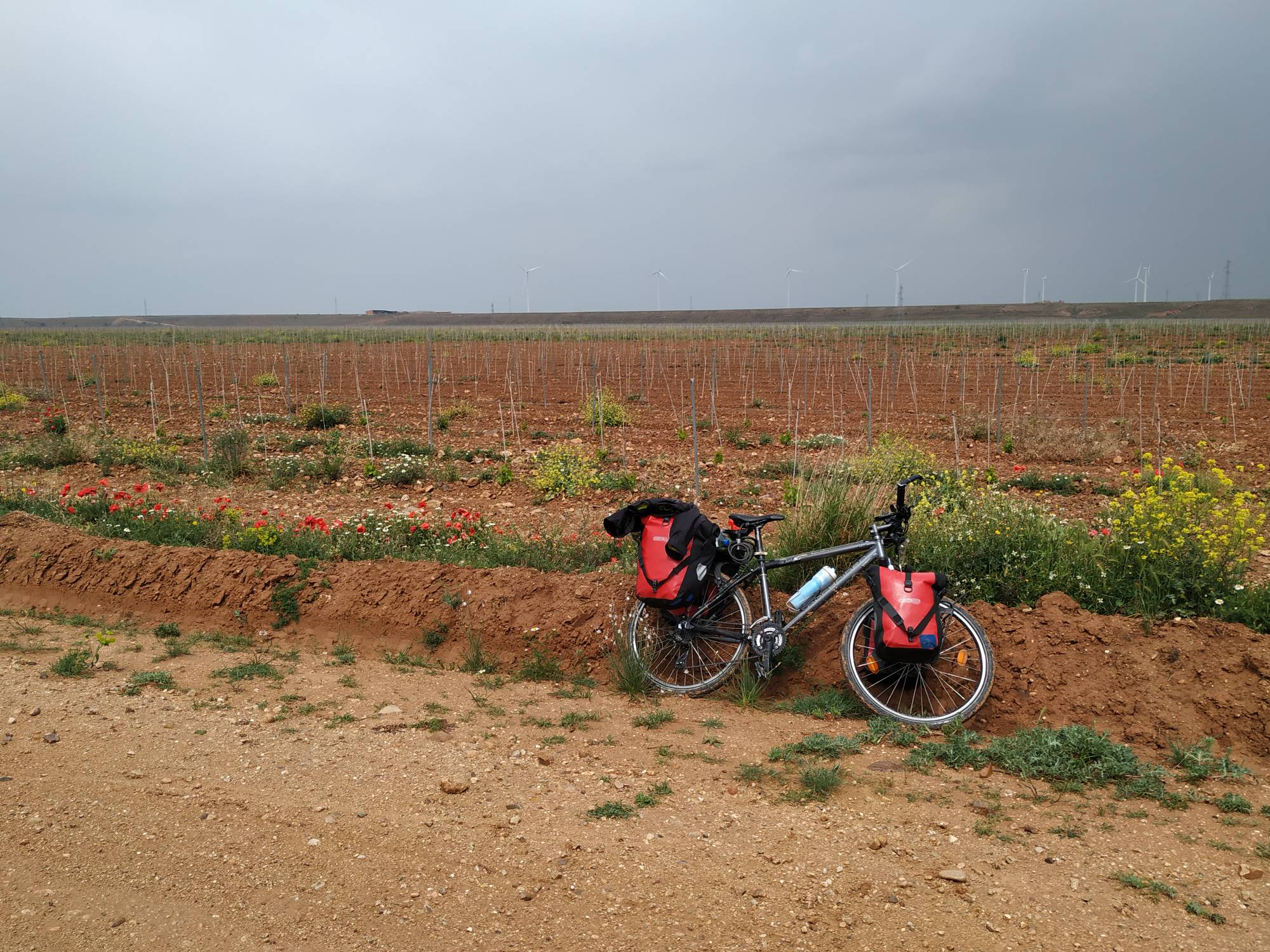
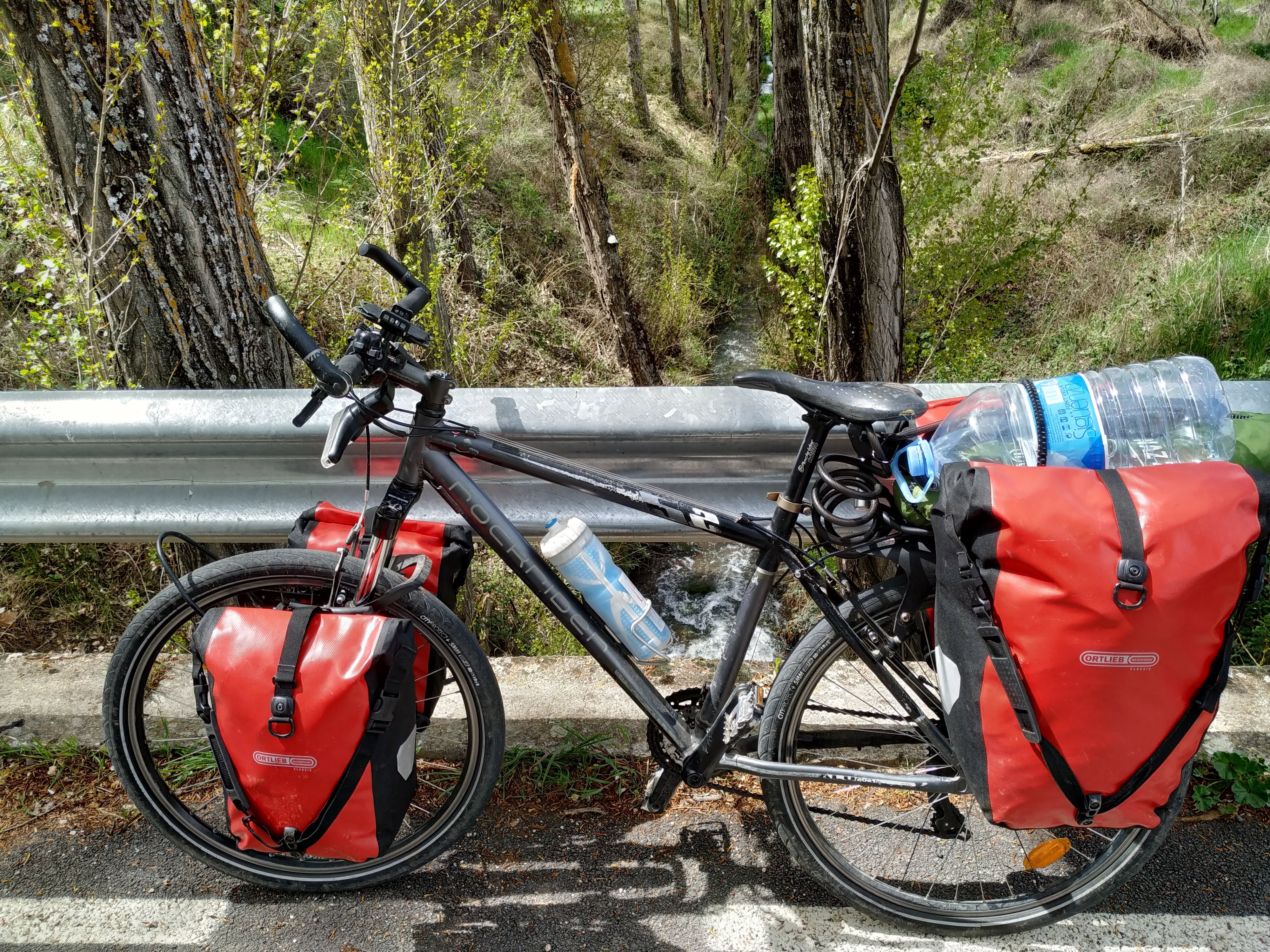
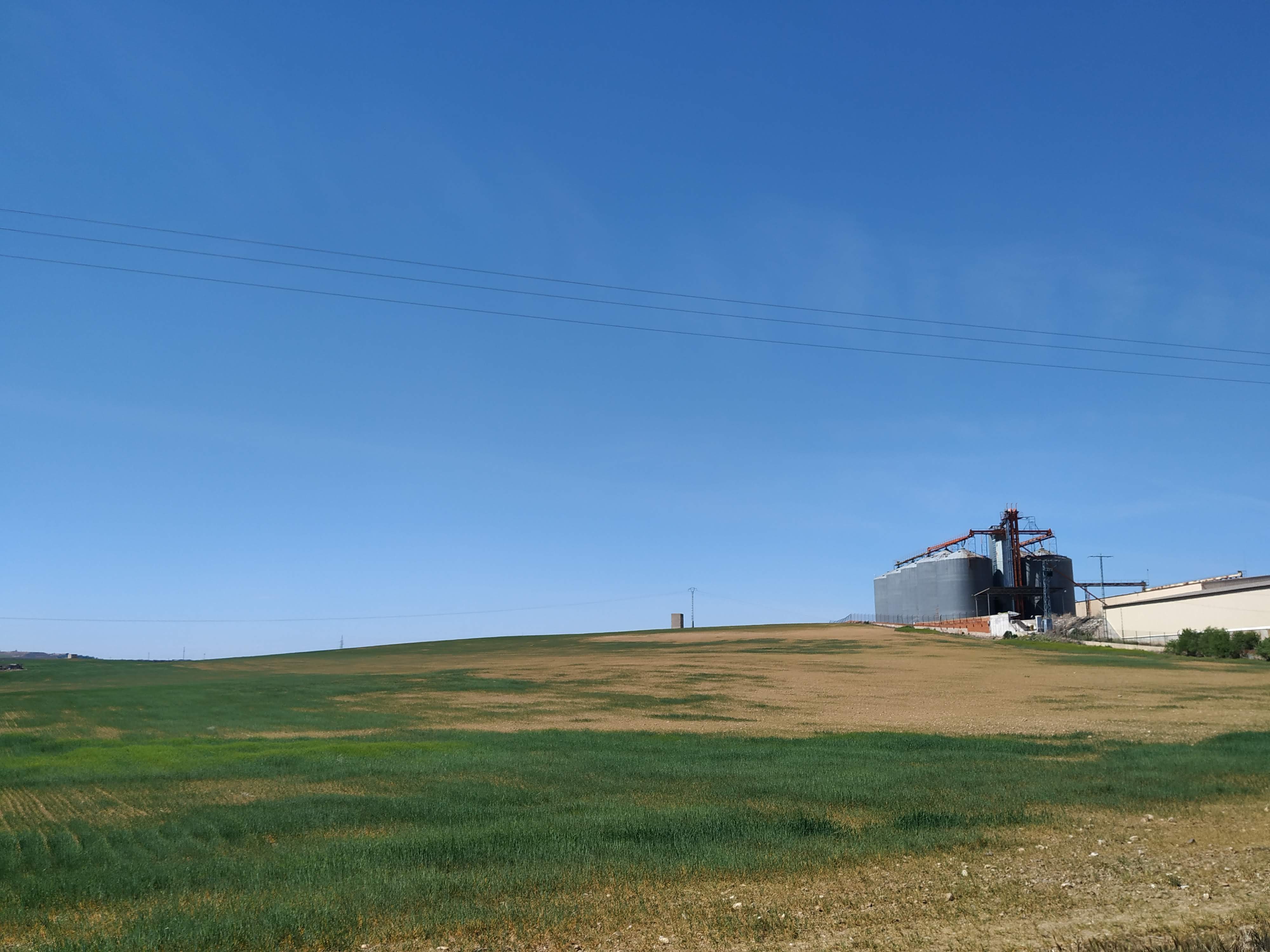
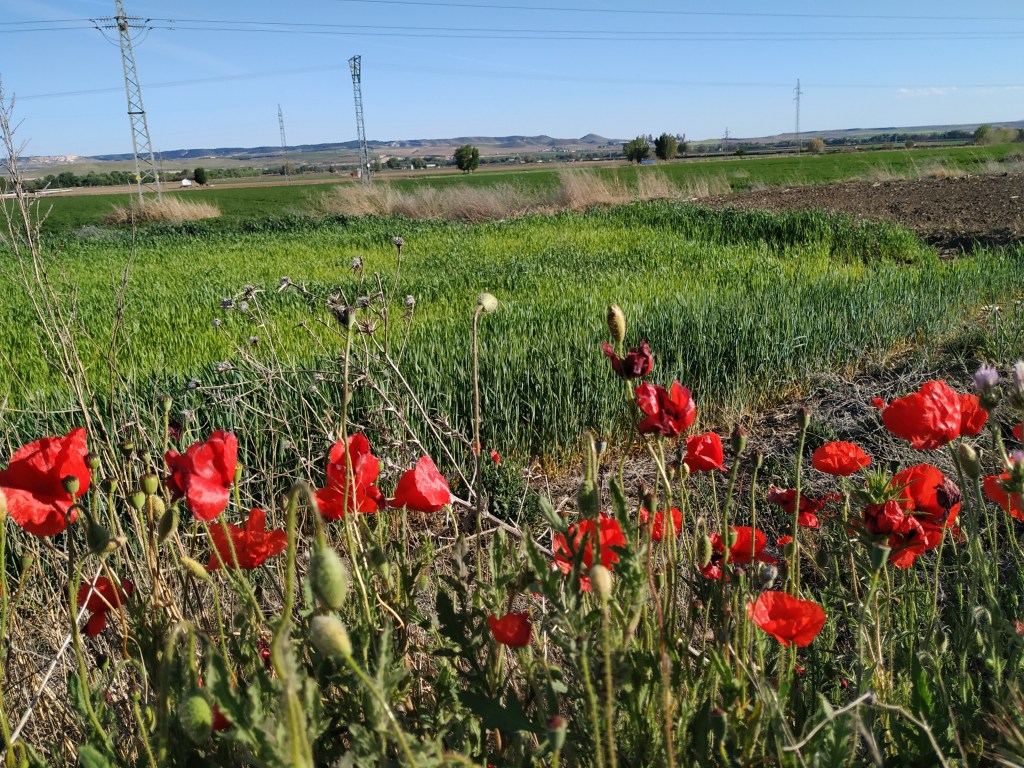
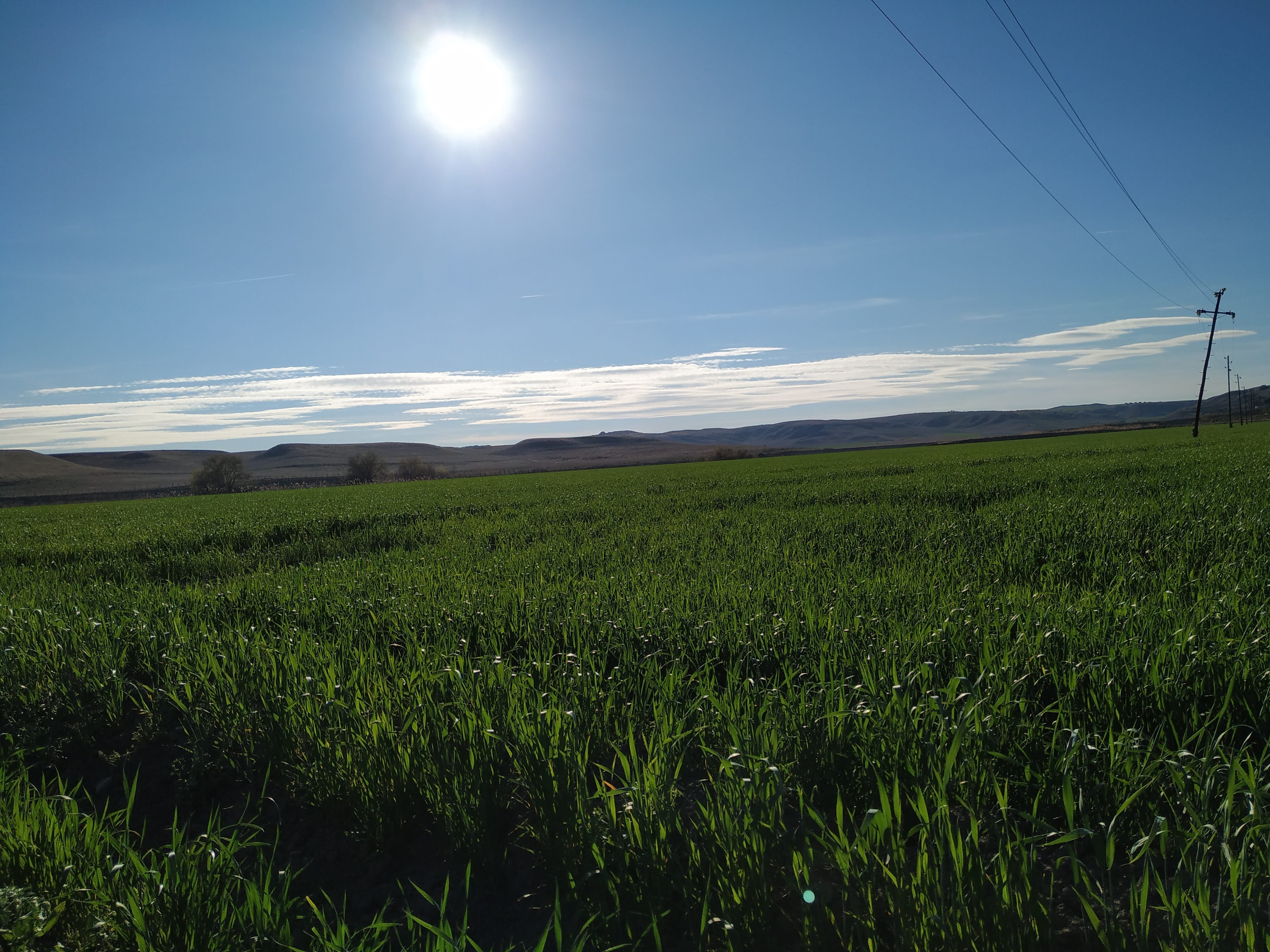
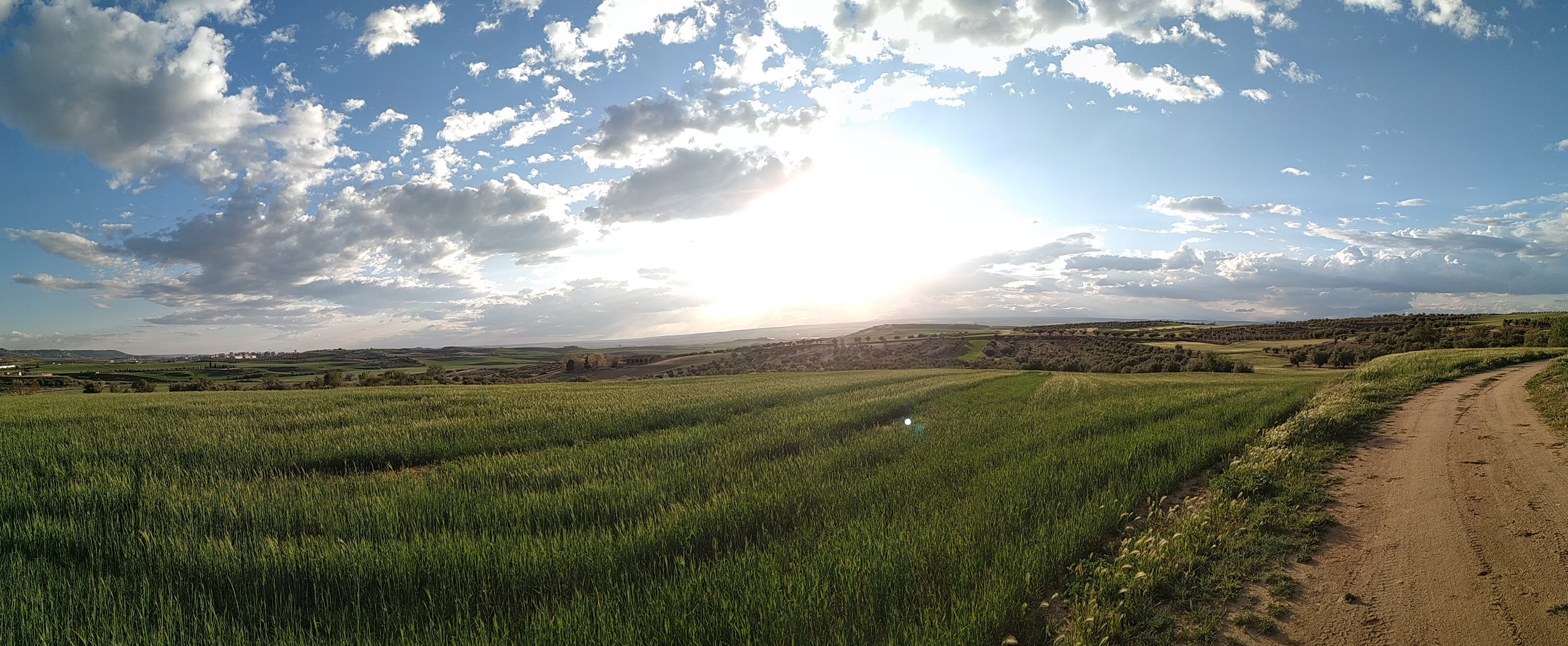
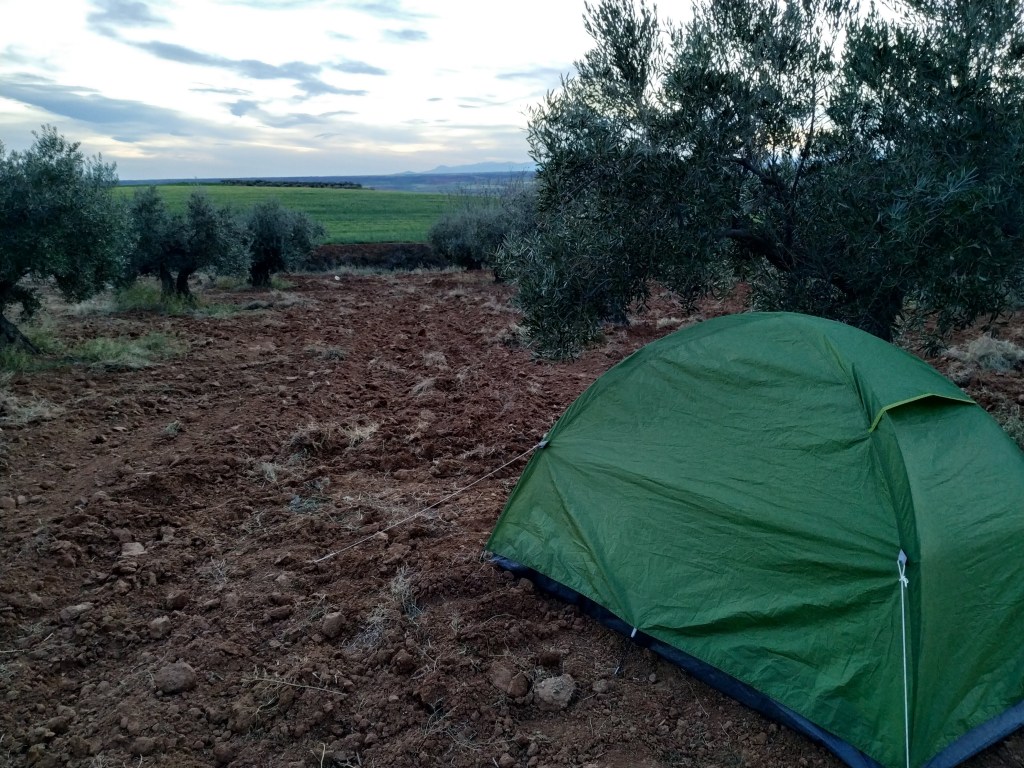
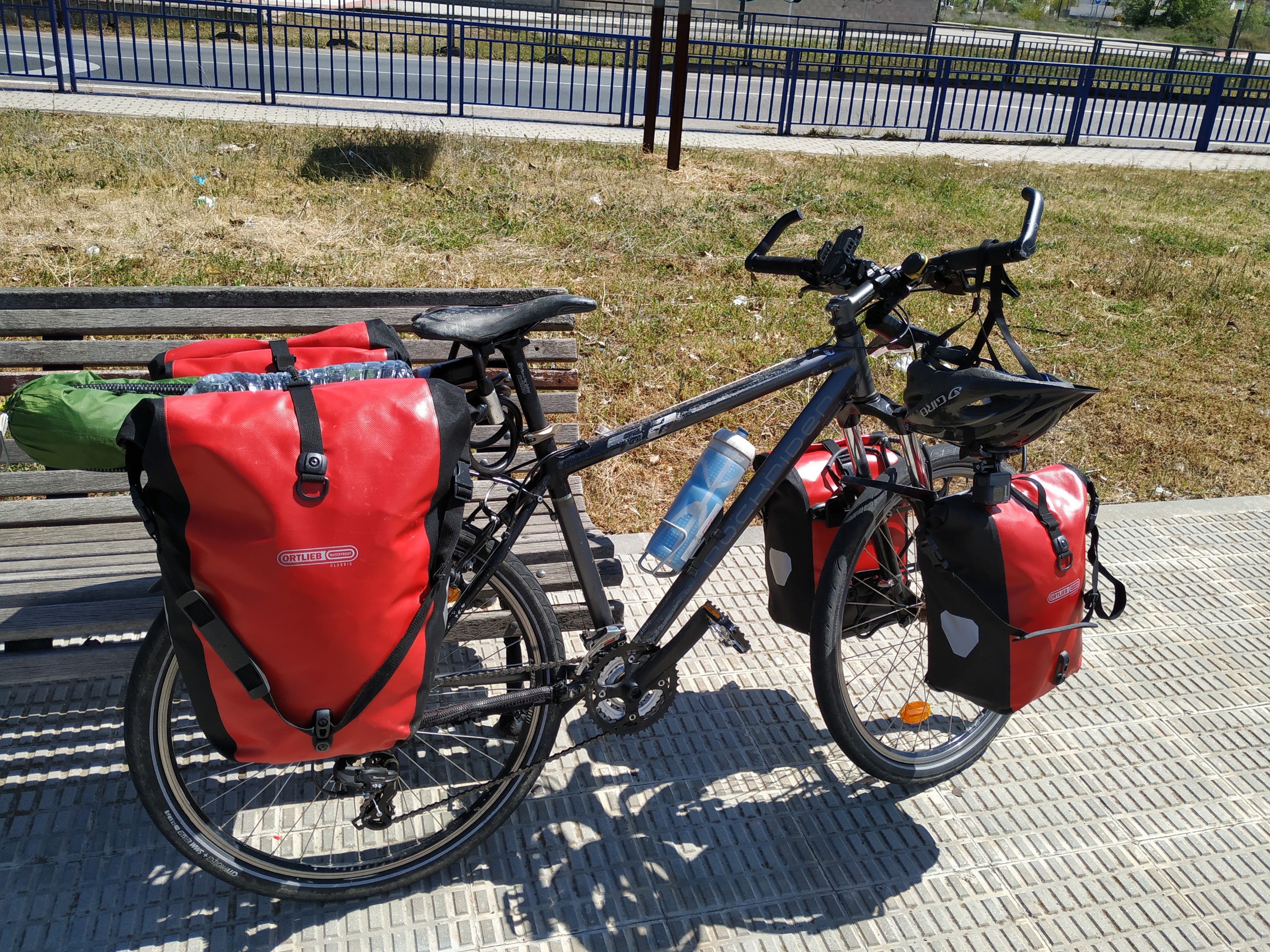
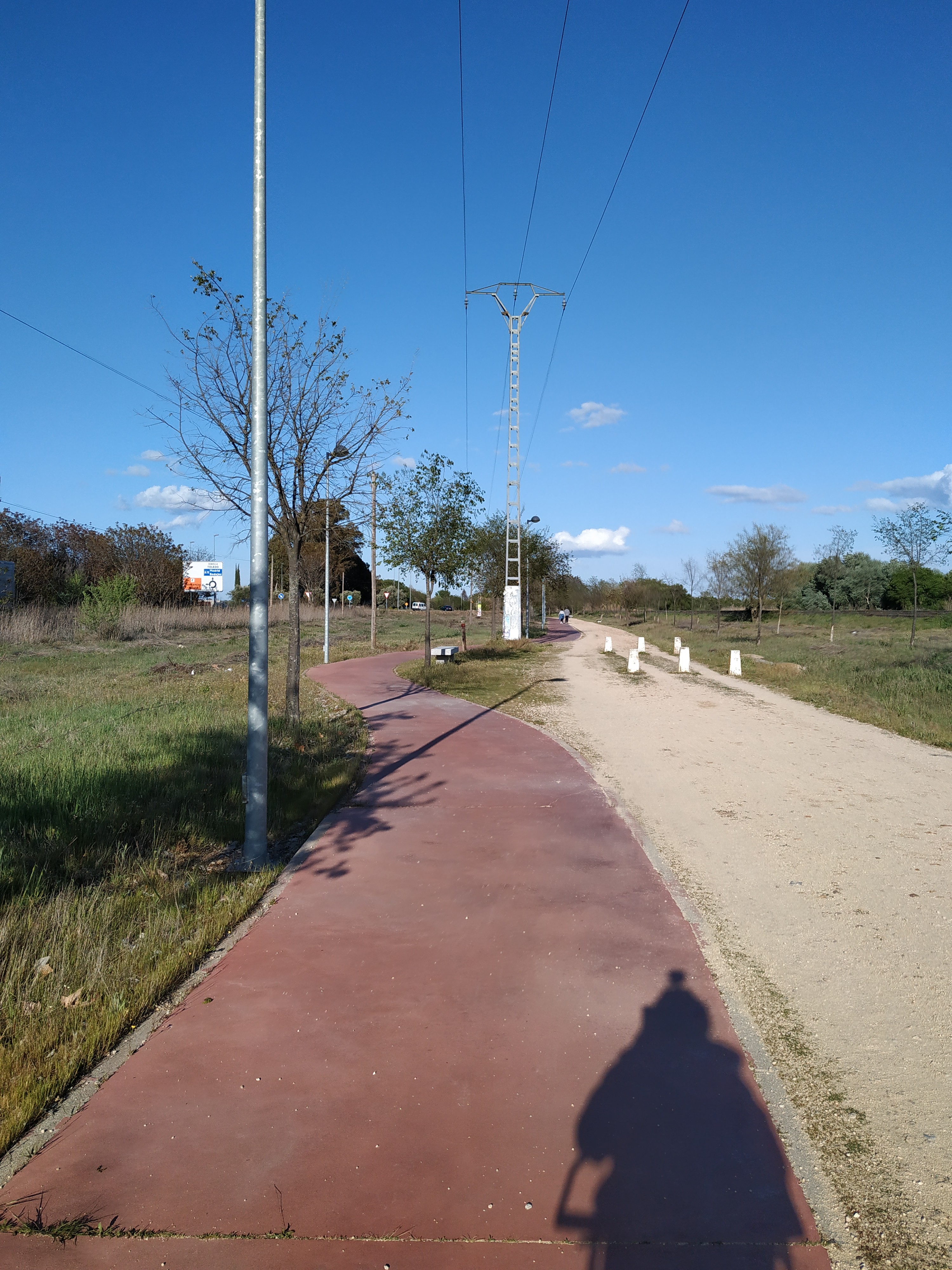
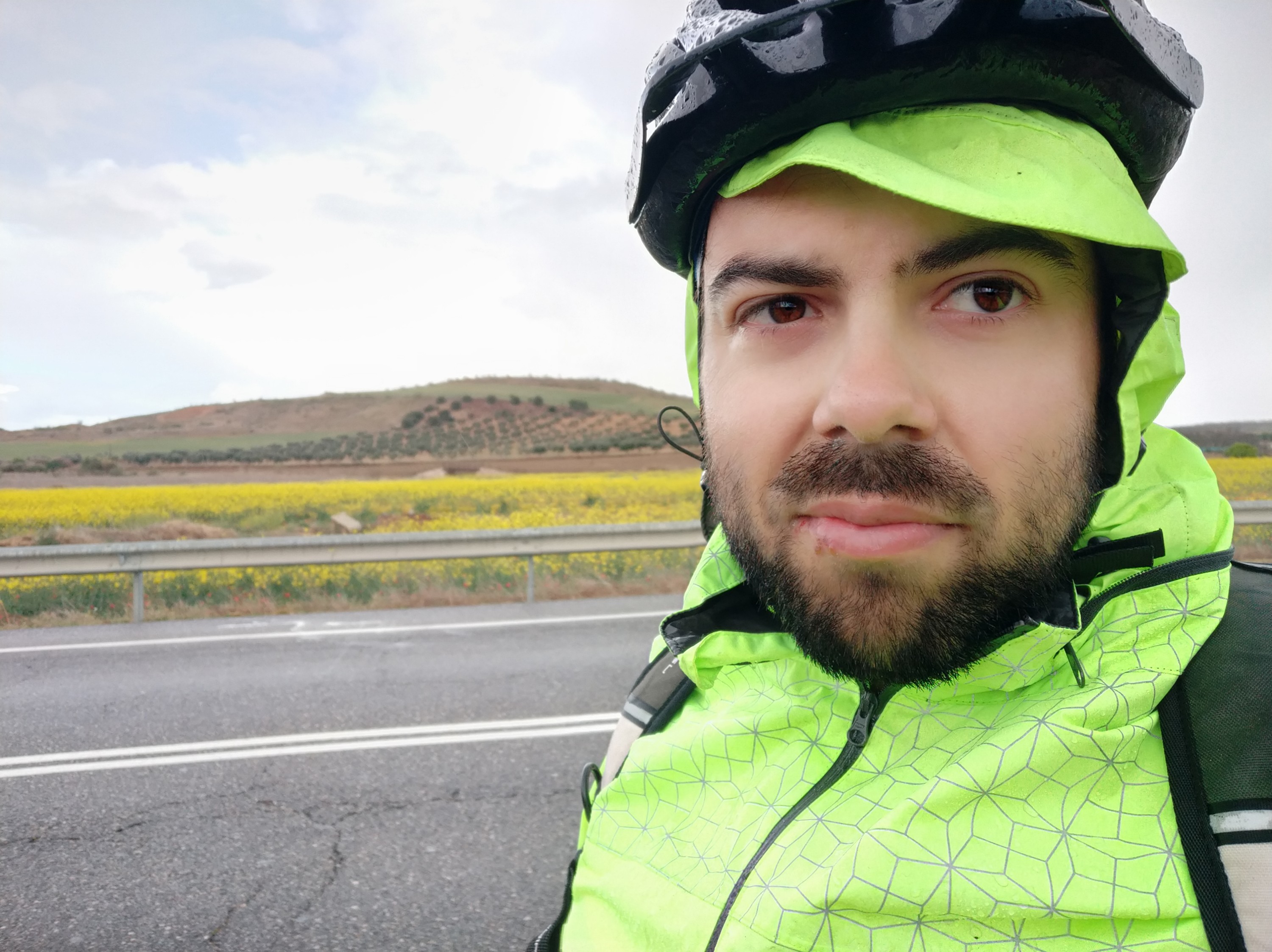
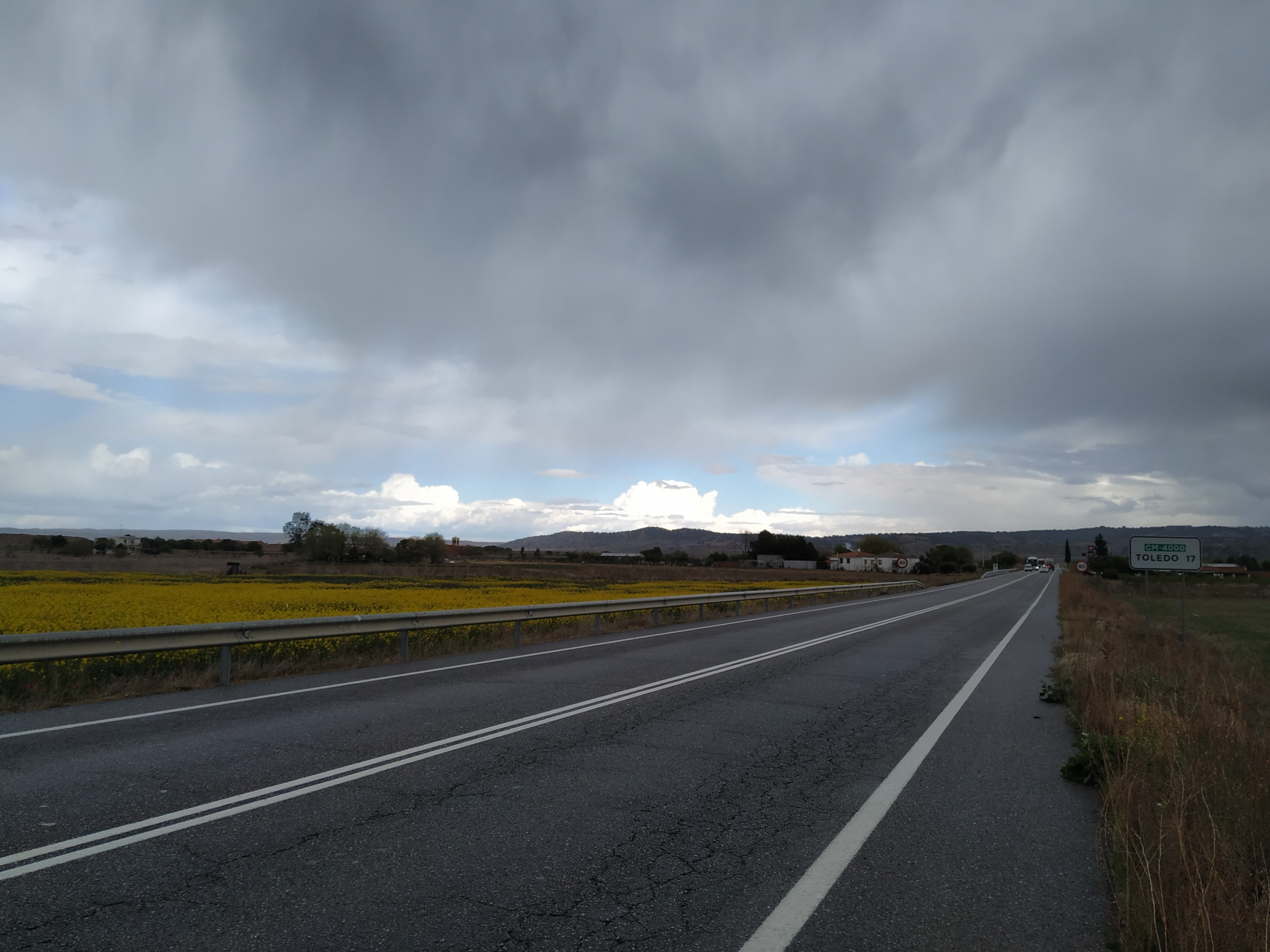
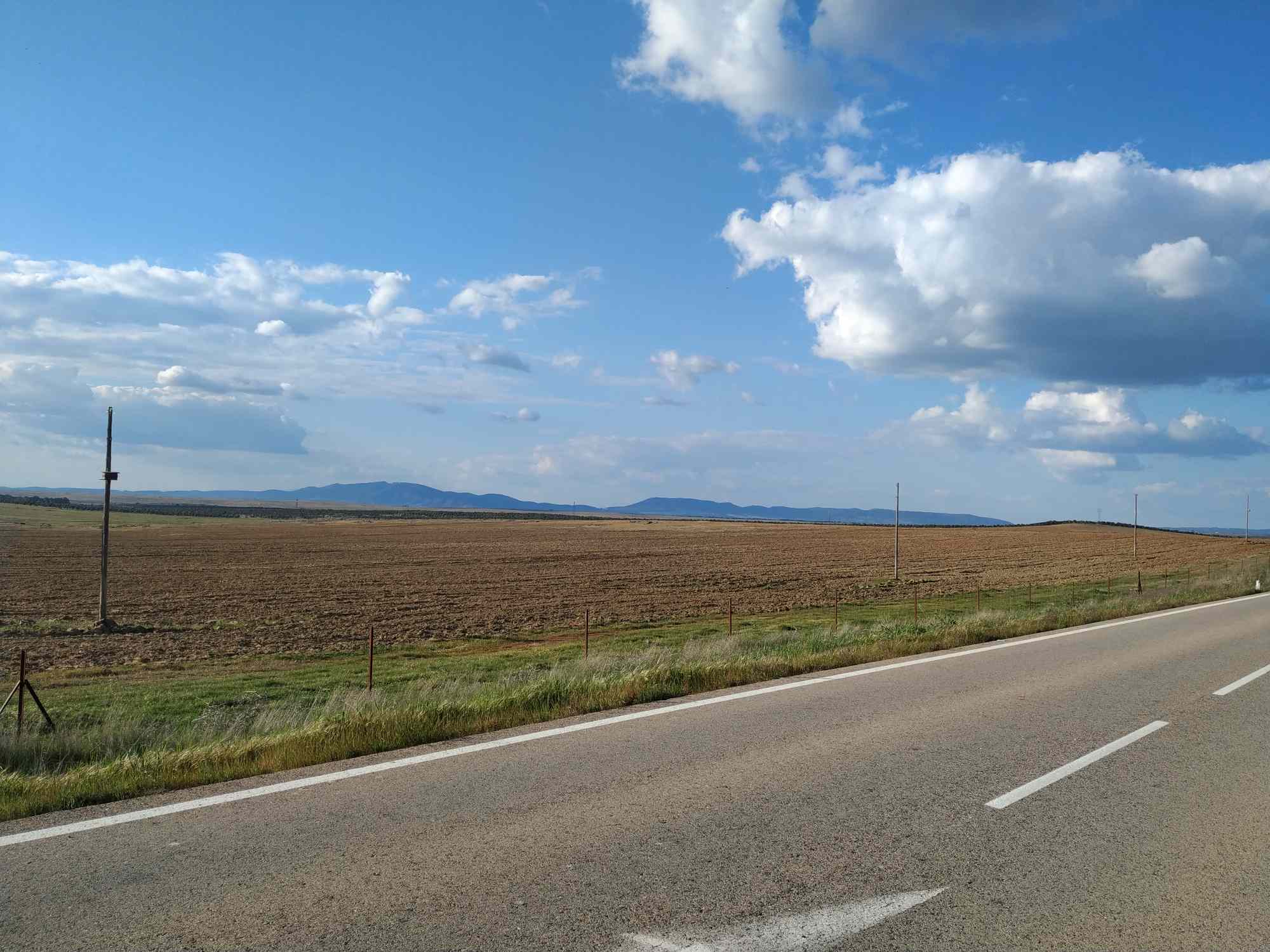
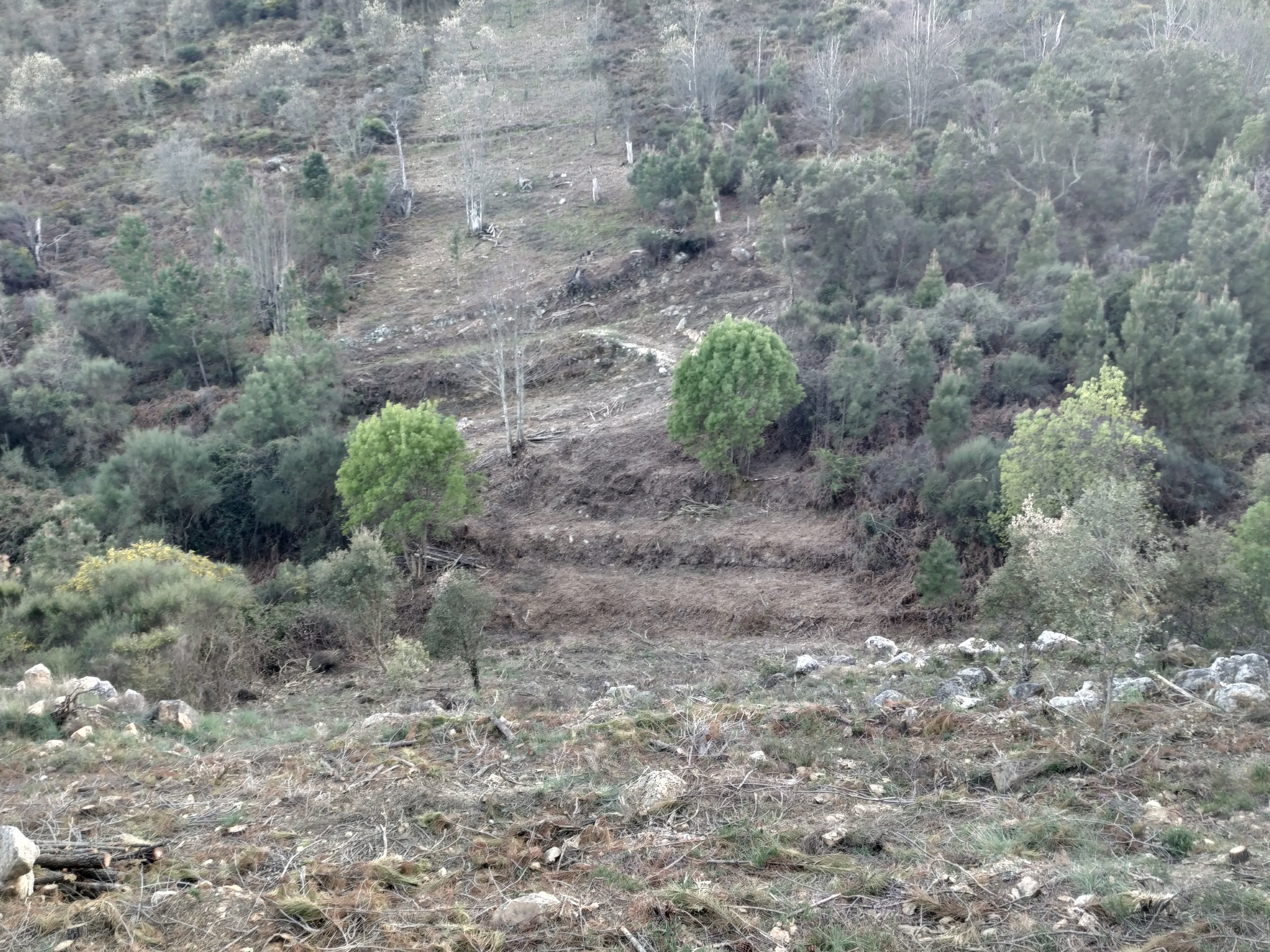
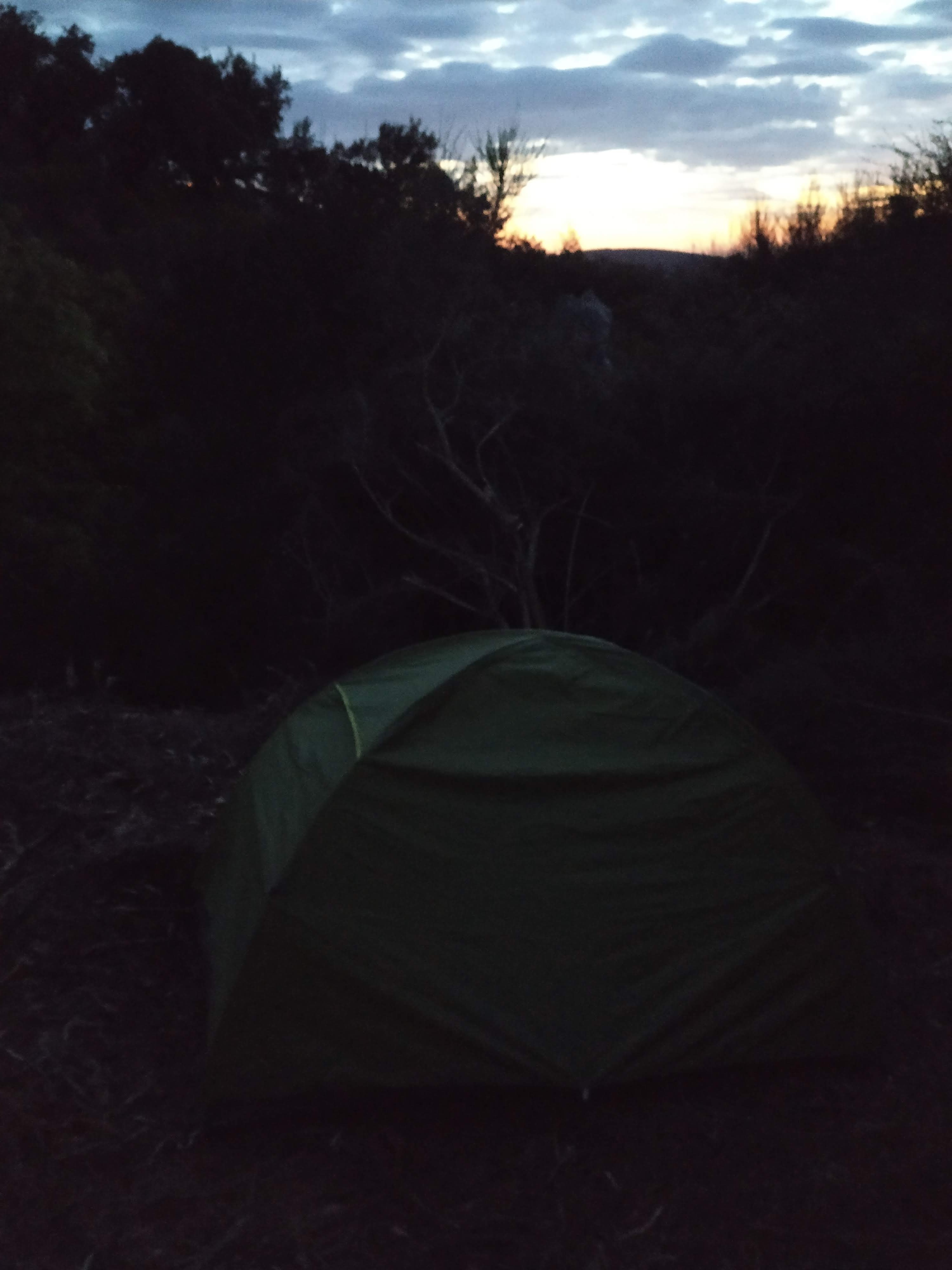
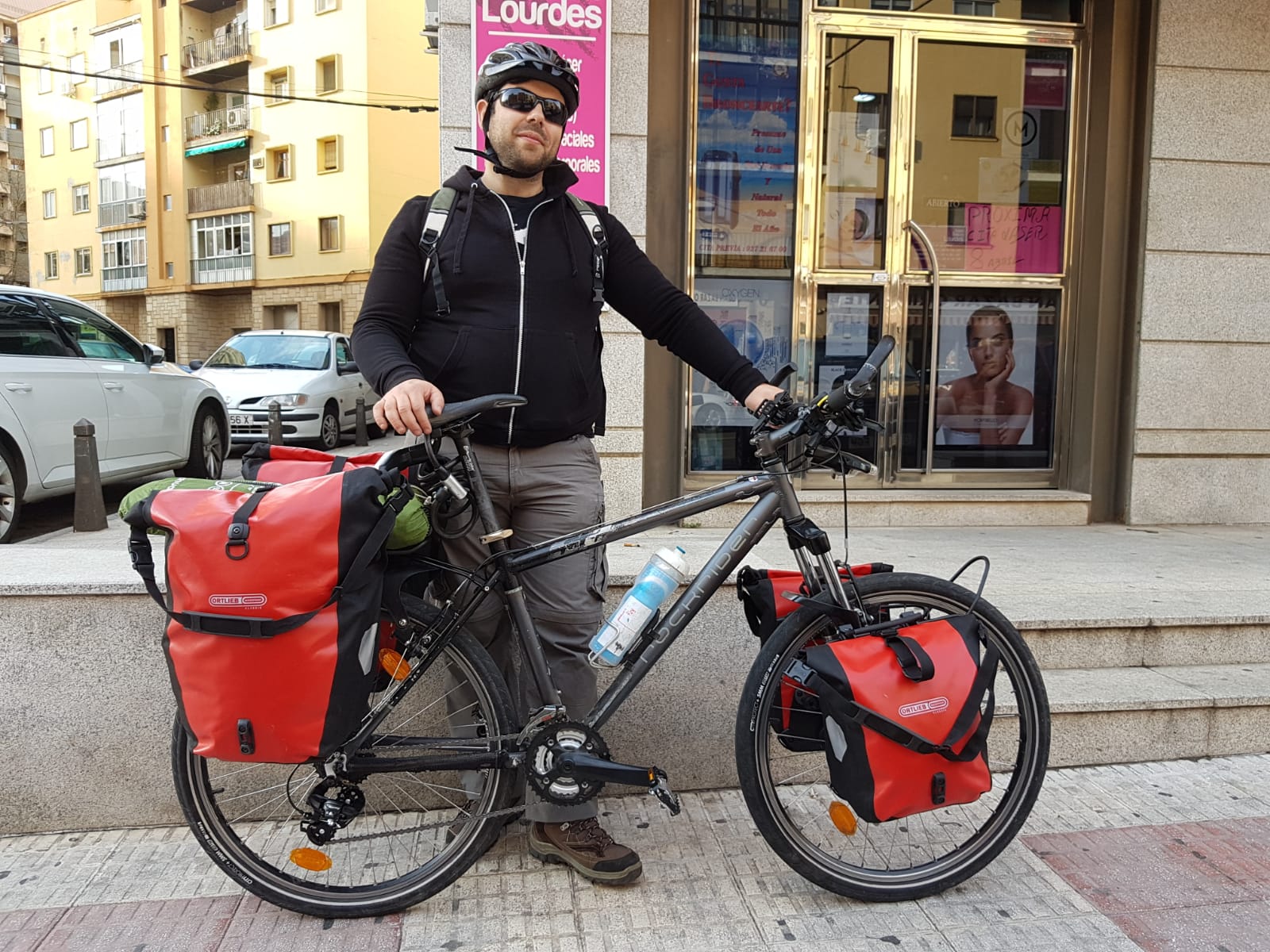
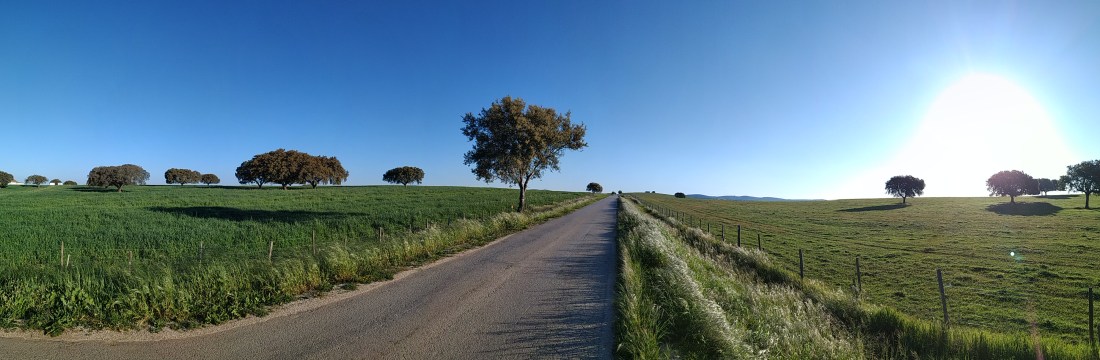
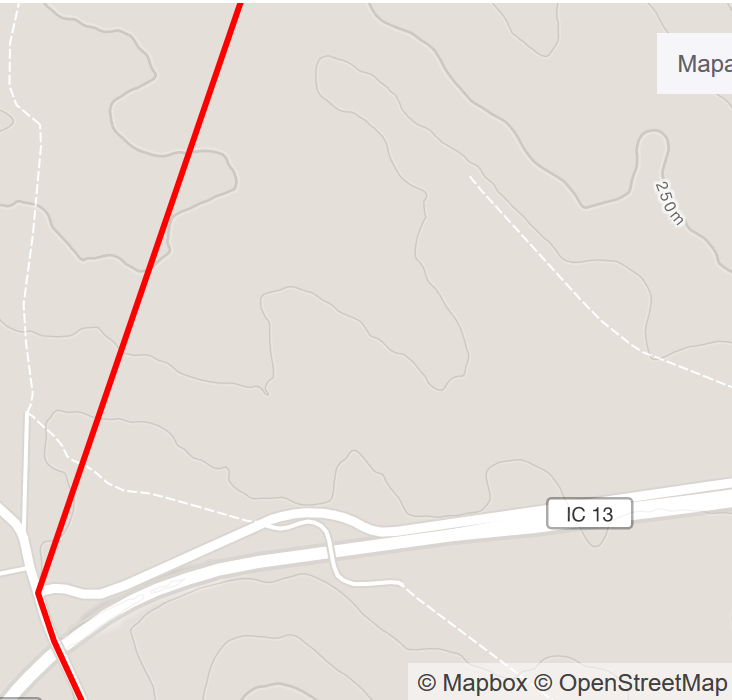
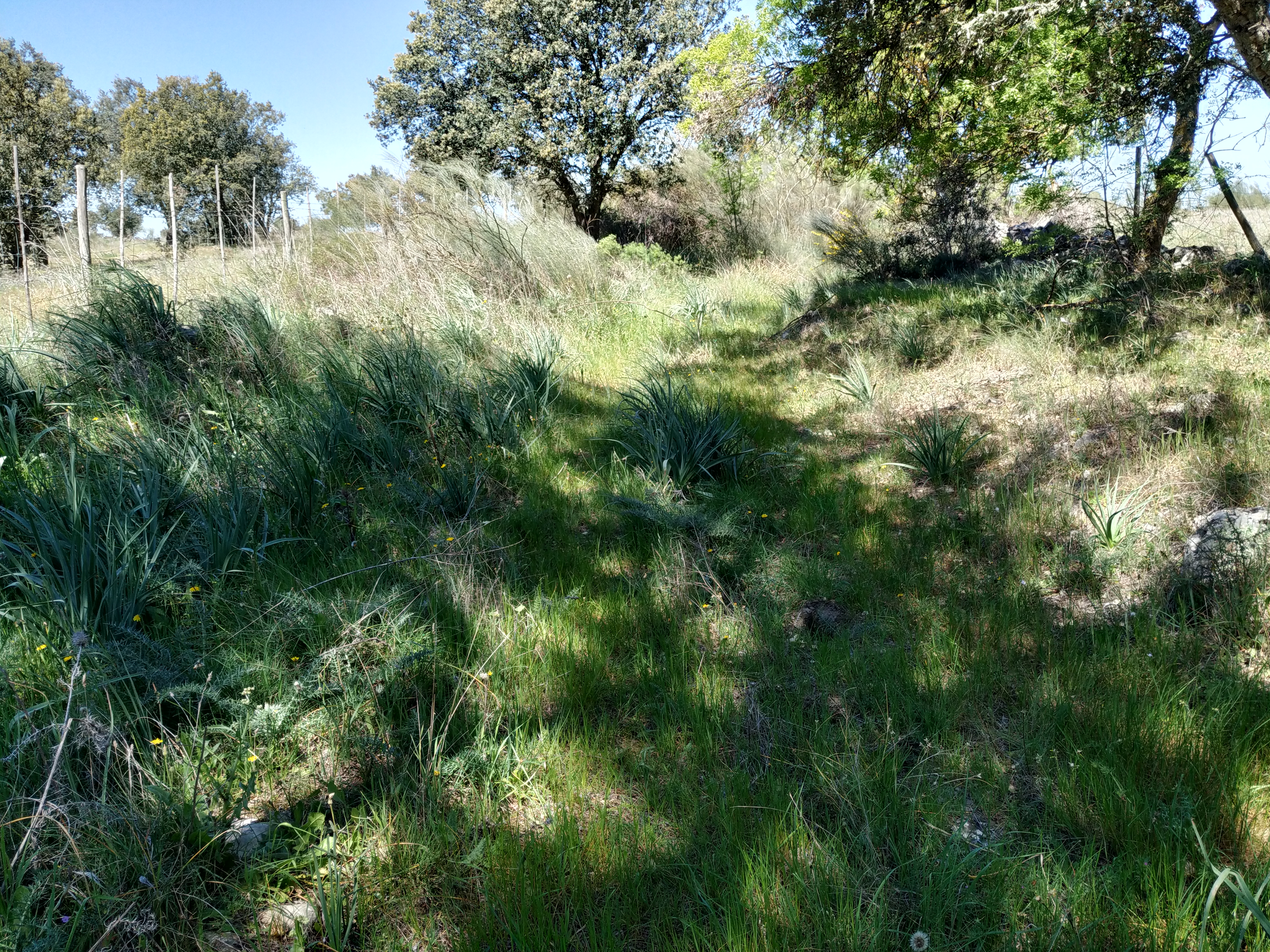
Since I started quite late, I didn’t get too far the first day. The route would be through Via Verde de la Val de Zafán, an old, deactivated railway between Alcañiz and Tortosa. It totals almost 100 km and starts with a gentle climb, though it is 15 km long. I’d do 10 before it was time to turn in for the night. The campsite was an old favorite: an olive tree grove.
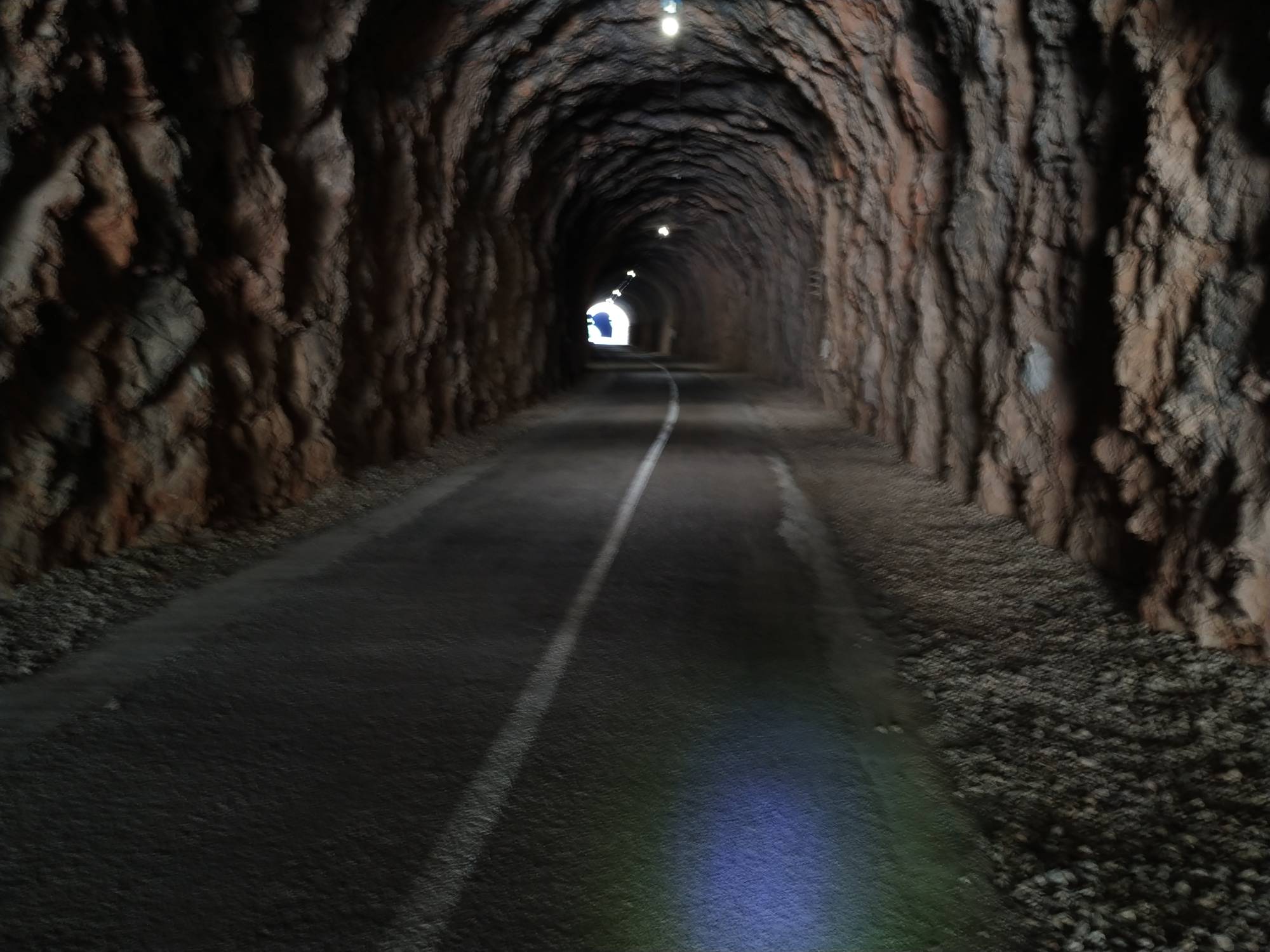
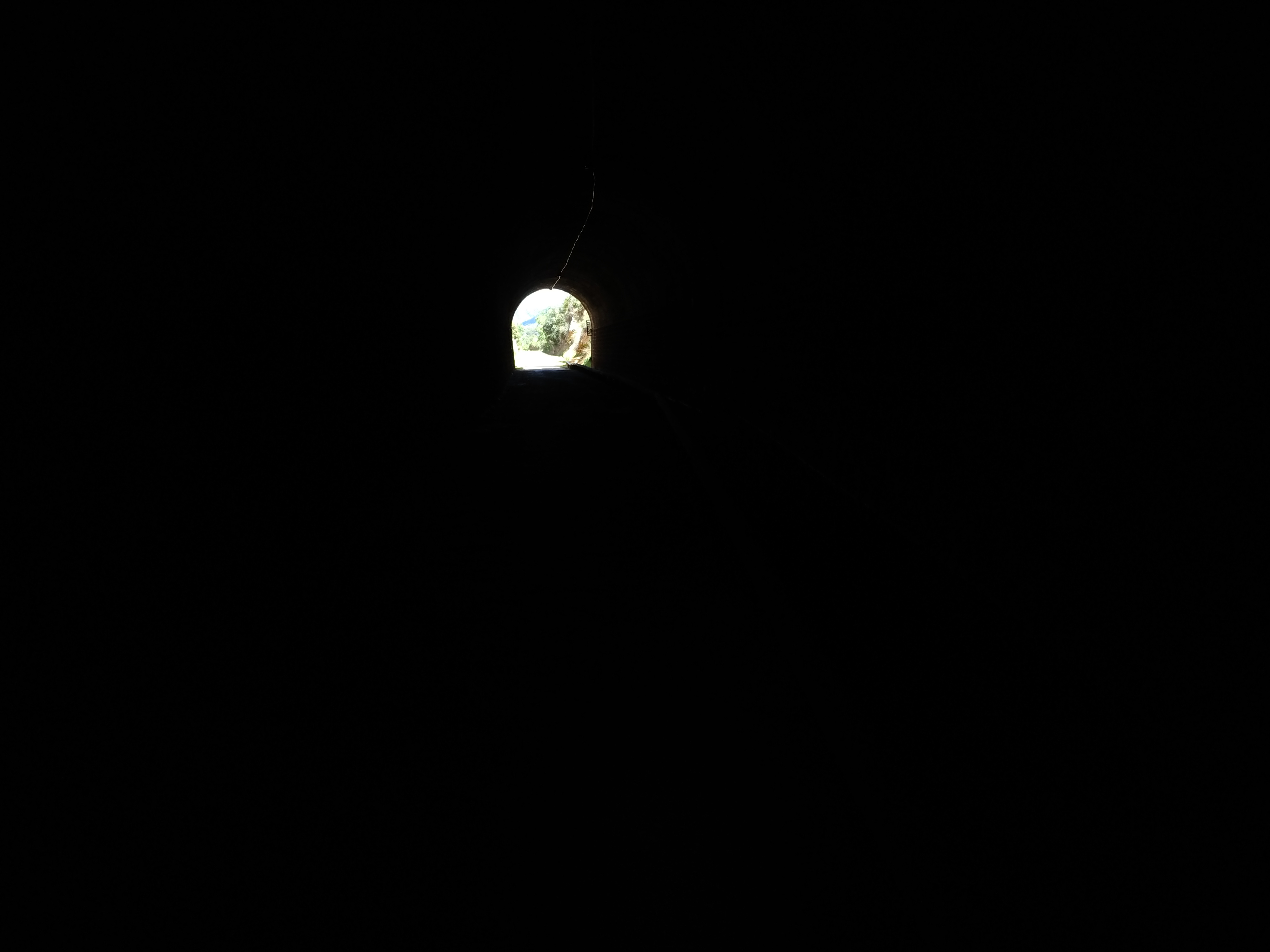
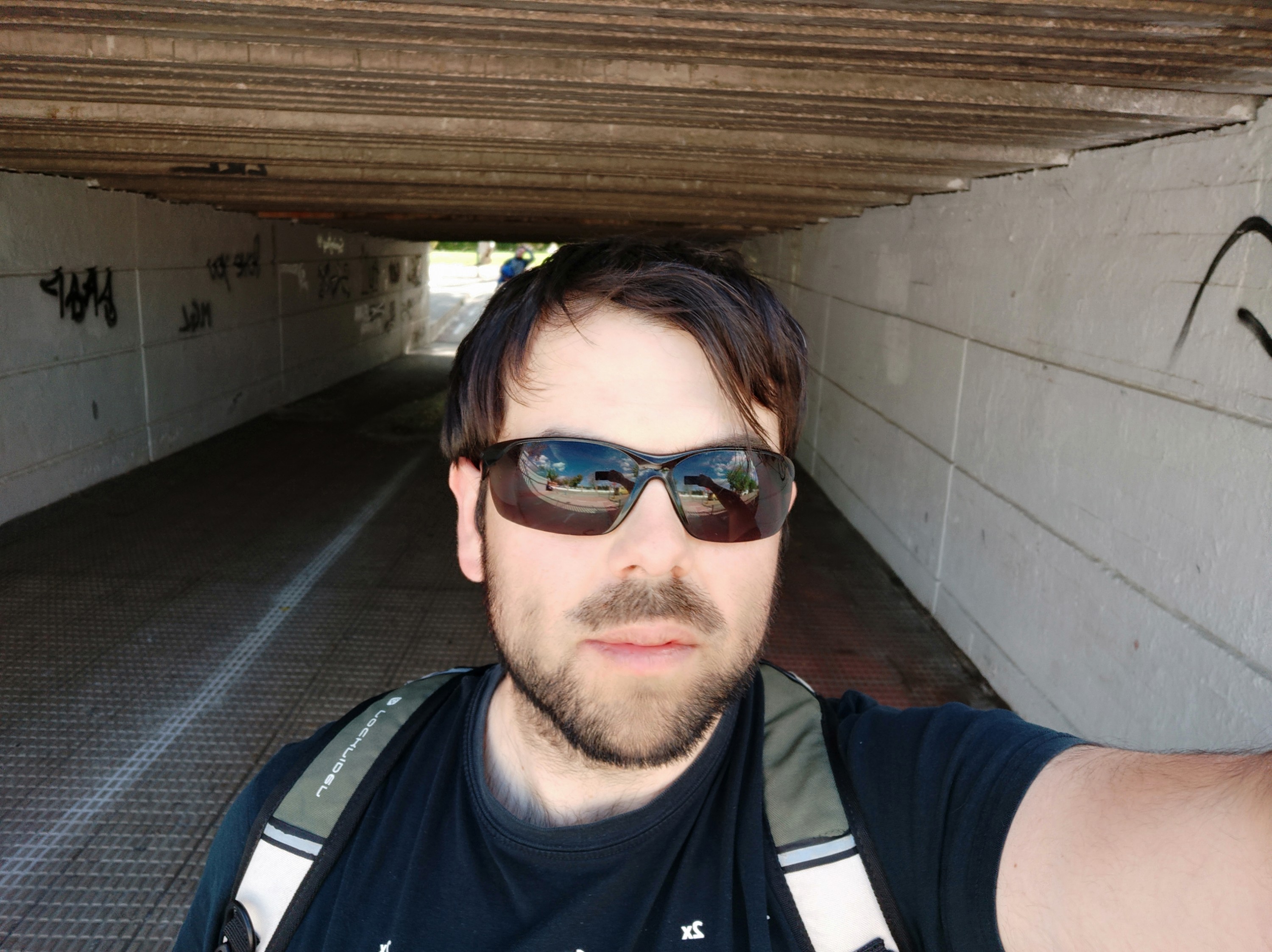
The next morning I’d arrive at the Equinox tunnel, so named because at the equinoxes, there’s a time where the sun shines right through its 2.2 km. The are a bunch of scary warnings not to go inside and the official path goes around the hill. After googling a bit, it turns out the big problem is a lack of light and loose gravel i.e. a tripping hazard. I can handle that, so I went in.

The route is peppered with abandoned stations. I’m glad I was well stocked up on food and water, because it’s almost 100 km of nothing, since most of the towns are quite a bit away from their stations and almost every station is abandoned. There are only two exceptions, which have been converted to hostels. The first of those was quite weird. The door was open and there’s was a sign informing people there was a single hour for each of breakfast, lunch and dinner. No one was there and there were no cameras on the bar. I’m no thief, but anyone could clean that place up with no consequence.

At first it felt like this would be good cycling, but the scenery wouldn’t be very interesting. The main reason why it would be good cycling is simply because bikes and trains have one thing in common: their power to weight ratio sucks. That makes people plan for gentle slopes and they’re not shy about blasting mountains to get them.
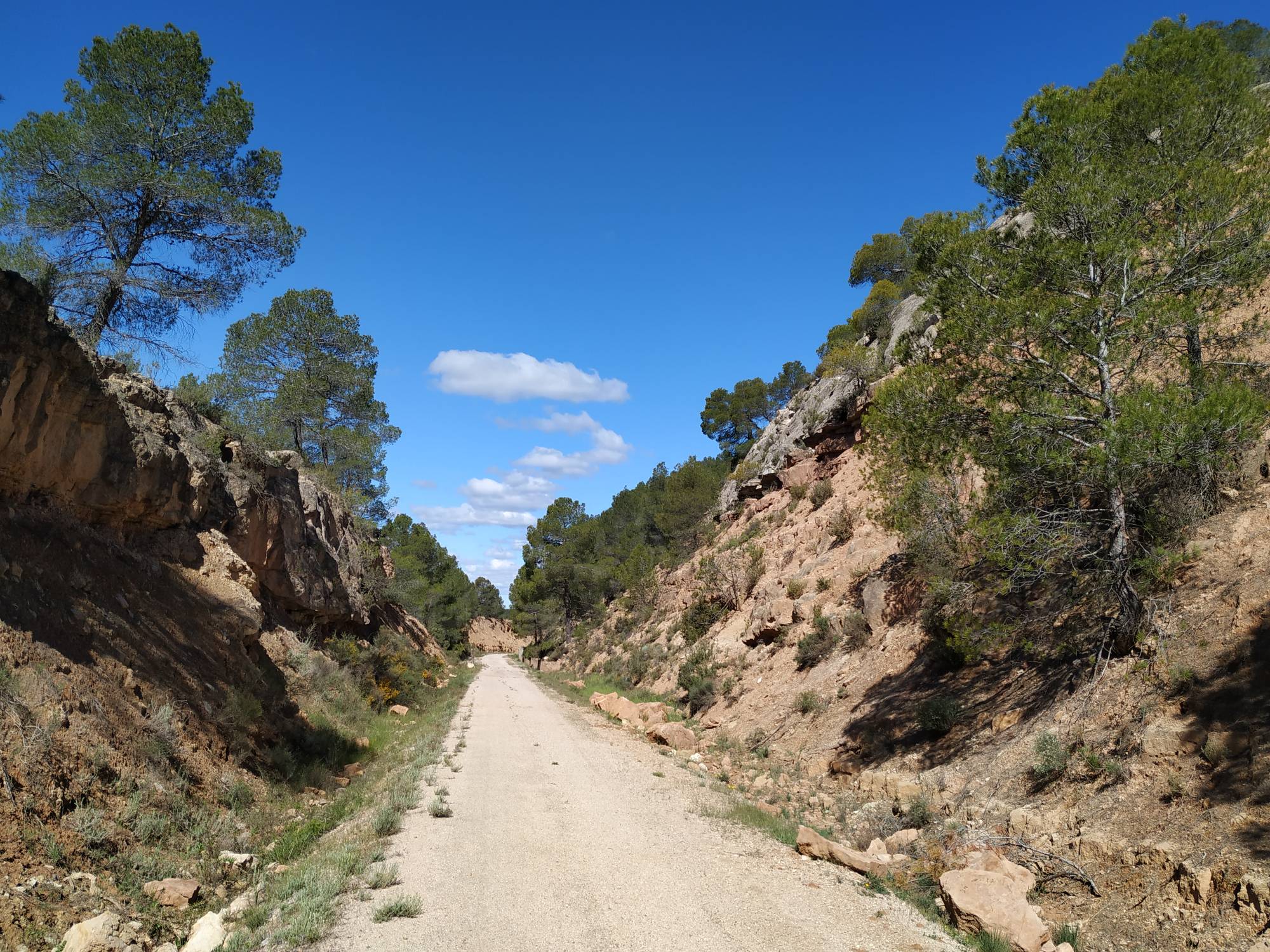
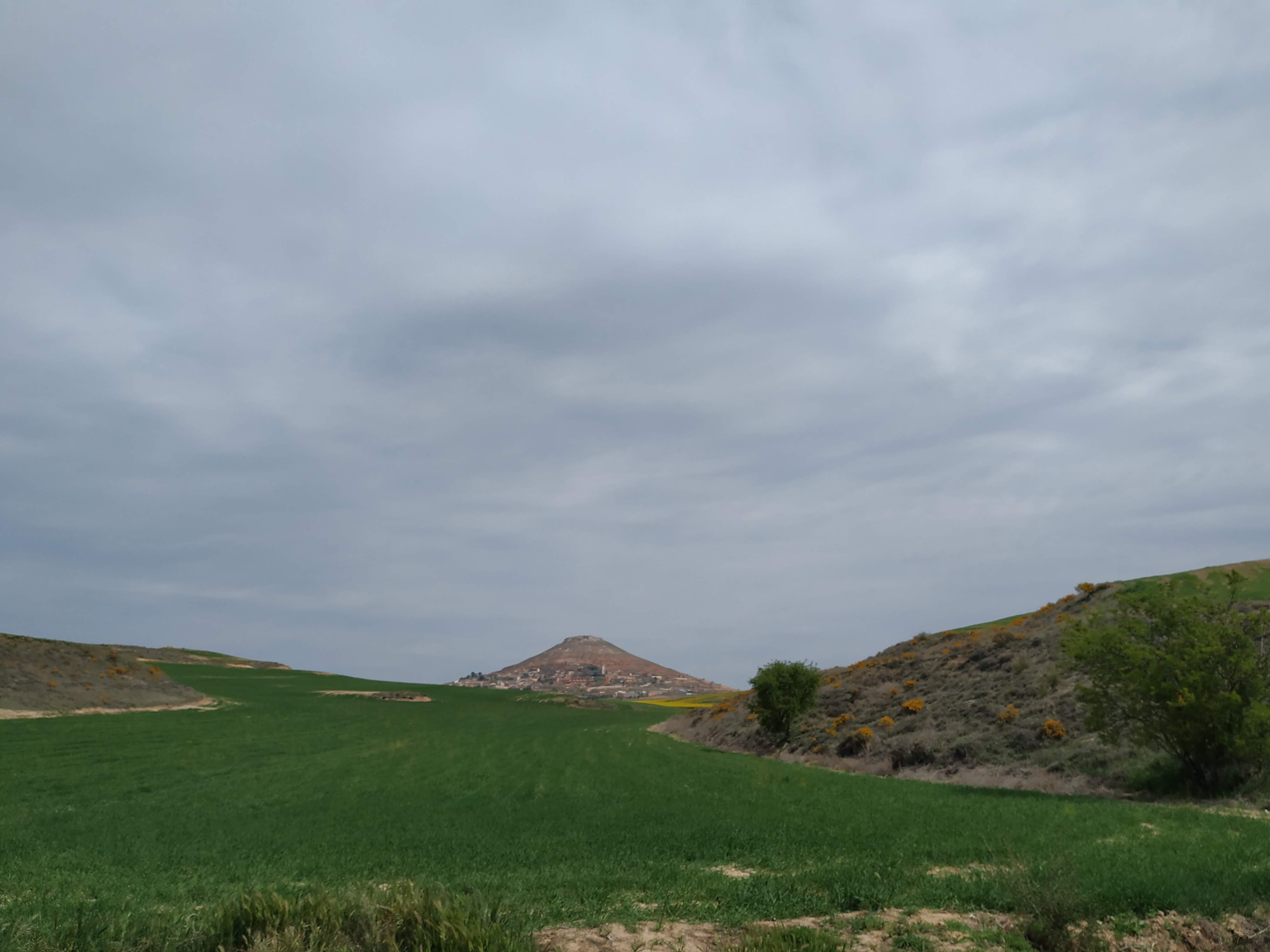
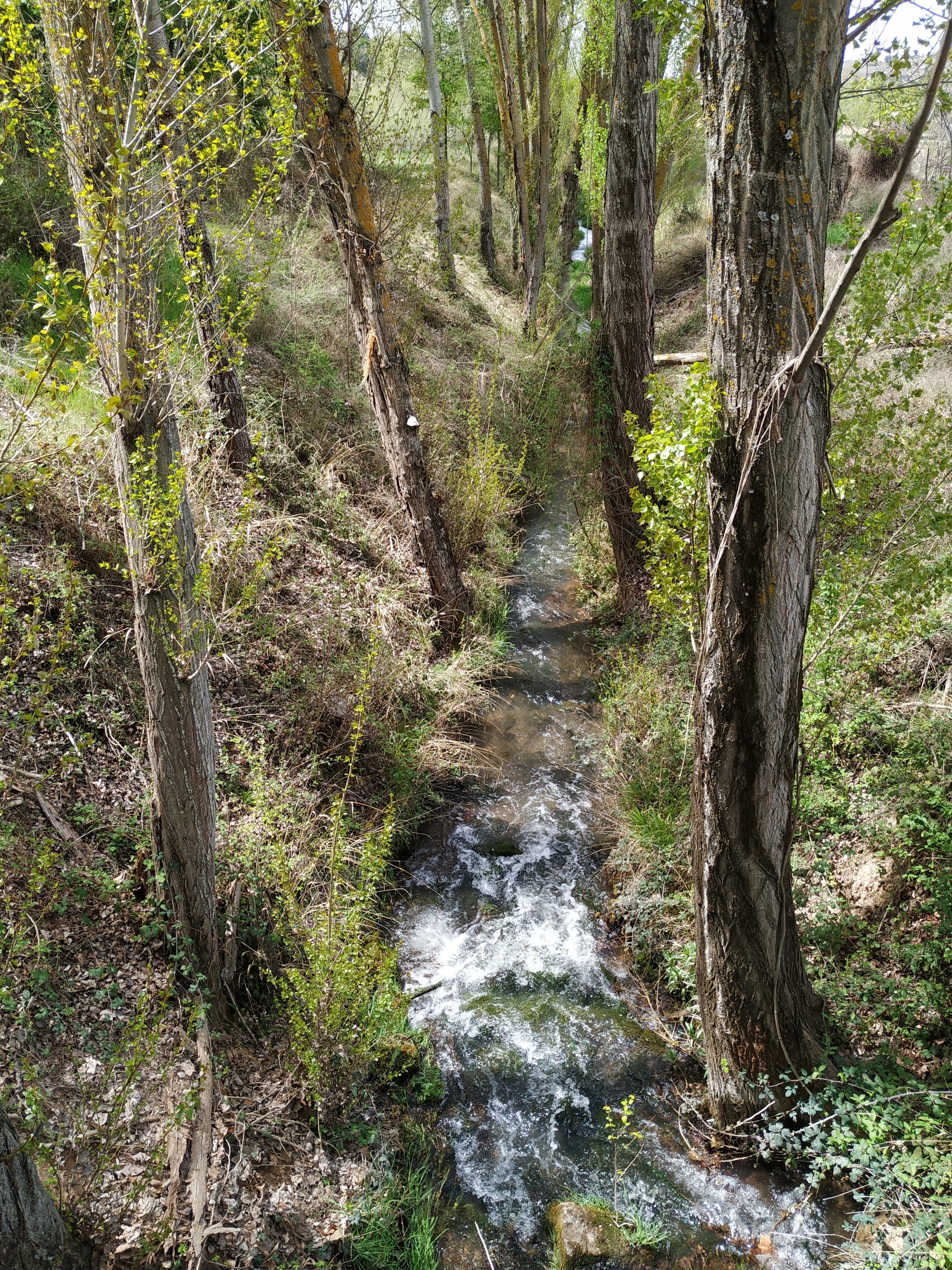
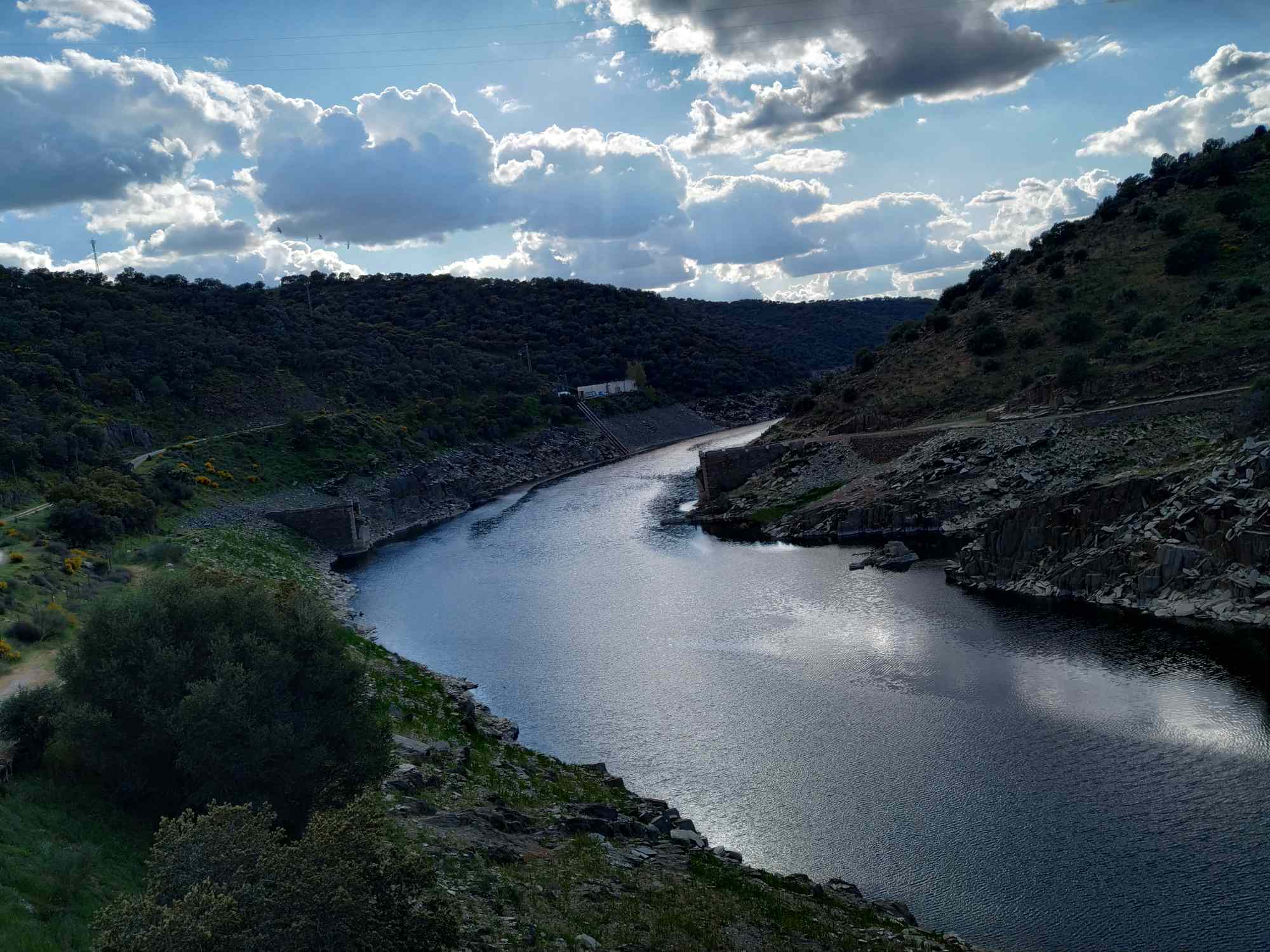
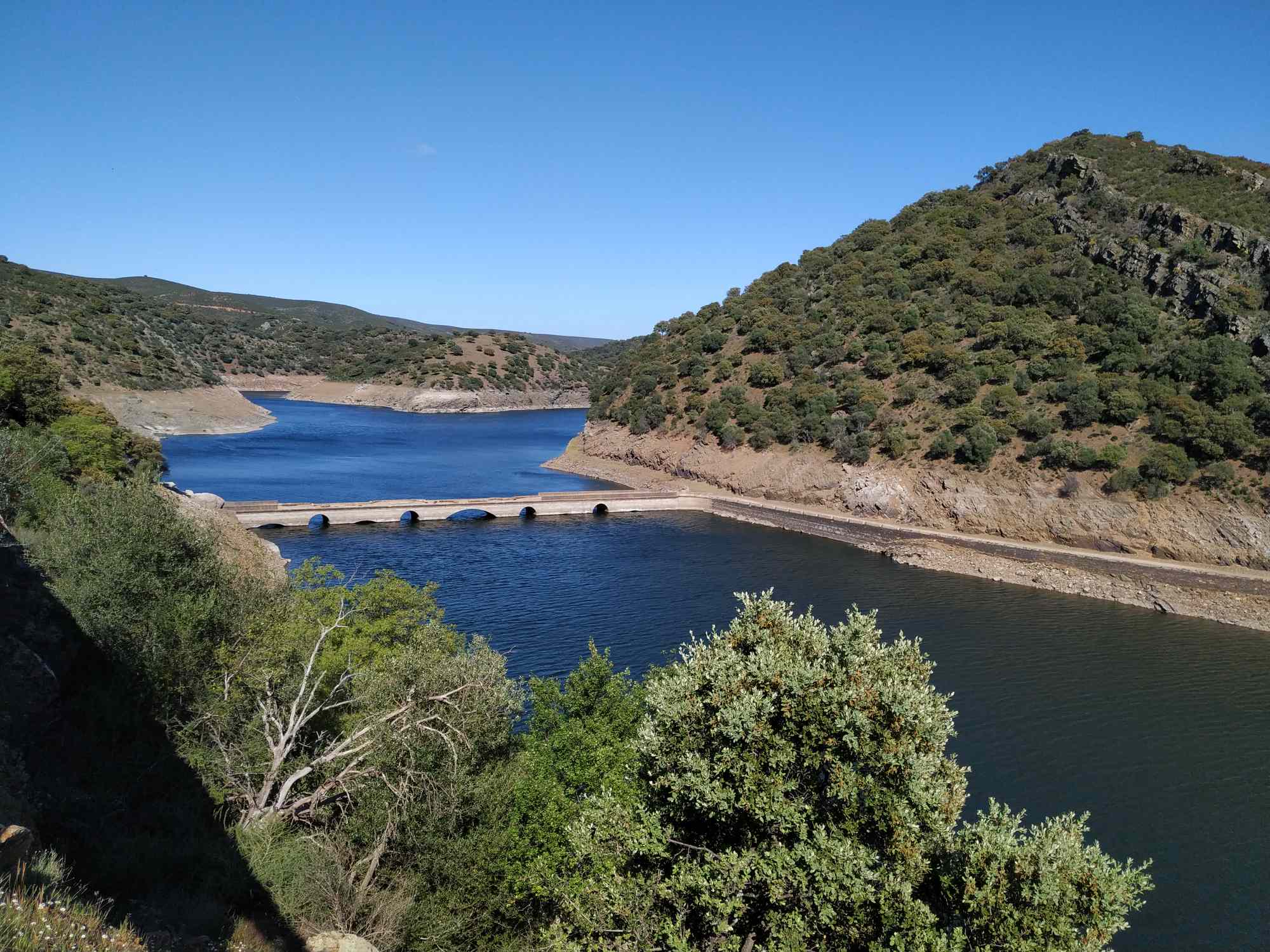
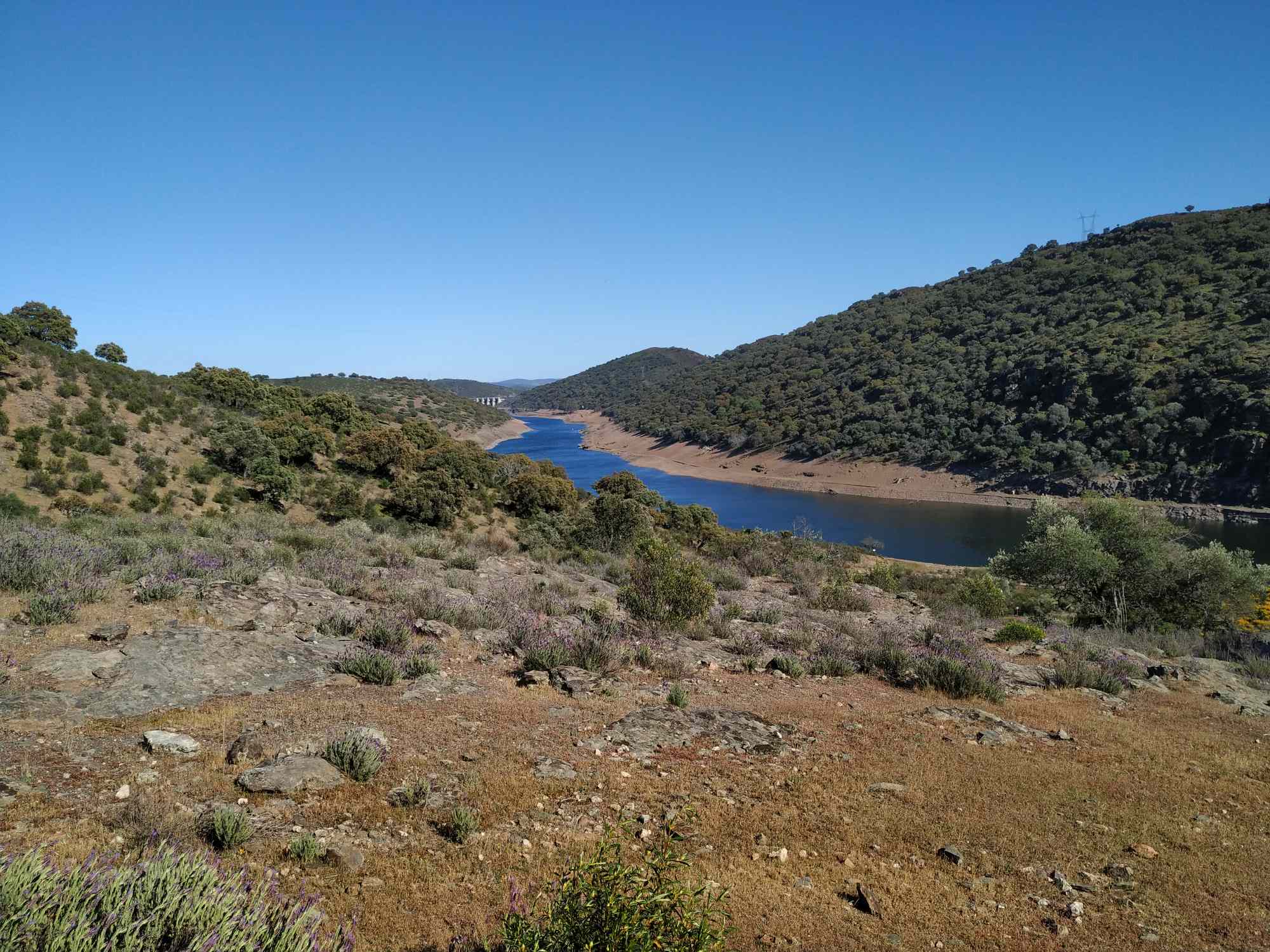
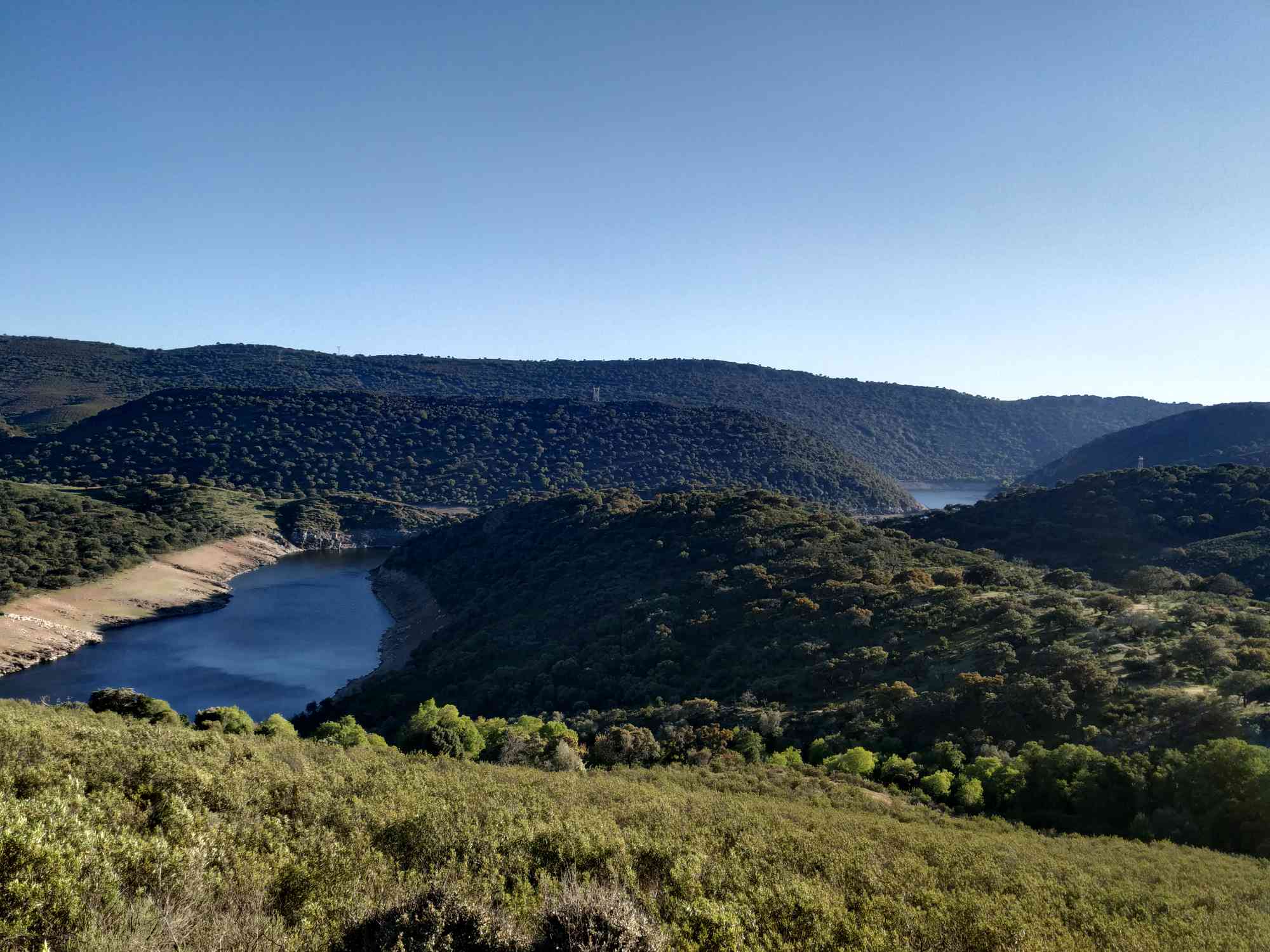
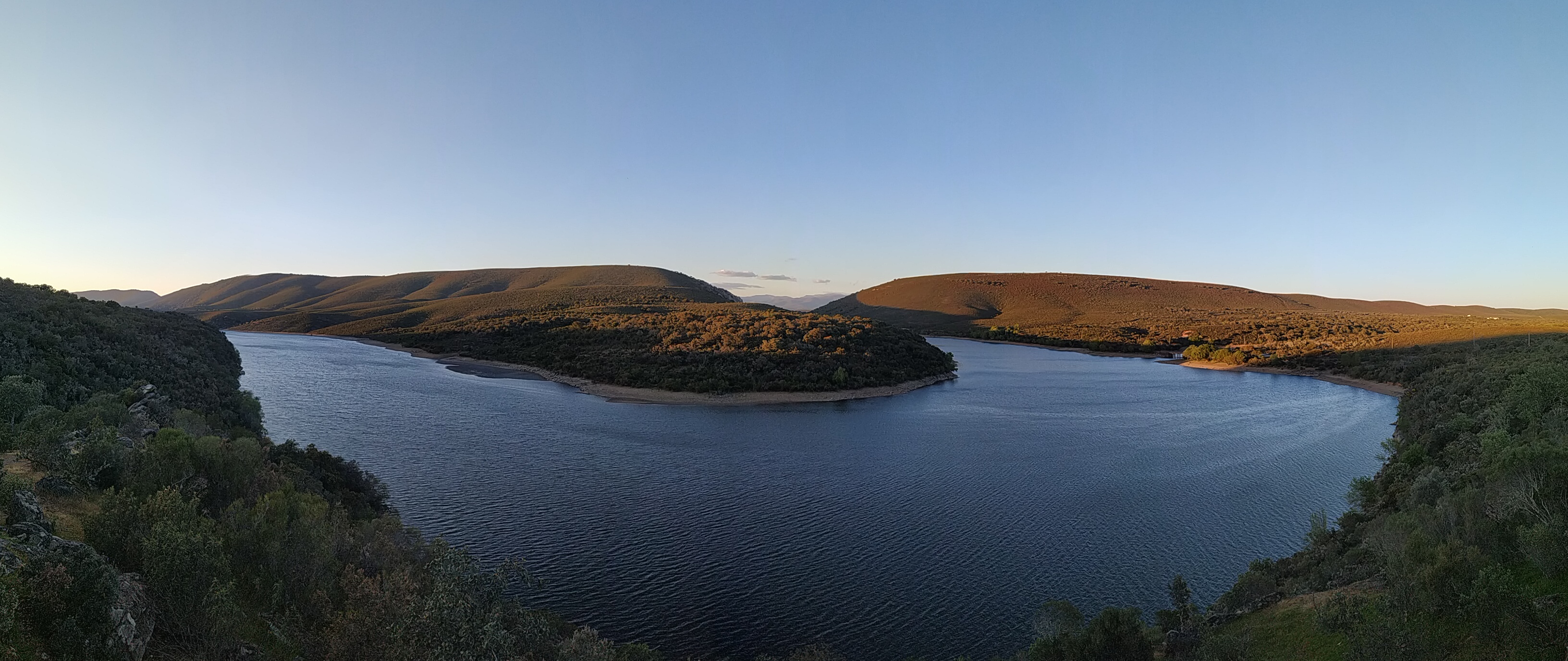
Luckily, as the railway started going through river valleys, the scenery would get interesting.

Yes, I was hanging a towel out to dry.

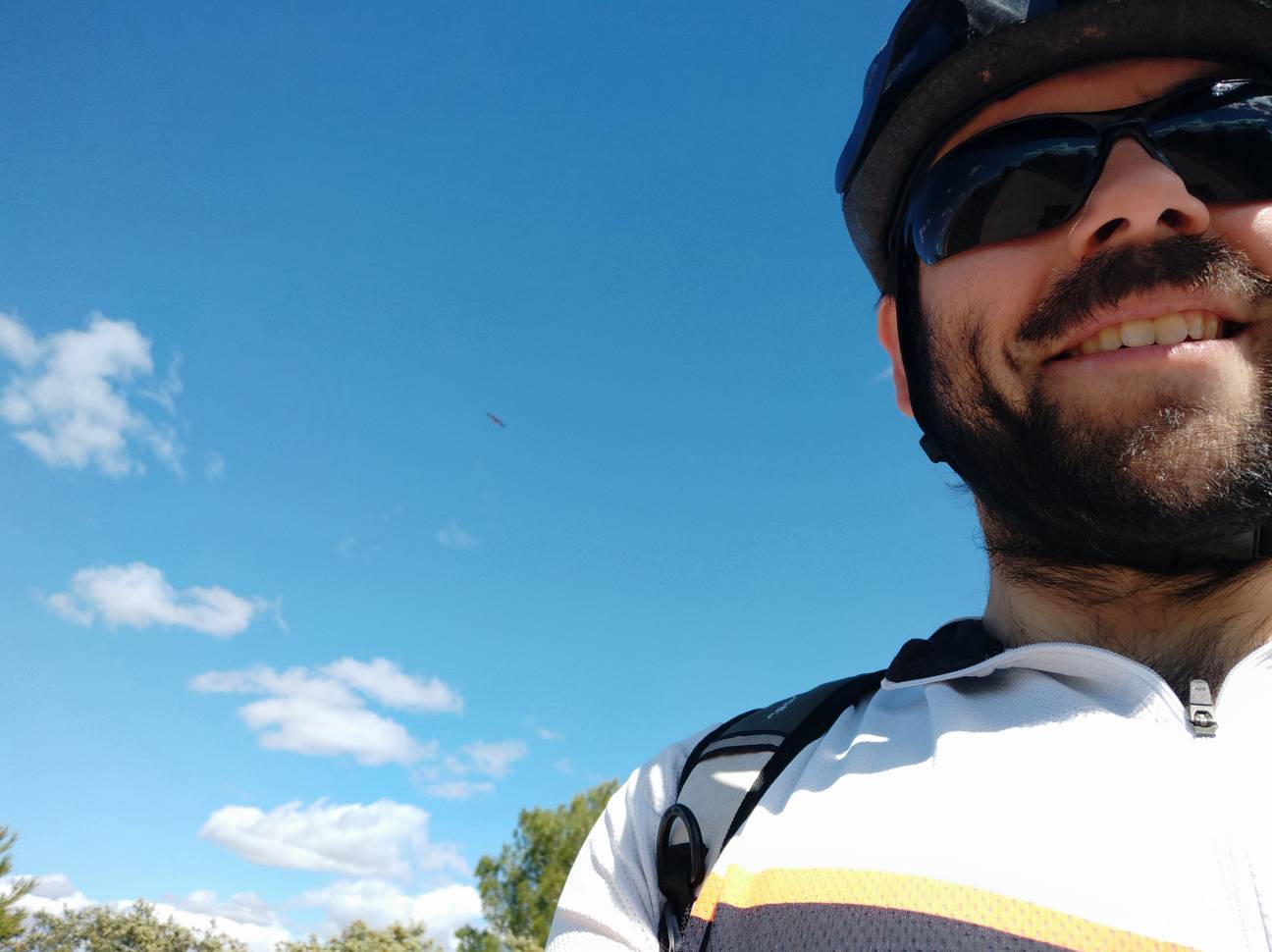
After another long climb, there were some huge raptors flying above. I’m not sure what they were, but I still took a selfie with one.
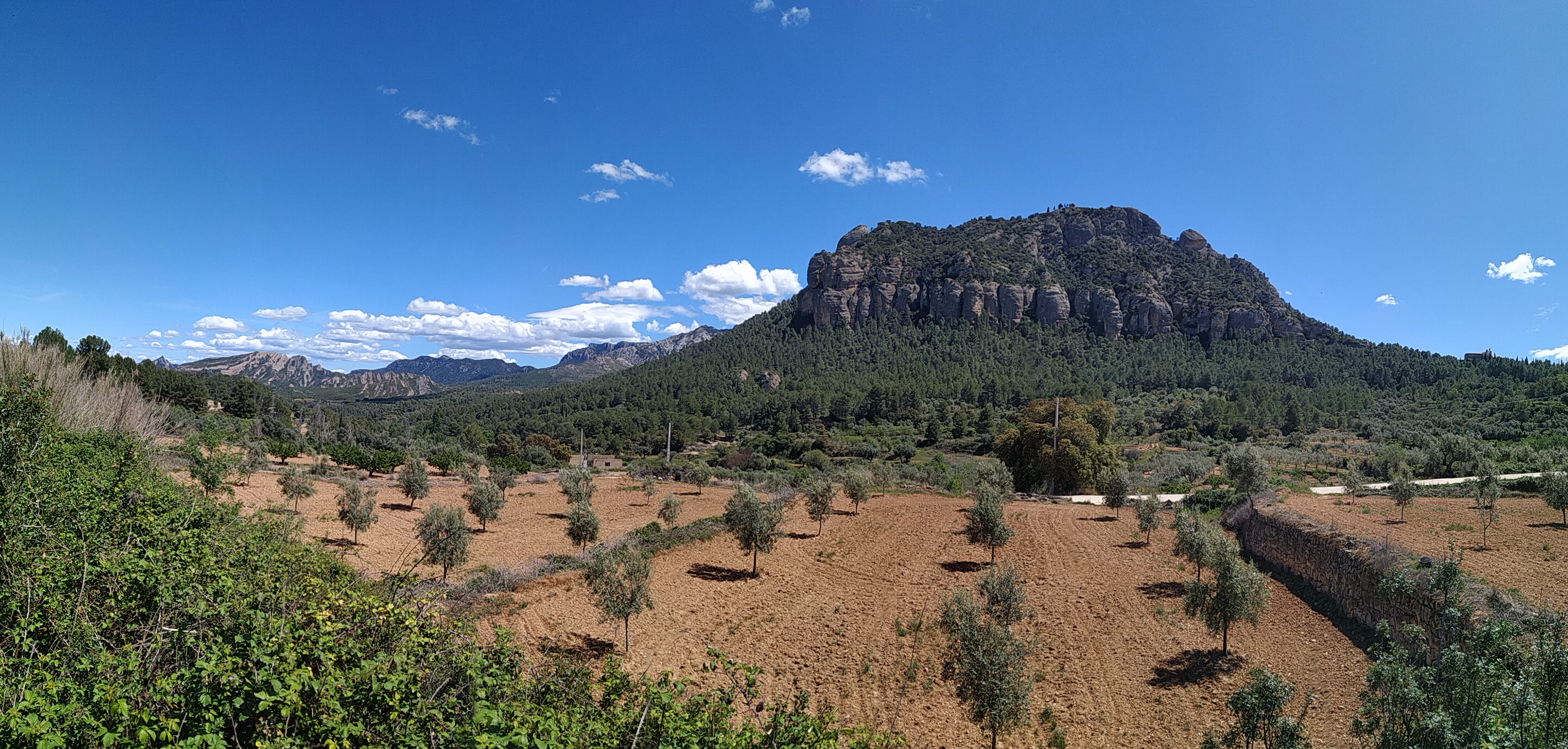
After a while, I’d entered Catalunya, where the language turned weird and the valleys turned into canyons. It was also downhill for dozens of km, making me glad I wasn’t doing it the other way around.

As you can see, the route was filled with tunnels too. The odds of them having functioning lighting are about even, so bring your own lights, if you visit.
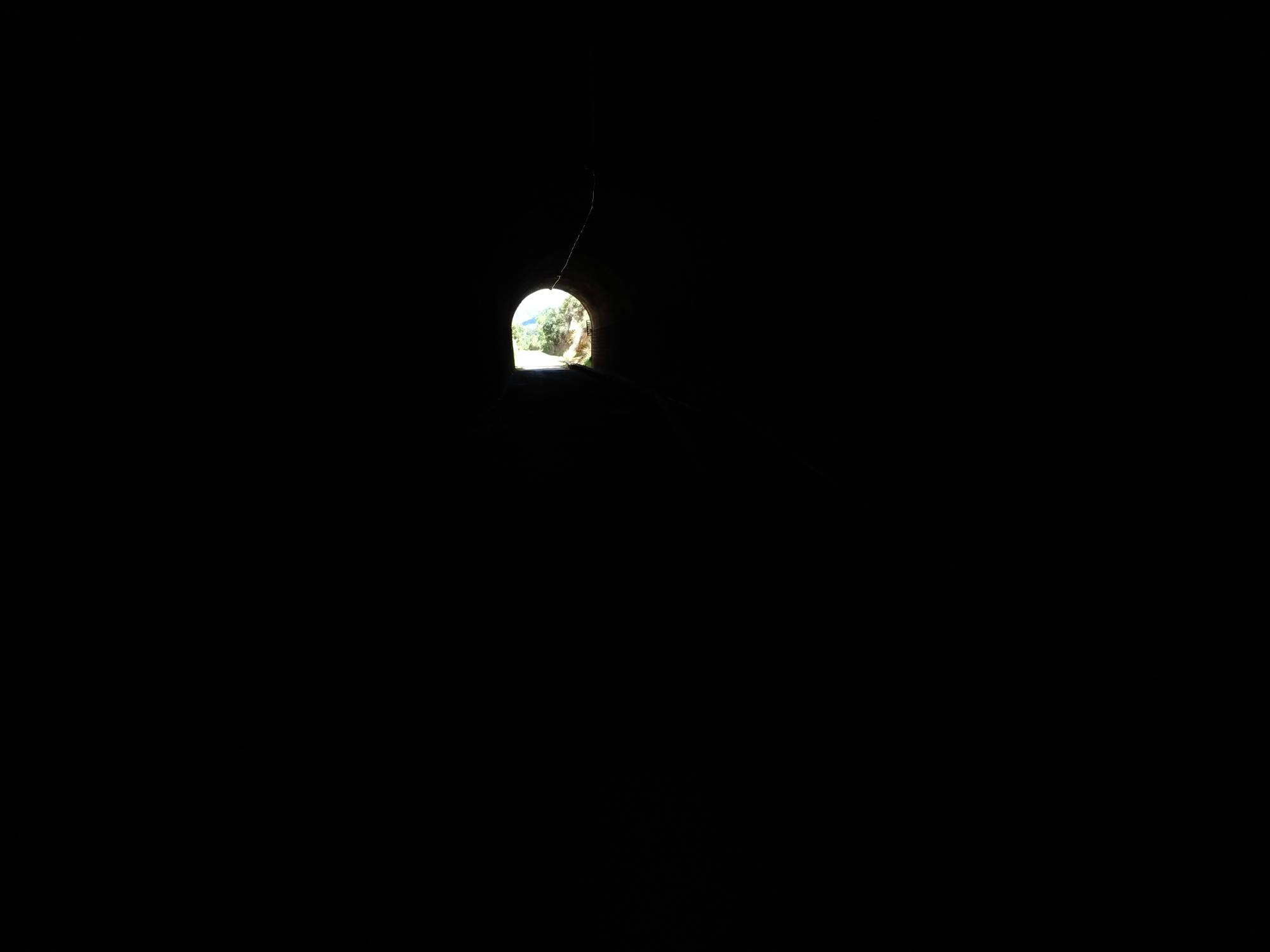
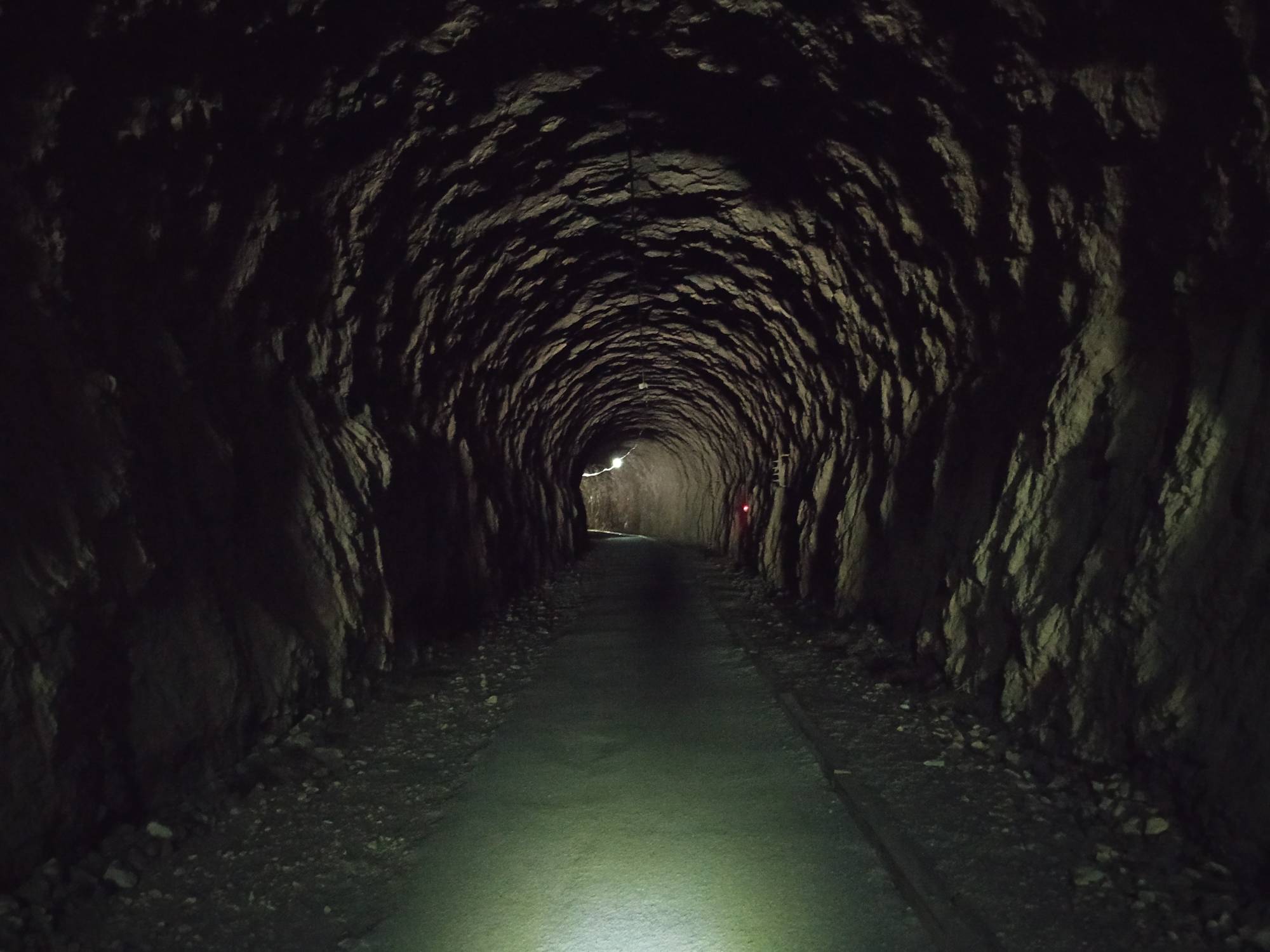
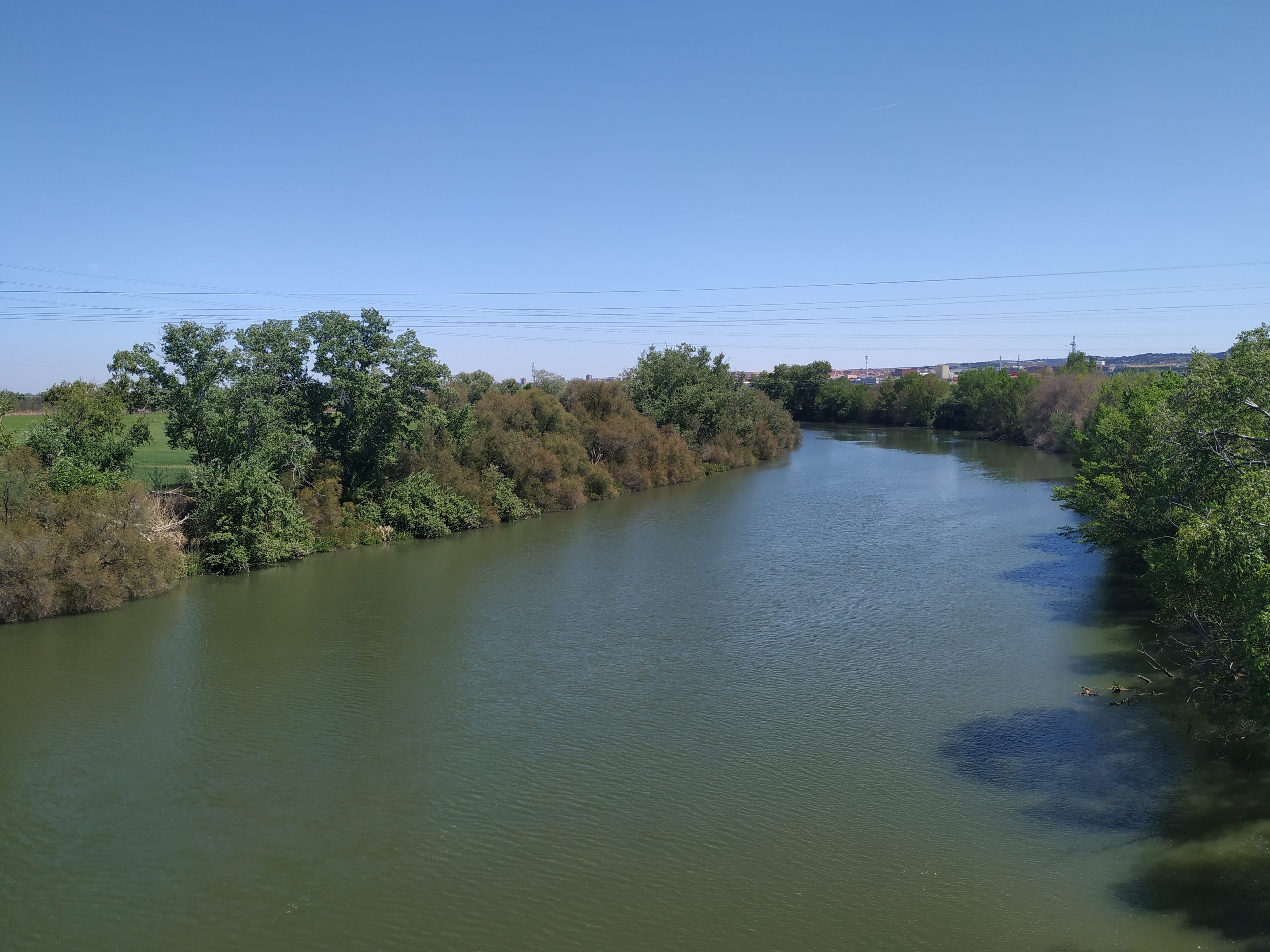
The route then mostly flattened, when it got to the Ebro river valley. This is the longest river that’s entirely in Spain.

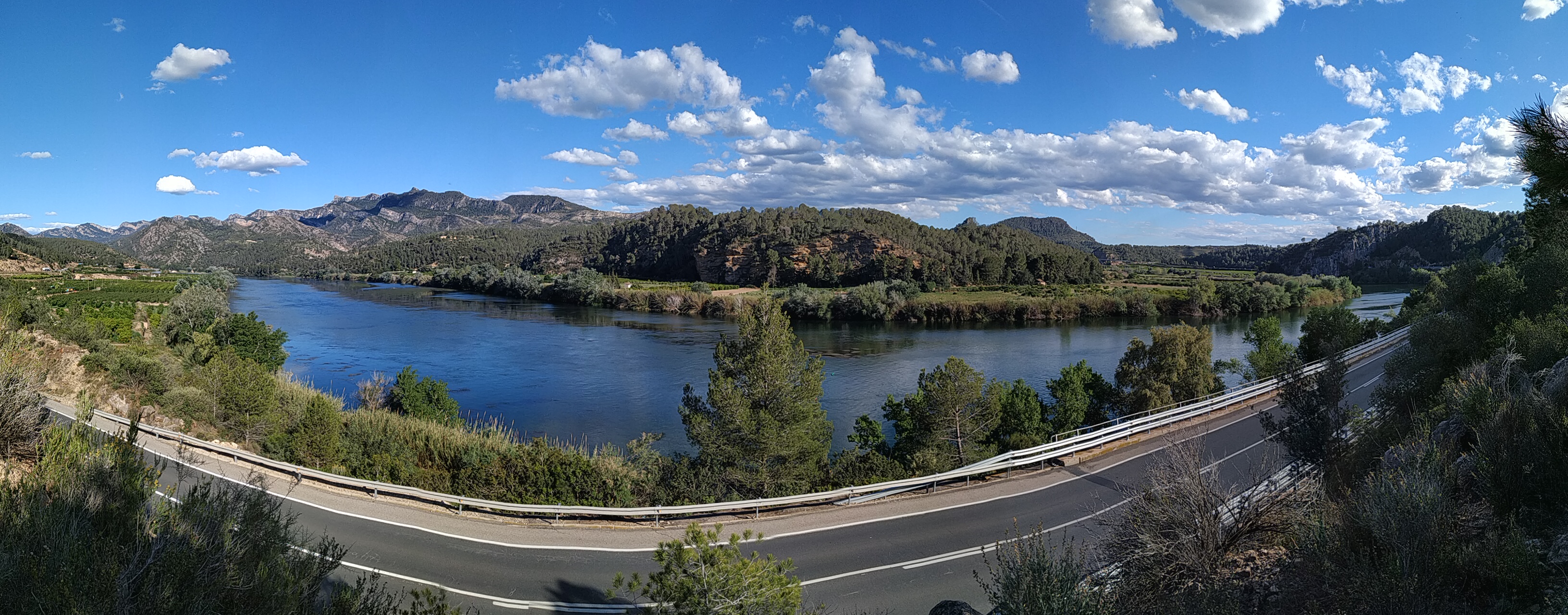
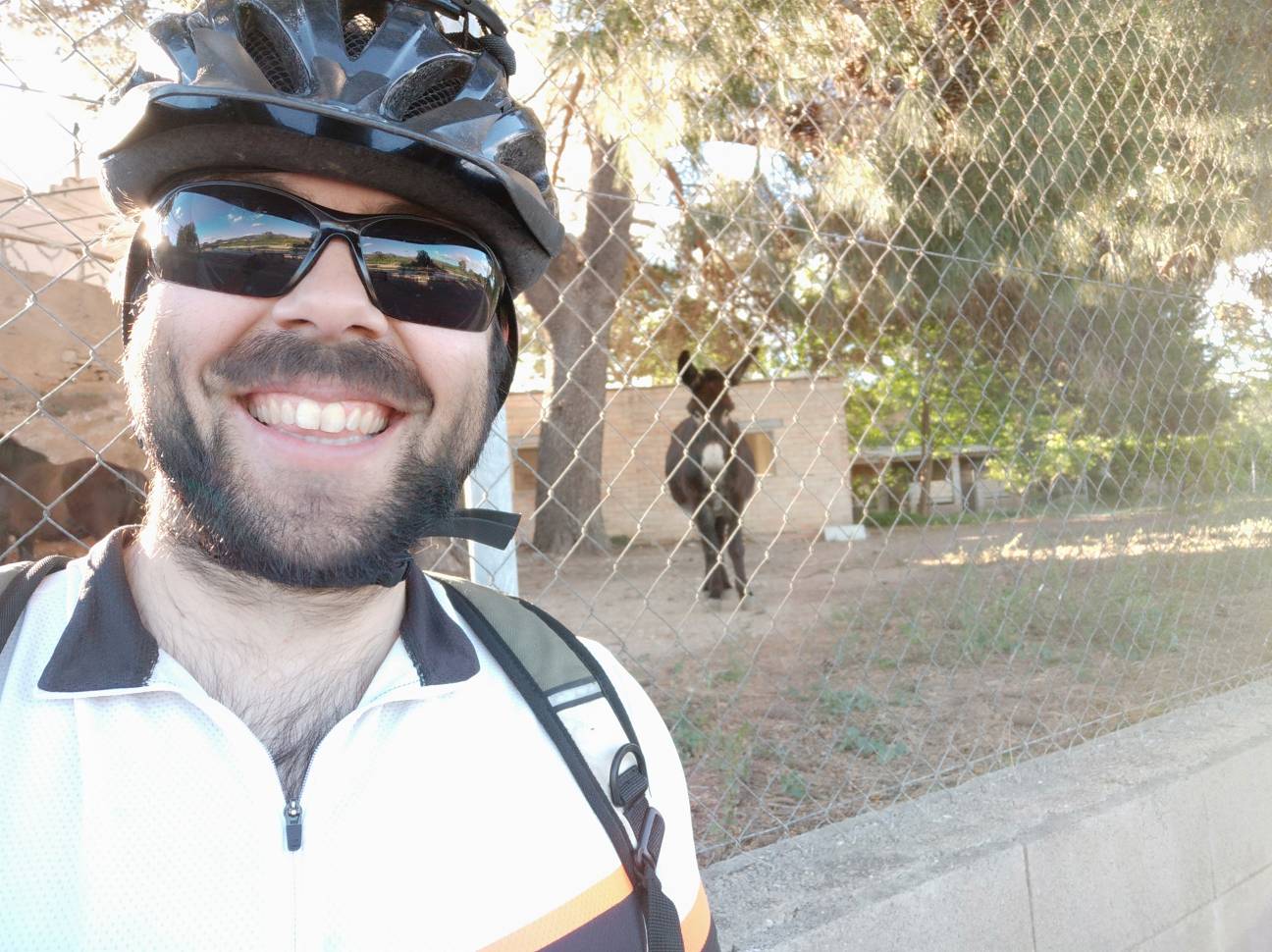
Here in the flatlands, there were a bunch of silly deviations from the rail line, mostly because they’d built roads over it. Some of them involved going up and down on steep inclines. To have a rest, I took a selfie with a donkey.
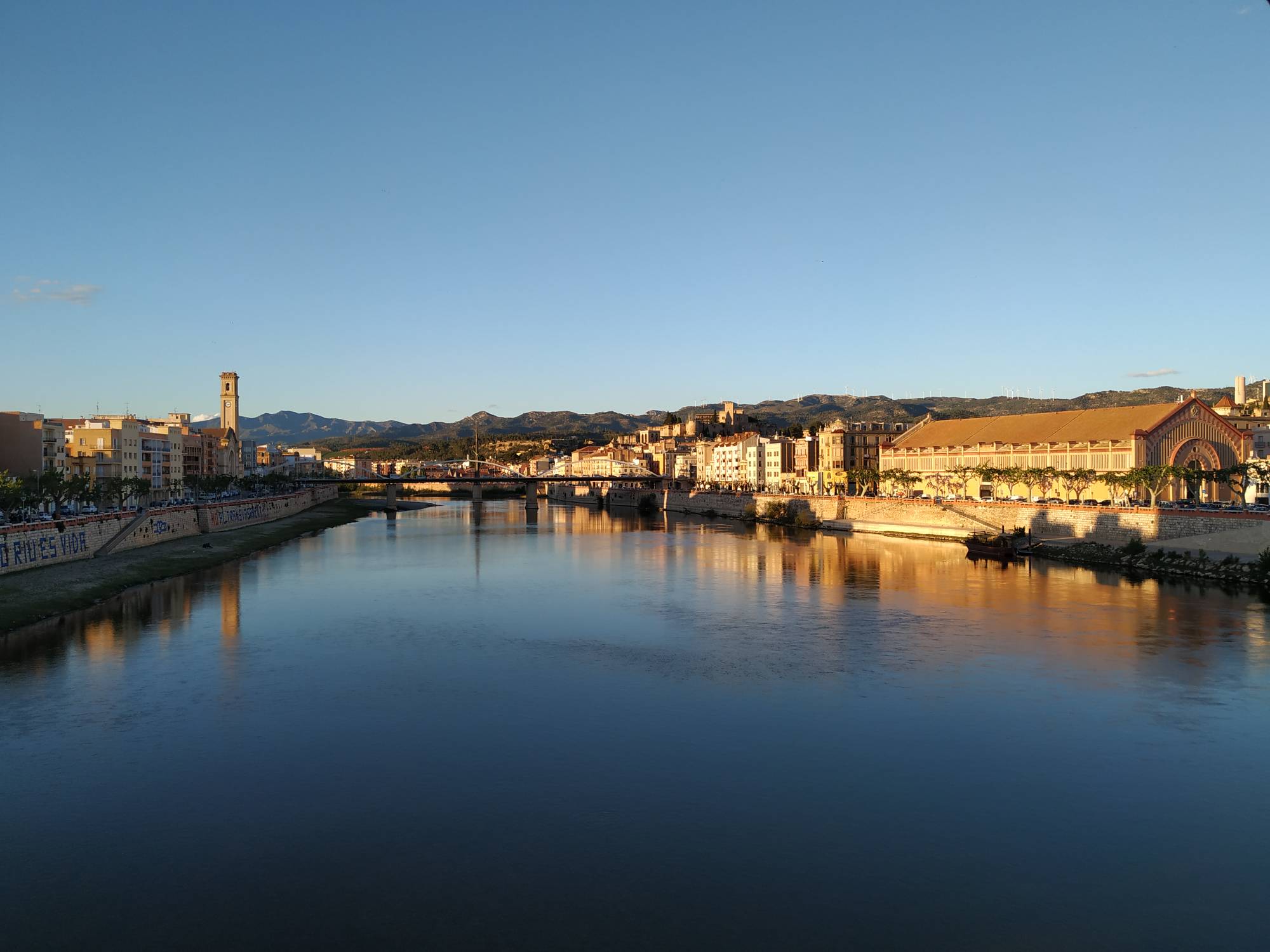
And then I’d arrived at Tortosa, where it was decision time. I promised some friends in Tarragona that I’d spend a weekend, and another friend that I’d be in Geneva by the start of June. After a bit of math, I realized it wasn’t going to happen if I biked there. So I took a train to Tarragona.

Tortosa looked lovely and had the first vestiges I’ve personally seen of Catalonian “resistance”.

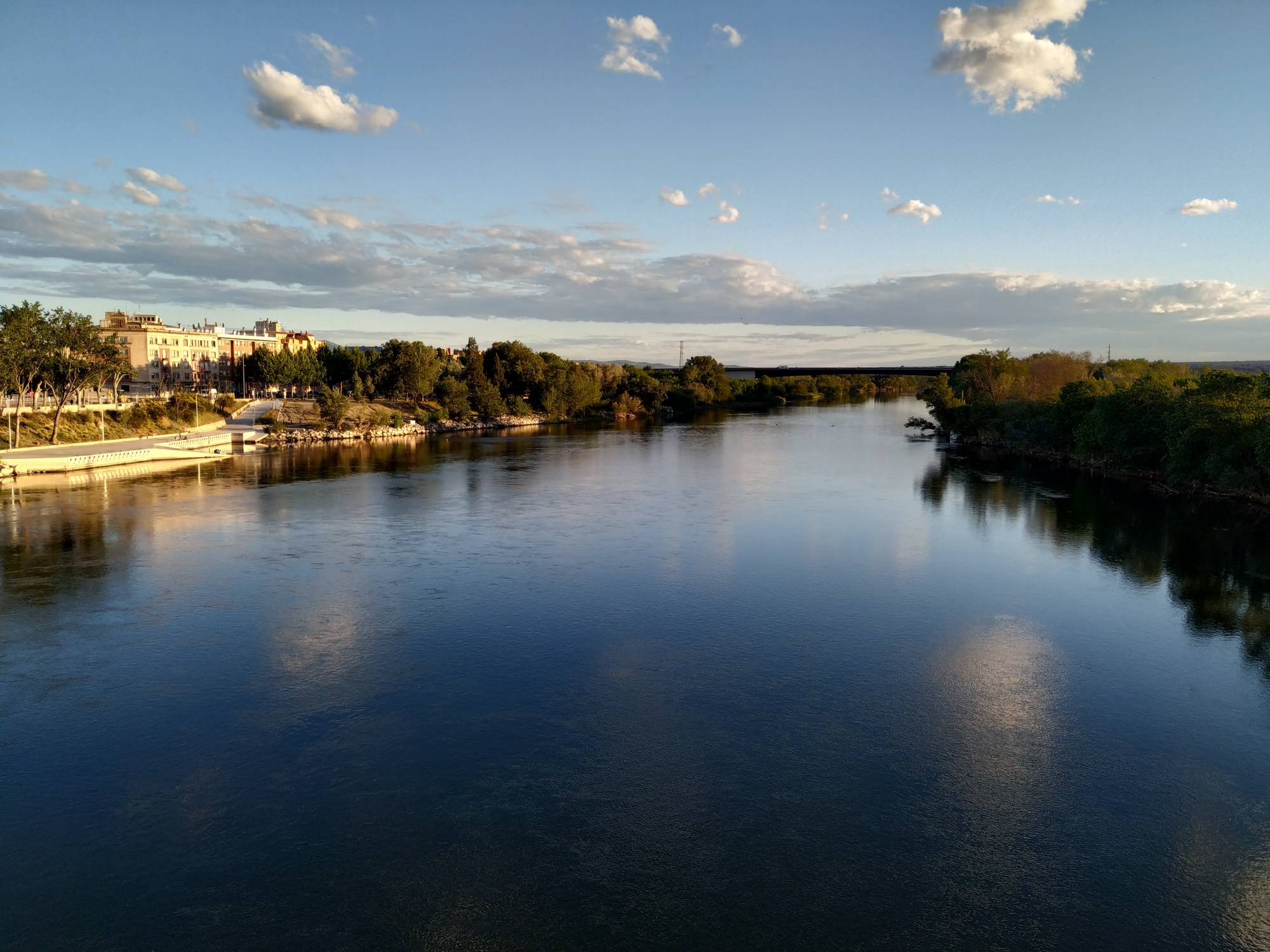
Sadly, I had a train to catch and no time to explore.
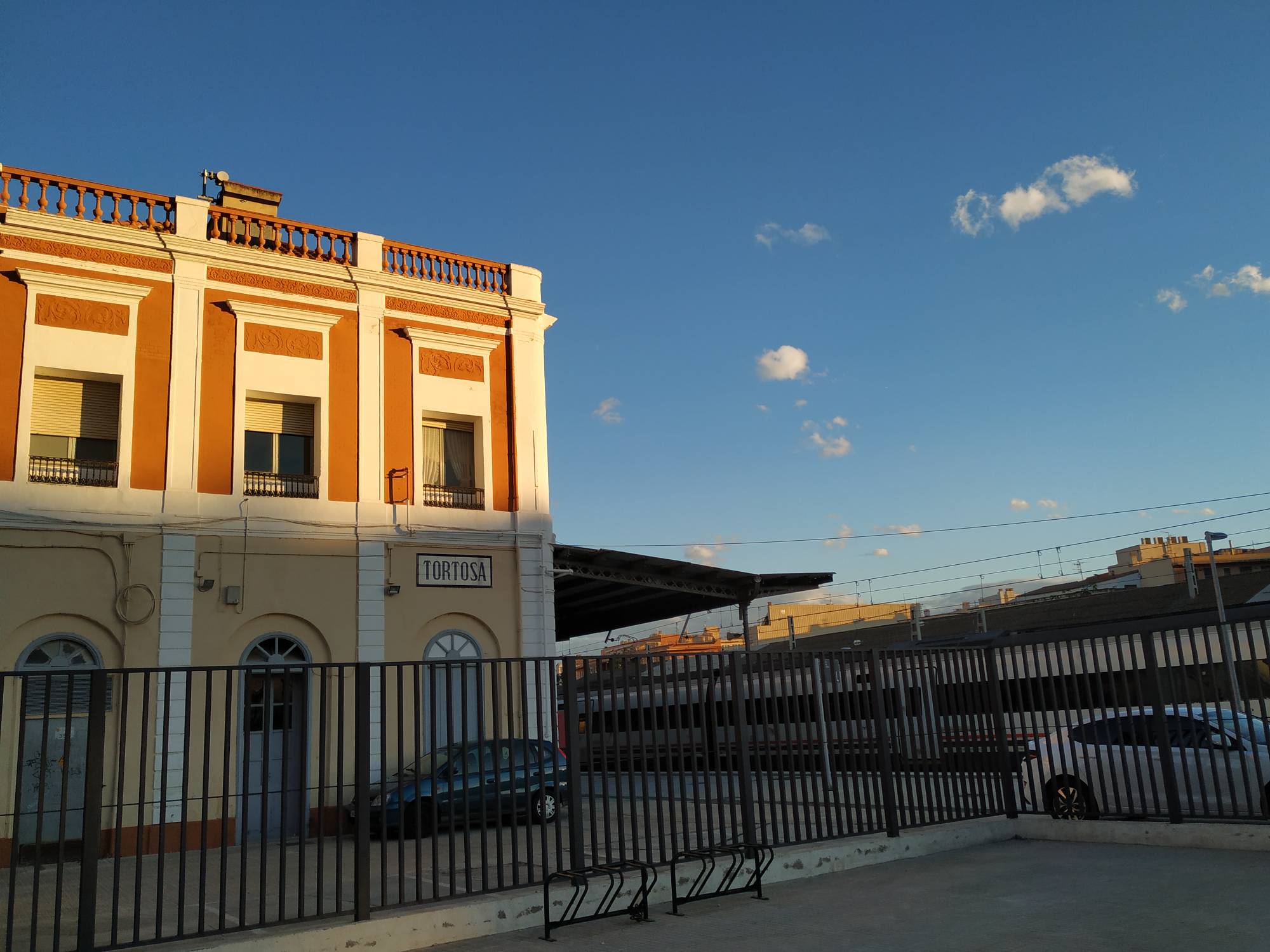
The trip happened without incident, except that unloading a bike plus tent plus saddlebags on a train stop is quite stressful.

That’s all for today. Thanks for reading.
Back on the lowlands

After a good night’s sleep among the olive trees, it was time for breakfast and restocking, at the nearby town of Azuara. A nice old gentleman wanted to chat and paid for breakfast after hearing I went through Cáceres, where he’s from. He also helped me find a fountain and a supermarket. Many thanks, sir!

Back on the road, I passed through the Waters river, on a village where a French gentleman likes formal wear.

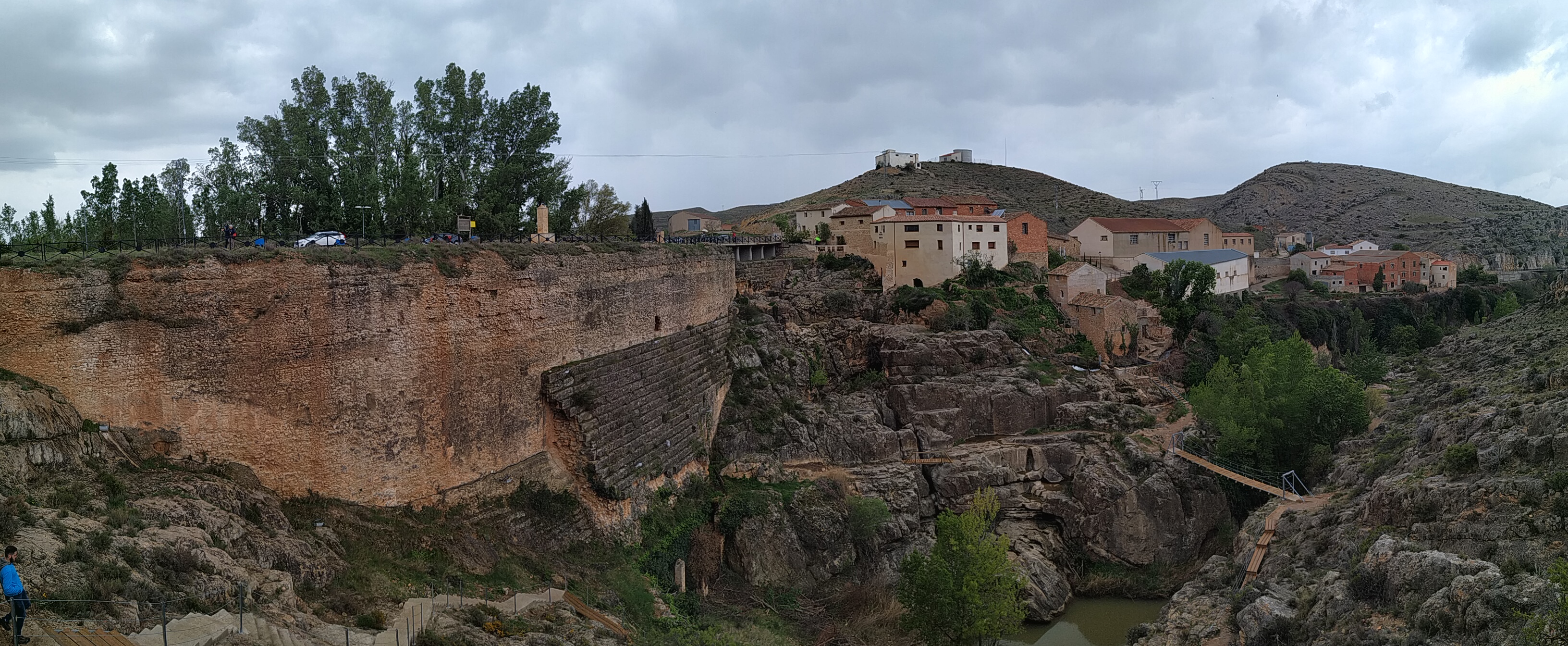
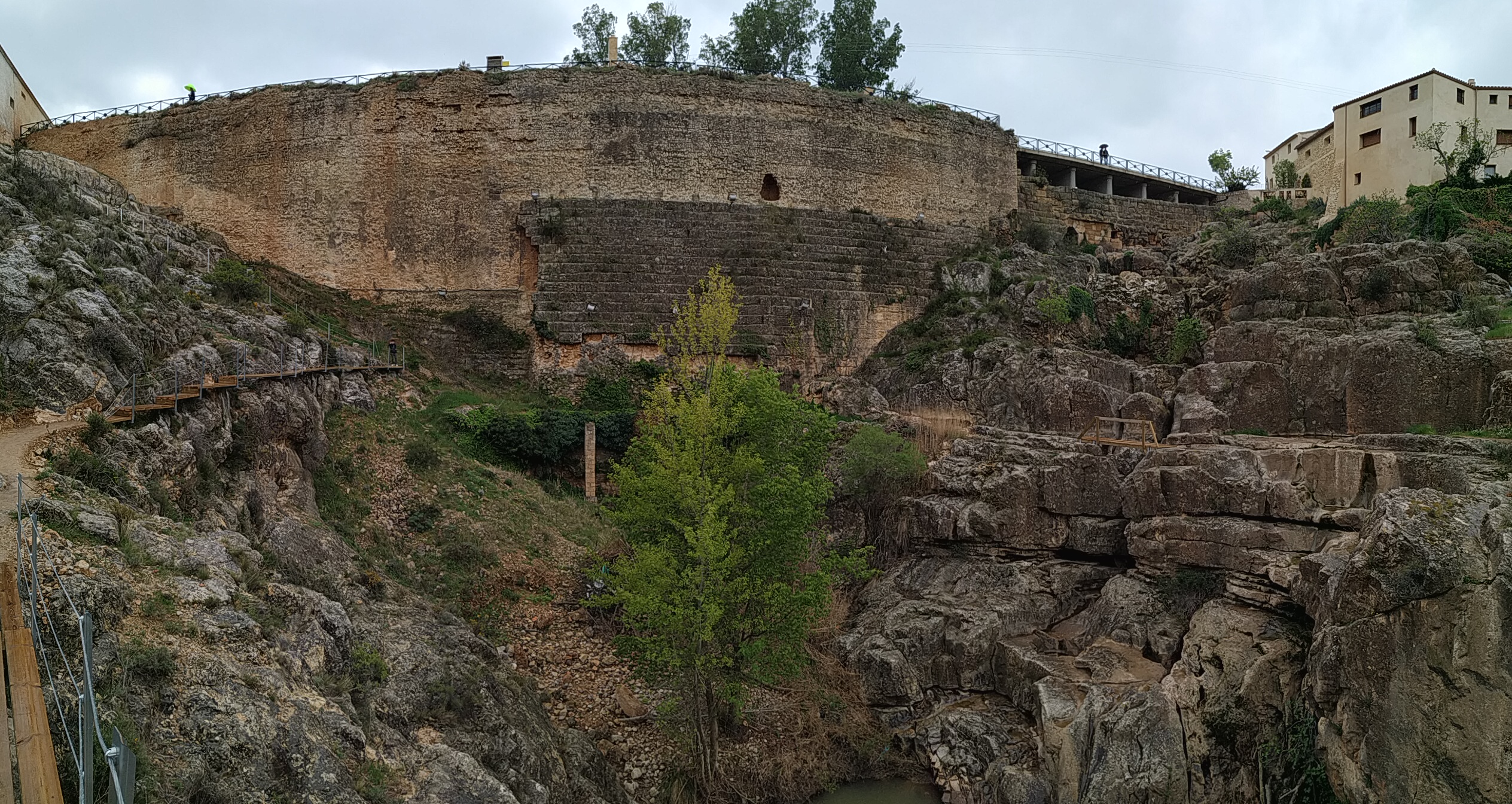
The barely visible older gentleman on a bike behind the sign then struck a conversation, asking where I was headed and if I was passing by San Vicente de la Cuba. Upon seeing my confusion, he proceeded to explain that there was an old Roman dam there, which was actually the tallest in the empire for almost three hundred years and it was still in pretty decent shape. When I saw that it wasn’t too far off my route, I decided to go and he led me to where I’d need to turn off the road. I’m happy to report that, despite the rain, it was worth it.

Construction was finished in the year 84.
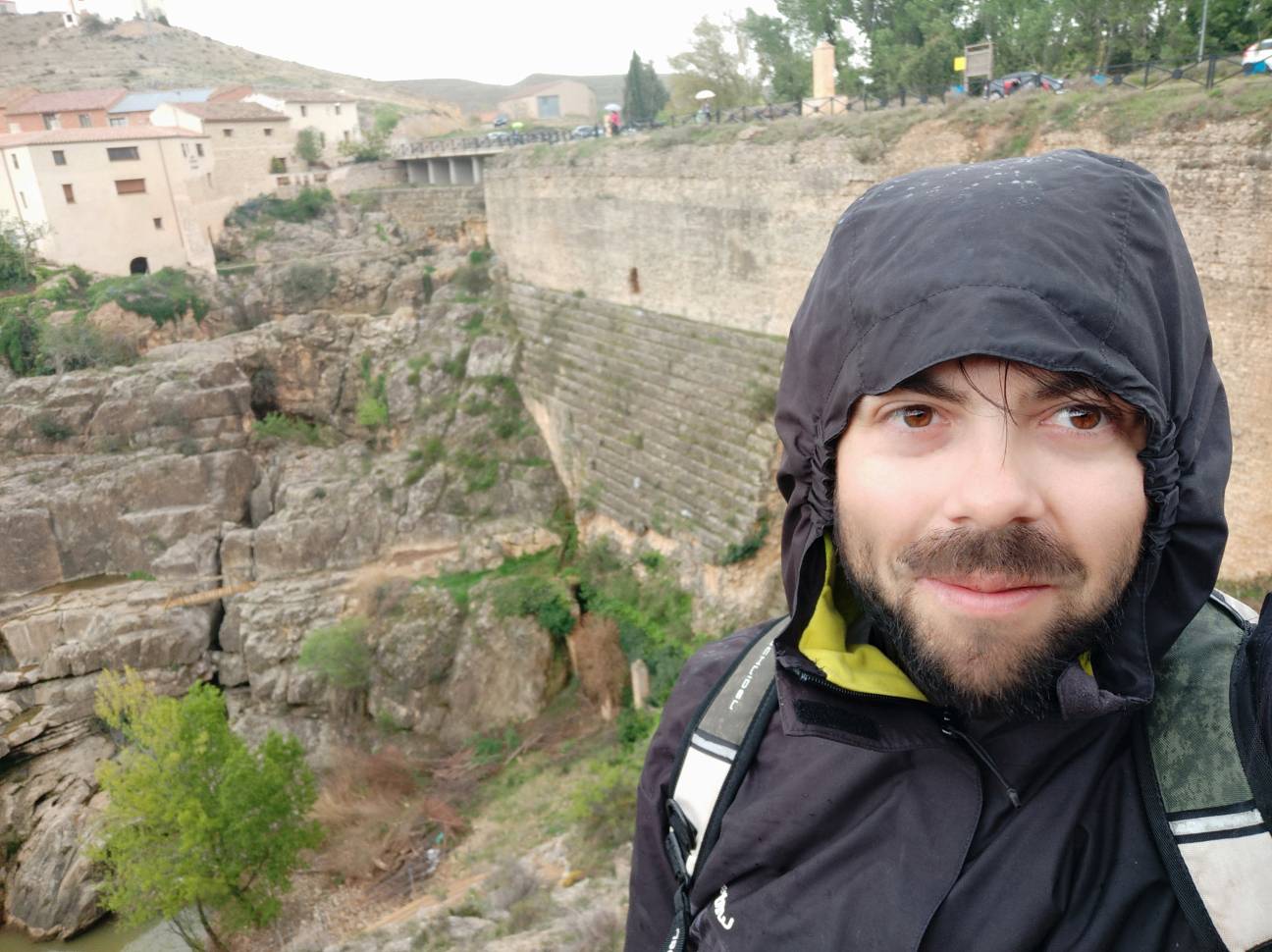
The best “smile” I could manage. The conditions were rather miserable.

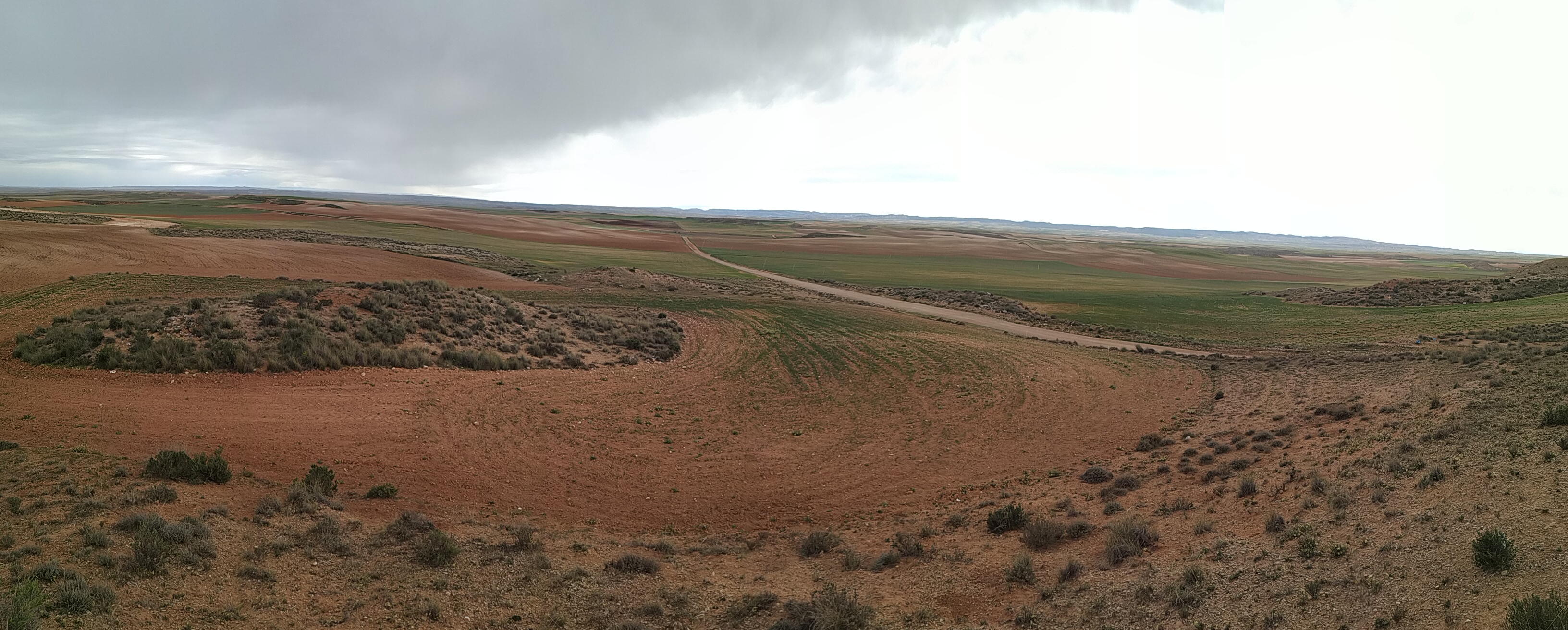
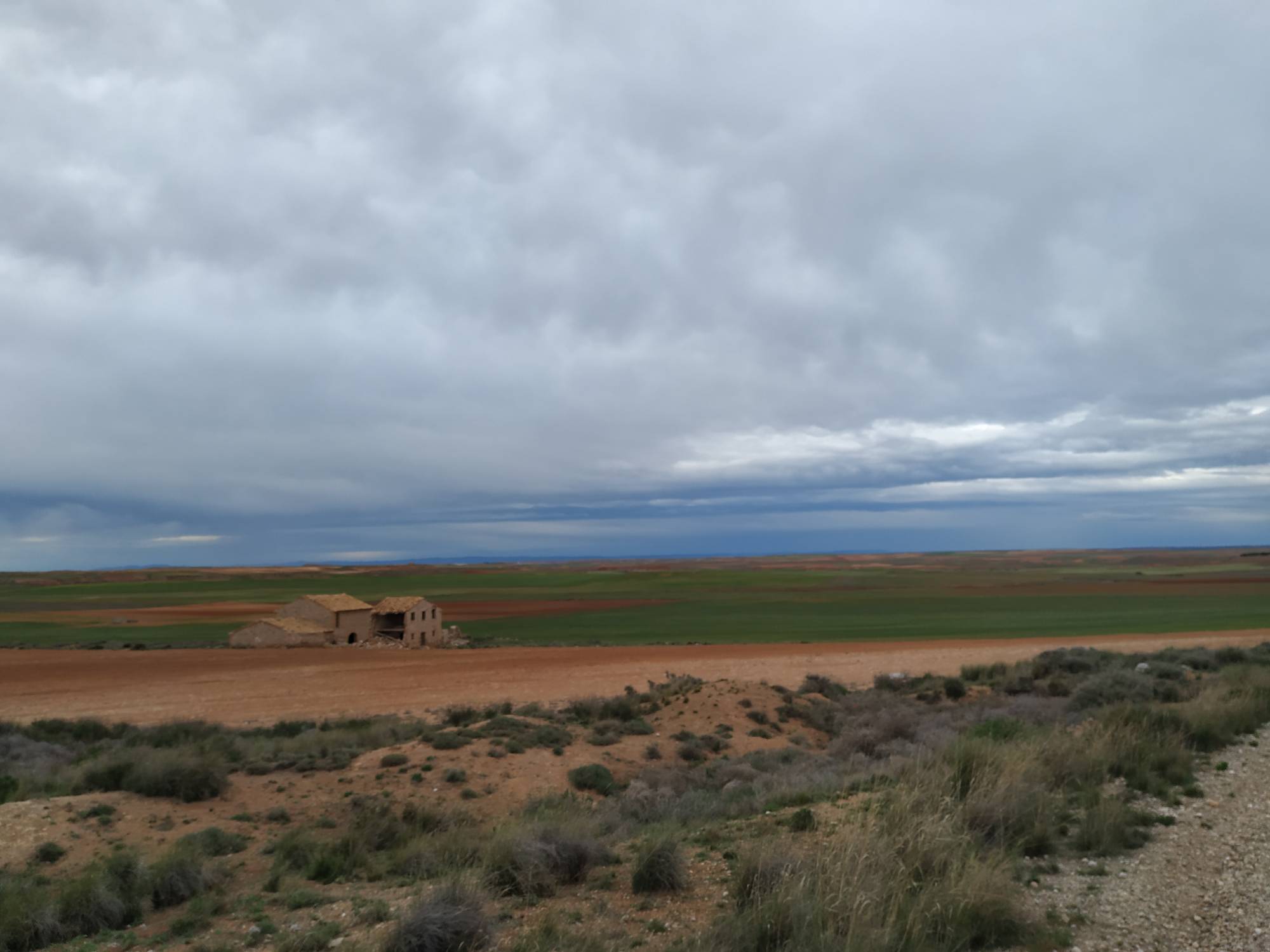
A hill later, it was back into dirt roads and farm country.

I stepped onto that bank to take a picture and accidentally committed genocide instead, then proceeded to forget taking that picture. ¯\_(ツ)_/¯

Yup, there was an ant’s nest precisely where I stepped on.
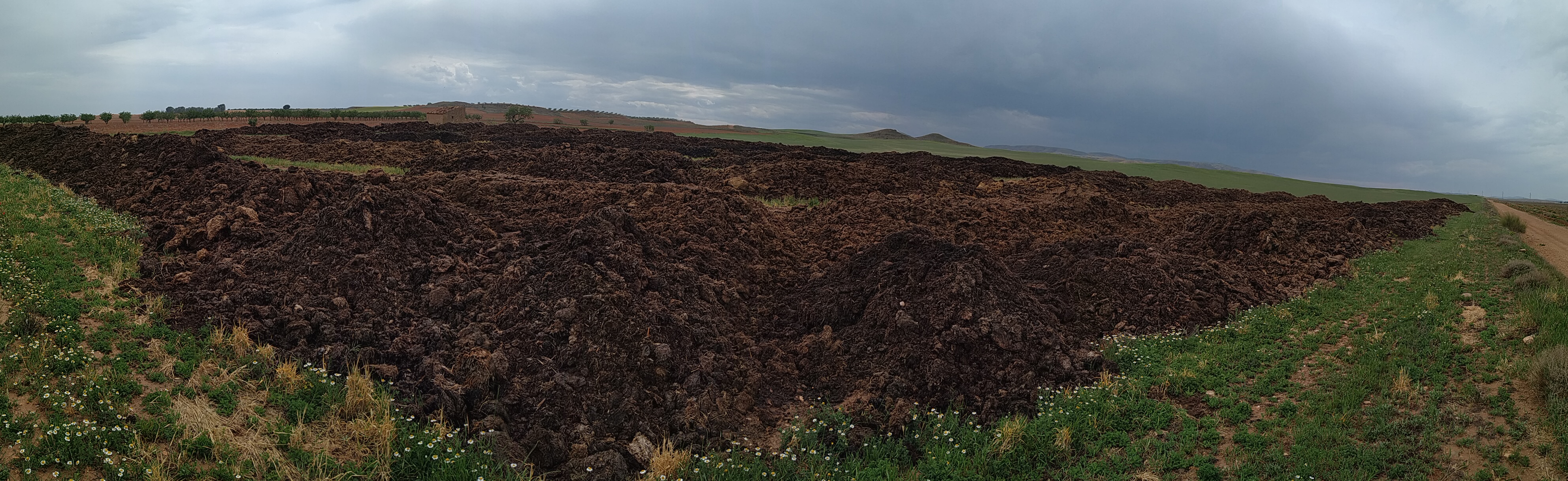
The place was also full of shit. Literally. It was very non-smelly, surprisingly.

Now anyone would say that going on dirt roads with city tyres after three rainy days was a bad idea. Well, it was, but it still went better than expected. The drainage was quite good along the road, but still, just 30 meters of mud did this:

A stop for the world’s biggest bacon and cheese sandwich later, it was time for more farms.

Since dirt roads are, quite literally, a pain in the butt, I stopped for a second to get artsy with the camera.

I’m still rather delighted you can do this with a phone, now. 😁

This is not just farm country, it’s also pig farm country. All over Aragón, you could see facilities looking exactly quite this and… just be glad you can’t transmit smell over the internet.

By this time, it was my fifth day without a shower, so I was rather looking forward to reaching an actual campsite, near Alcañiz. I would reach it, but sadly not under my own power.

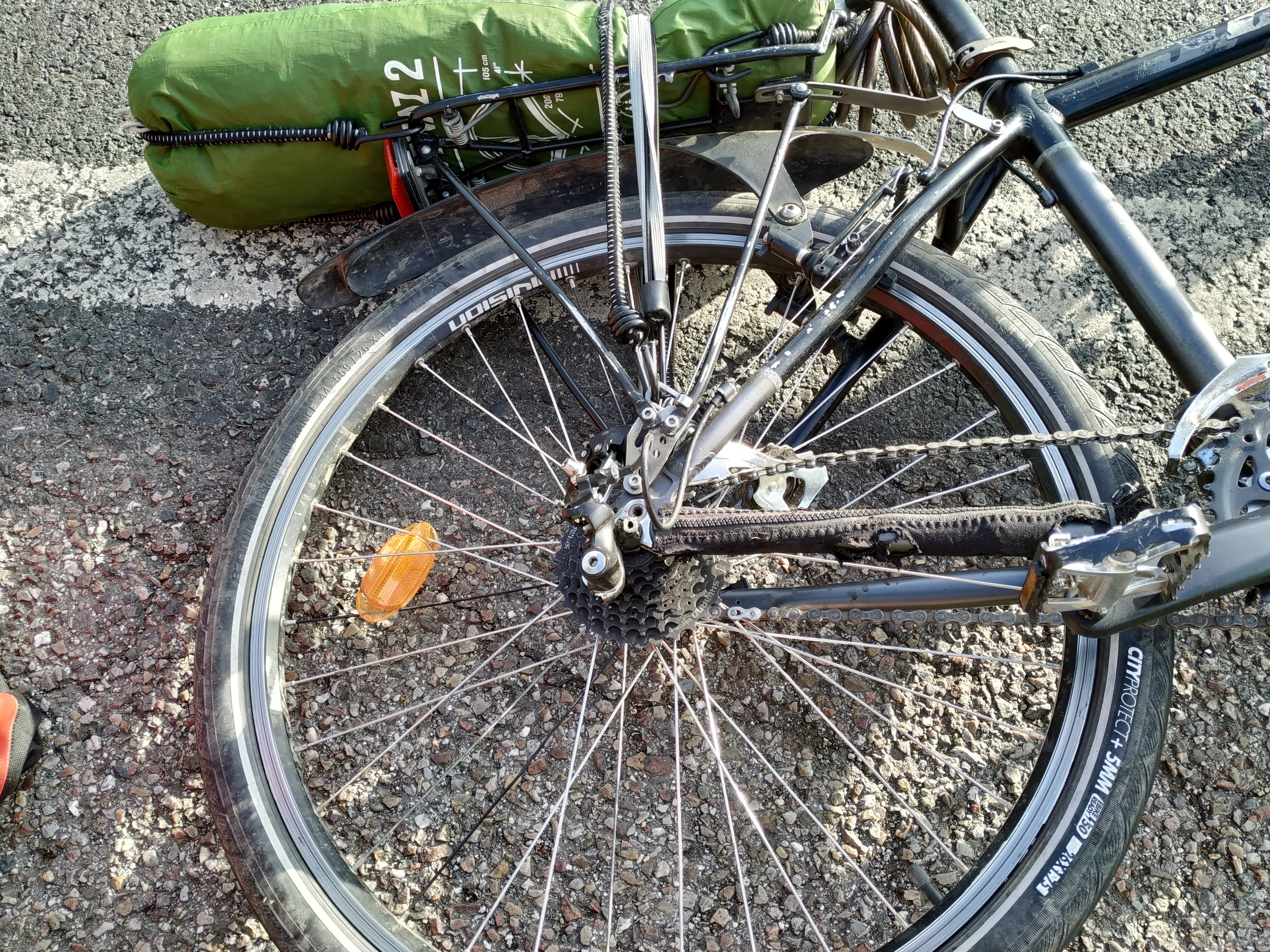
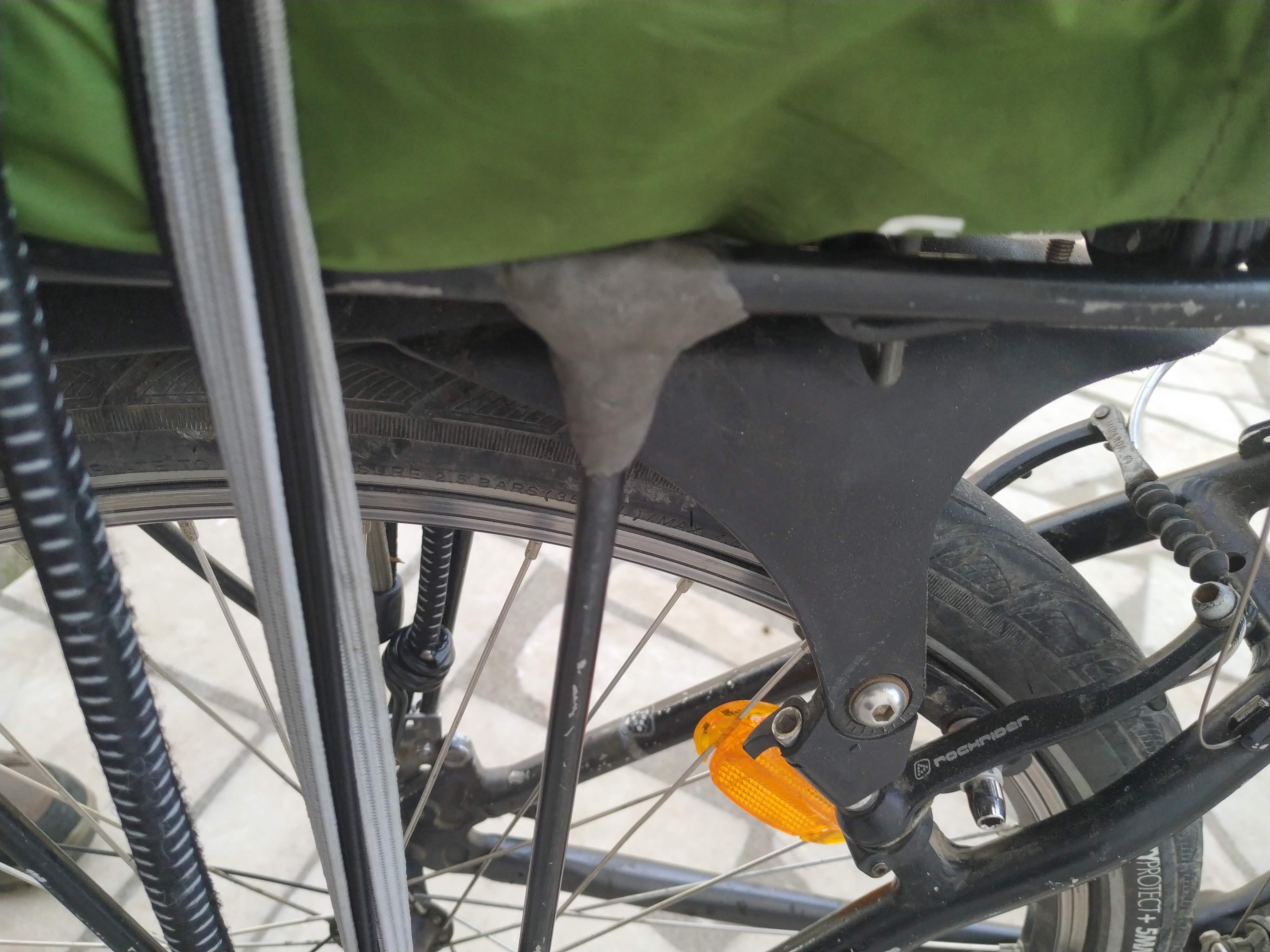
The bolt for the luggage rack sheared right off. Funnily enough, it was on a smooth, paved road, after hours of dirt roads.

The luggage stayed on, since the rack was held by the other three bolts. Still, I wasn’t going to put any more stress of it, so I scrambled to go on the internet and call a cab. Two local drivers on vacation and another on sick leave later, I finally called David. He’s a tough man to reach, since it’s easier to find news articles saying that he had the first electric cab in the province of Teruel than his actual phone number.

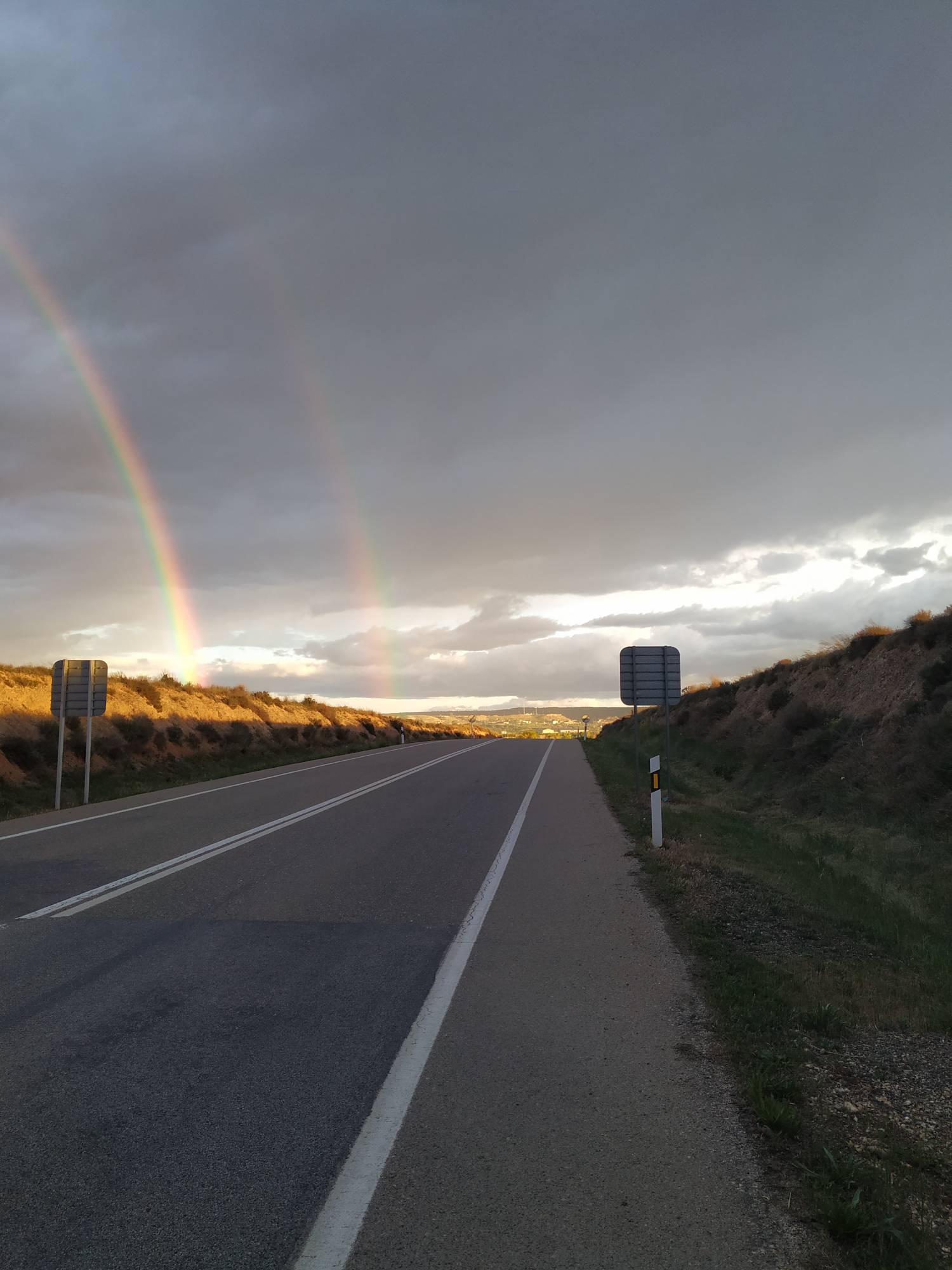
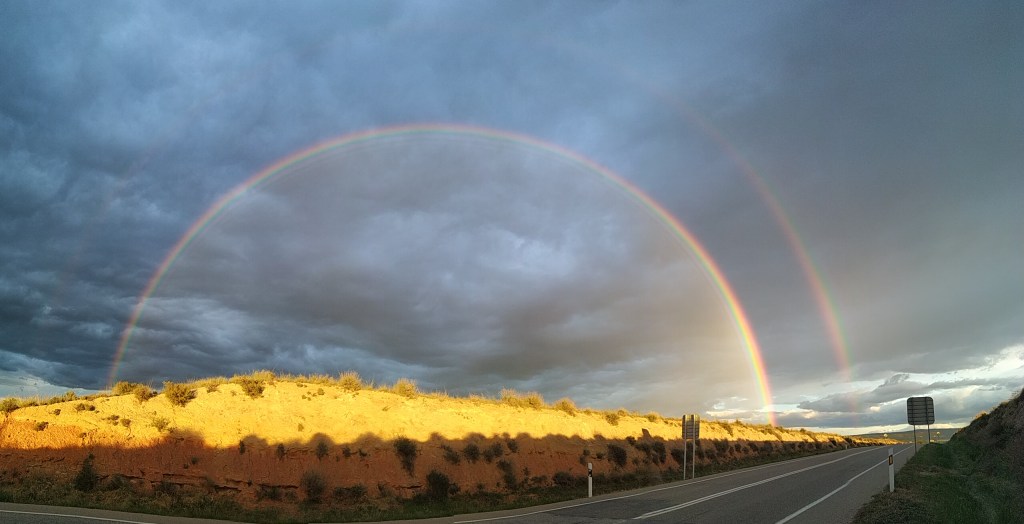
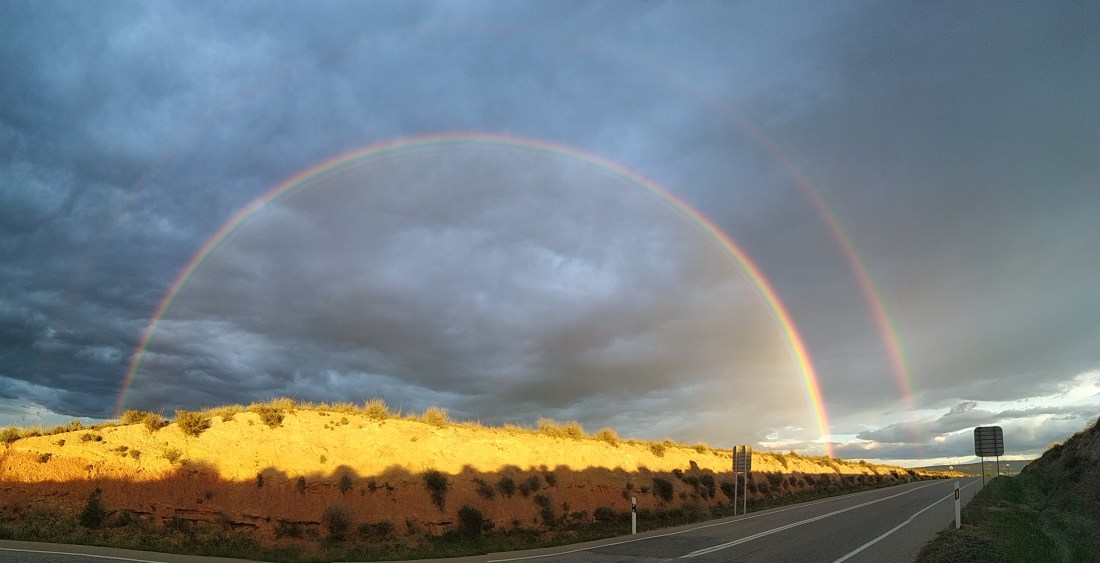
While I was waiting, it got quite cold and it started raining quite heavily. But that got me great shots anyway, so I ain’t even mad.

And then…

A DOUBLE RAINBOW! ALL THE WAY! ACROSS THE SKY! SO INTENSE!

David then took me 30km, to the campsite, while we had a conversation in Portuñol, a mix of Portuguese and Spanish. I kind of wish he’d pick one, but I was too tired to really care.

The campsite advertises itself as the closest lodging to Motorland Aragón, a series of racetracks for multiple vehicles, one of which is part of the MotoGP series. Unfortunately, that means waking up with the droning of loud motorbikes is part of the experience. Which is a bit of a shame, since this is one of the better campsites I’ve been to.

The day before got me really tired, so I relaxed until around lunchtime, while I got caught up on shows, news and general internet things.

Then I had lunch at the campsite, since the restaurant was plentiful and cheap.

There was a tuna salad before this. Honest!

All this, plus dessert, plus coffee was 11€, which is by far the cheapest food I’ve ever had in Spain.

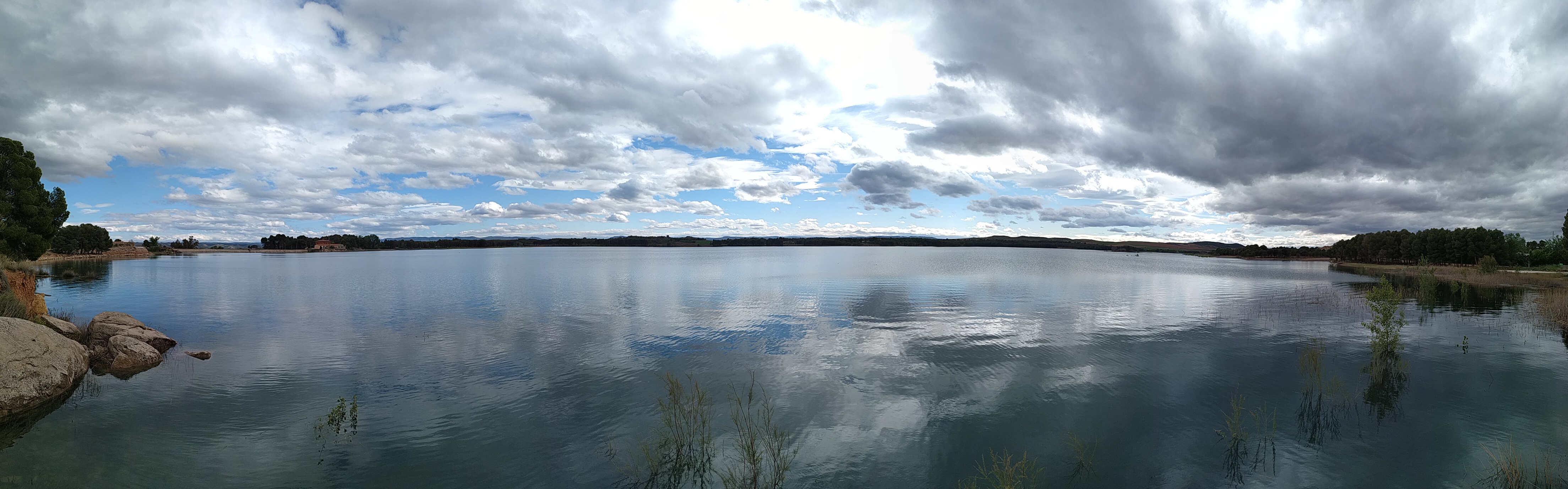
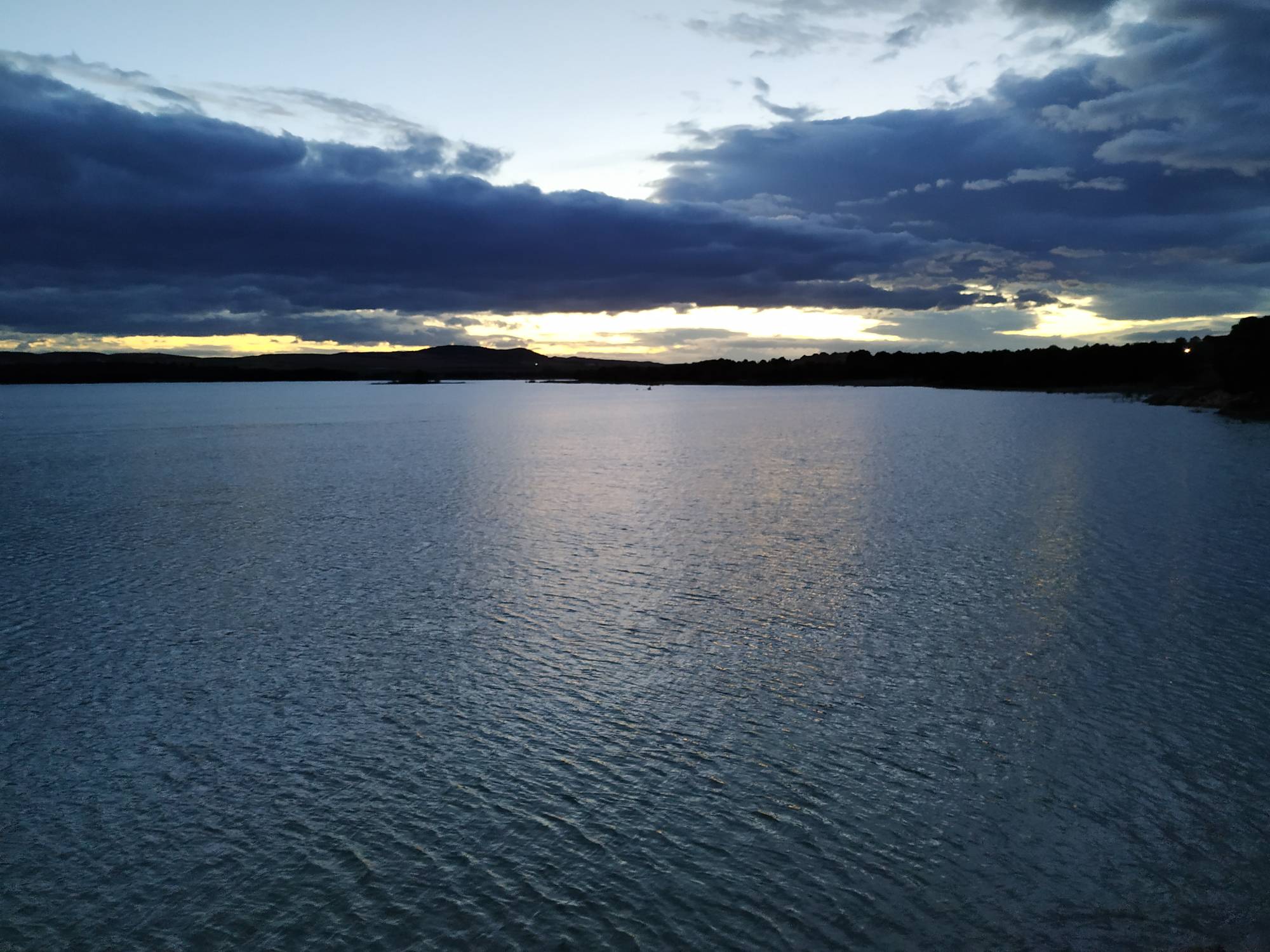
Ok, focus! It was time to get the bike rack fixed, so I headed into town. Just outside the campsite, however, was La Estanca, quite a nice lake.

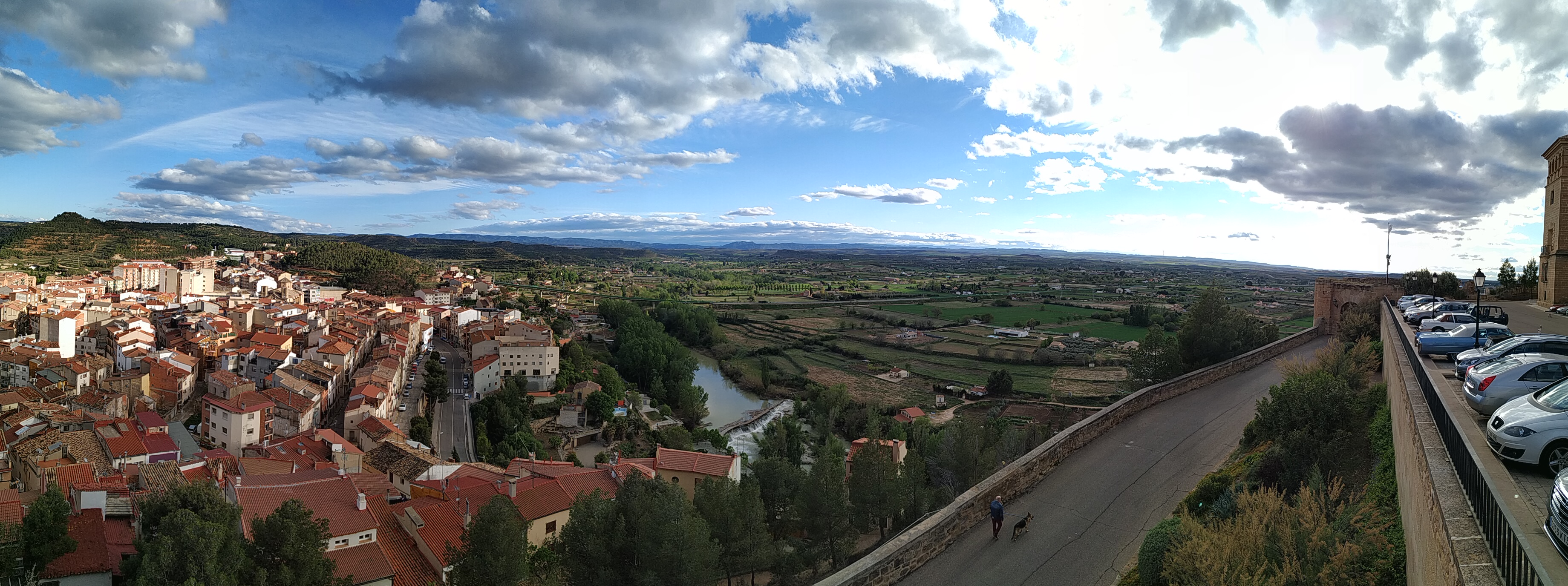
The shop was on the other side of town. When I saw the terrain, I decided to go around it, on a road along the river.

I ignored the “road closed” signs, like I usually do while I’m on a bike. This time, it was actually closed for everyone, even pedestrians. The park below had an ineffective fence. When I crossed it, looking up, I could see some machine hammering away at rocks a good 100 meters above. I crossed the fence right back and headed up into town. At least there were no saddlebags on the bike, this time.

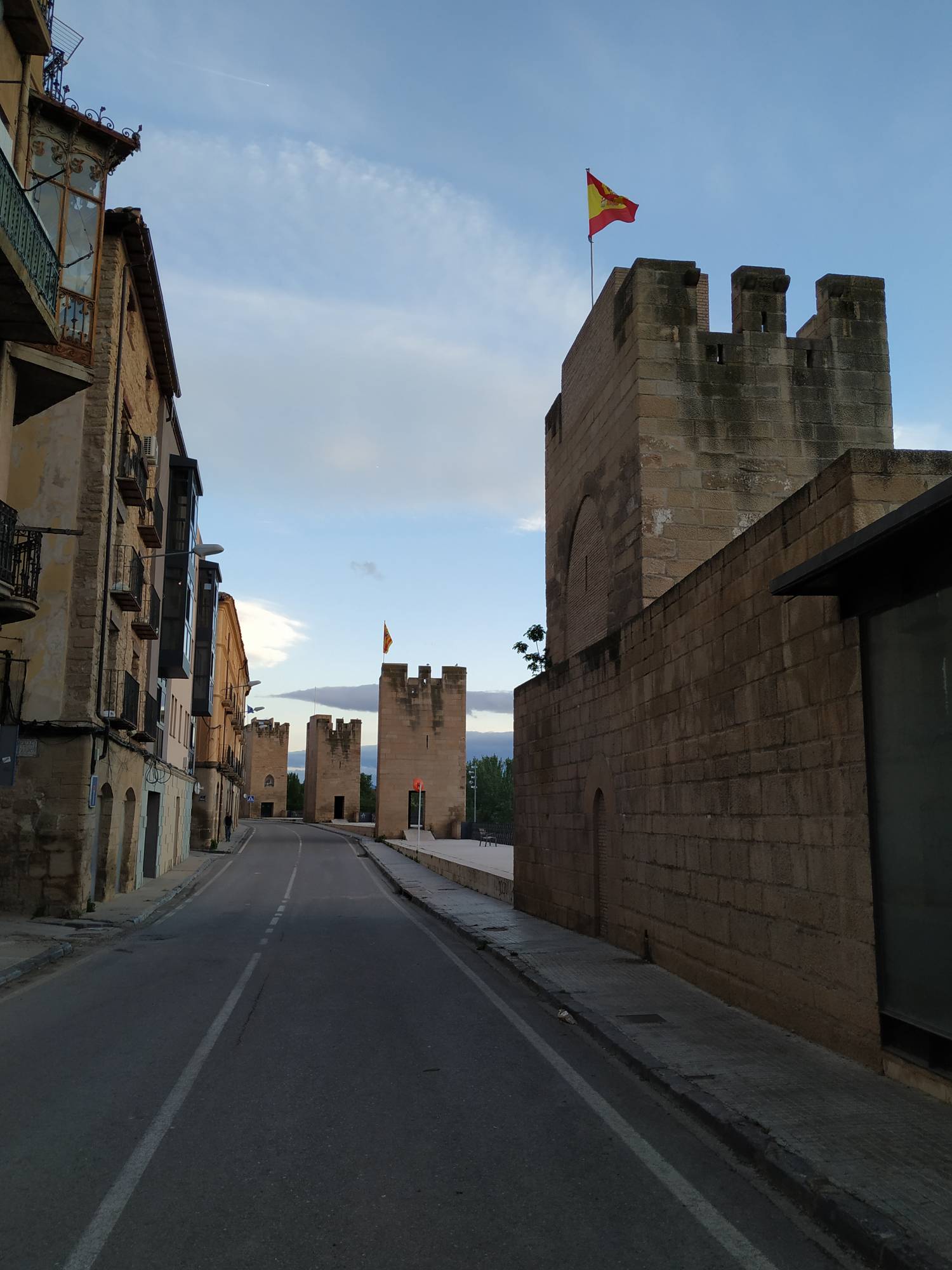
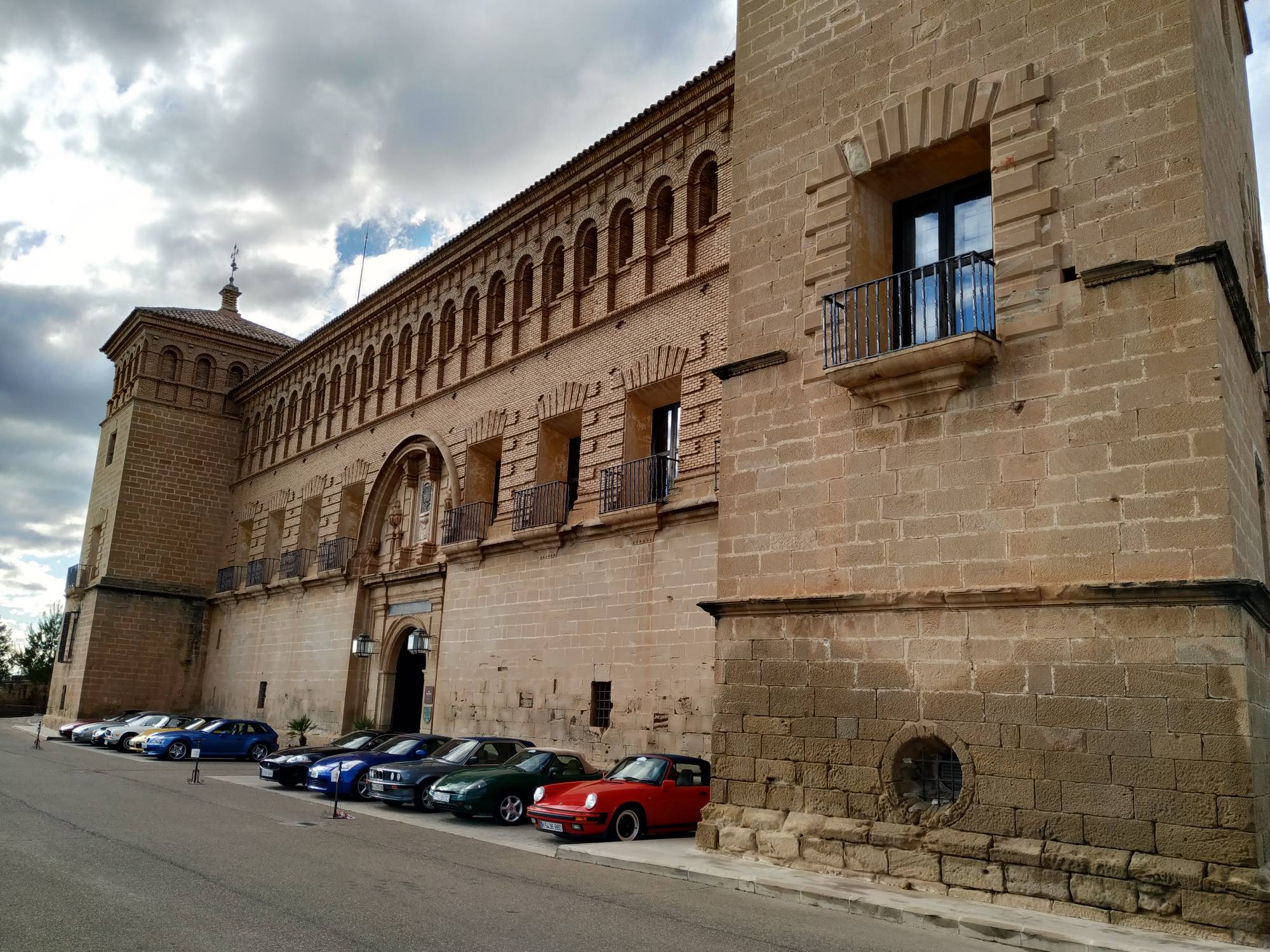
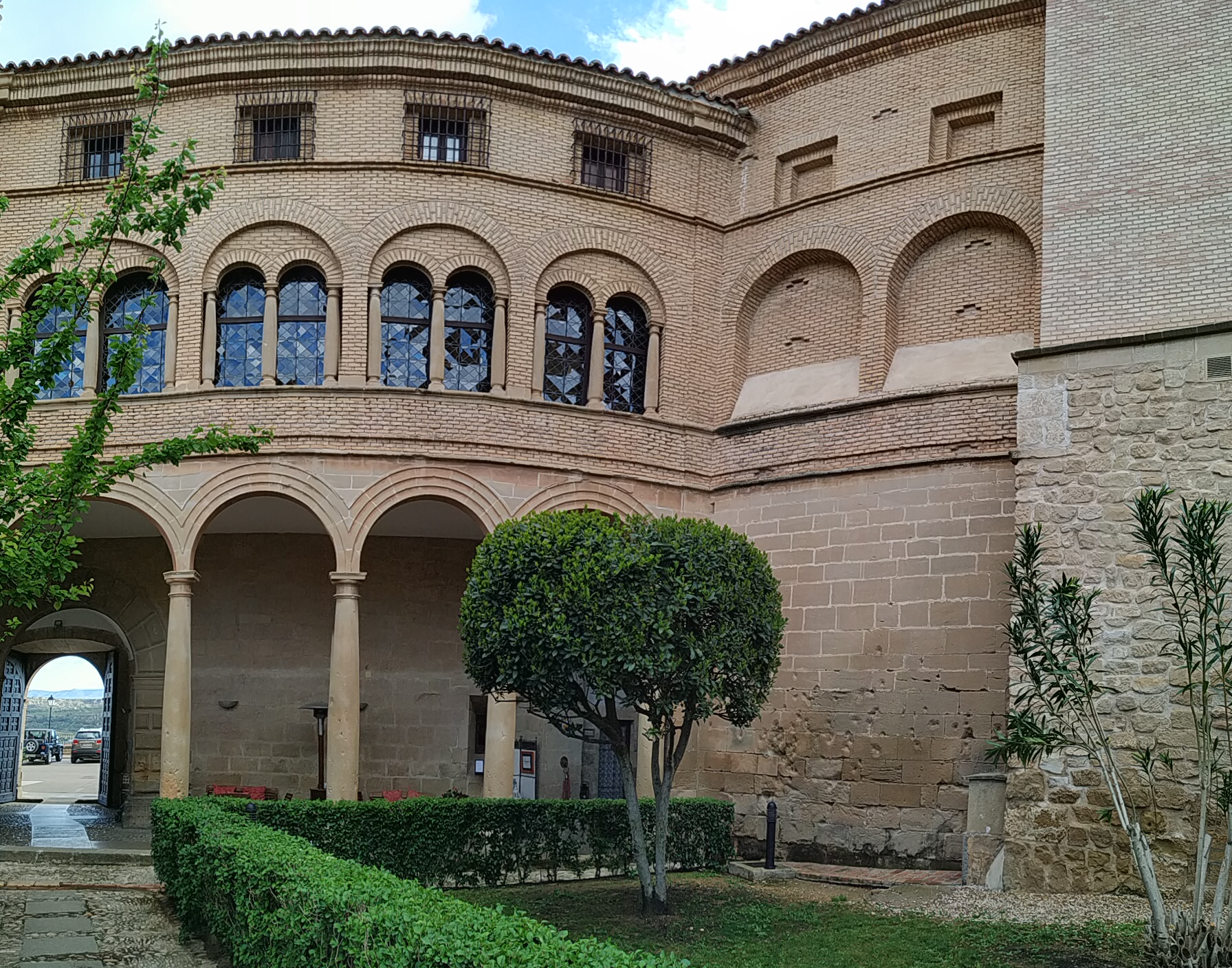
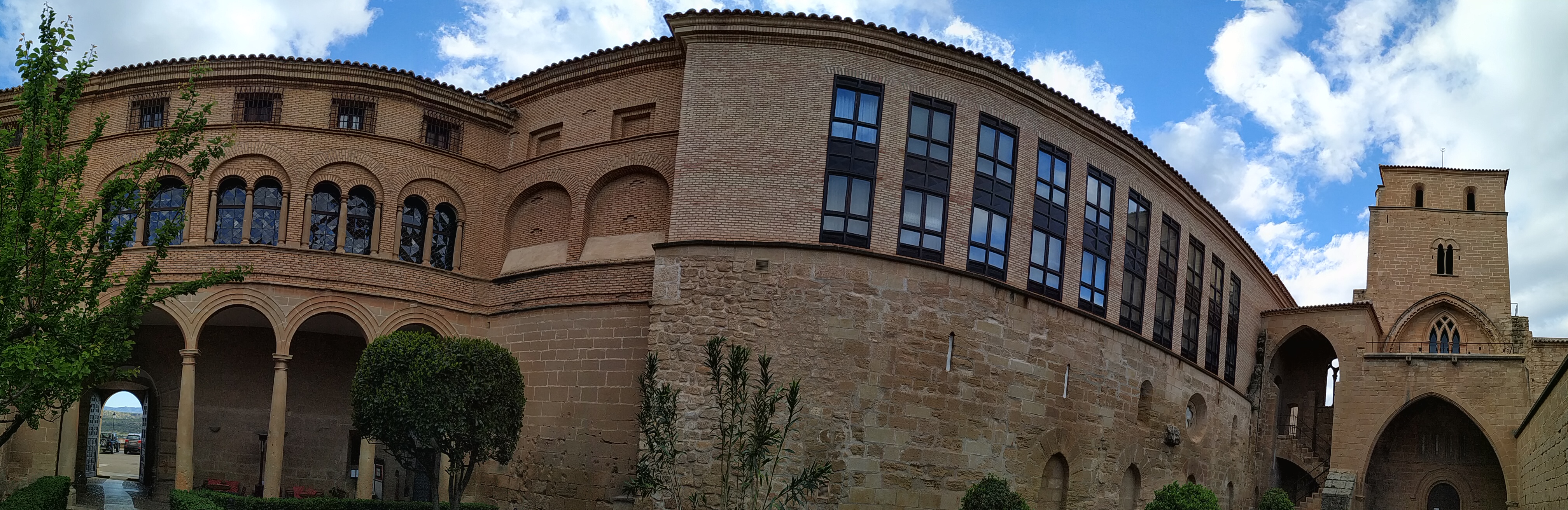
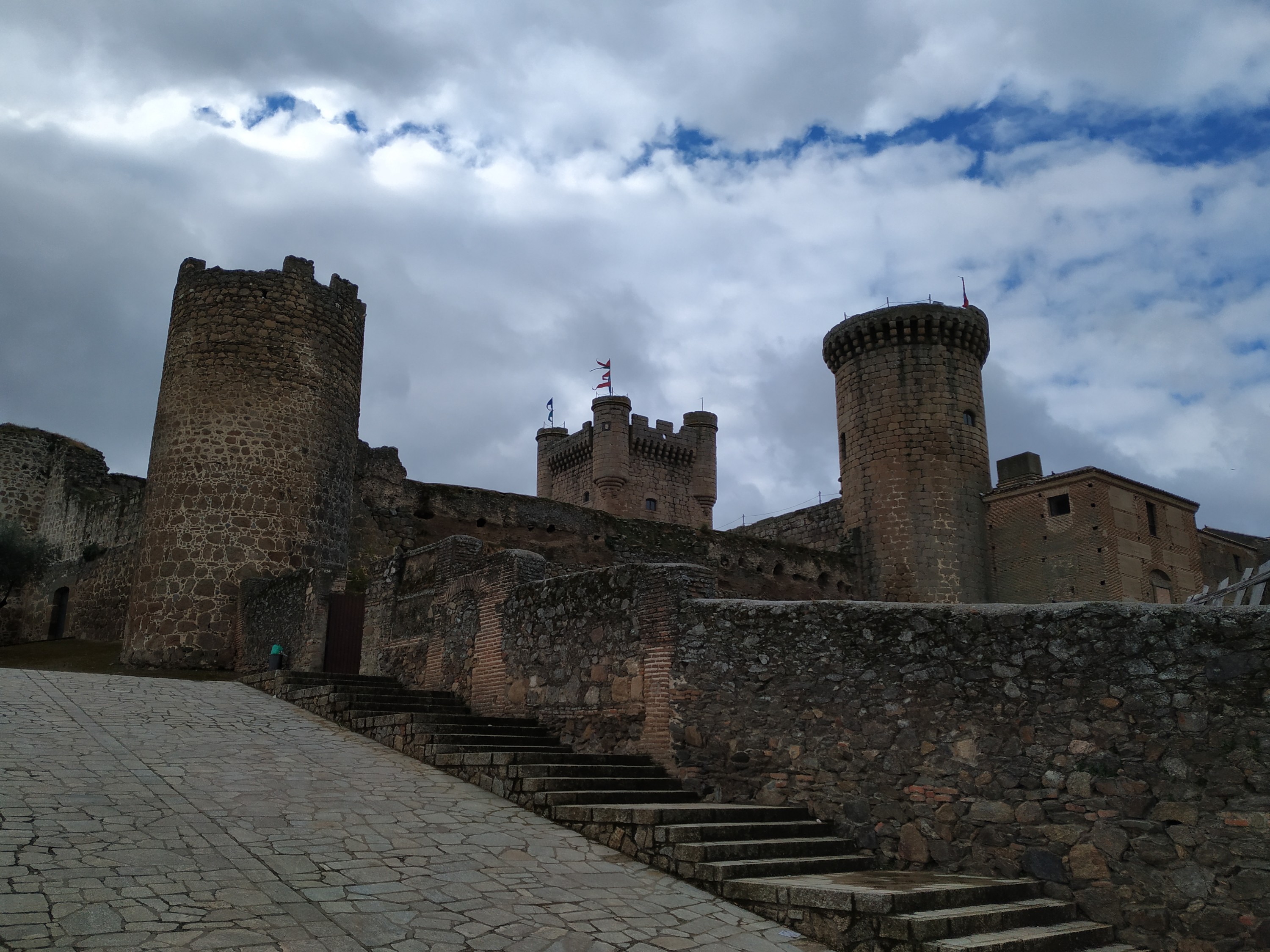
With the bike in the shop, it was time to explore the town. First up: the 12th century castle. They turned this one into a hotel, too. Still, could be worse.

They really want to make sure you know where you are.

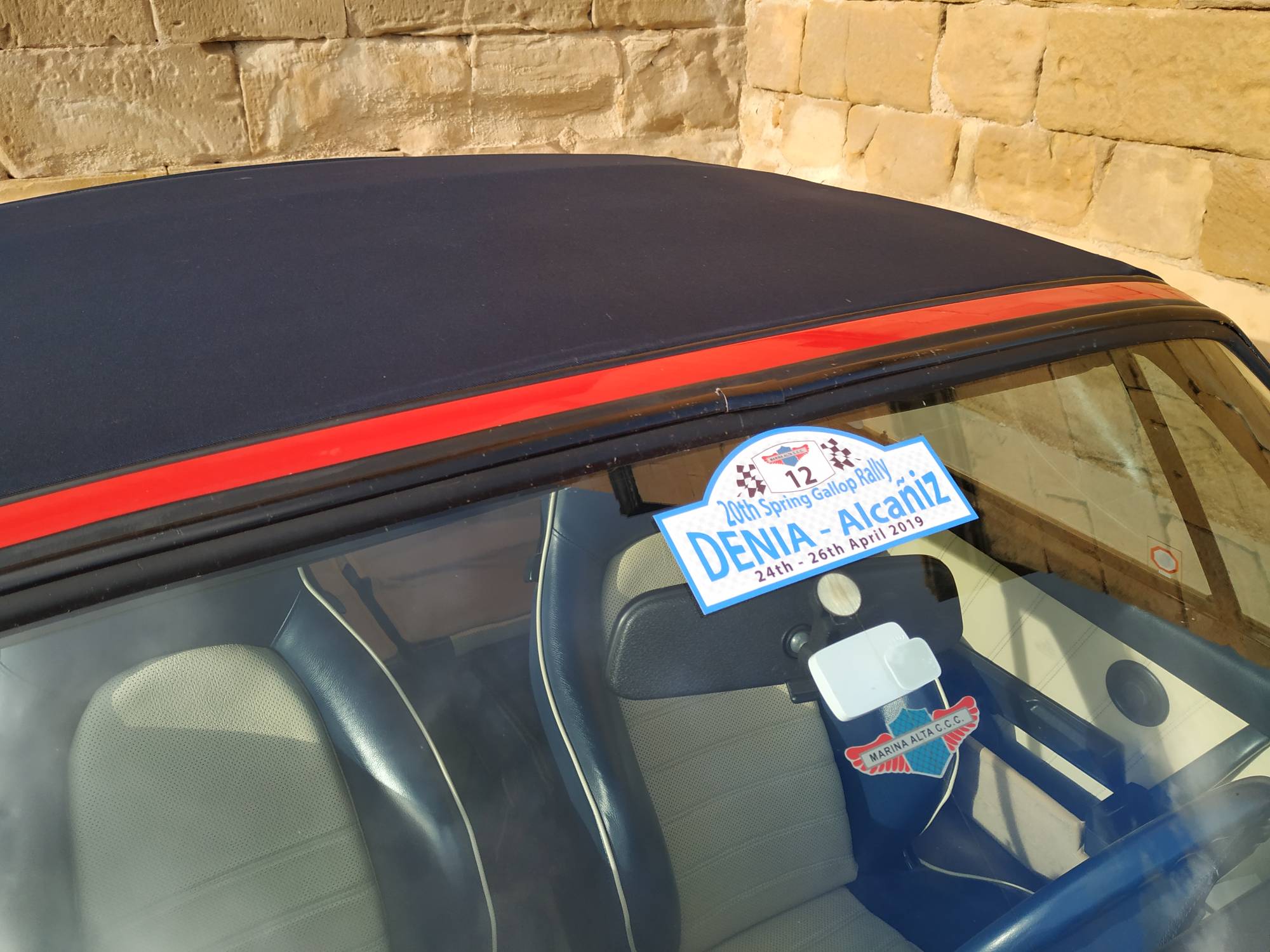
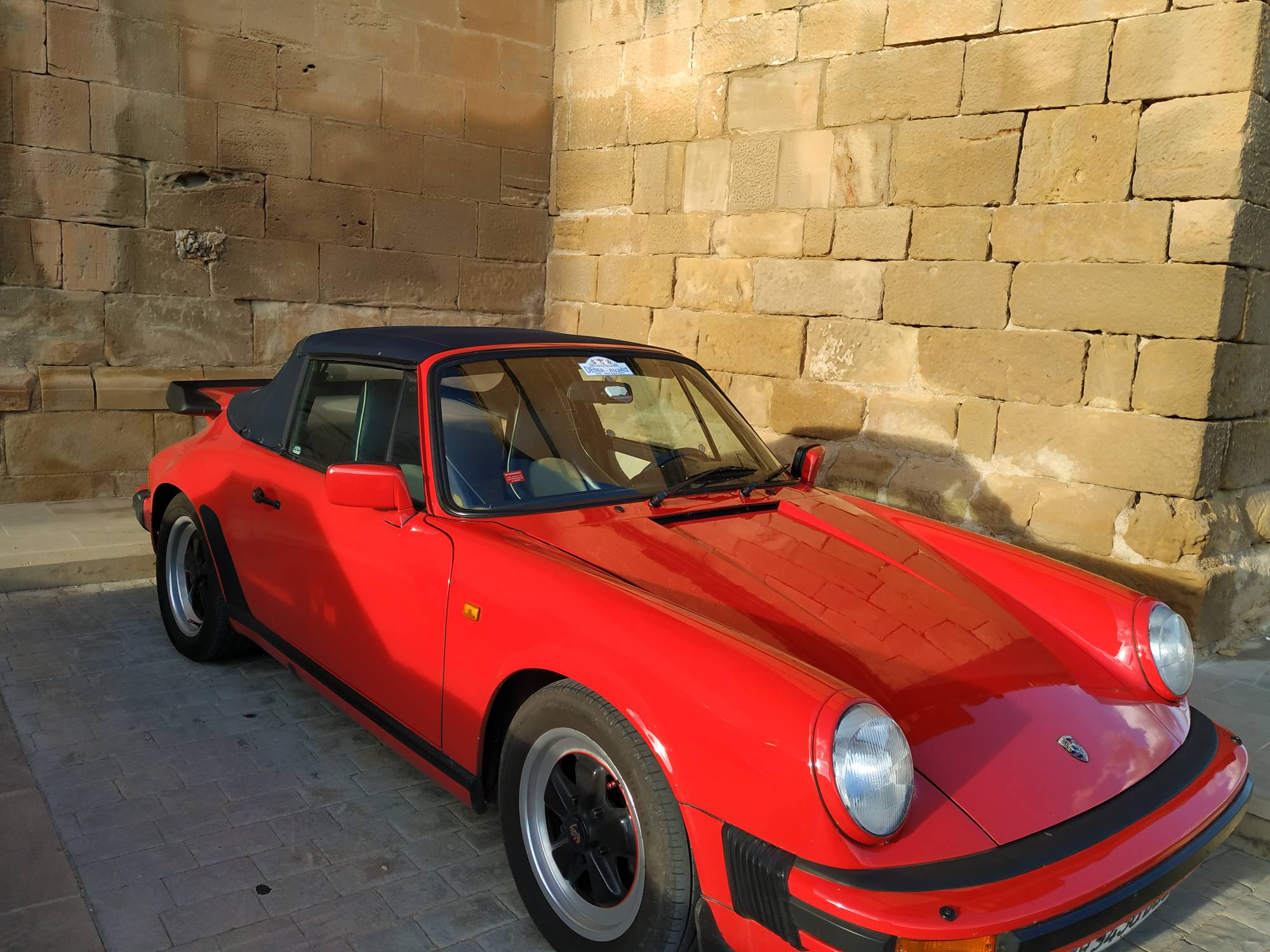
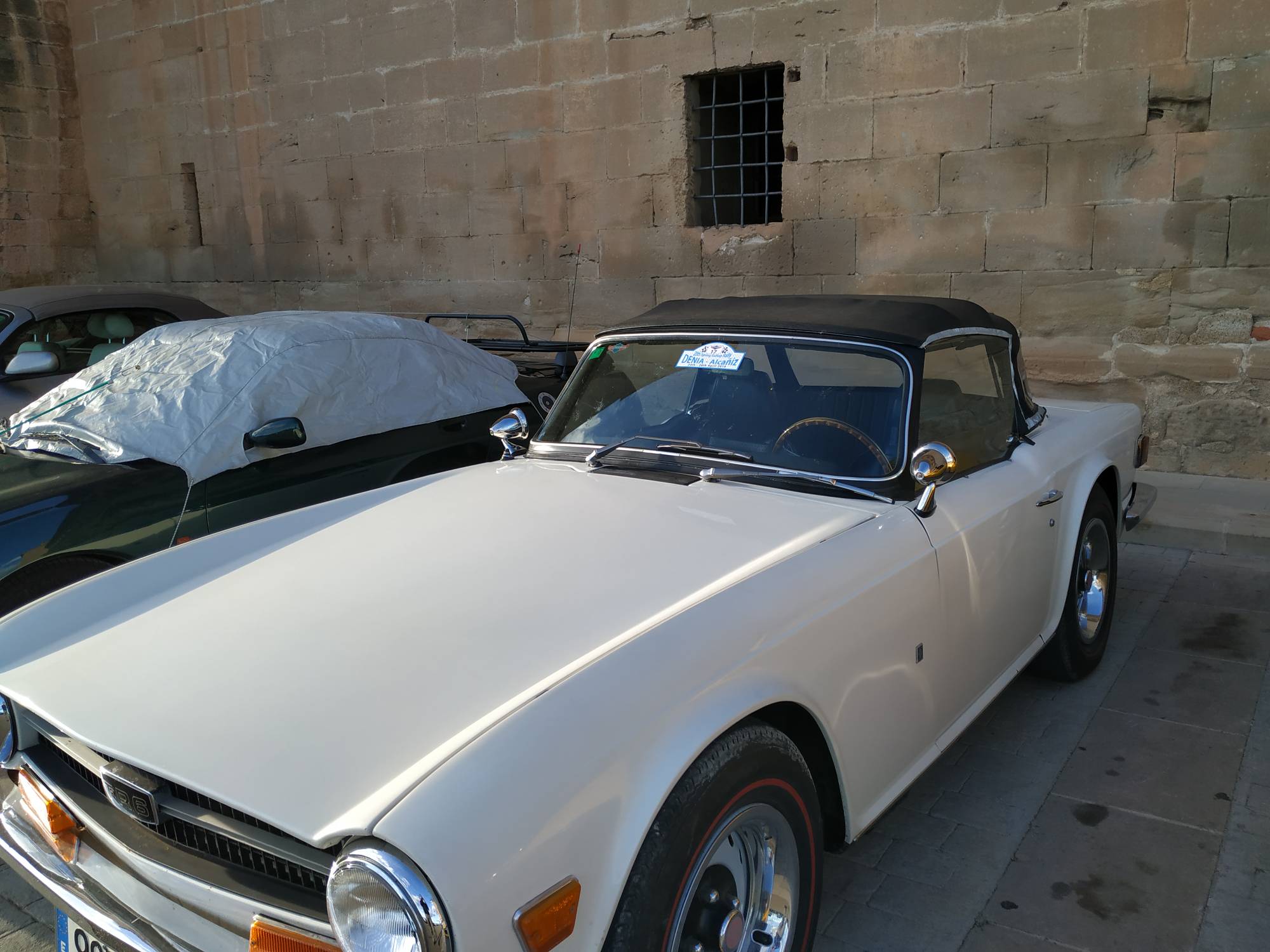
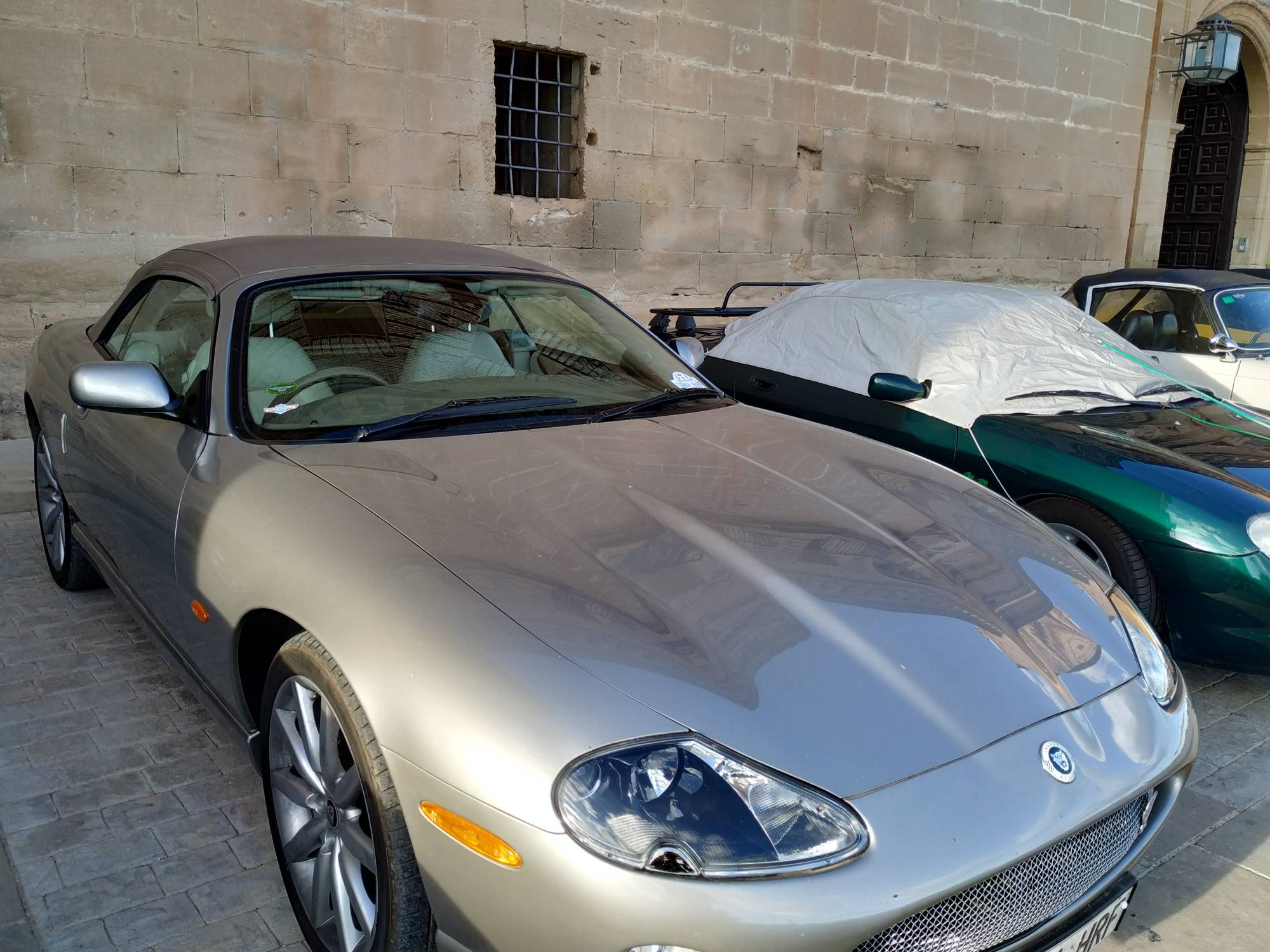
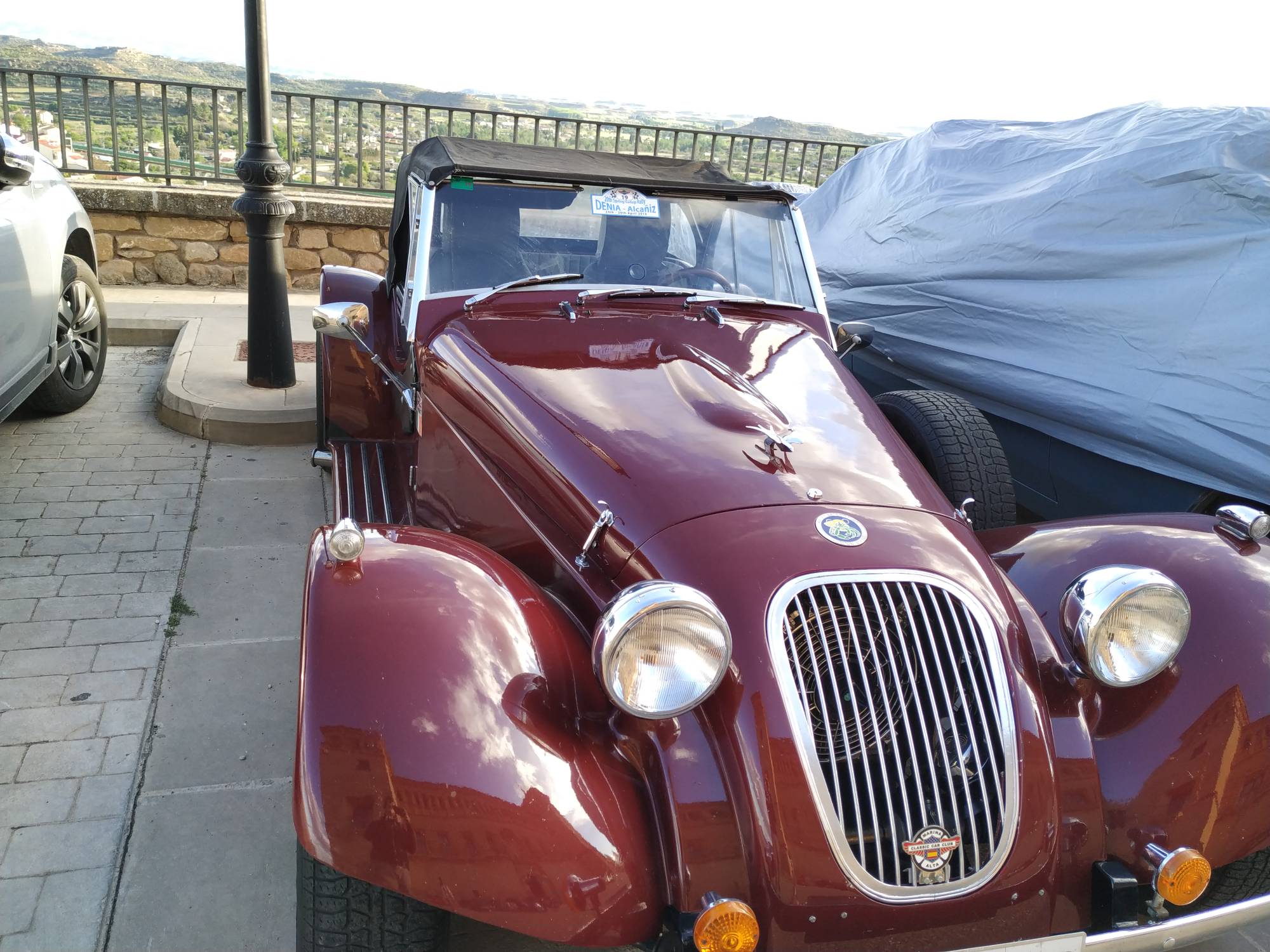
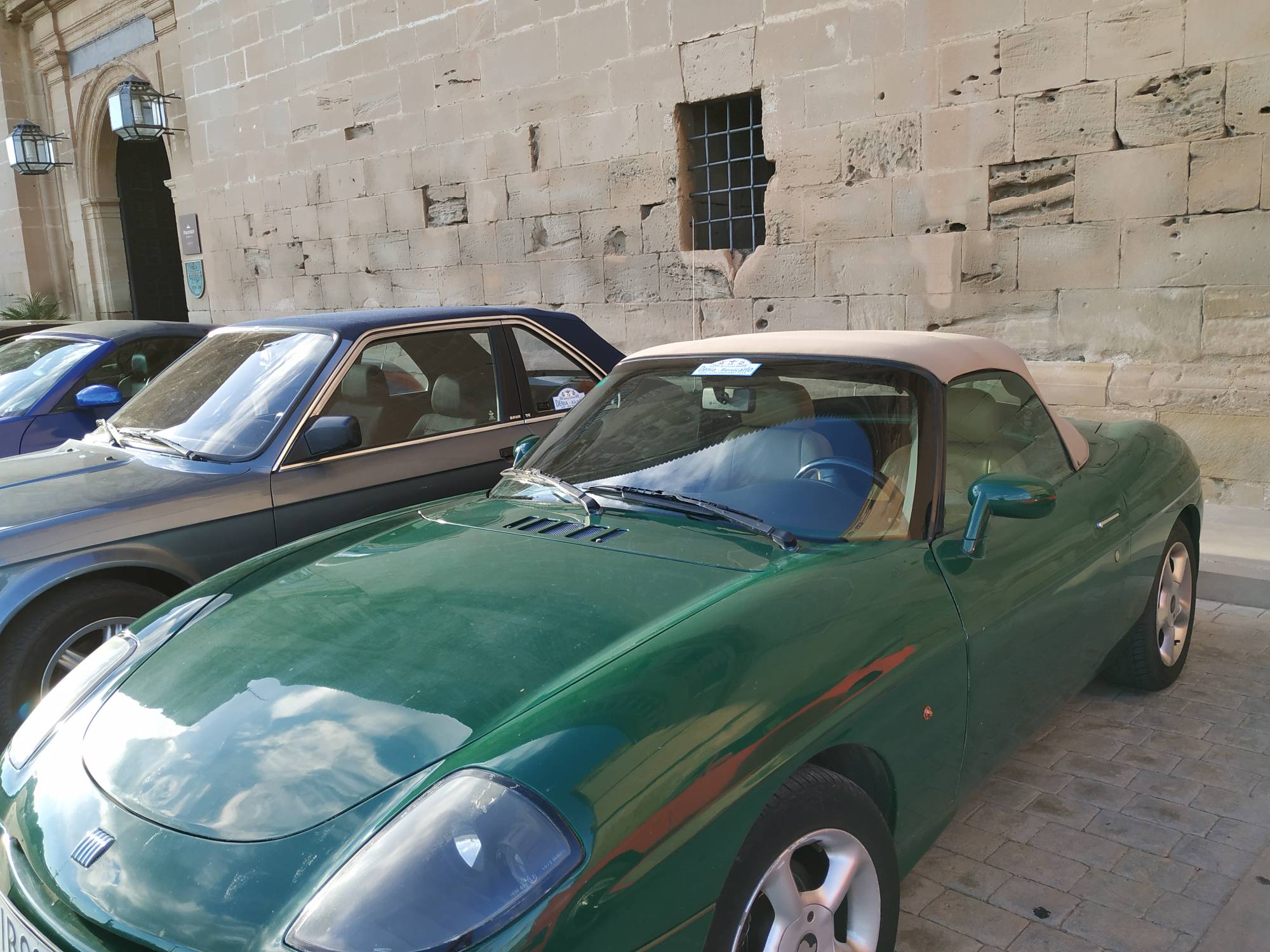
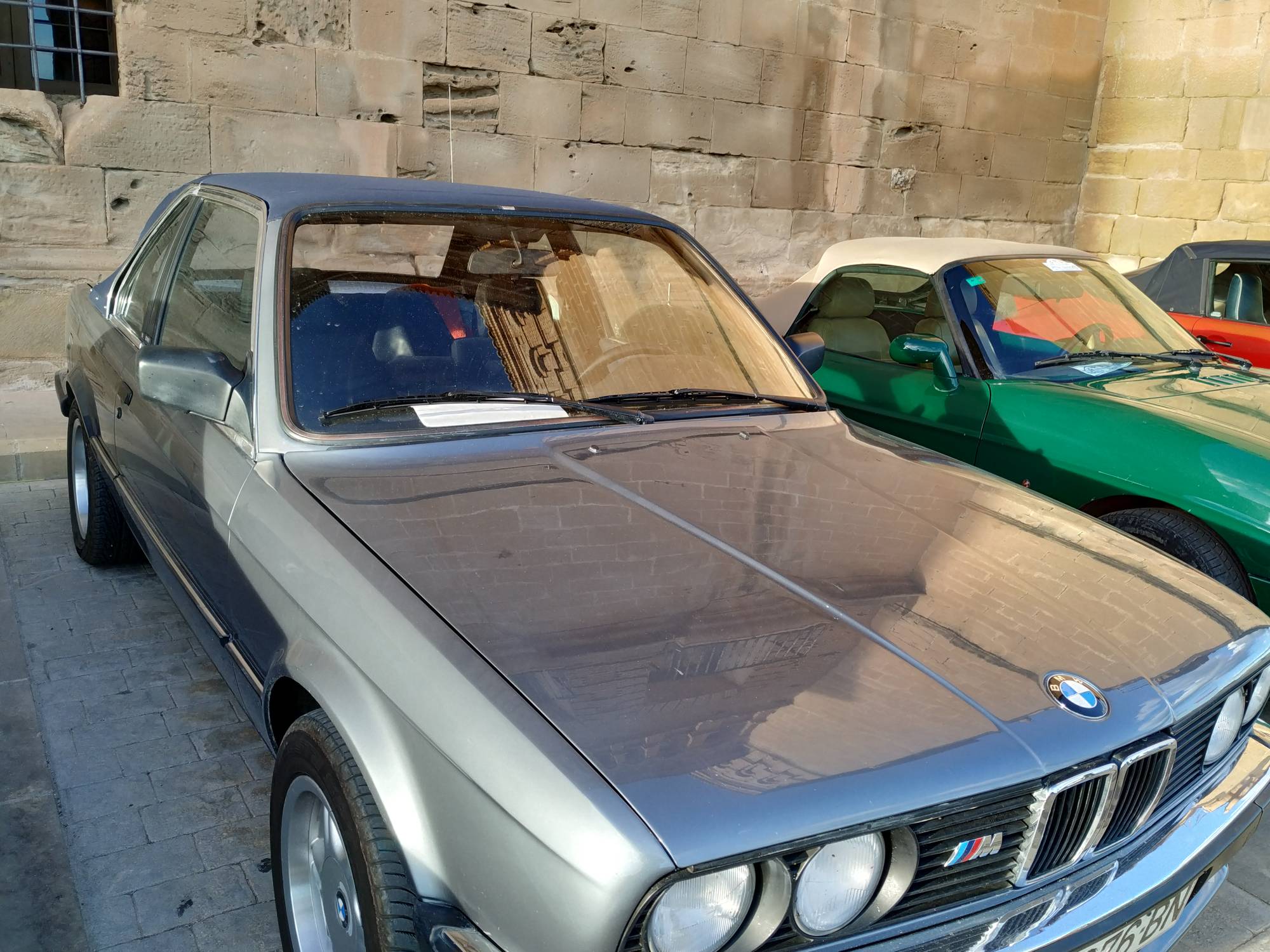
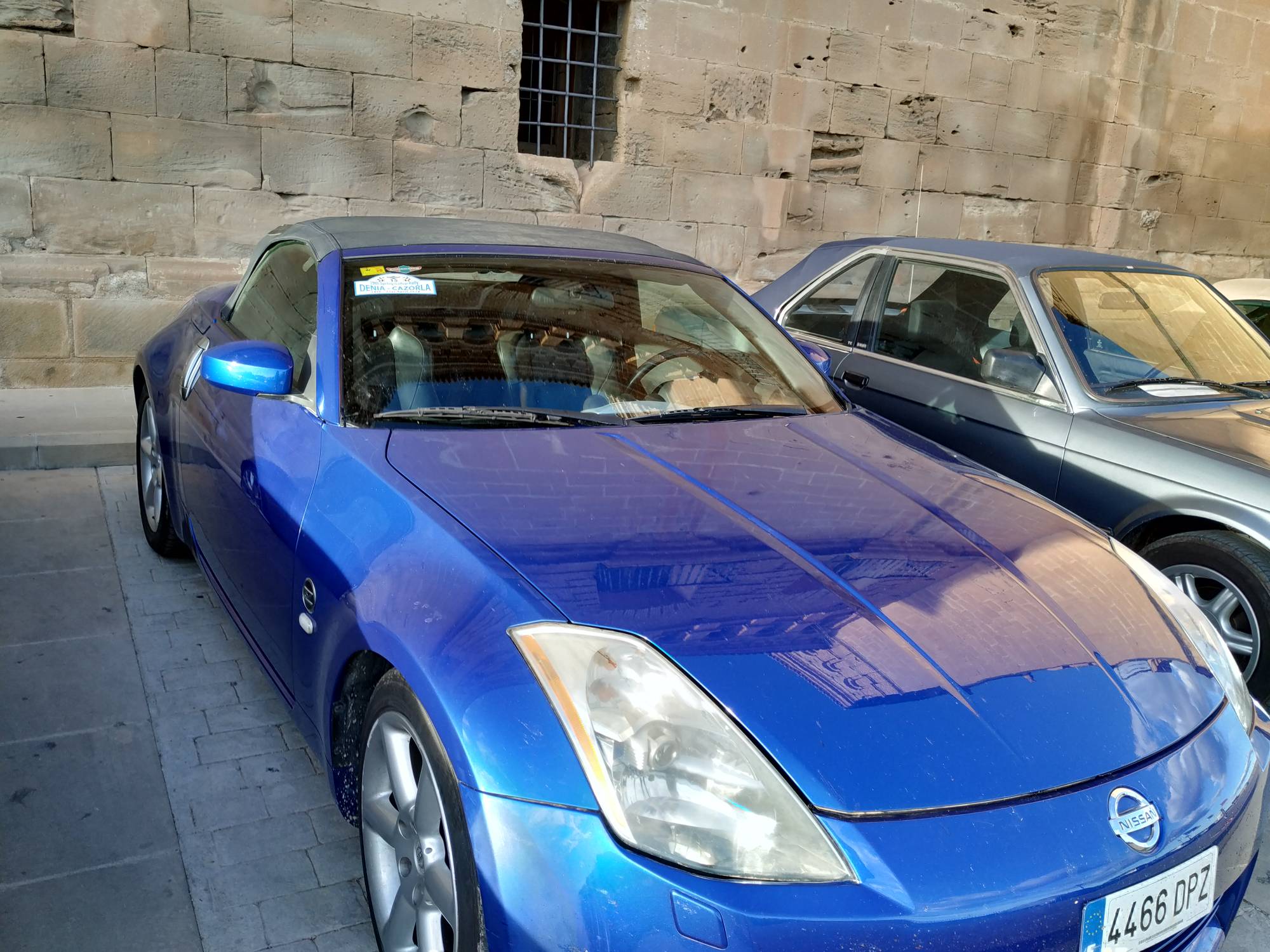
There was some sort of race going on and the drivers were staying there. That makes for lots of cool-looking cars, classic and otherwise.

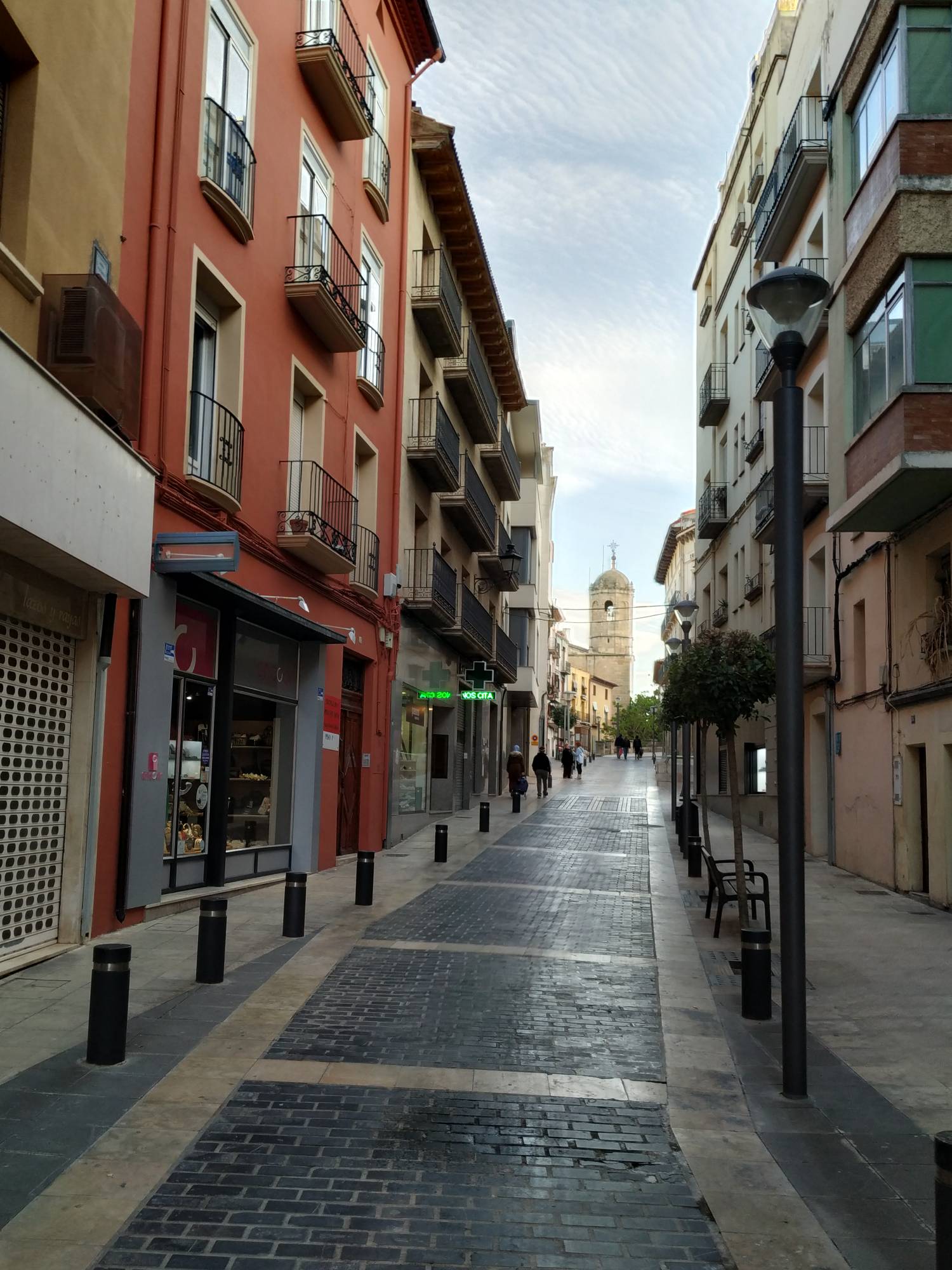
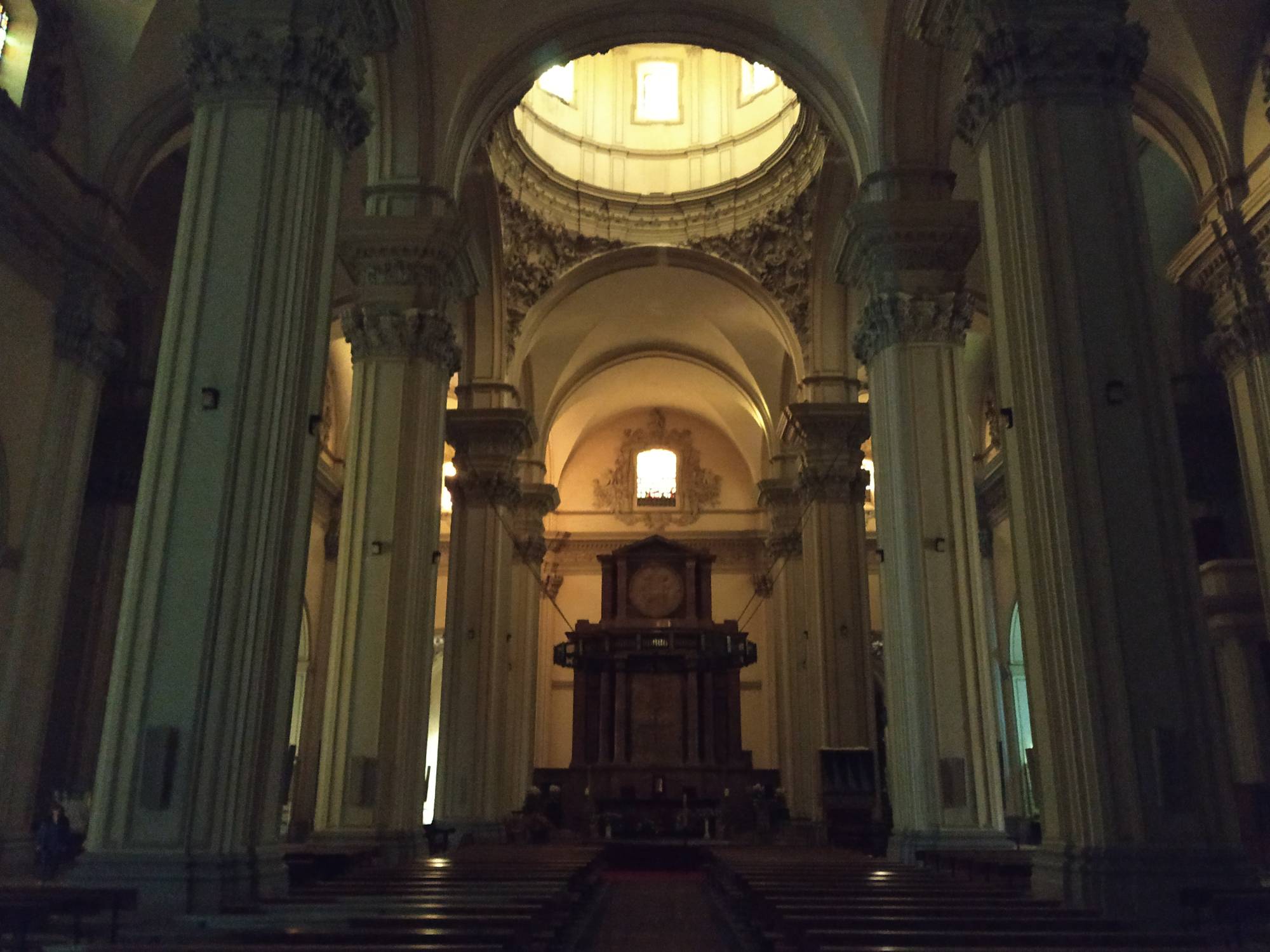
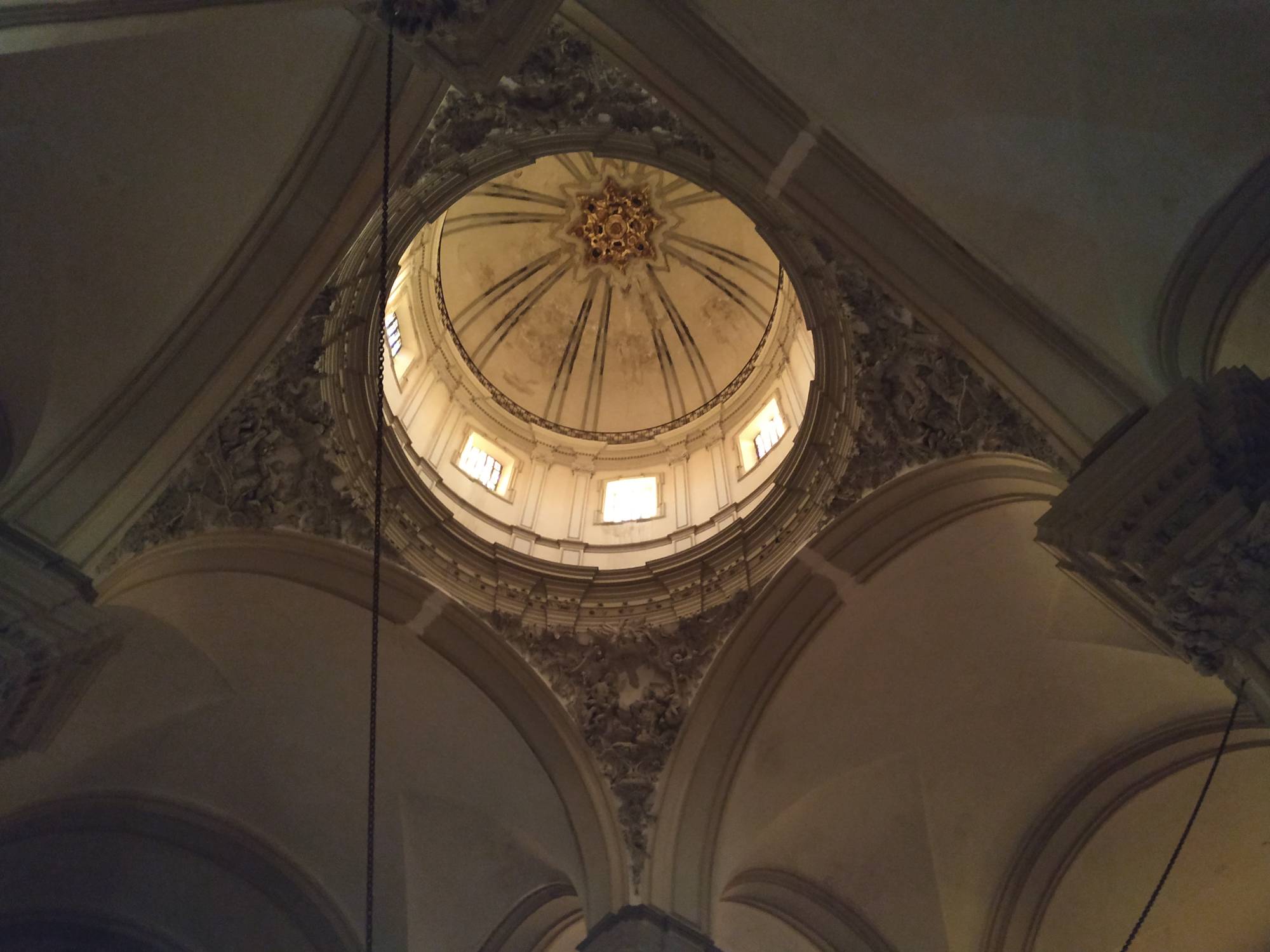
And the cathedral:

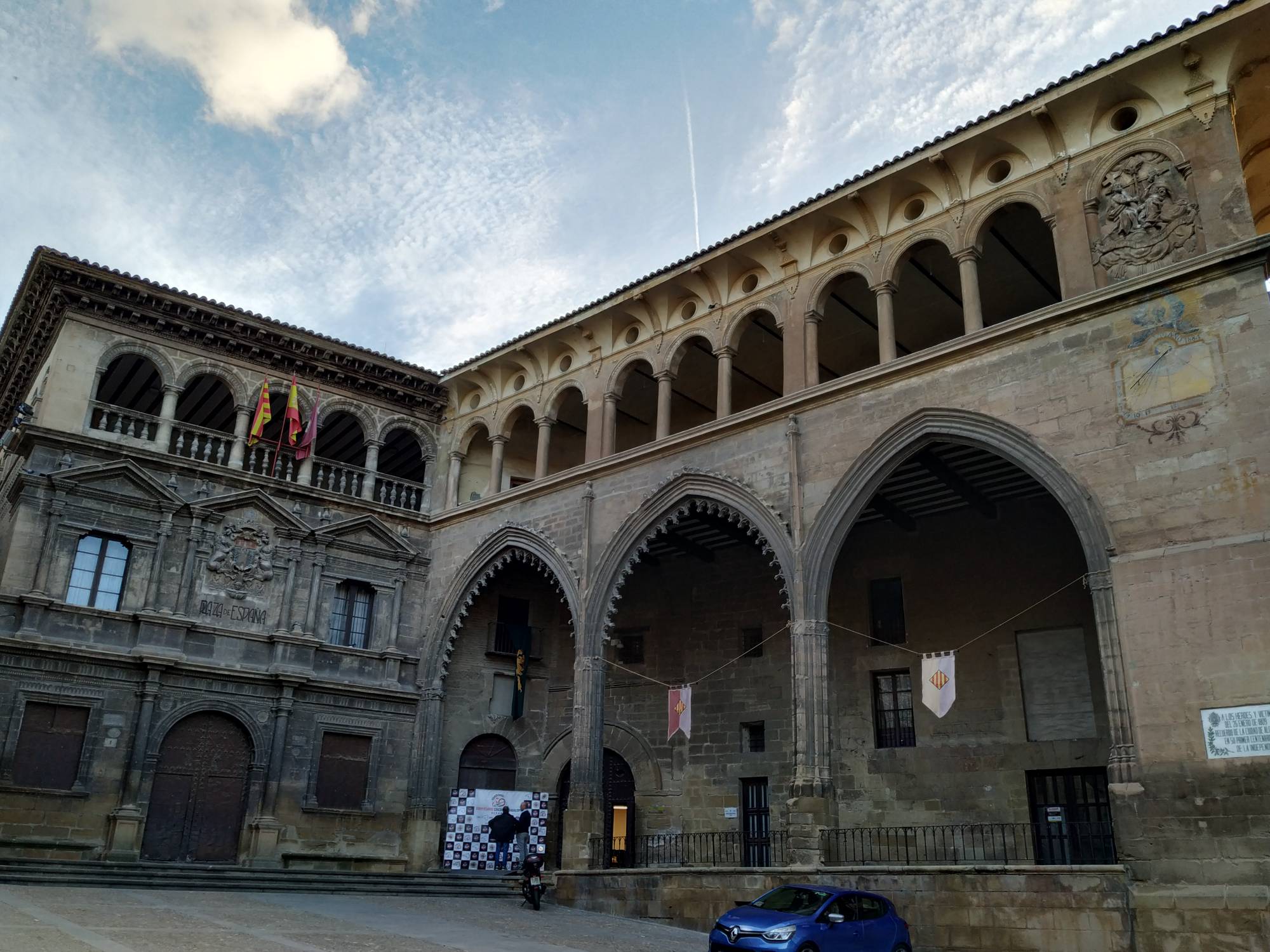
And city hall.

What about the Spanish race, now?! I’m a bit surprised this sign survived until now.

Bike’s fixed. Back to the campsite!

The job was rather shoddily done, but I managed to make it right before I went on the bike again. The good news is: I fixed what’s wrong before putting the saddlebags on it. The new rack also looks more sturdy and the lack of spacers puts way less torque on the bolt, so I think it’ll last, this time.

The next day, I took a while leaving and… where’s my helmet? The answer was… in the shop. Since it was lunchtime already, I had to wait until 4, when the shop opened.

I went there, and then it was time to bike on an old railway. But that’s another post. See you there!

Easter weekend

The next day started off windy as the last one. I had breakfast near Medinaceli station, which was a bit away from town. The town looked interesting enough but it was high on a hill, and I had a lot of ground to cover, since I’d advanced so little the day before, so I didn’t visit.

After that, there were a couple of things I don’t see everyday:

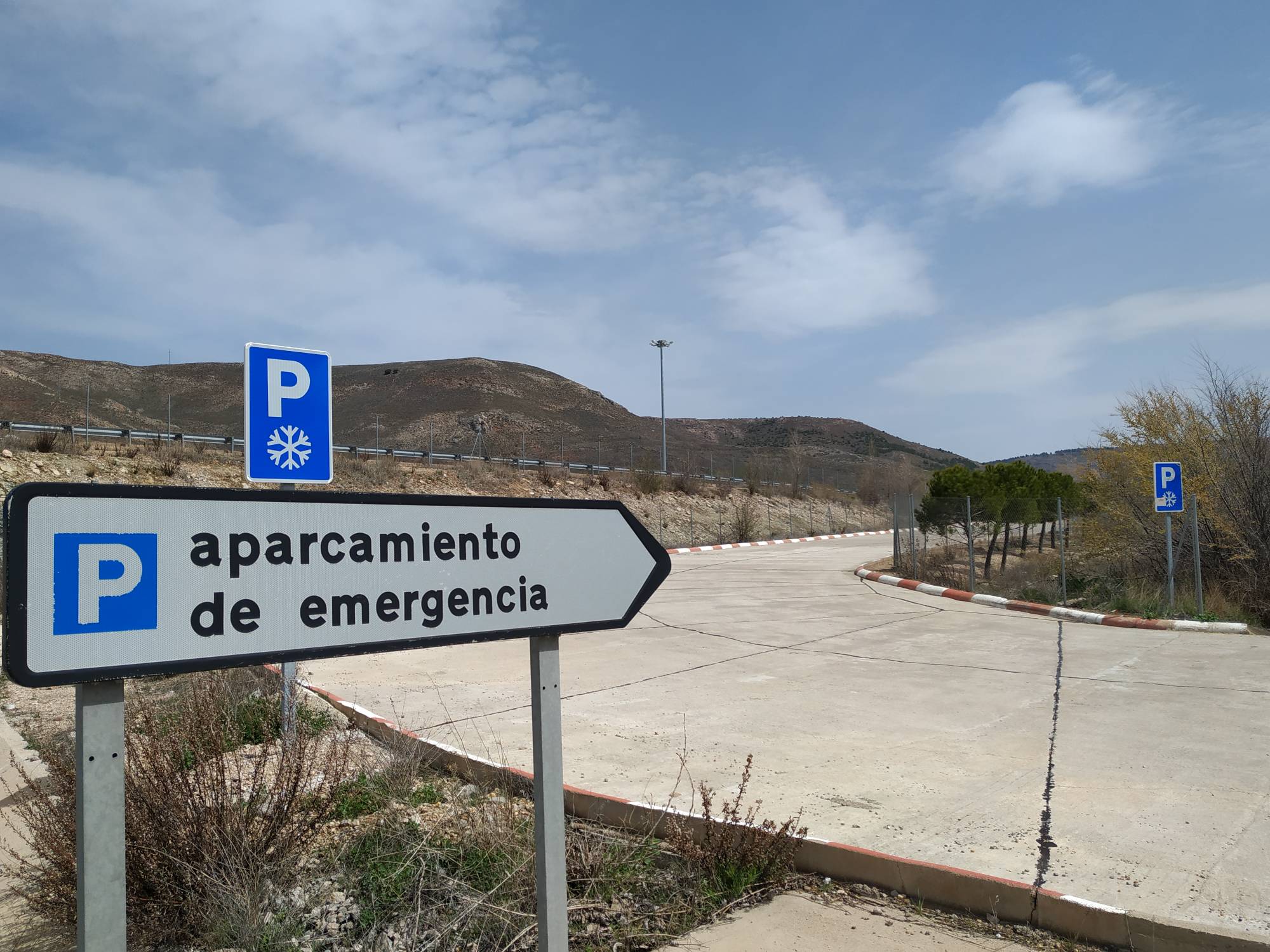
An emergency parking for icy conditions. Yeah, there’s pretty much no ice back home.
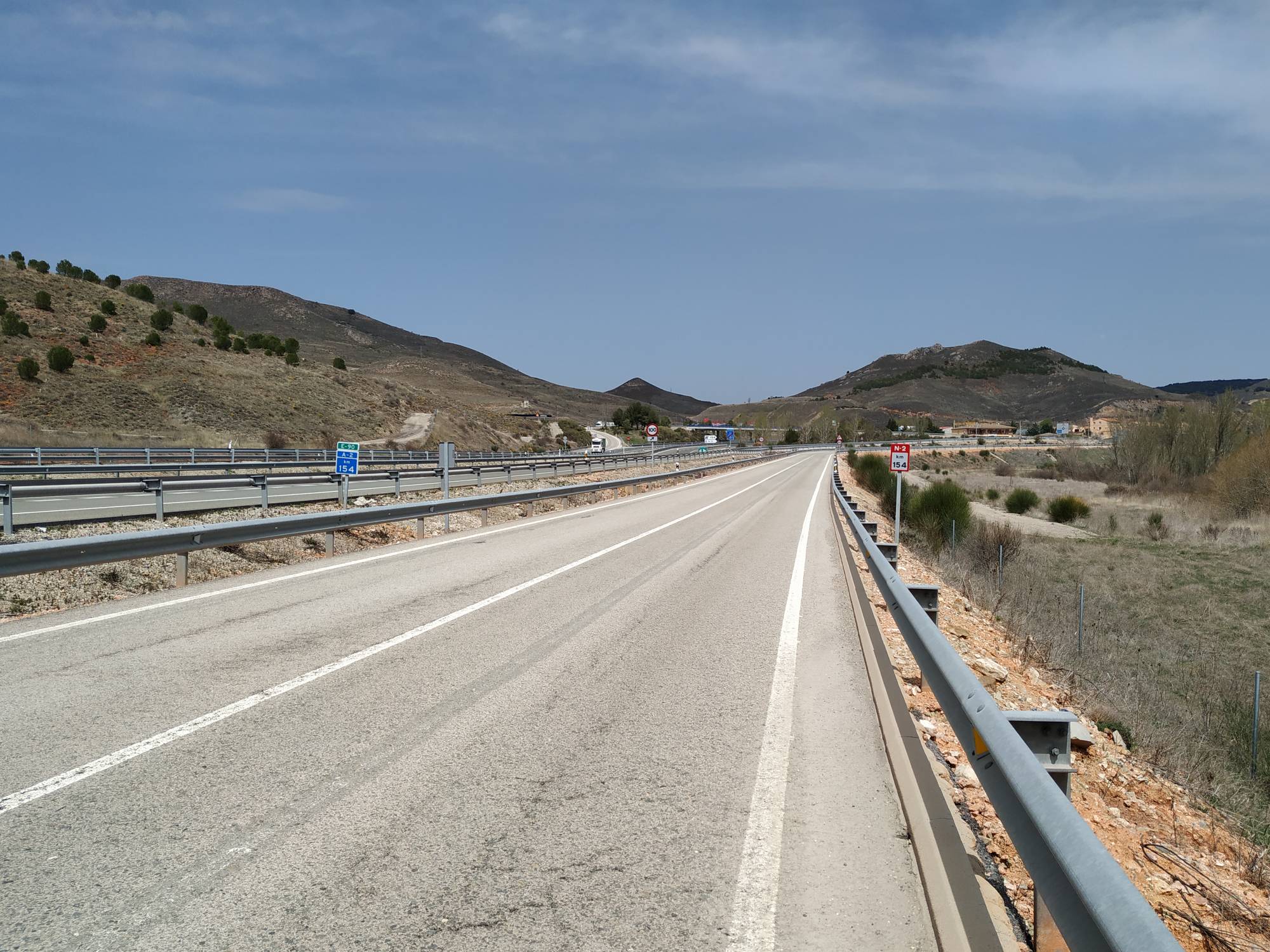
The same km on two different roads, in the same place.

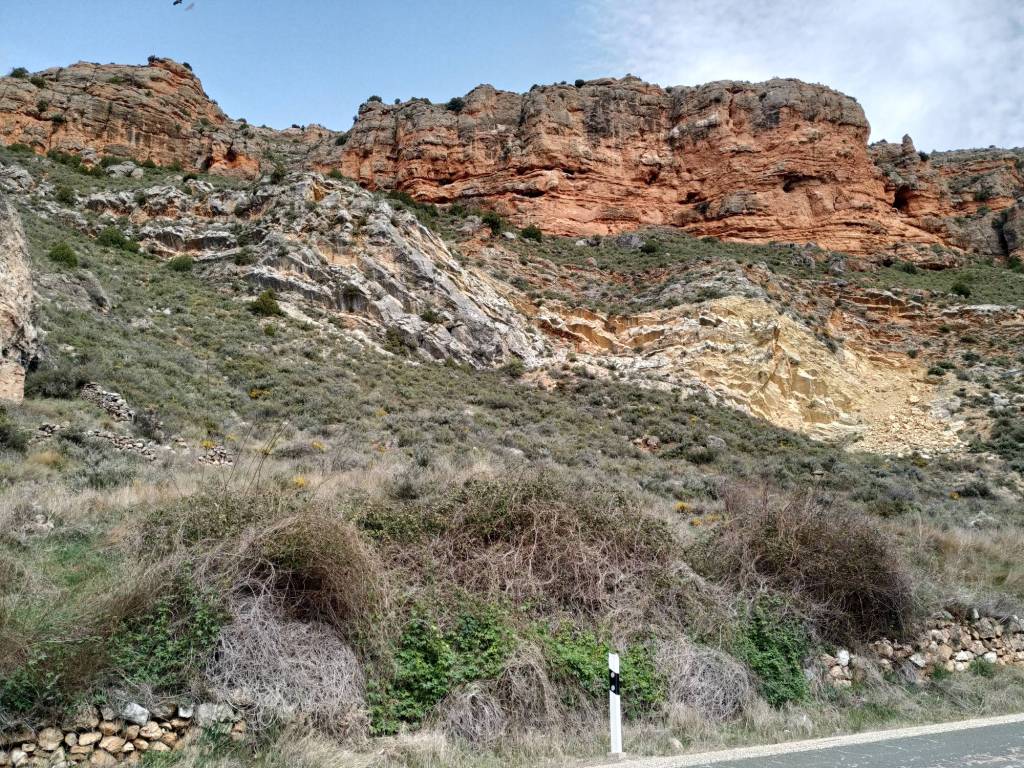
It was then time to head into a nice river canyon, mostly next to the Madrid-Zaragoza train line and the Jalón river. Sandstone canyons were quite a landscape change from the usual.

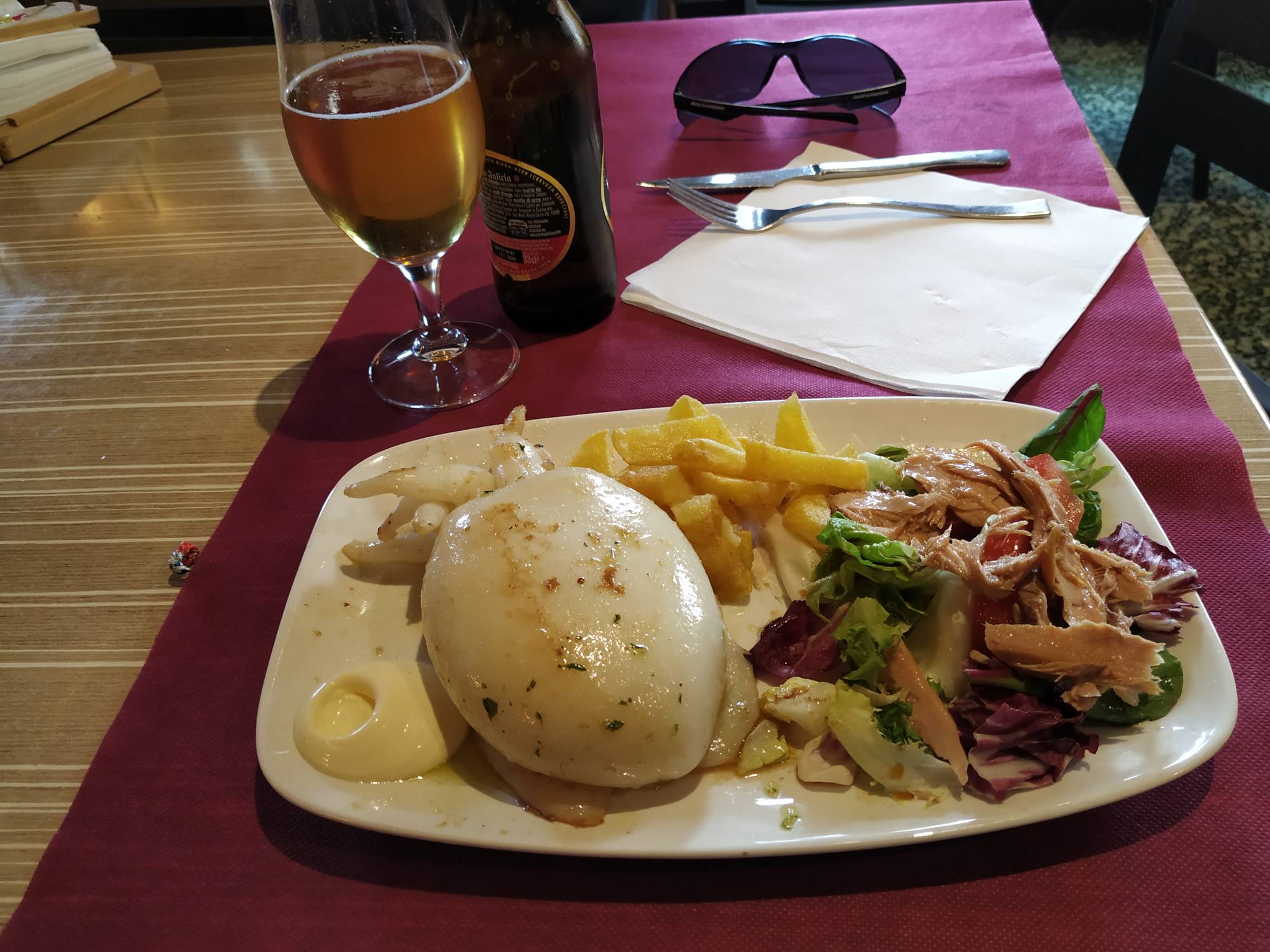
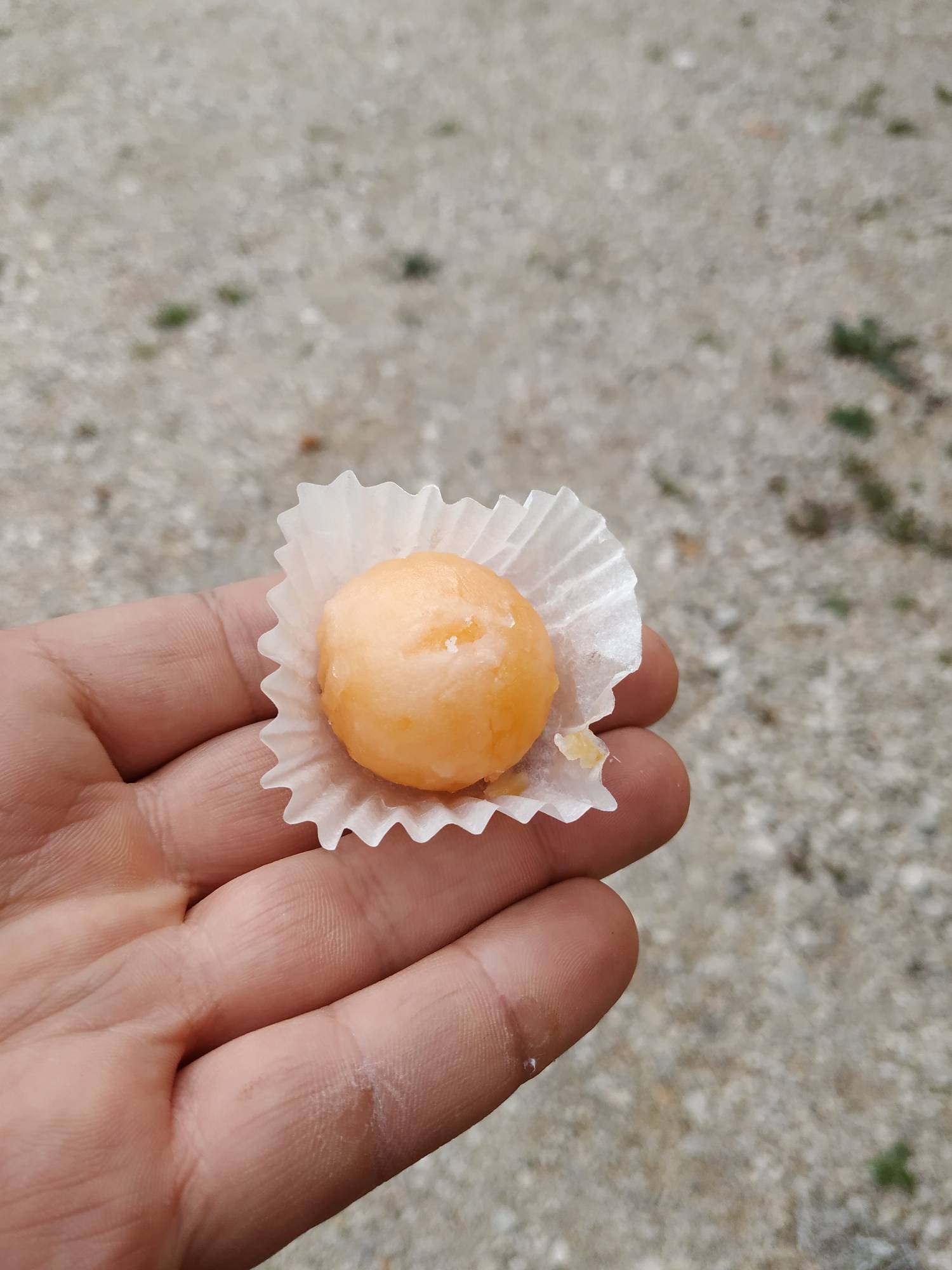
I then arrived at the town of Arcos de Jalón for lunch, where I experienced first hand the “local shop for local people” sketch, from League of Gentlemen. Fortunately, one of the places was more accommodating, and I had quite a nice meal. Then I sampled a local delicacy.

Yemas, literally meaning yolks, are sugary egg yolks with glazed sugar around them. They remind me of Aveiro’s ovos moles, but somehow with even more sugar.

Since the road just ended on the highway and the alternative was quite a deviation, I went on it.

When I got off, I had a little trouble with the route.

Well… technically, it was passable.

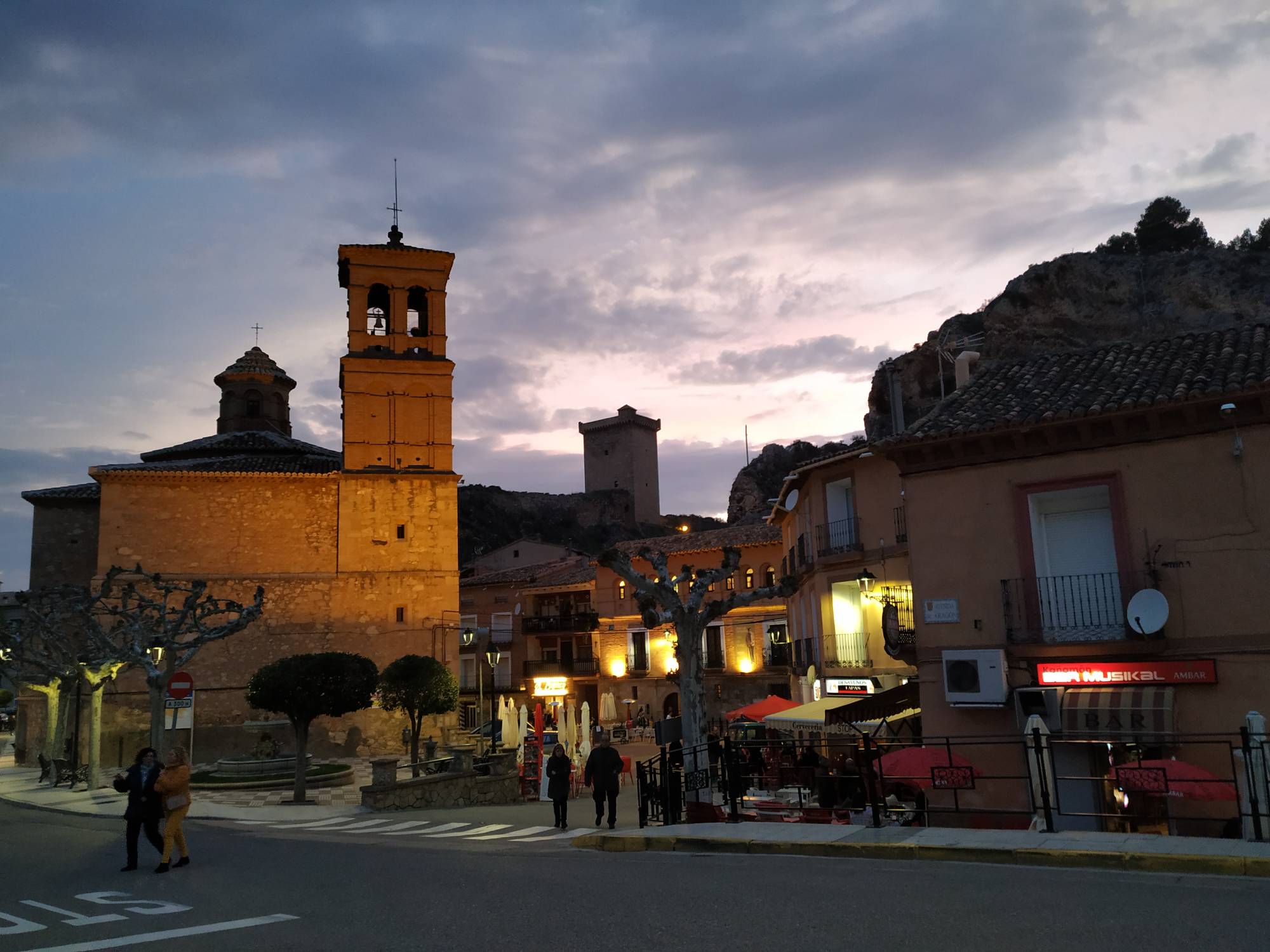
A few km later and already at nighttime, the town of Alhama de Aragón appeared.

And right at the edge of town, a creepy abandoned factory was my campsite for the night.

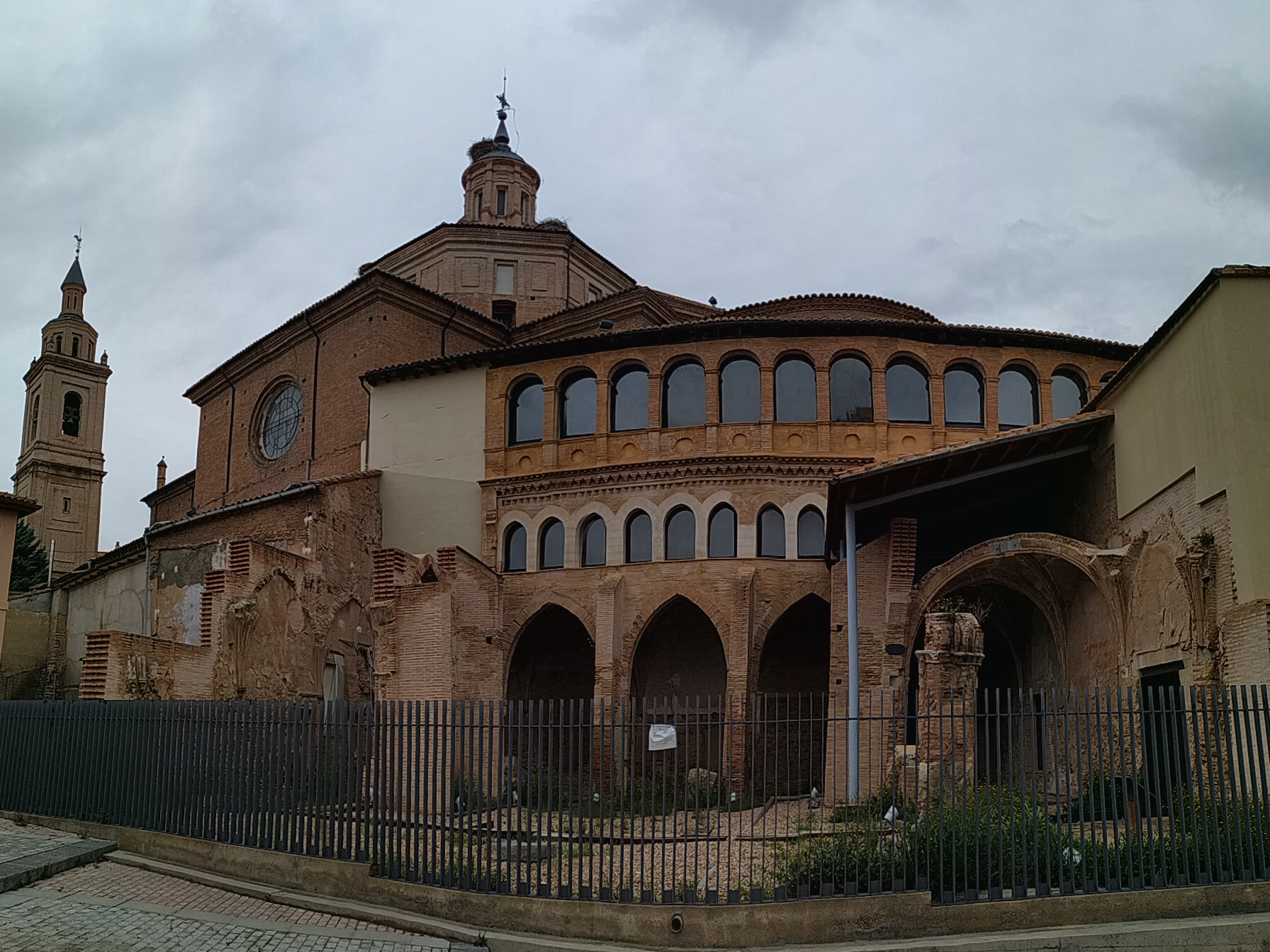
Along the way, there were plenty of mosque-o-churches, in a style the Spanish call mudéjar, coming from the Arab word مدجّن [mudaǧǧan], meaning domesticated, referring to the muslims who stayed in Spain after the Reconquista and “converted” to Christianity.

I then arrived at Calatayud, a town that immediately tells you that there are no sexist aggressions there, no siree.

I wonder if this is like a country that has “democratic” in its name.

Sadly, it was Easter Sunday, so most everything was closed. Here are the pictures anyway.

The unimaginatively named “fountain of the eight pipes” and one of the city gates.
Those balconies don’t look too safe.

It was then time to head back into the hills, onto wine country.

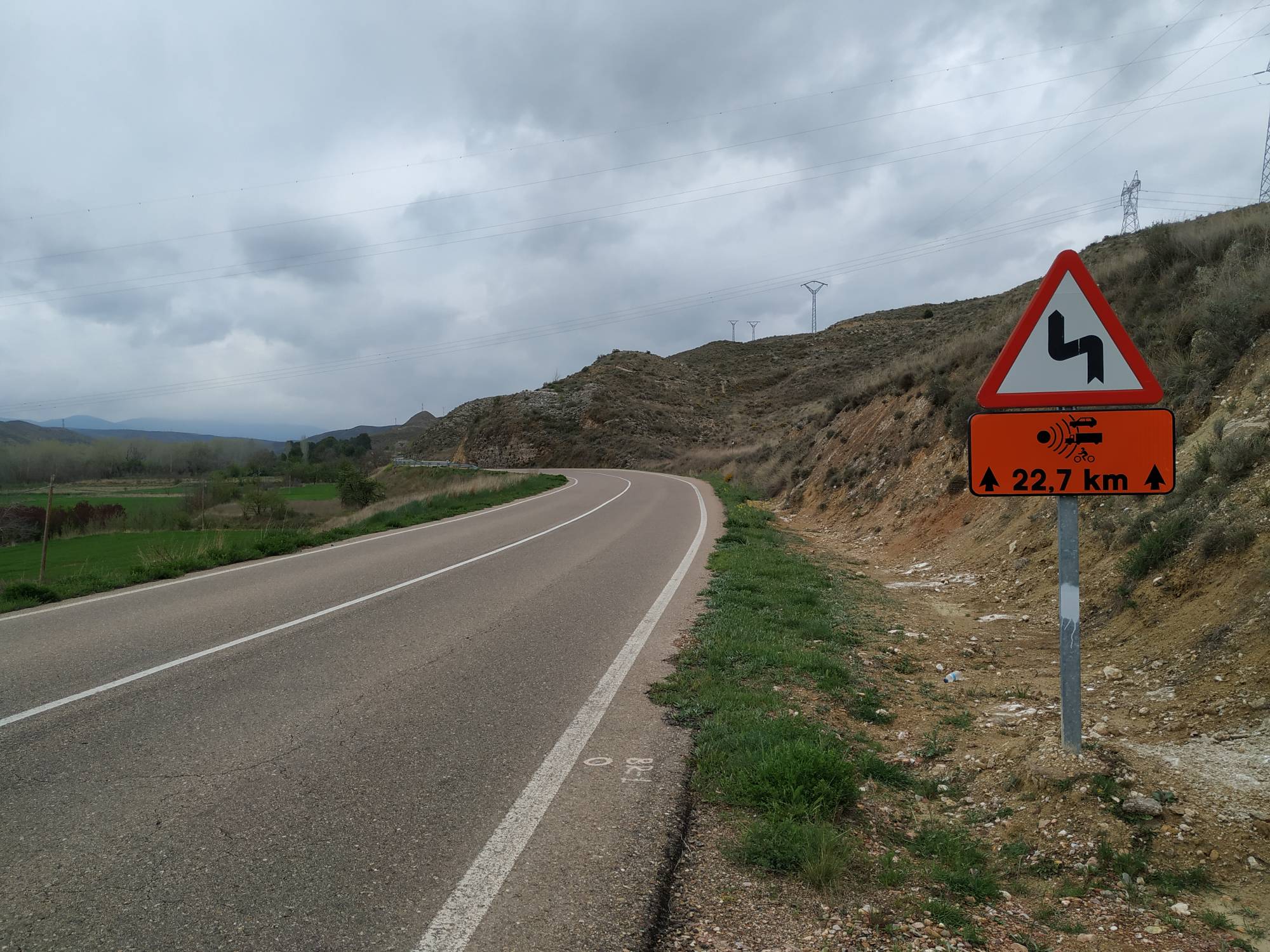
Of course there are speed cameras for 23 km on this rural road.

After a night spent in a pine wood and some climbing, one of the dumbest signs I’ve ever seen appeared.

It says that the dashed line “only” indicates the center of the road. That’s what it’s bloody well for, ain’t it?

In this region, there are little structures called neveras, that the locals used to make ice. They’re about as tall underground as above ground.

And then it was time to head way uphill, and then a solid 25km mostly downhill, along the Herrera and Cámaras River valleys, all done in good time.

How about you? How was your Easter weekend?

Into the hills

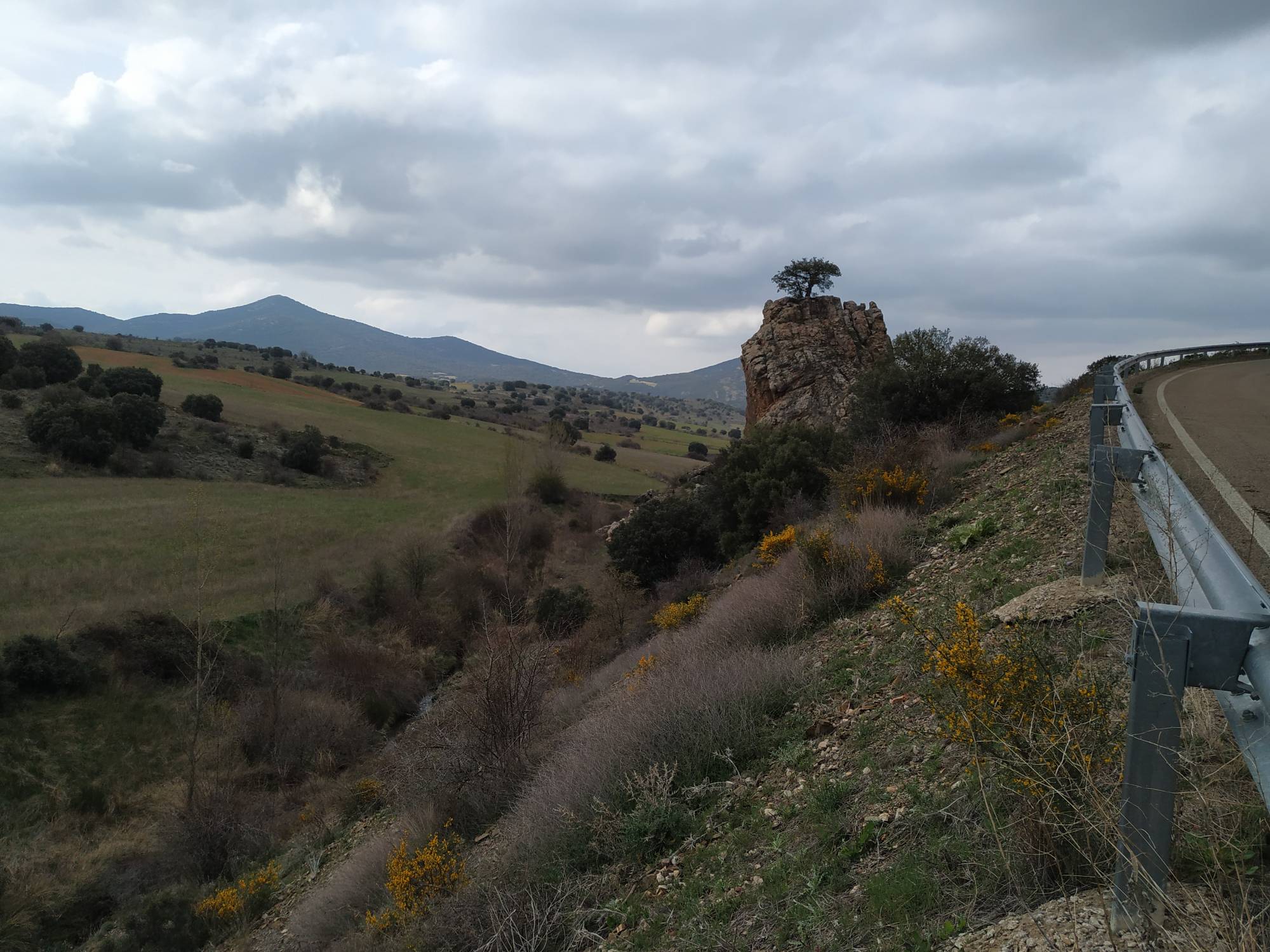
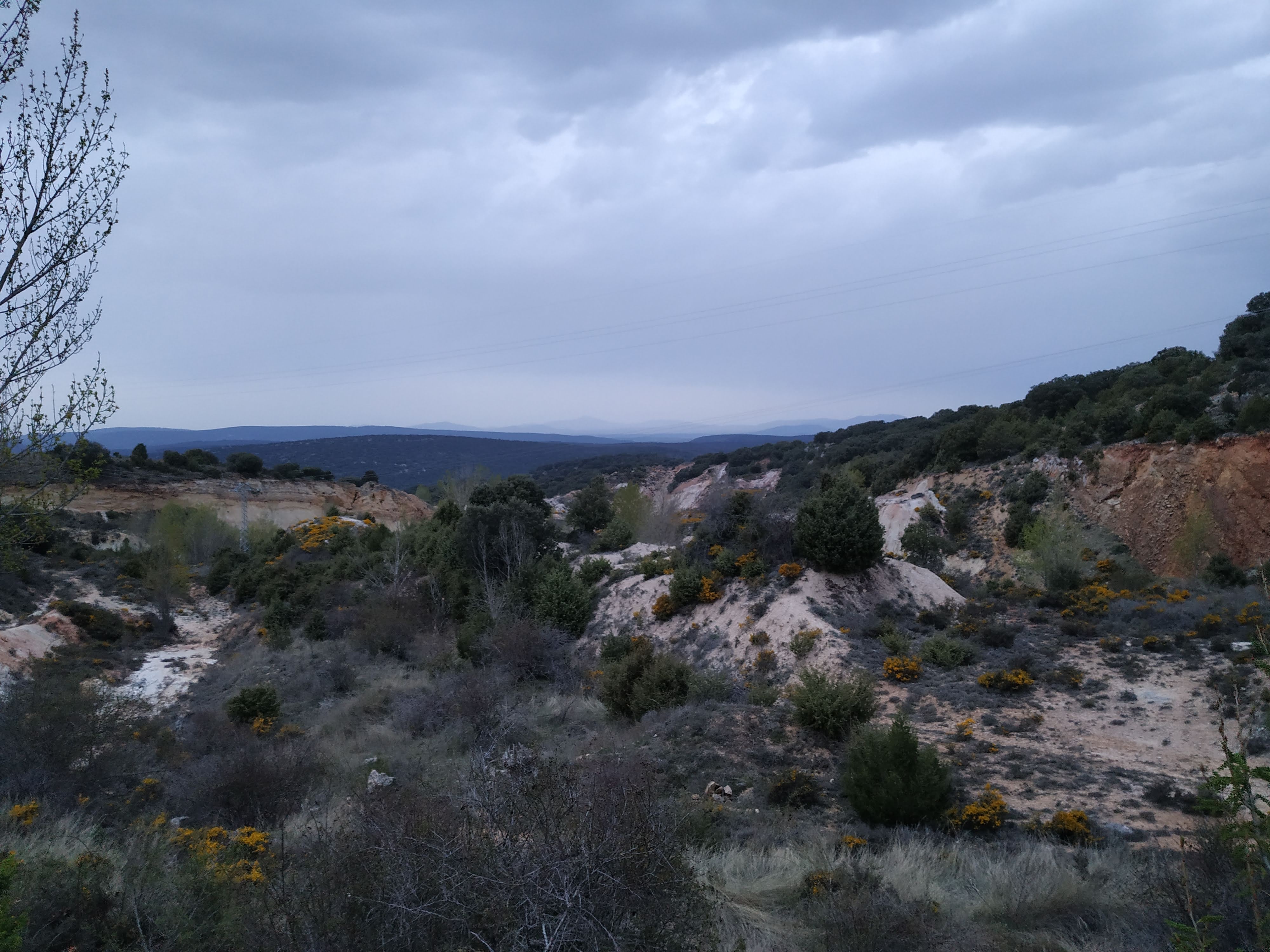
I started that day off at around 720m. Before it ended I’d go to 800, back to 720, up to 1050, 850 and 1100 again, all over more than 70km. It was a tough day. Being on the hills again had the advantage of having more good shots than usual. This is the first hill of the day.

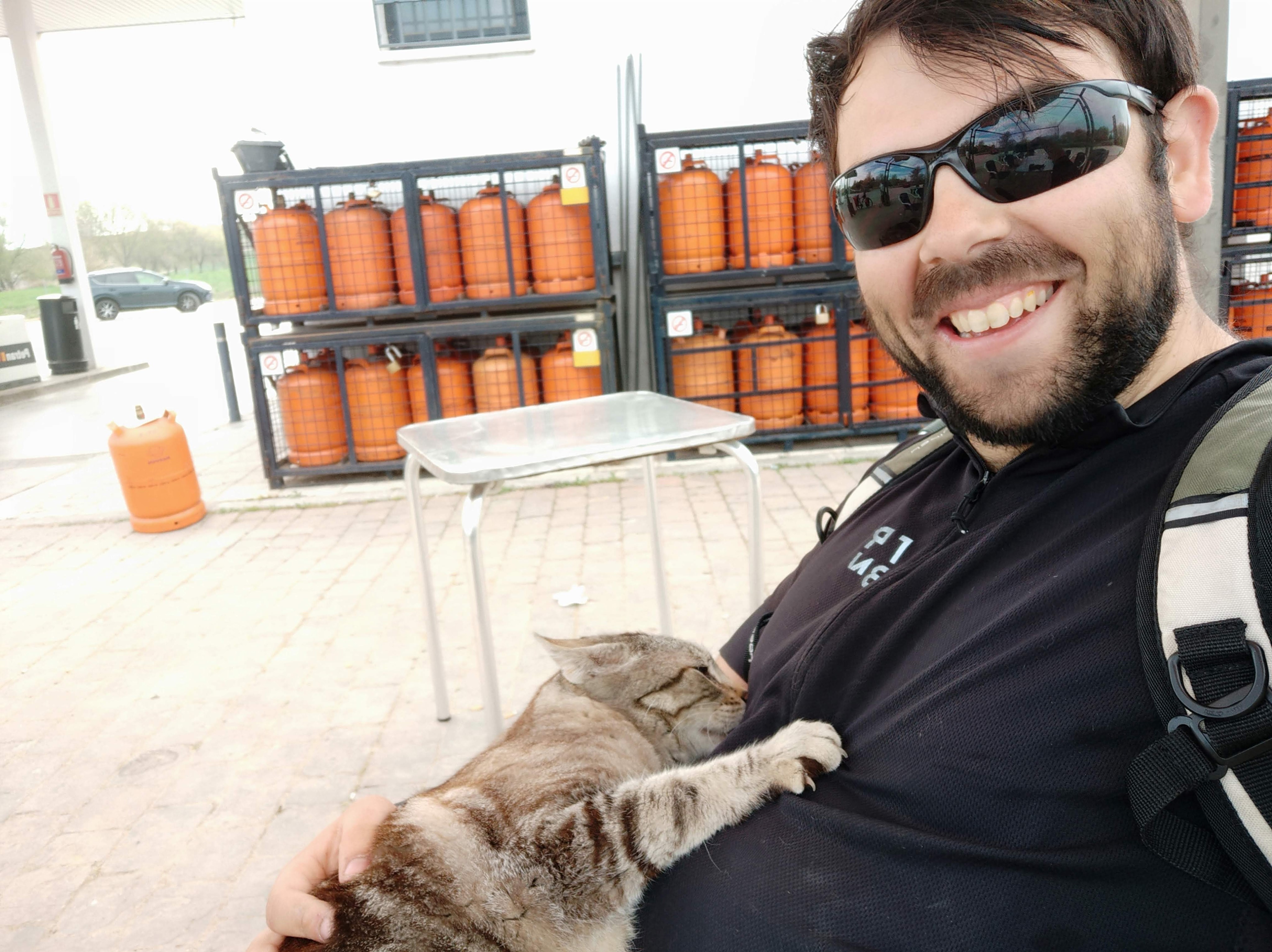
I’d run out of water and couldn’t find a fountain, so I bought some at a gas station. Then this happened.

He just jumped into my lap.

The water bottle was 6.25 l instead of 5, so I ended up having to carry it around while I hadn’t drunk enough.

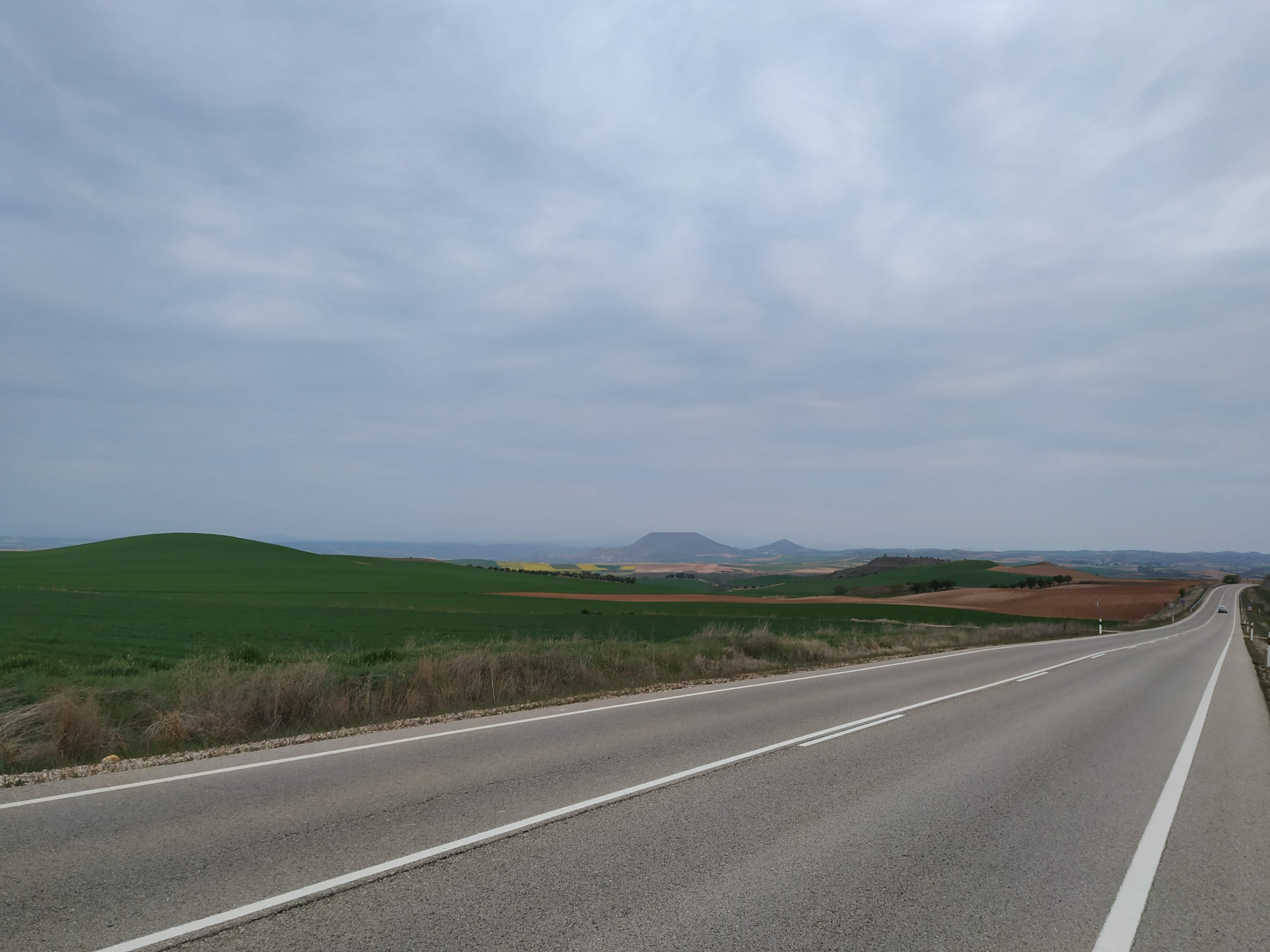
The landscape here was farm country. Not much more, not much less.

The town of Hita

It was then time to head upriver and then when there were no more turns in the river valley, have a nasty climb to a plateau.

That doesn’t look too safe.

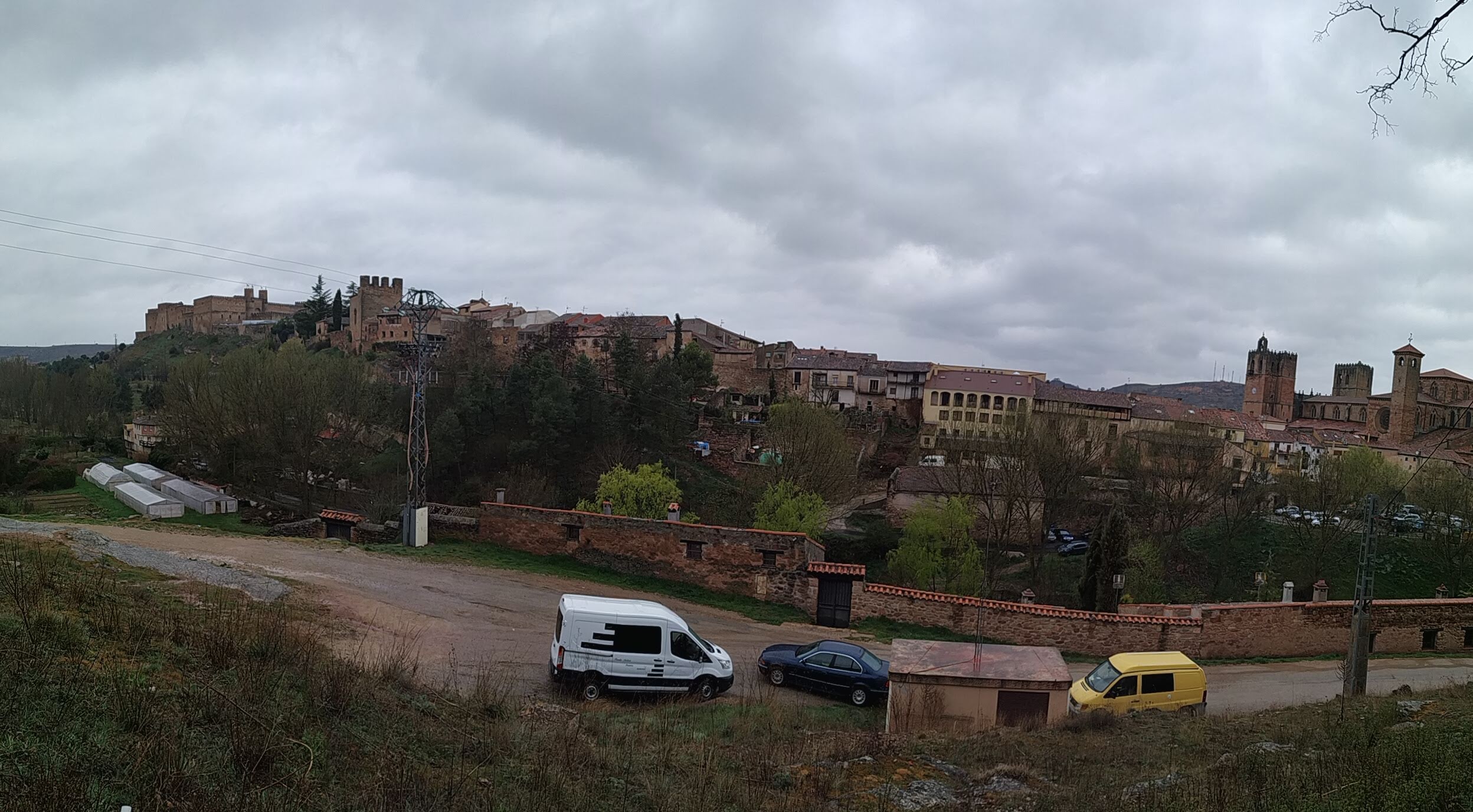
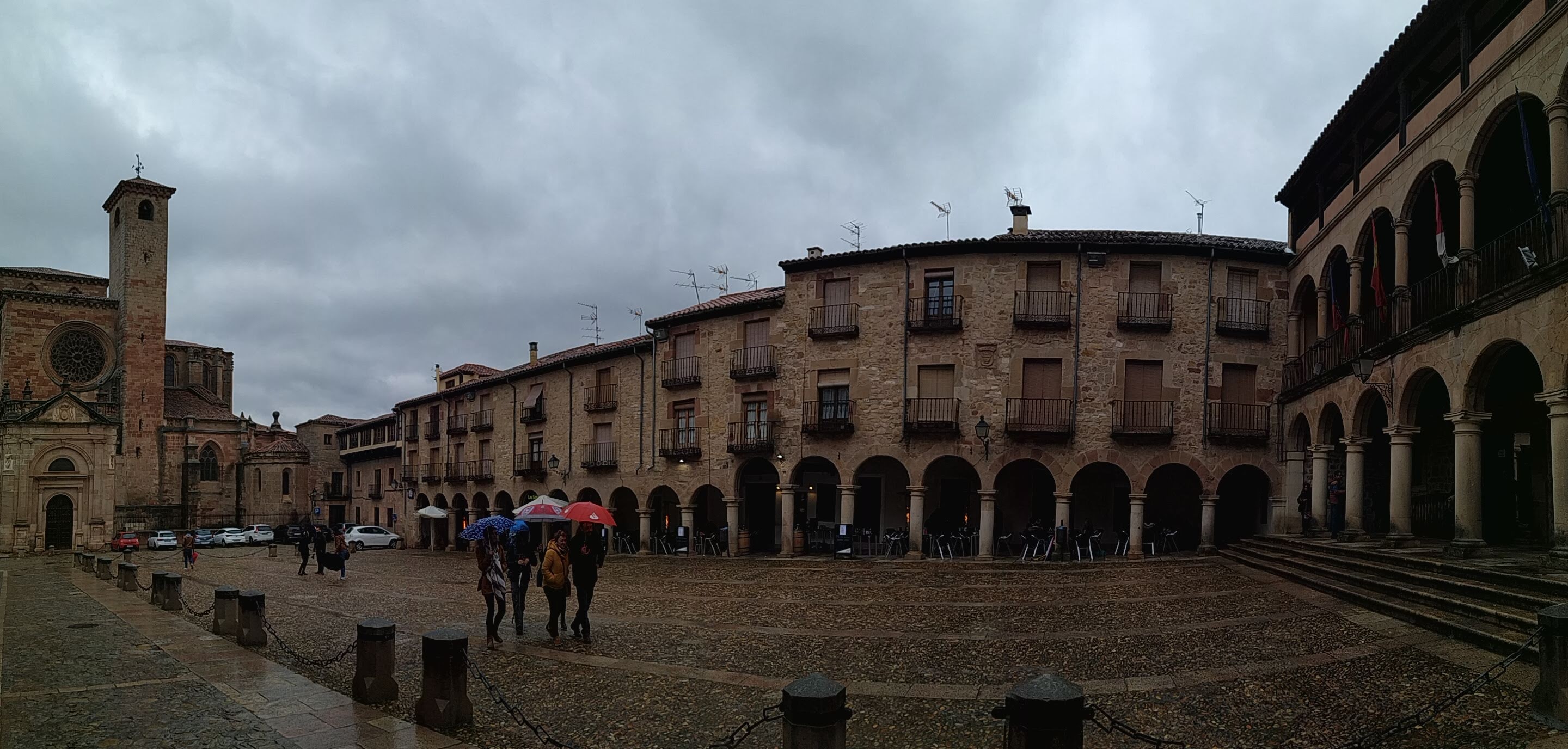
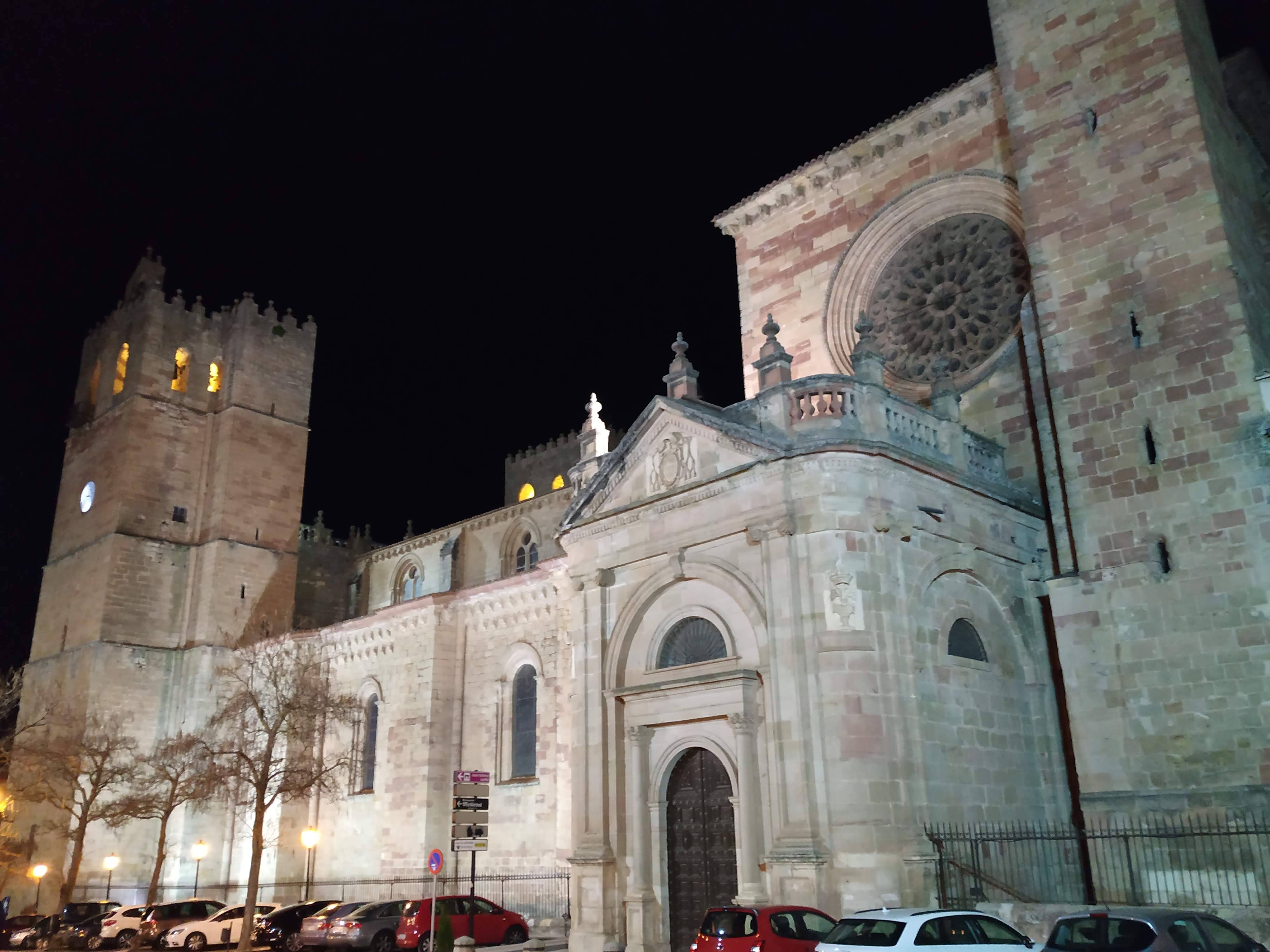
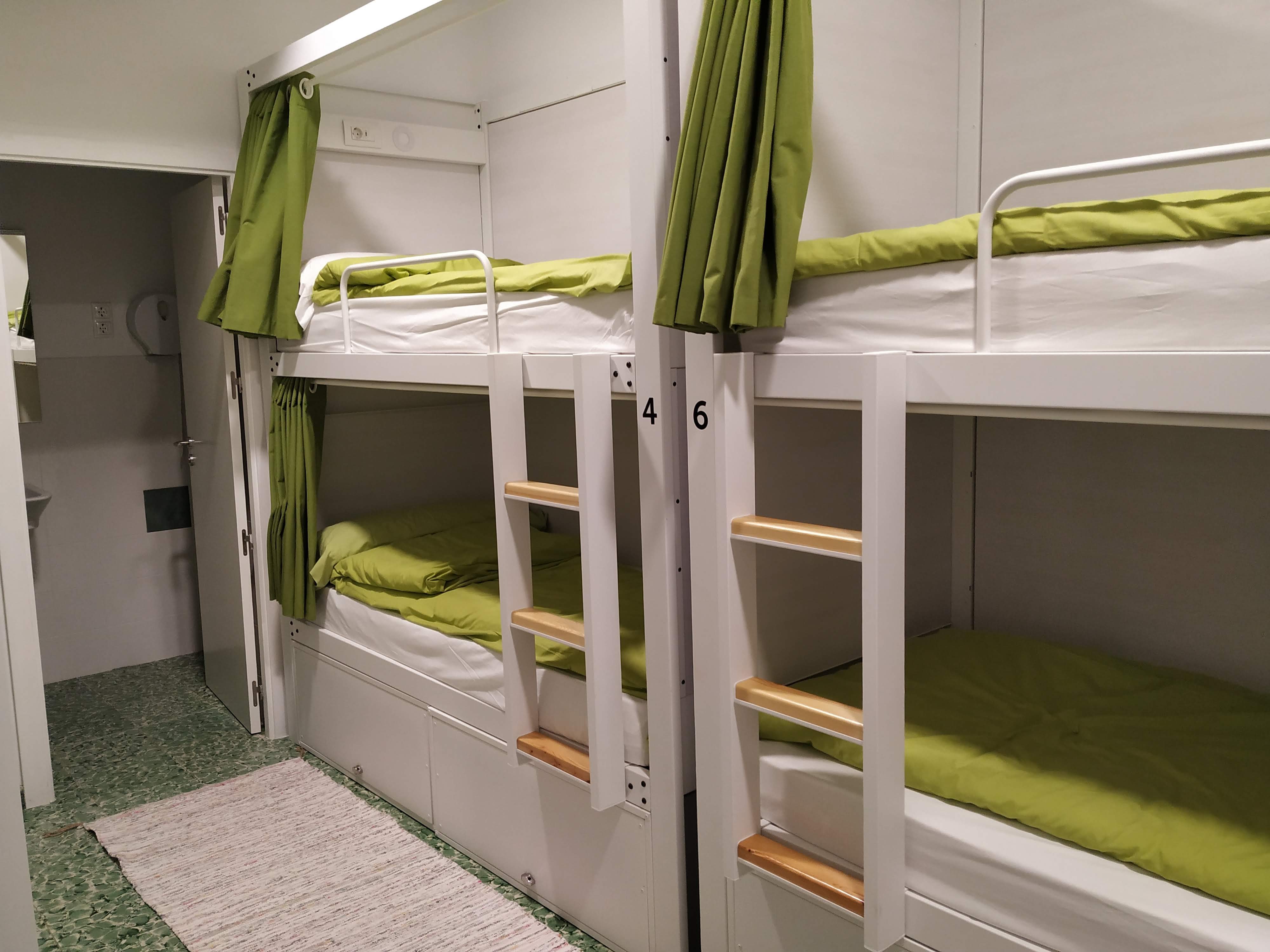
Since there was more than 40 mm of rain coming the next day, I’d arranged to stay a couple of nights on a hostel in Sigüenza. The town was a nice surprise.

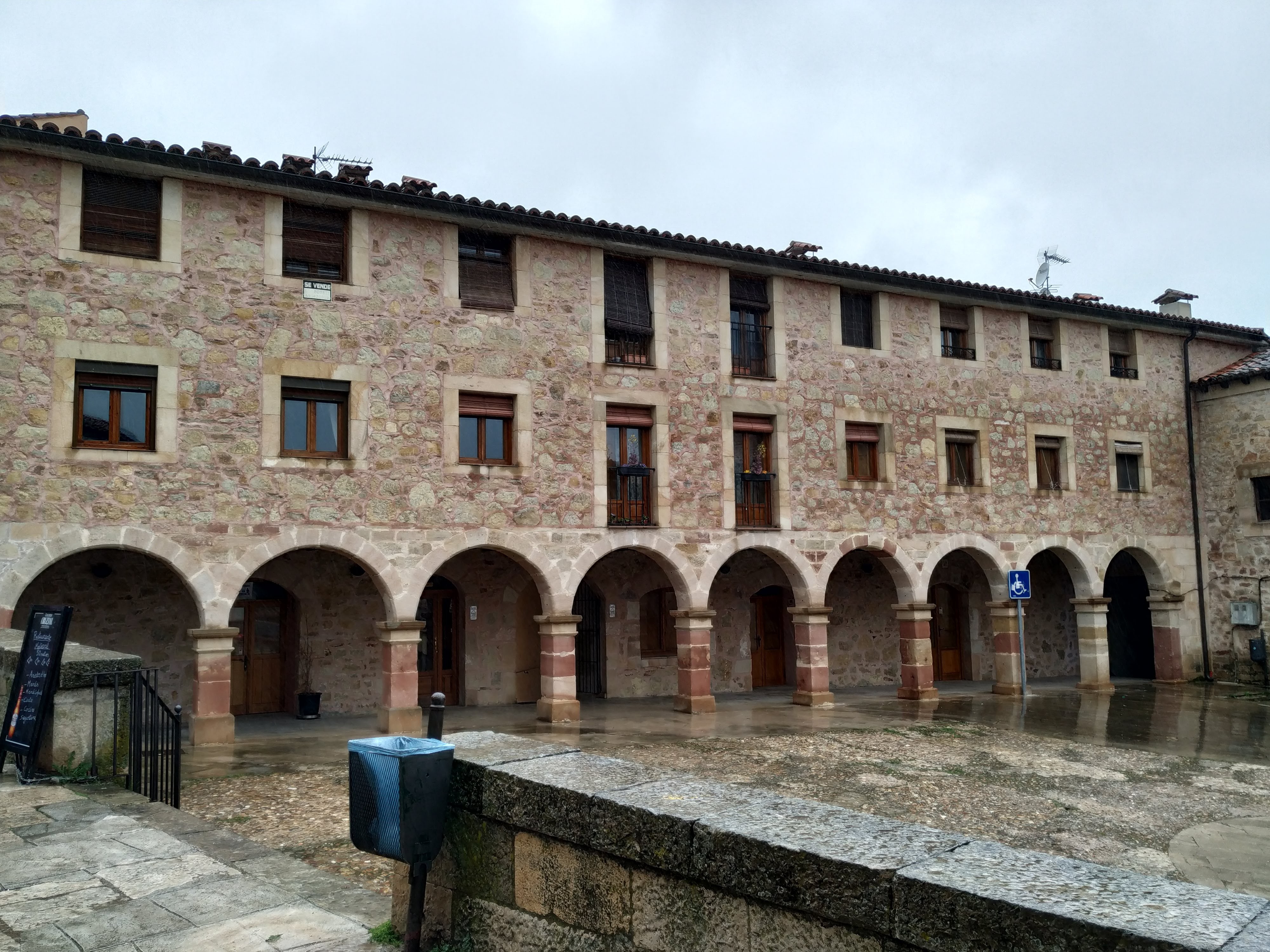
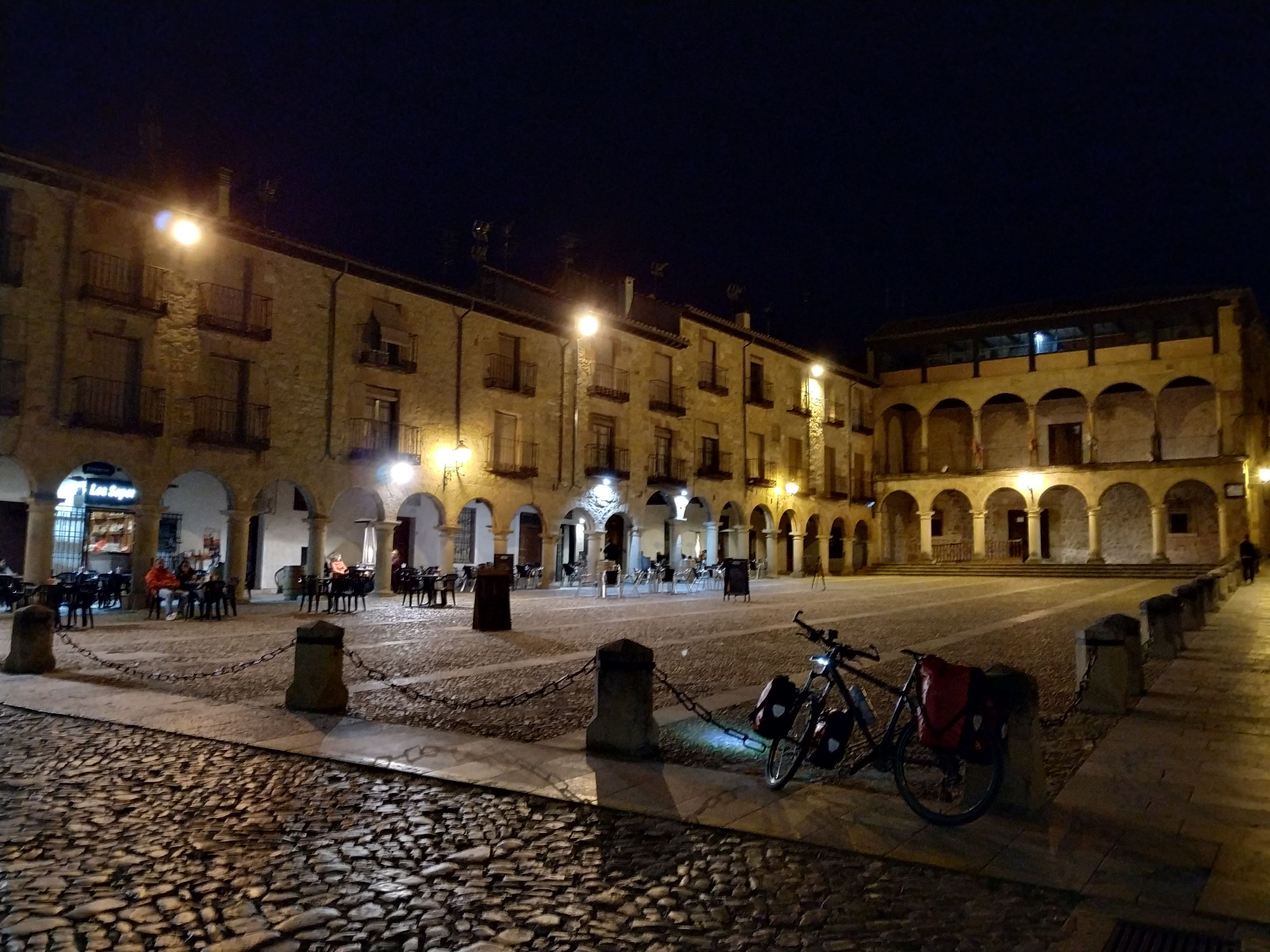
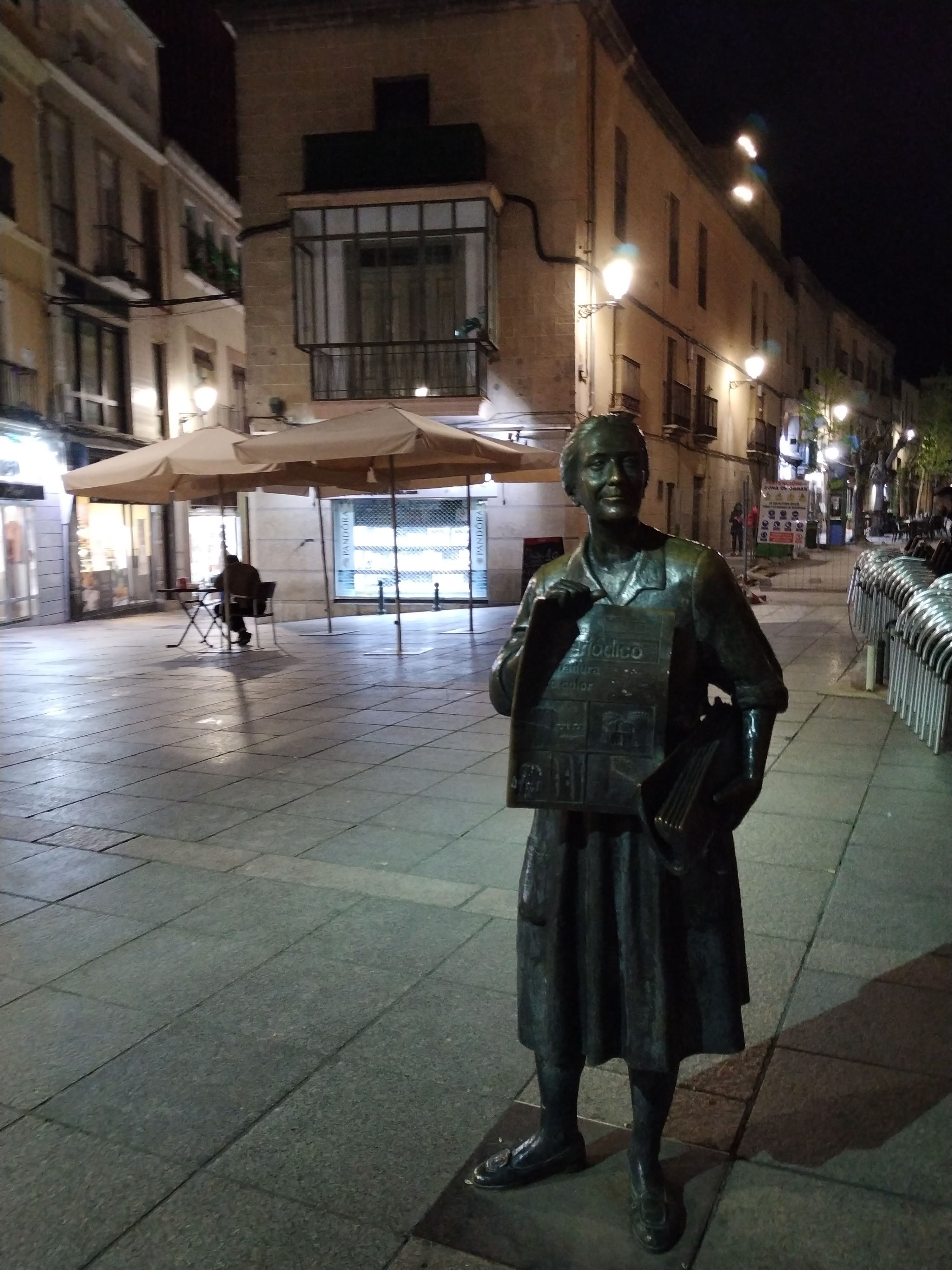
Plaza Mayor By night.
The cathedral by night.
Hostel room all to myself! Yay!

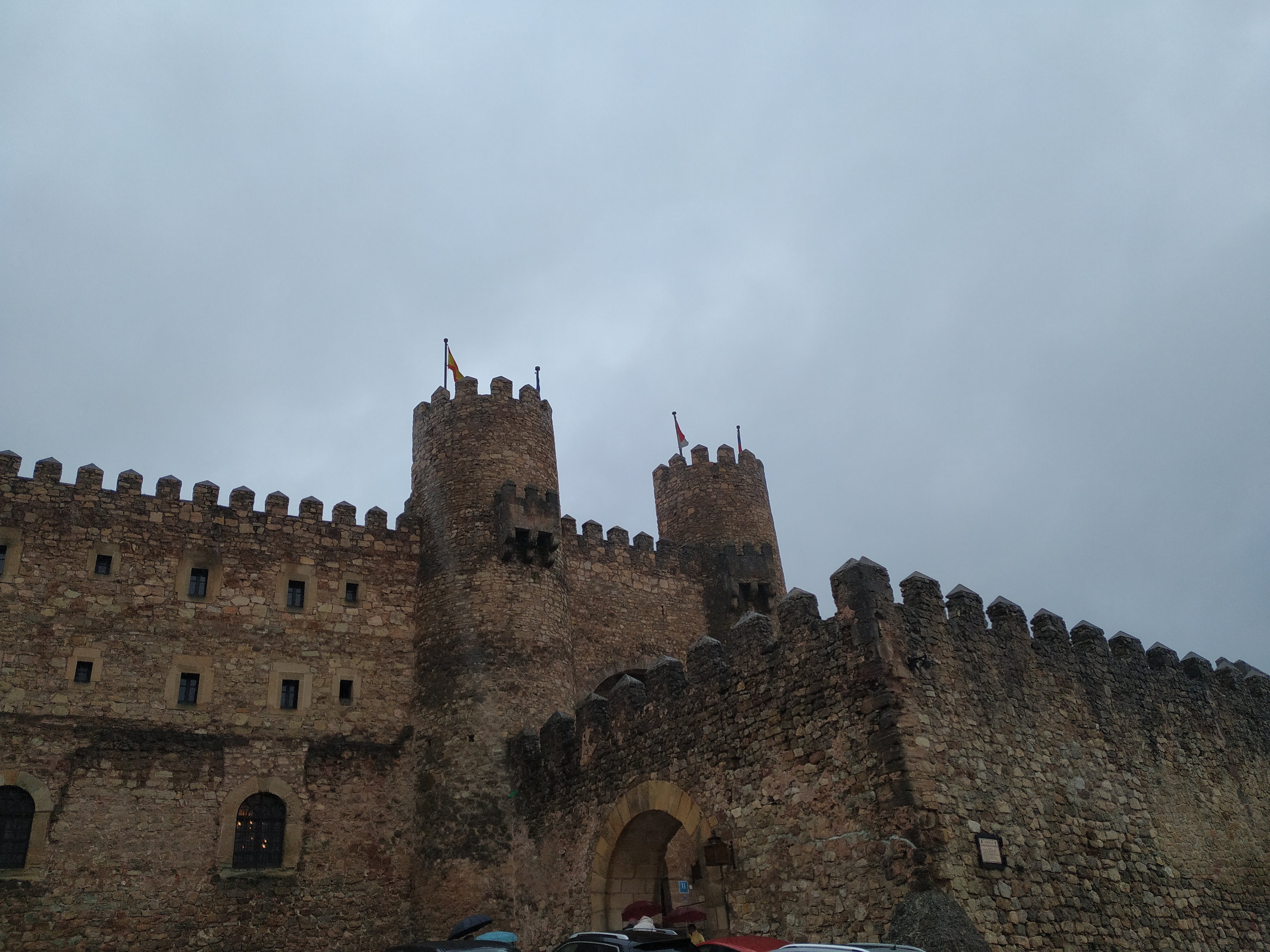
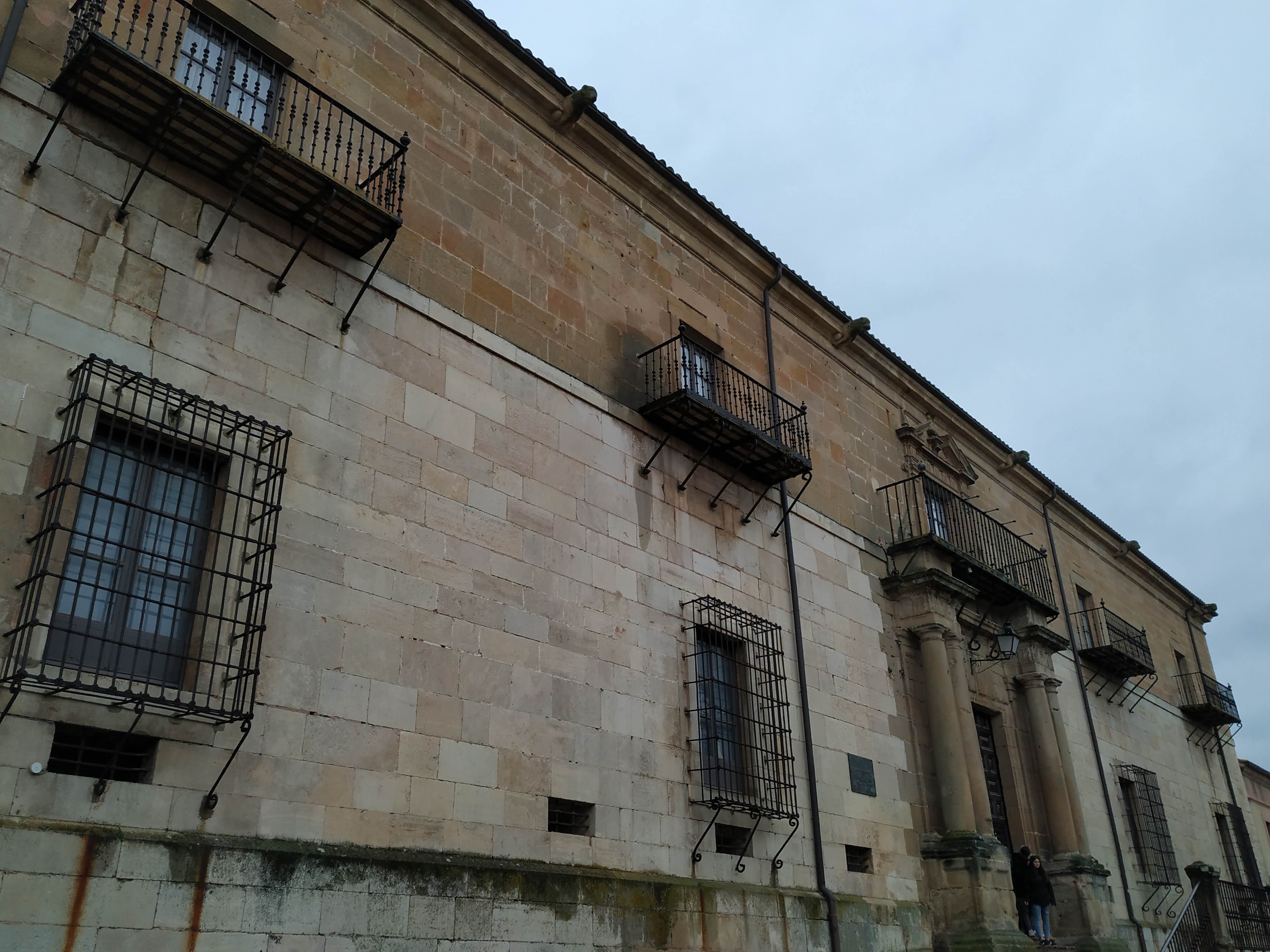
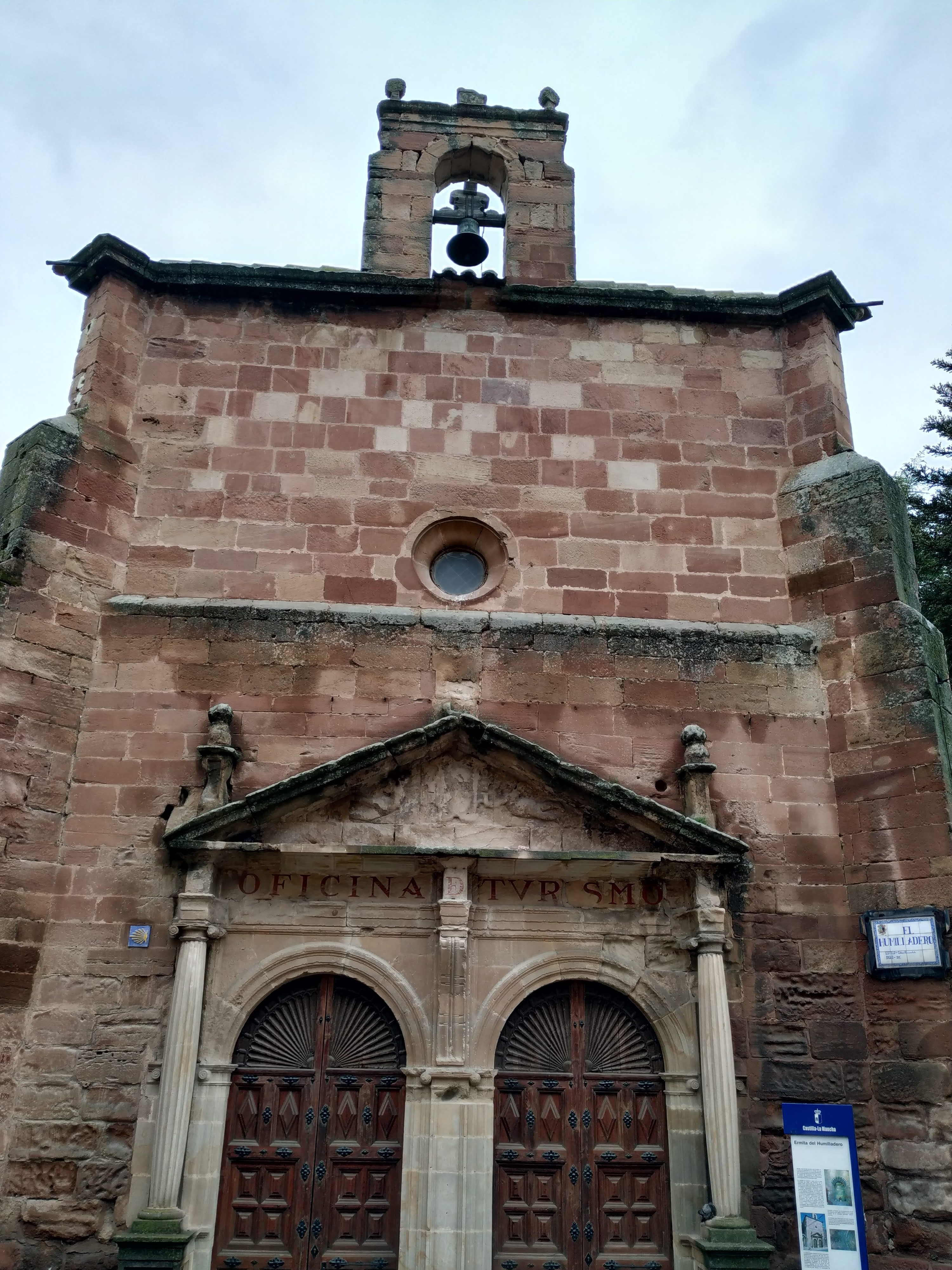
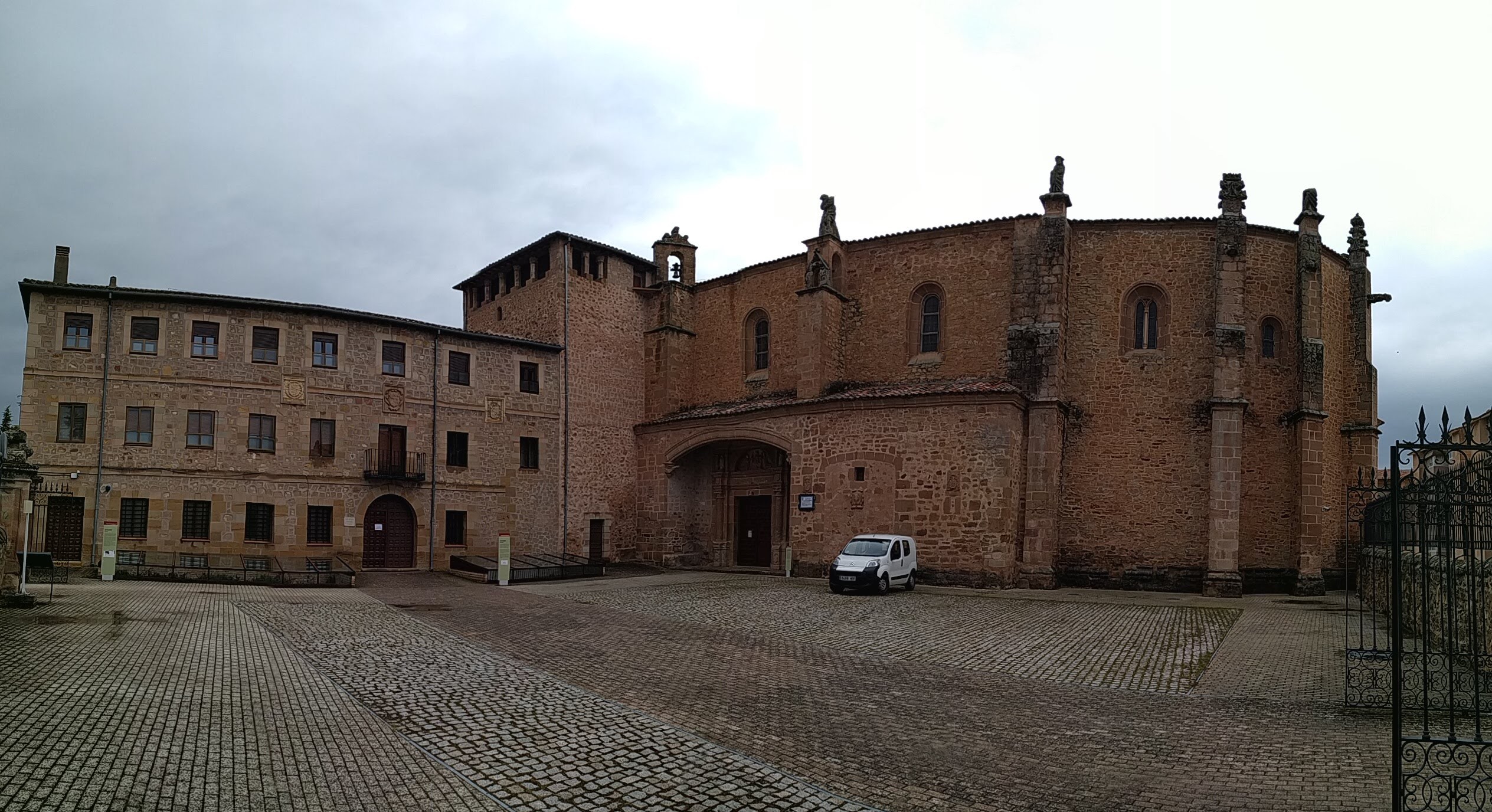
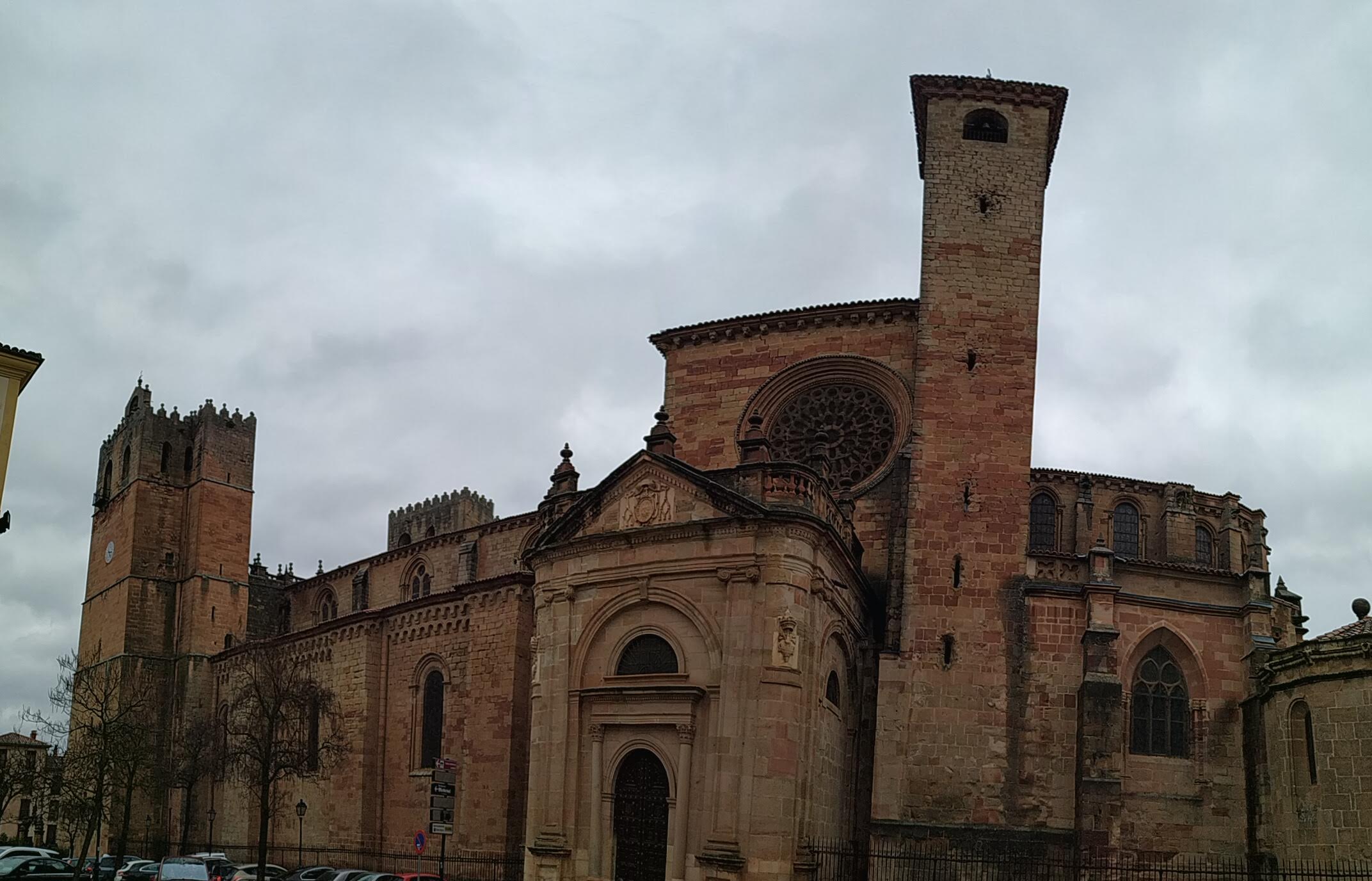
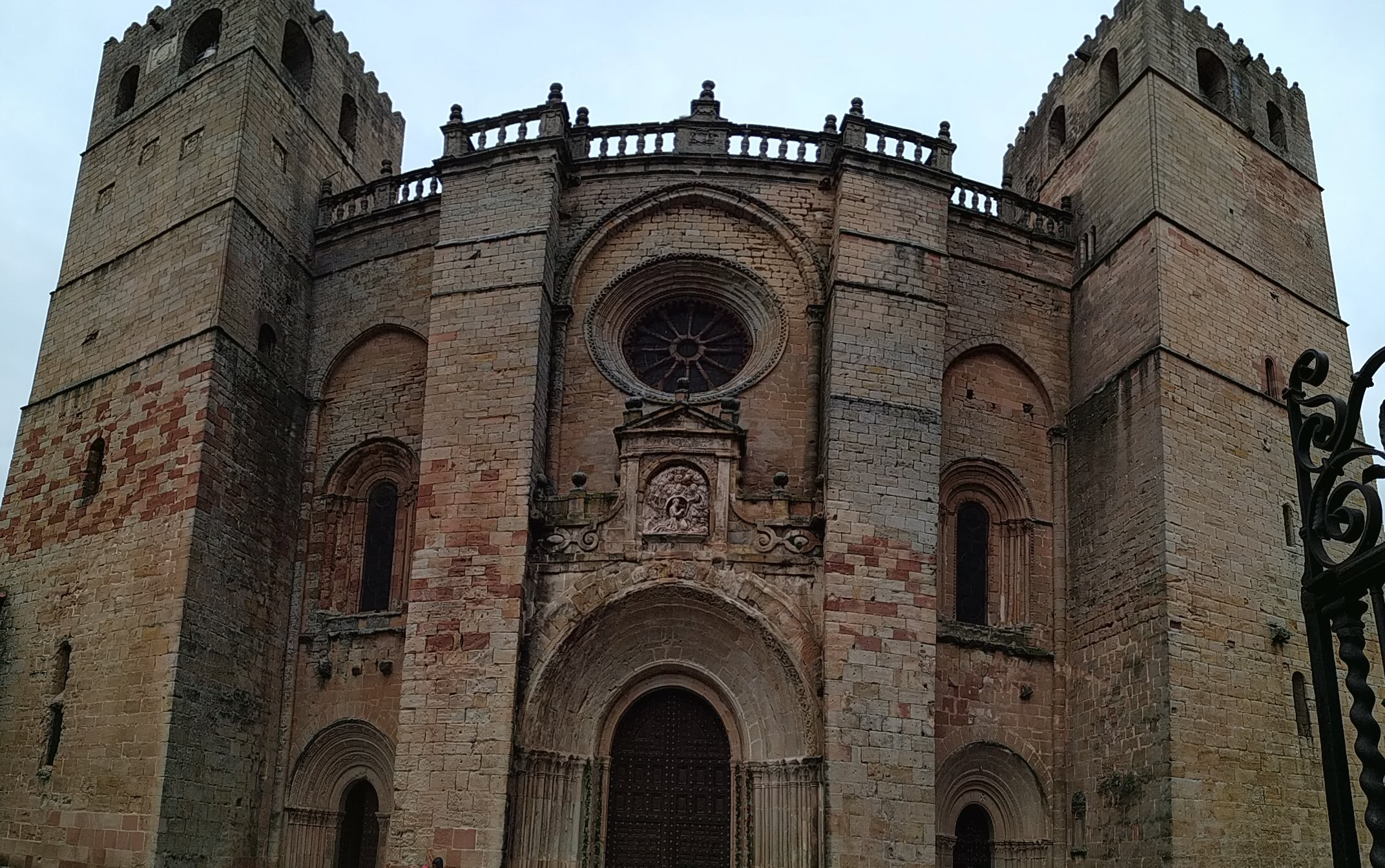
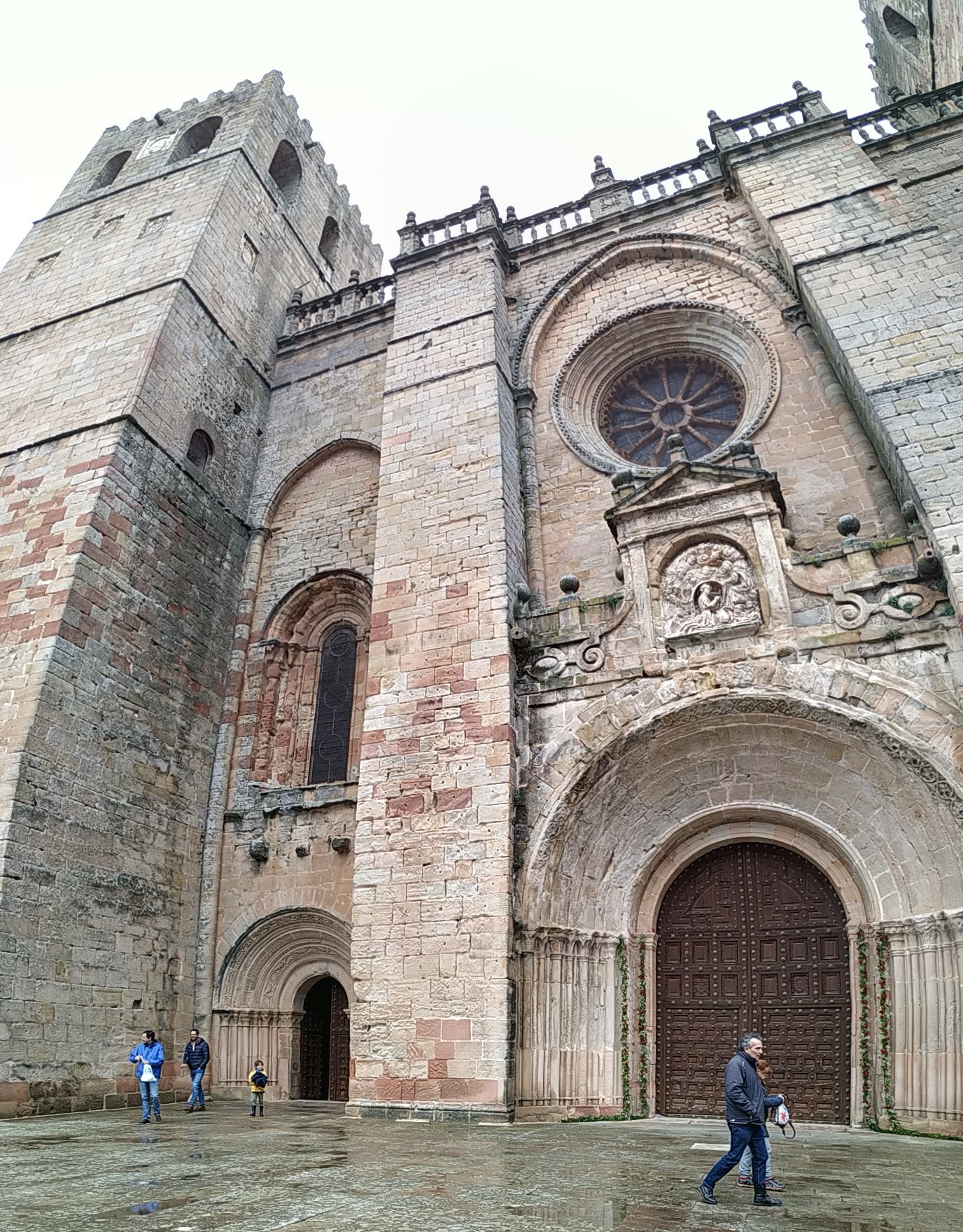
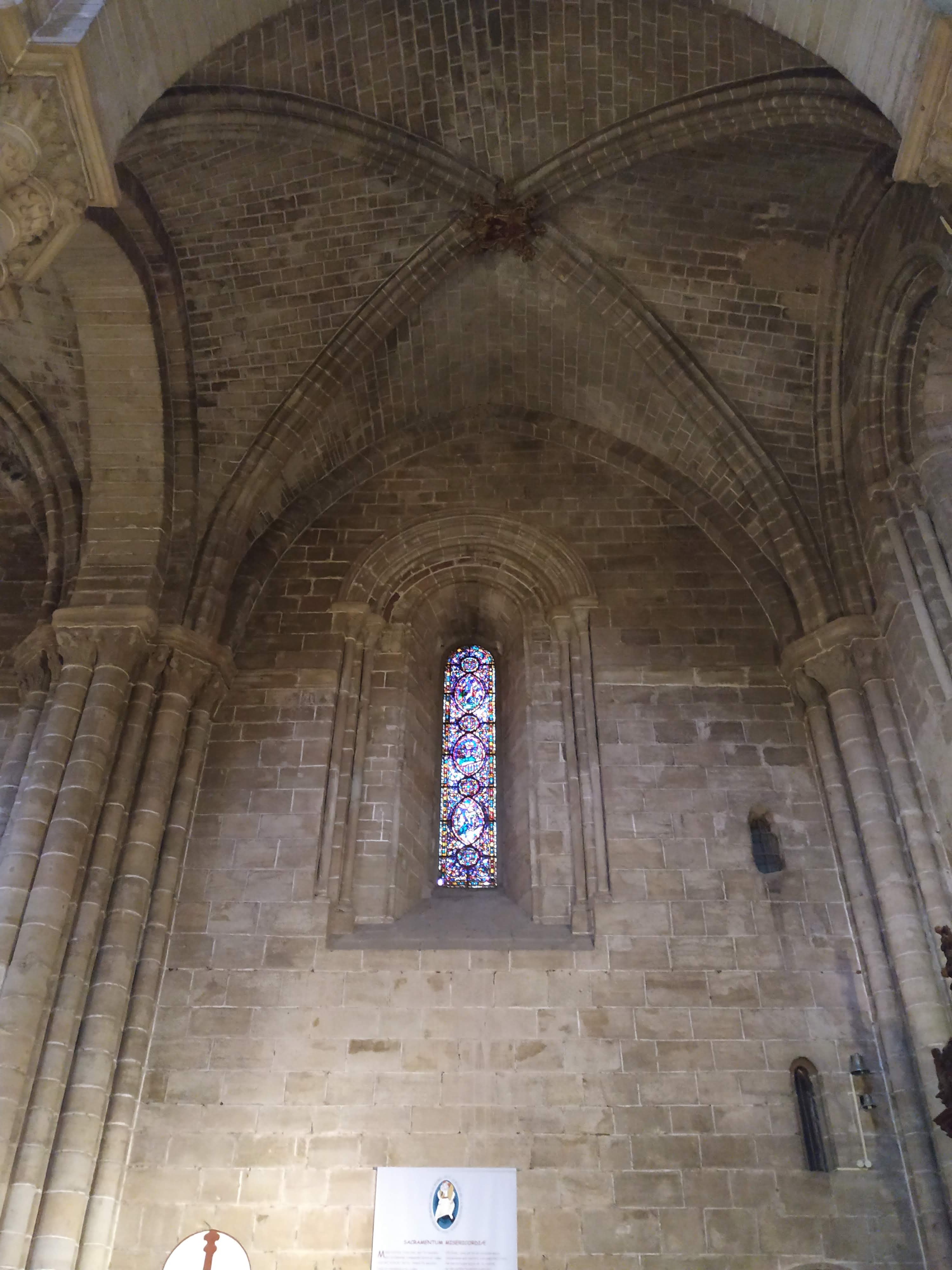
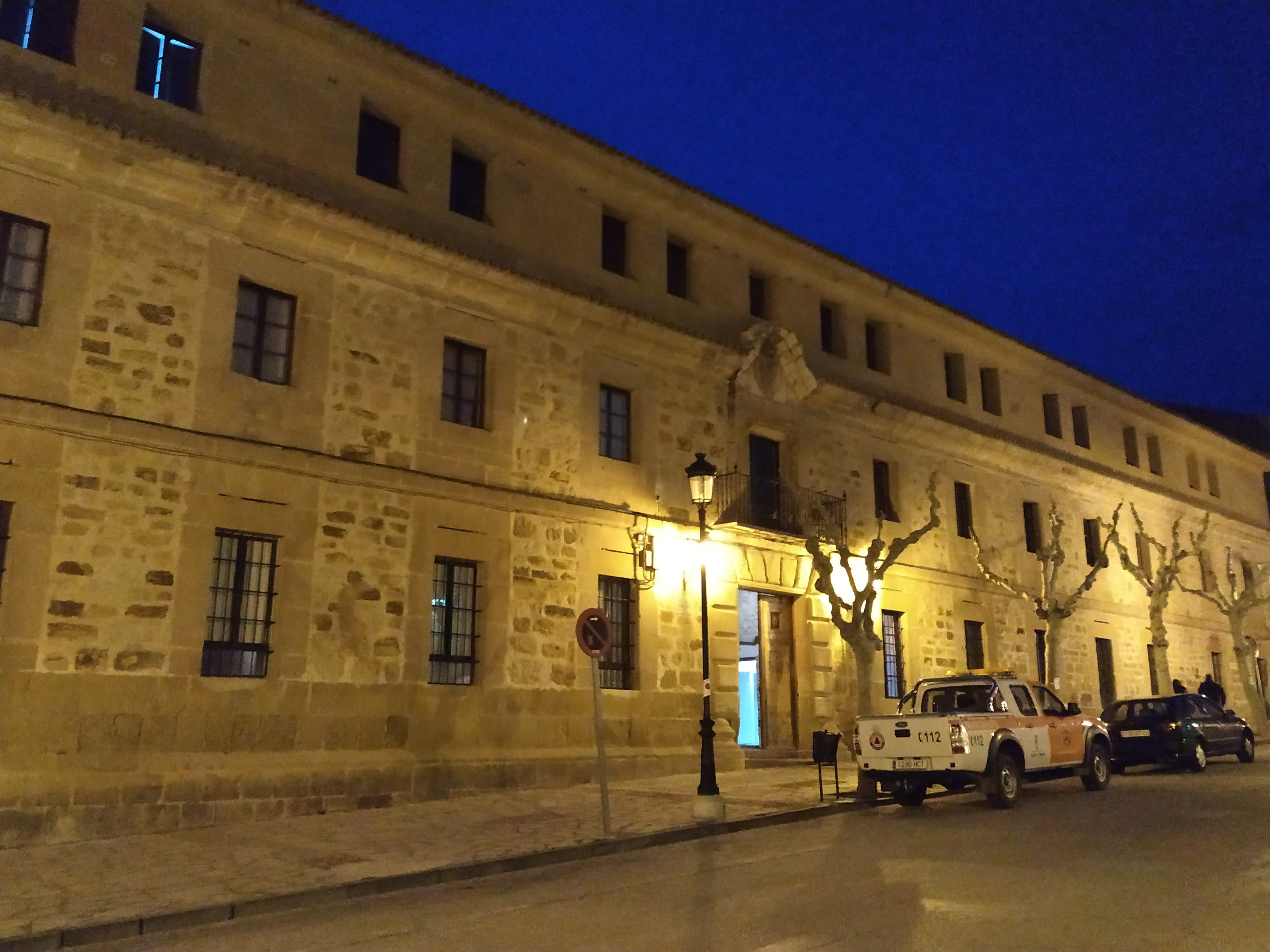
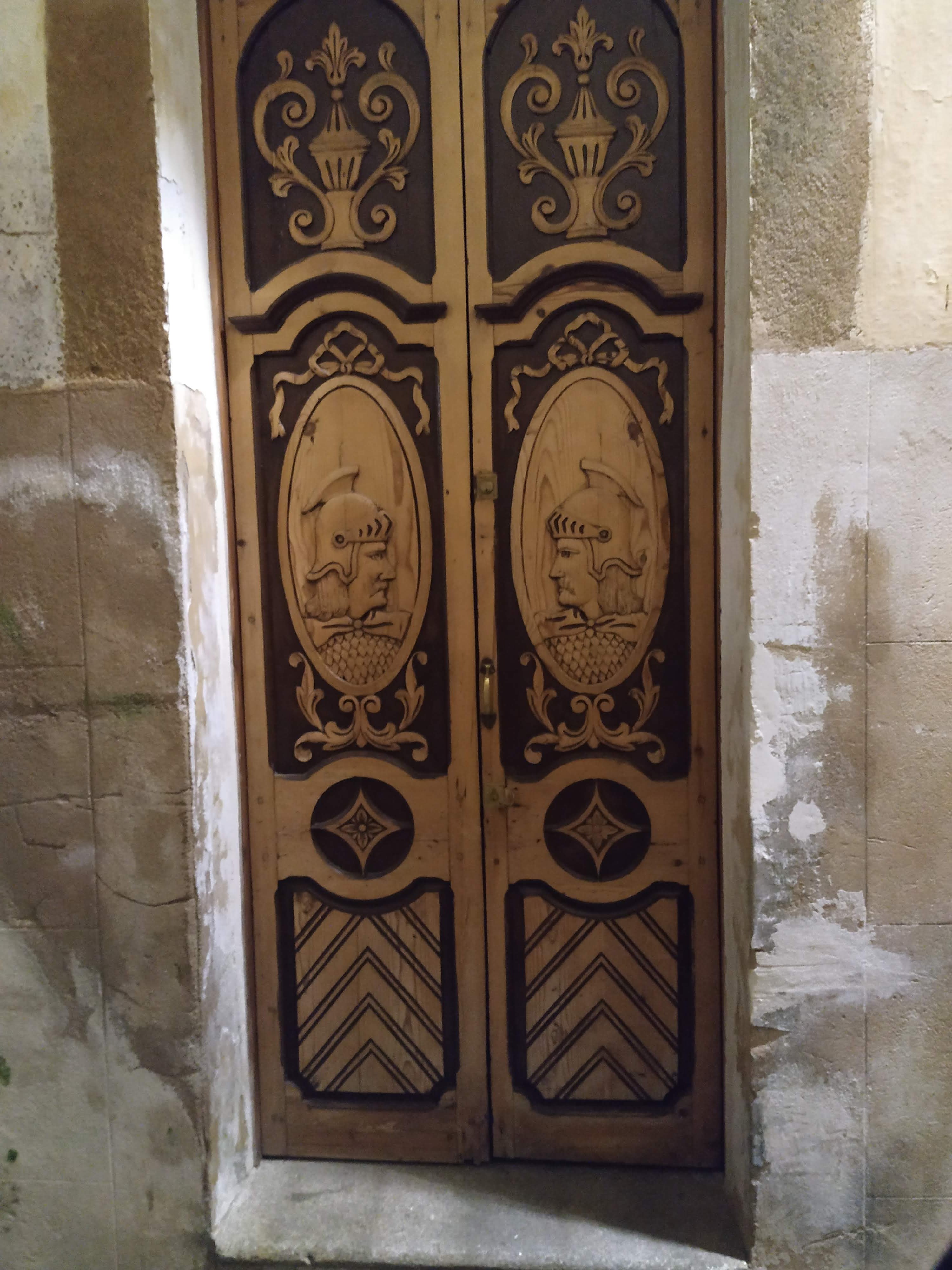
Sigüenza was a bishopric founded in the 12th century. As such, it features quite a large gothic cathedral, built over a roman one. It’s huge for the town’s size. It also got a castle, which has been converted to a hotel and is therefore not very interesting. Besides that, there’s an university from the 15th century, which no longer operates. A large chunk of the walls still exist, with many doorways around town. Without further ado, here are the pictures.
A view of the town, from the outside.
The aforementioned castle.
Plaza Mayor by day.
The cathedral by day.
The cathedral’s main entrance.

I then left Sigüenza into a 40 km/h headwind. Needless to say, I didn’t get far. The wind was just on the edge of what my tent can handle. Luckily, I found shelter.

There was no wind at all inside, and those boulders were way lighter than they looked, so with some work, I could get a tent in there. However, as night fell and I started to use a light, I realized the lack of wind was actually a problem: moving the boulders created a lot of really thin dust, so I settled for the upstairs and had a peaceful night.

Still got a ways to go today, so I’m signing off. Have a nice day.

Past suburbia

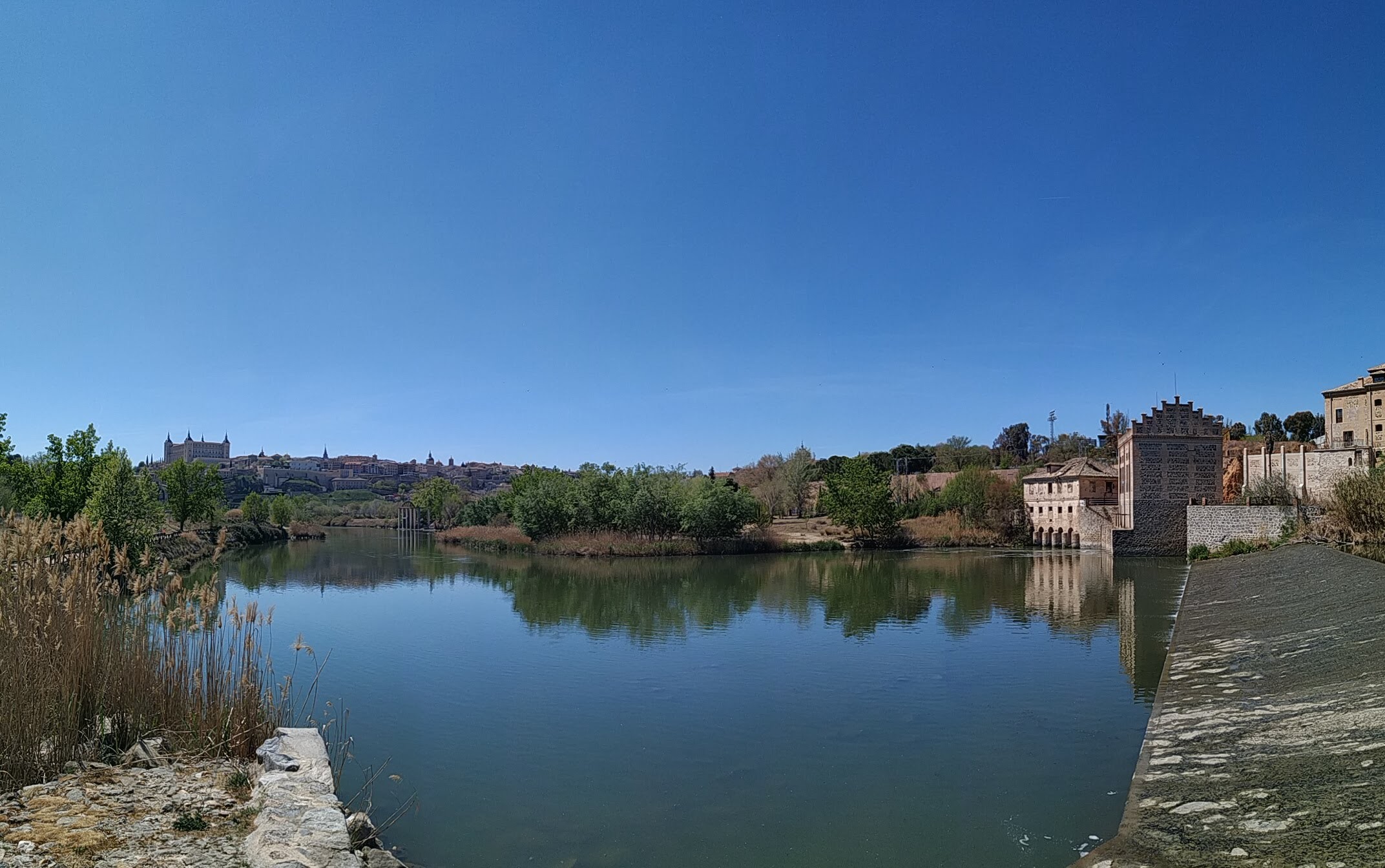
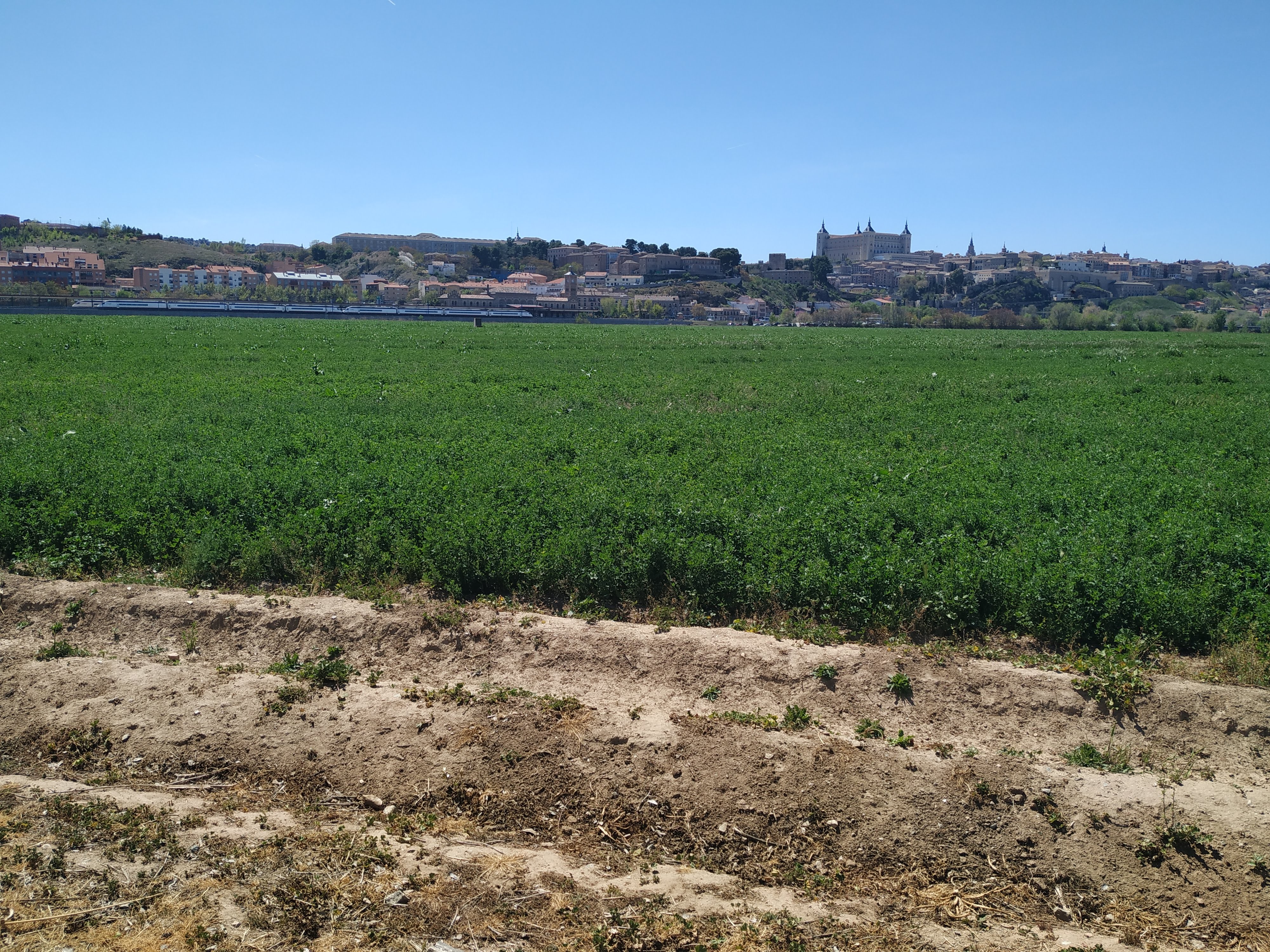
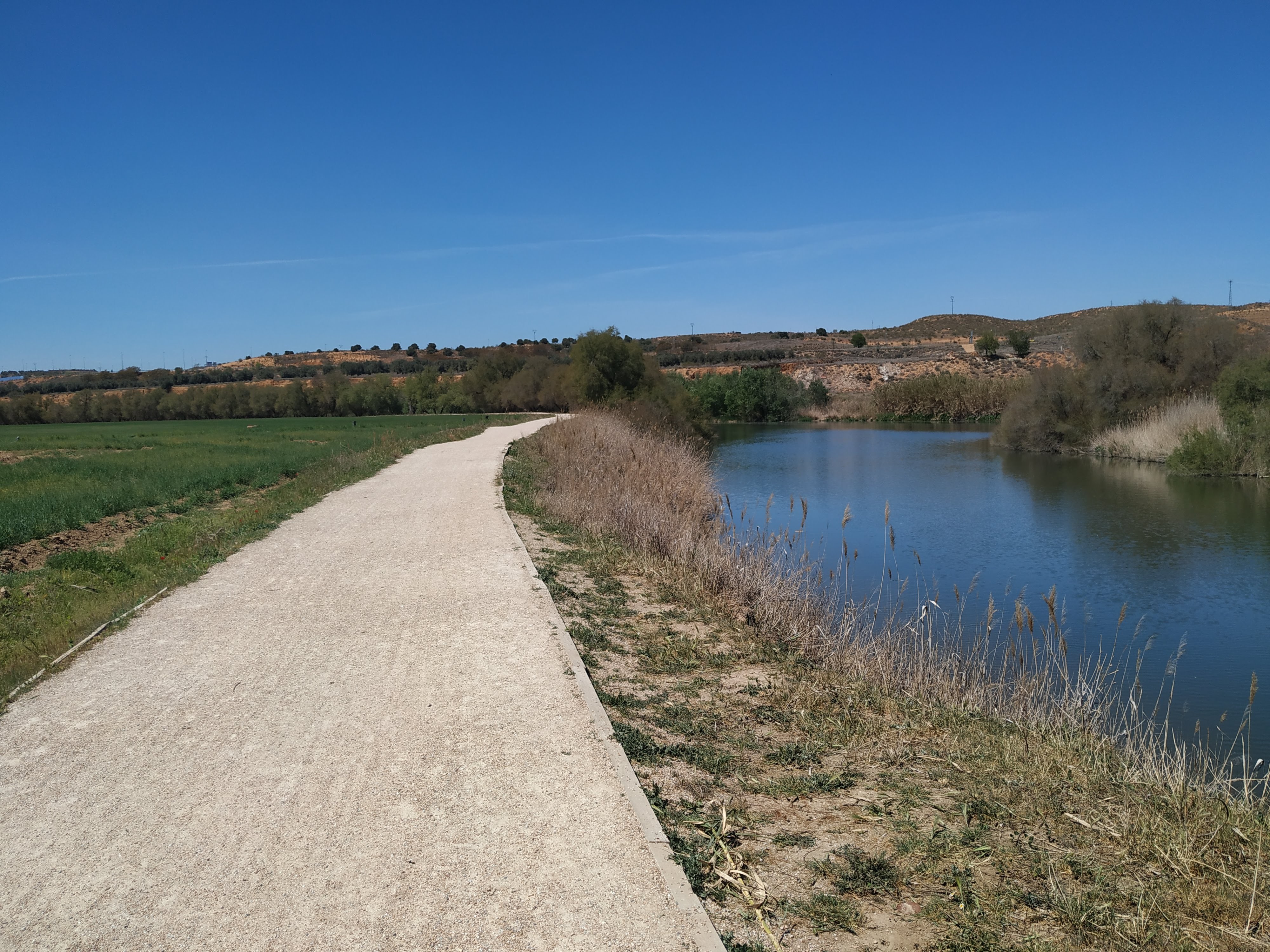
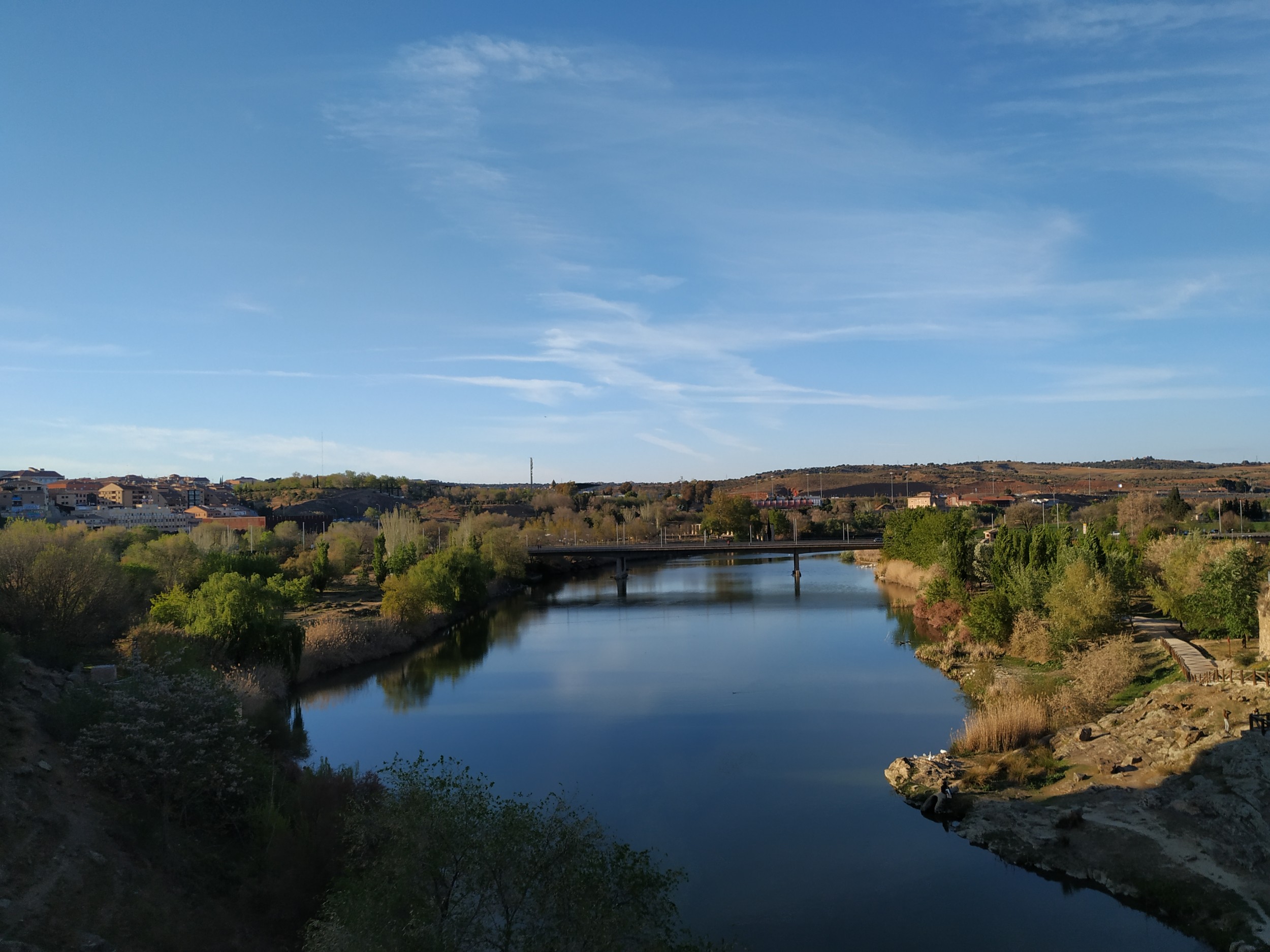
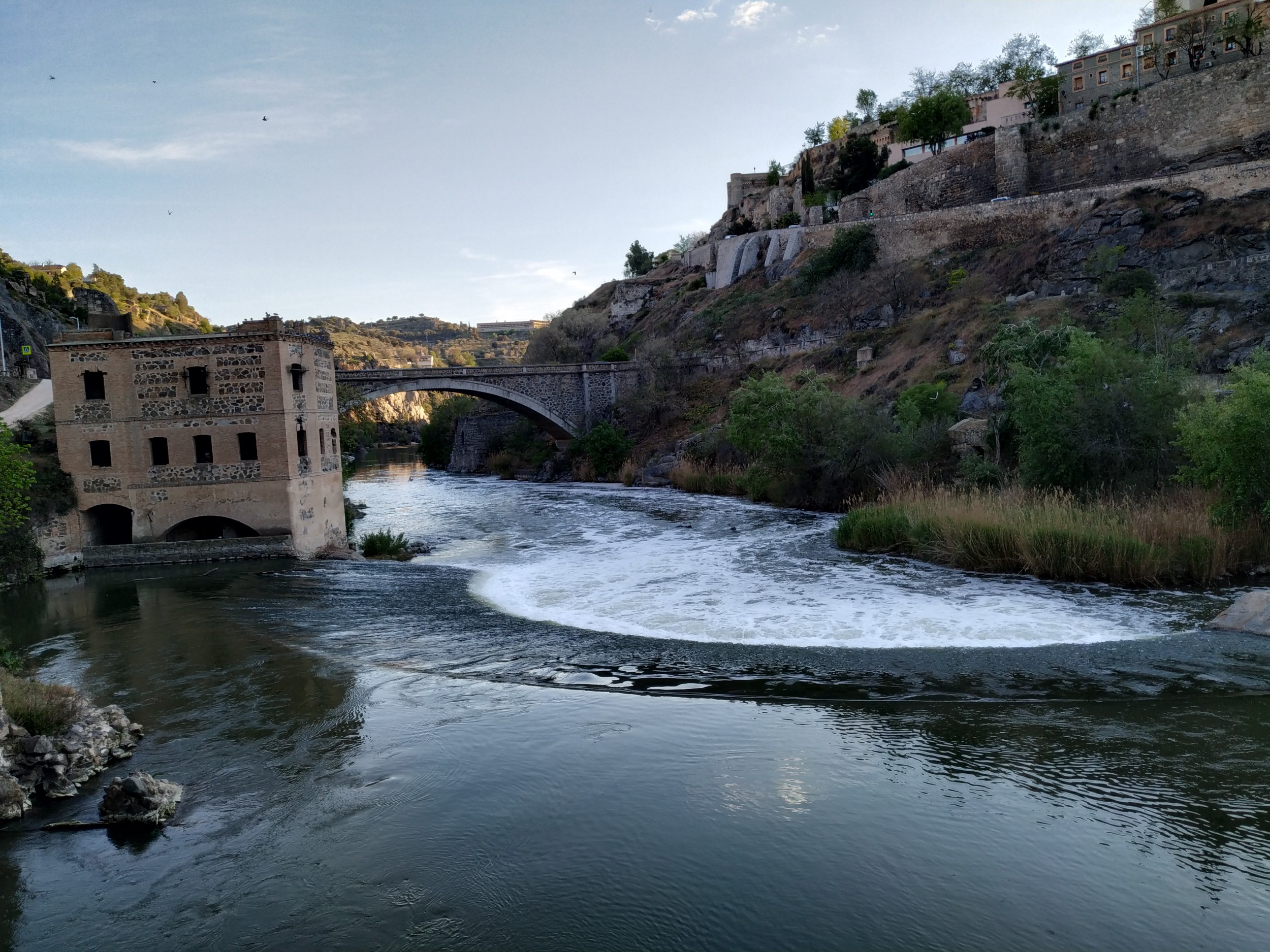
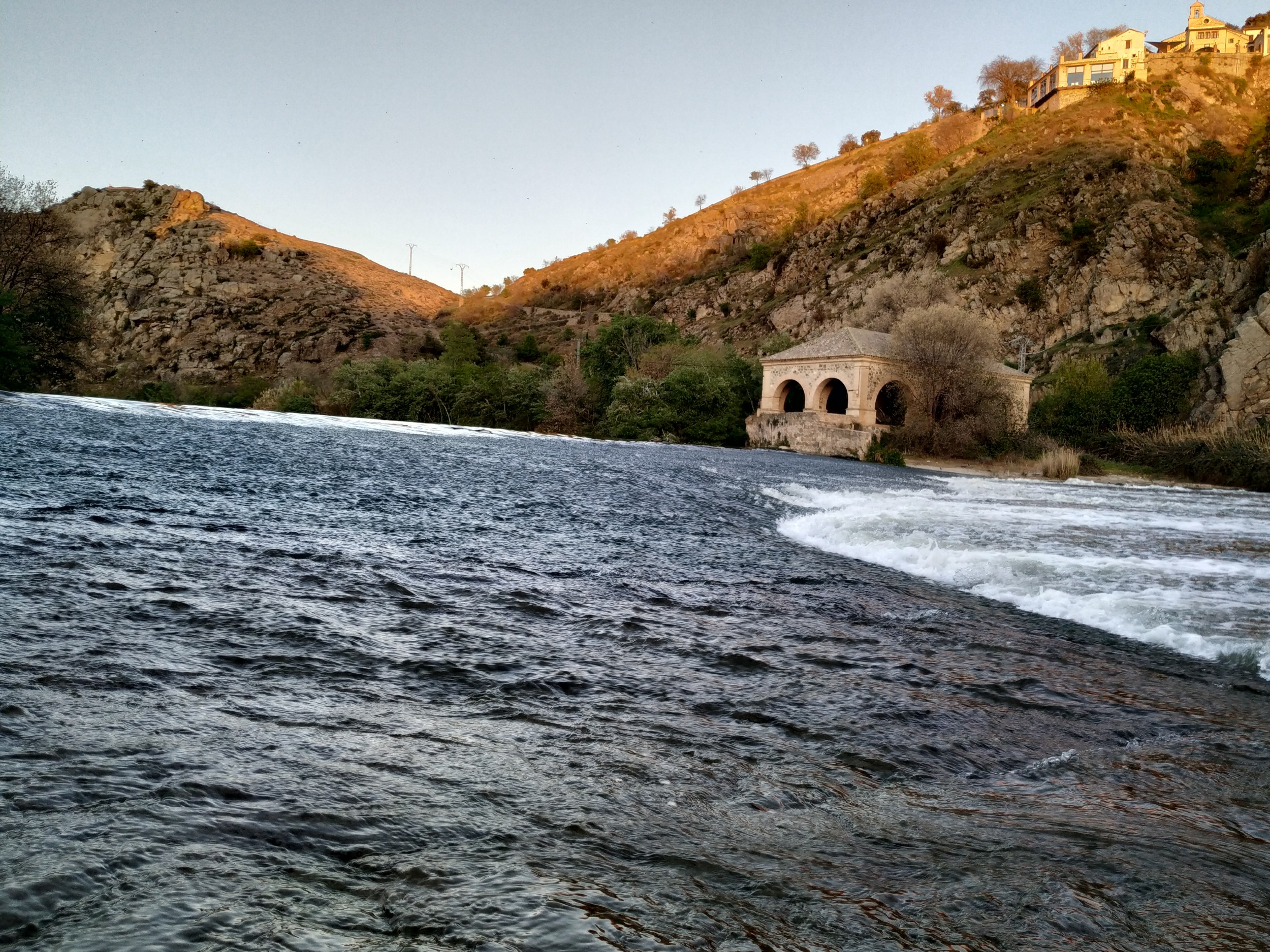
After leaving Toledo, there was this really nice path along the Tagus, with great views of the city. The sun had been shining for a couple of days, and would shine for a few more.

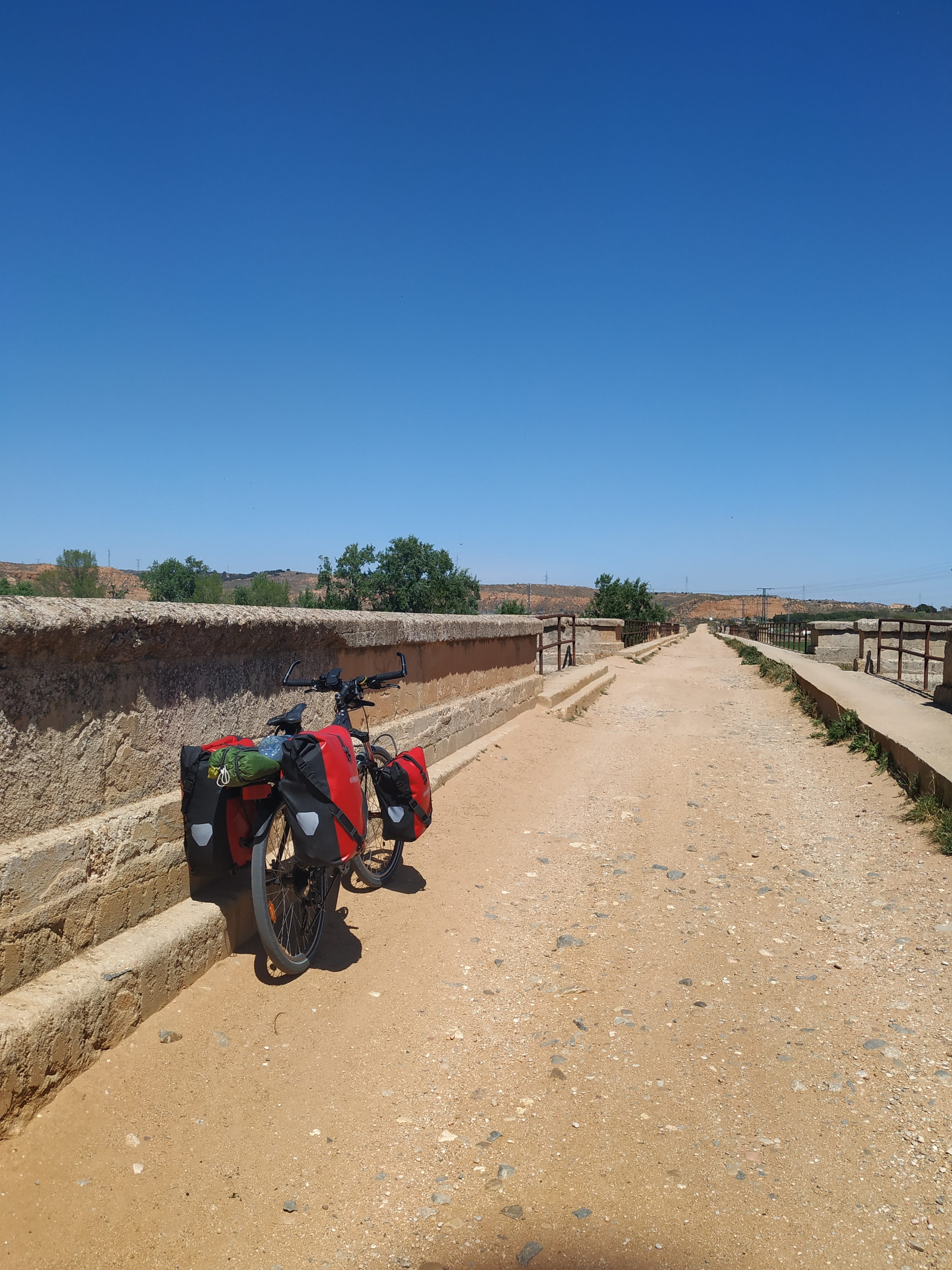
It was then time to cross the Tagus on an old, repurposed railway bridge.

This put me back into farm country, where I had a rather nice lunch.

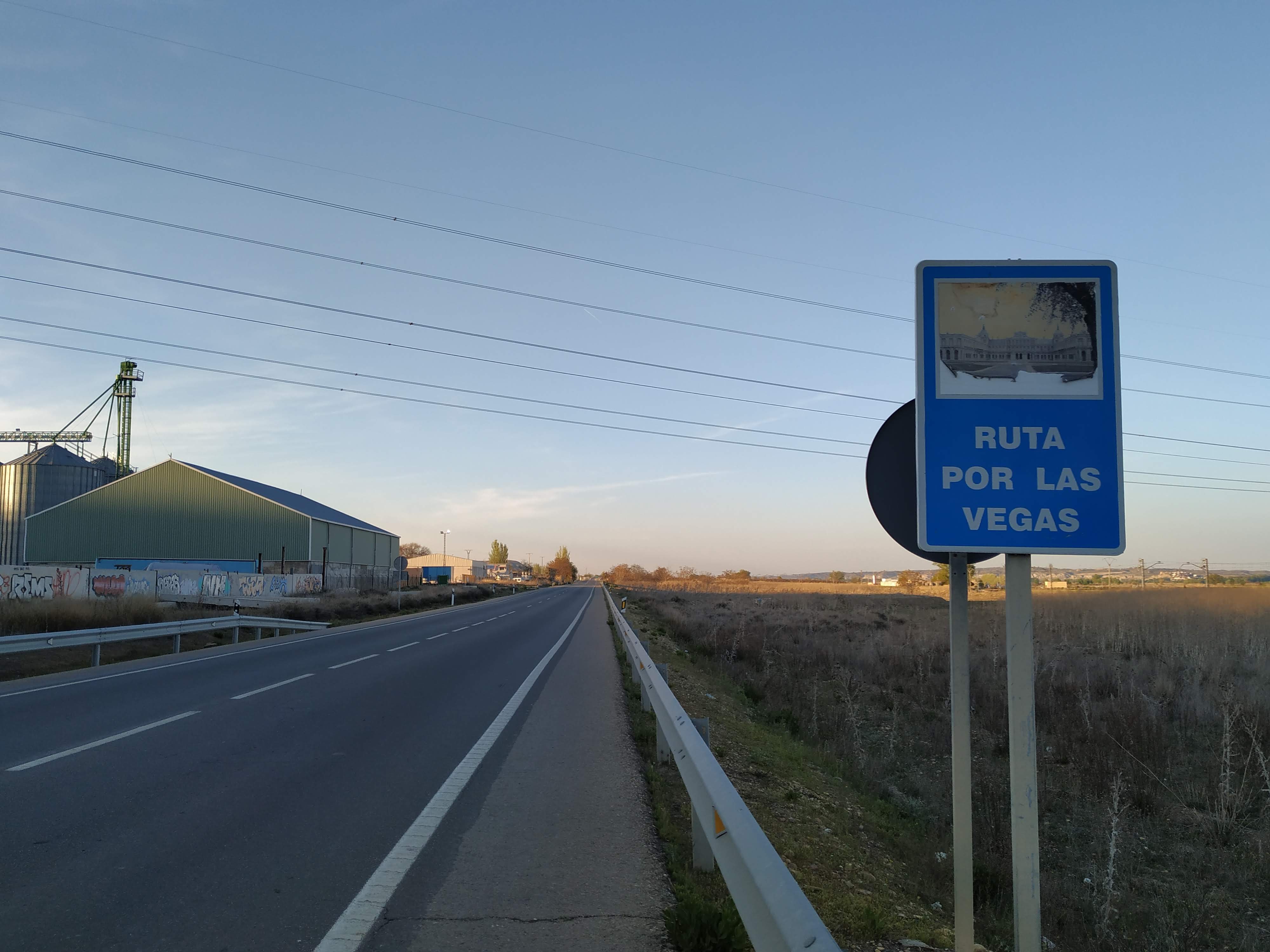
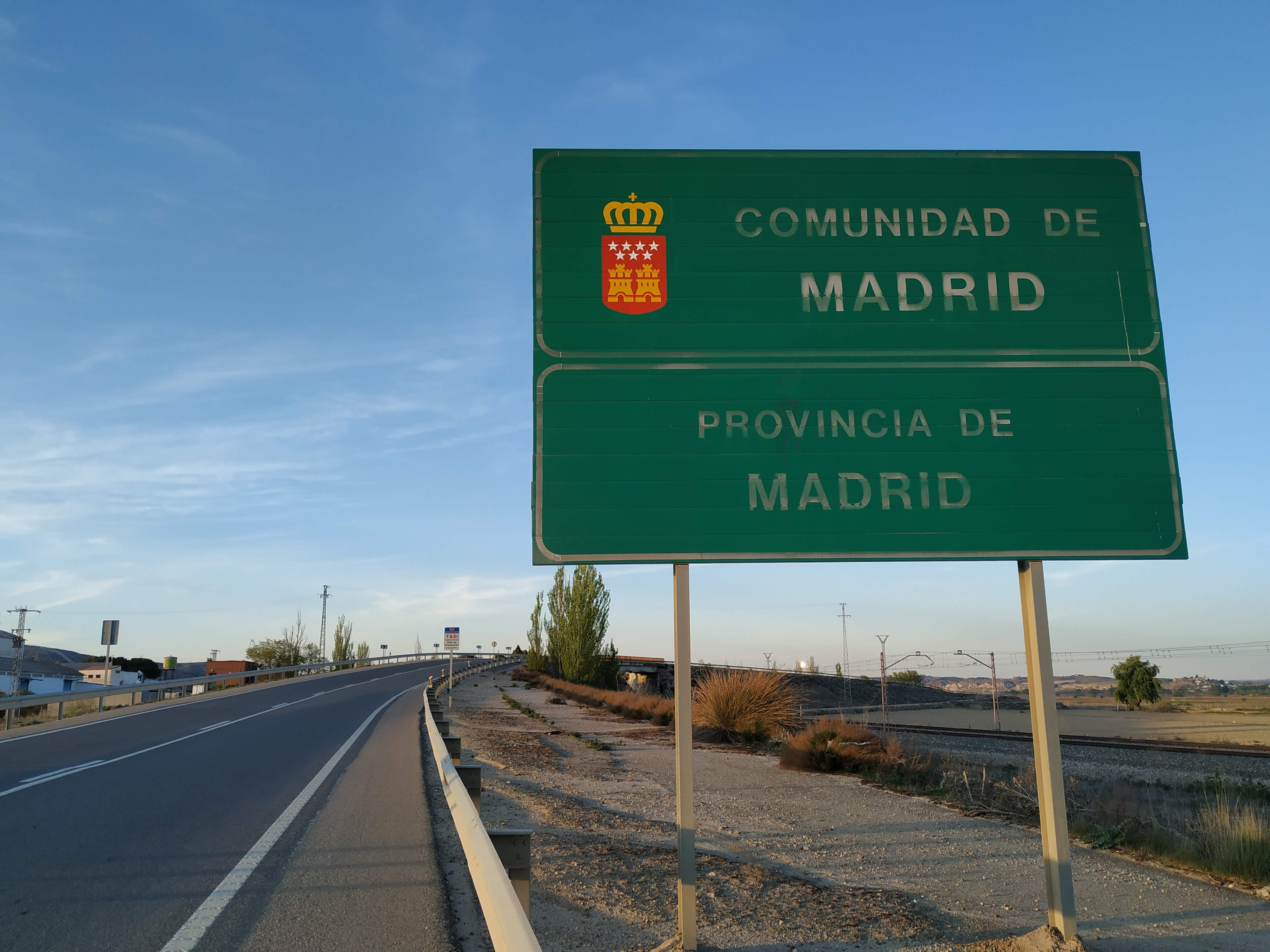
Then it was time to get inside the autonomous community of Madrid, through Las Vegas.

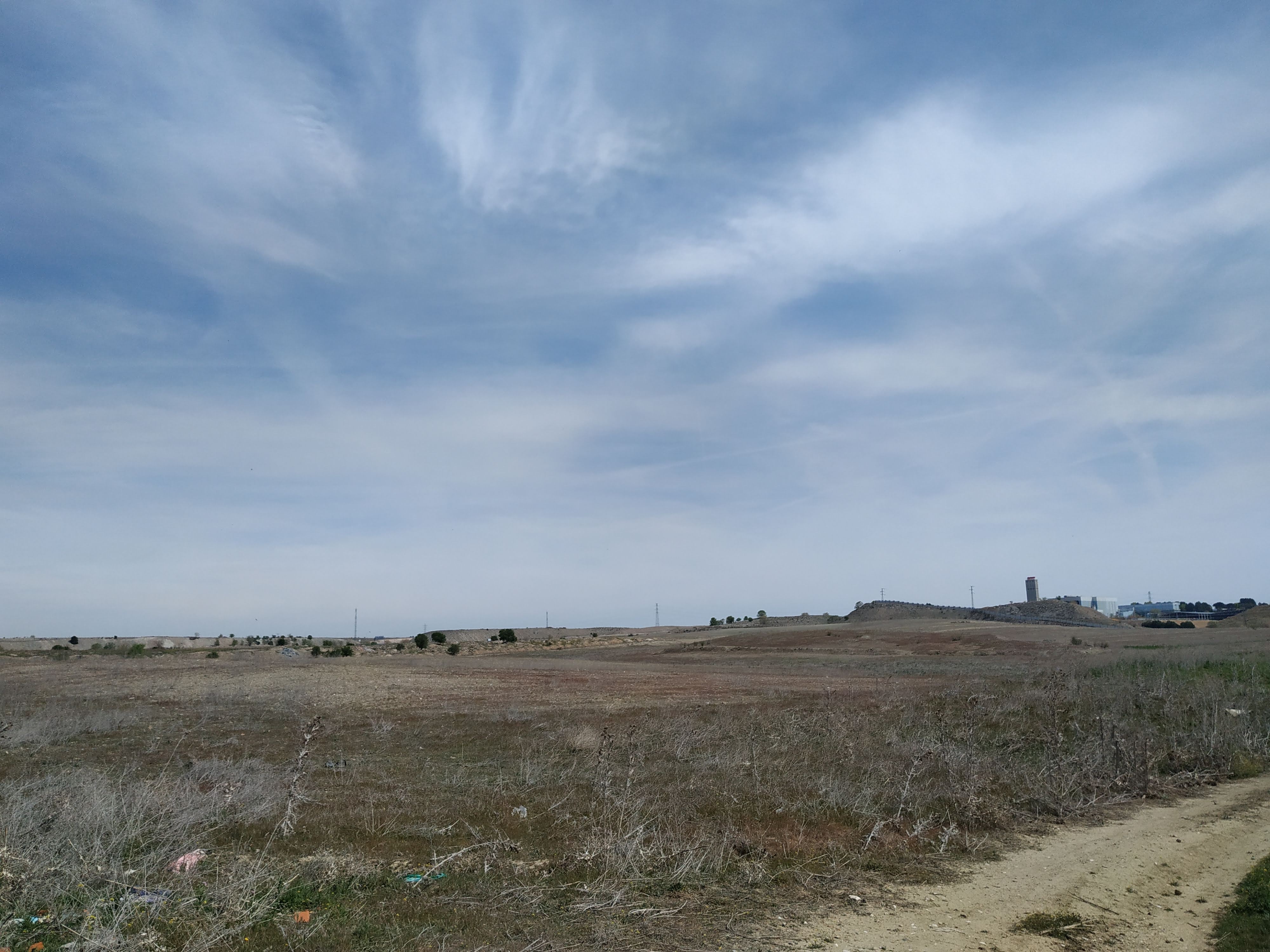
At first, the landscape was mostly the same as it had been up to here, but then it turned to a brown/grey soil, which looked like something out of the moon, only with more dead vegetation.

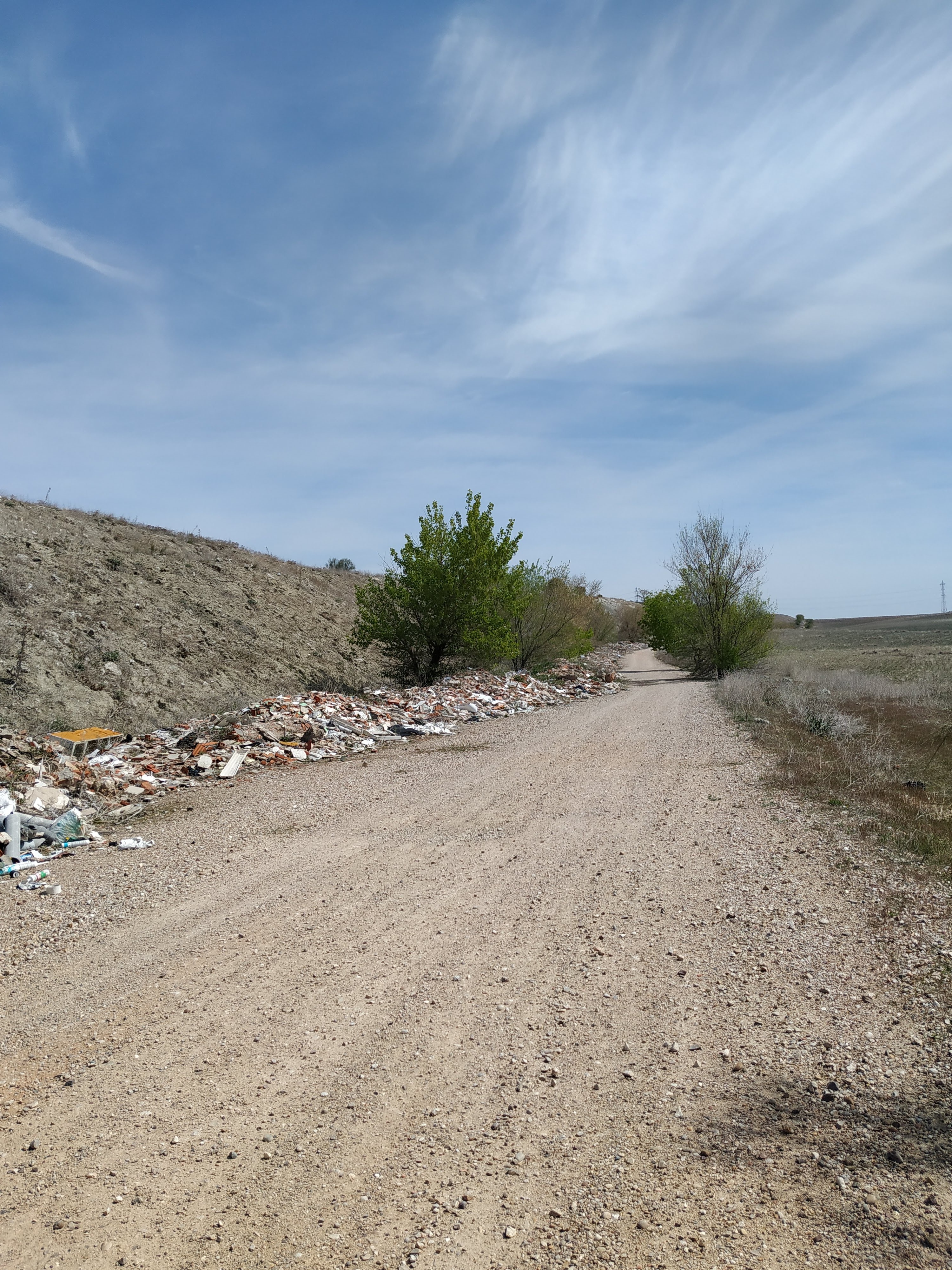
Worse still, I would pass by… well… a dump. If you’ve done any sort of rural dirt road, you probably have found garbage dumped alongside one of them. But this… this was the worst I’ve ever seen. It was like this for many kilometers, some of it even clearly visible from M-50, one of Madrid’s ring highways.

Hell, some of it is visible from space!

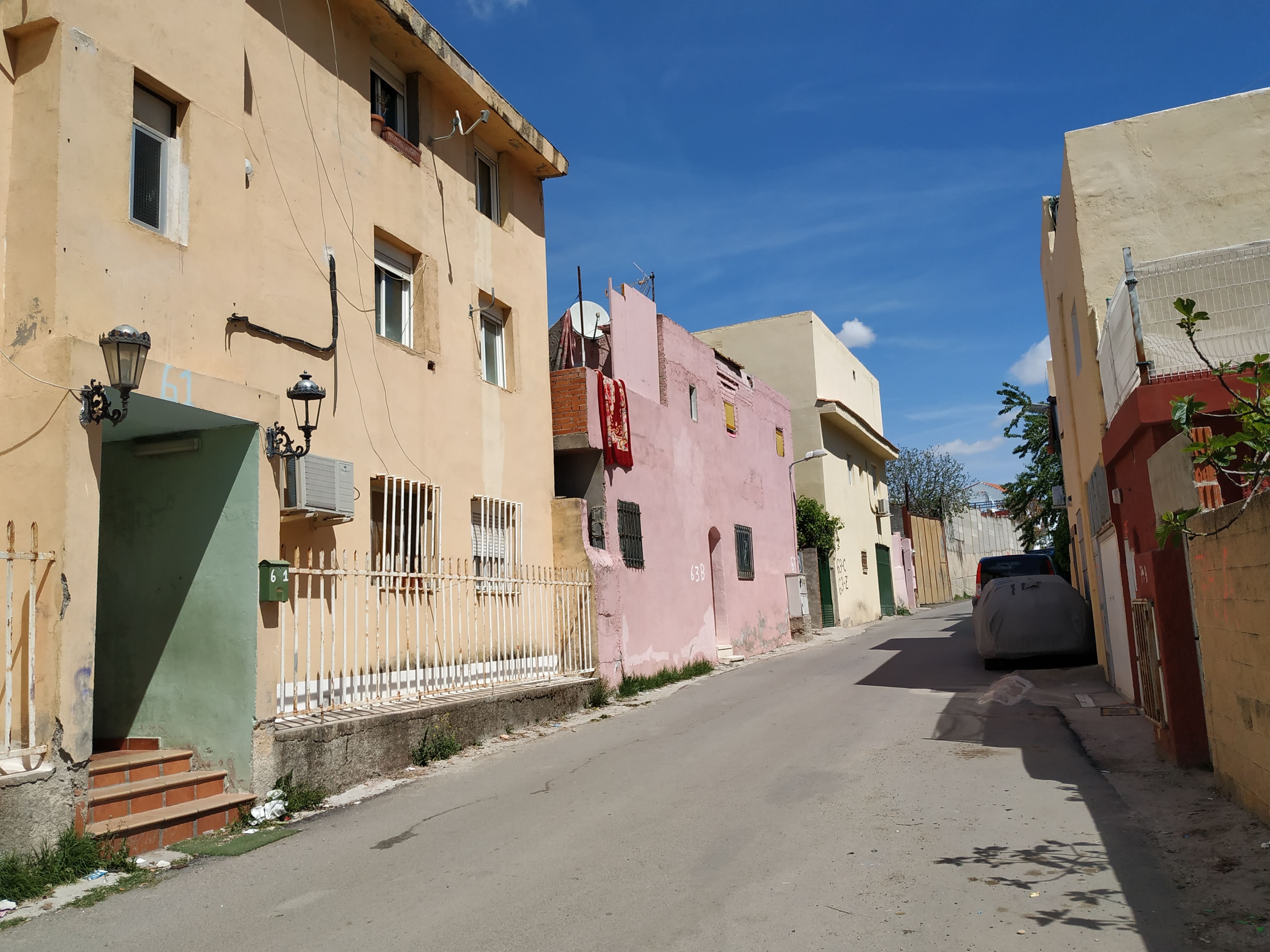
My route then took me through a rather dodgy looking neighborhood. The locals seemed friendly enough, though.

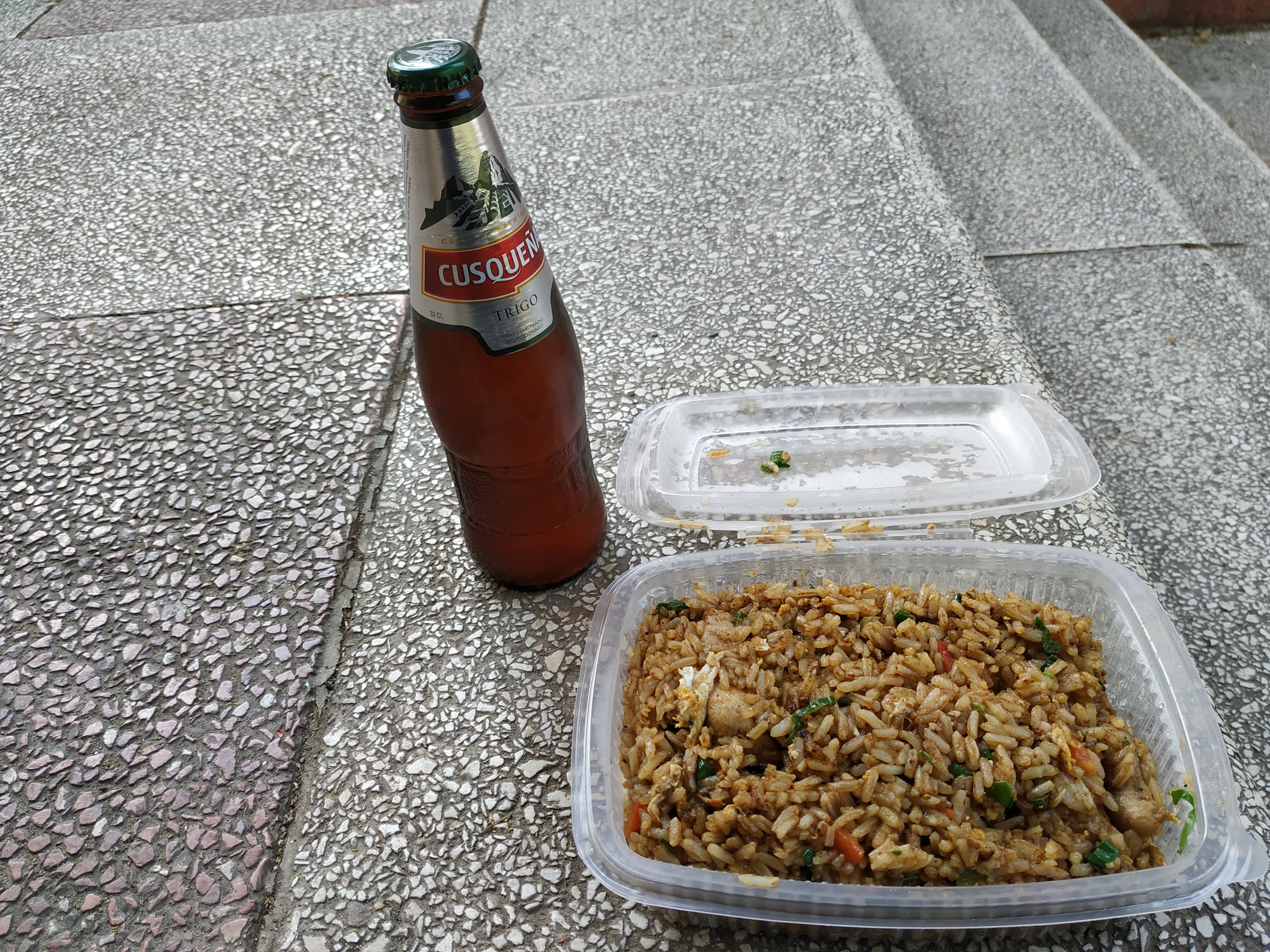
The rest of the day went by in a blur, in an effort to get out of suburbia. I couldn’t find out a place to eat. There was a Peruvian takeout place, though. In the end, the only things worthy of note were:

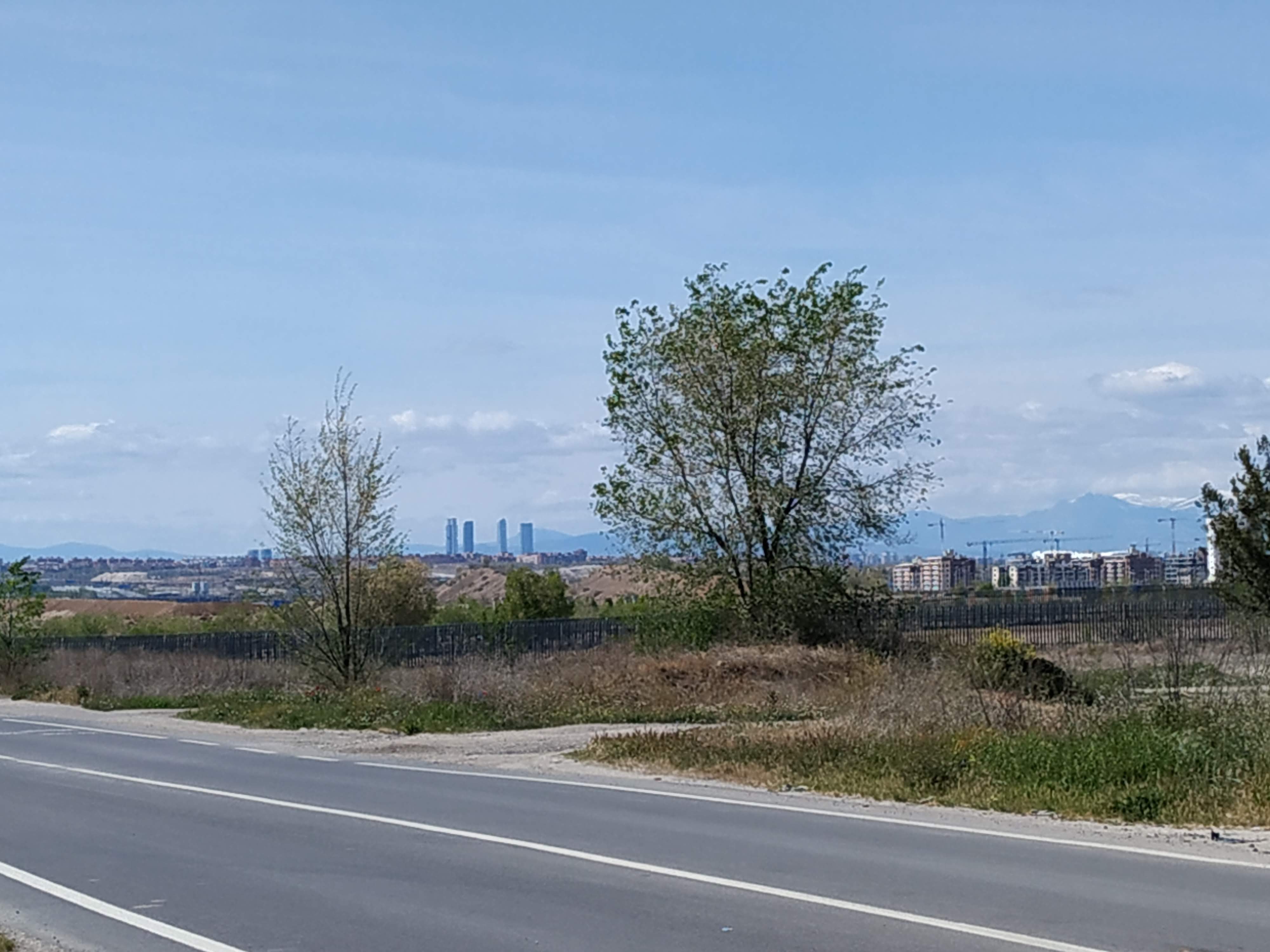
1 – you can see Madrid’s skyscrapers, even from a good 15km away.

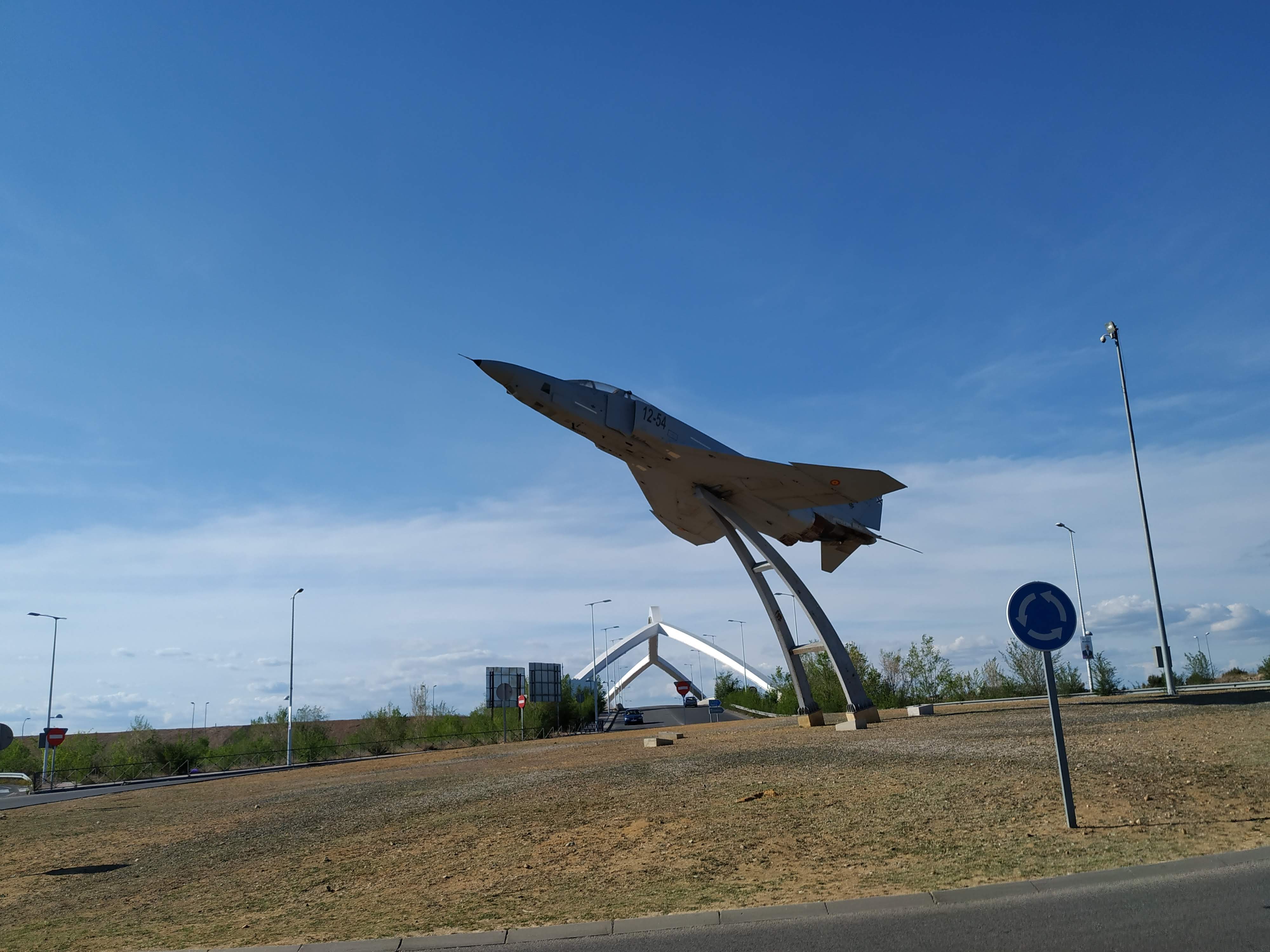
2 – the town of Torrejón de Ardoz. Not because it’s particularly interesting but because it has… a jet fighter roundabout. Your town does not have a jet fighter roundabout, therefore your town isn’t as cool as Torrejón de Ardoz. Sorry.

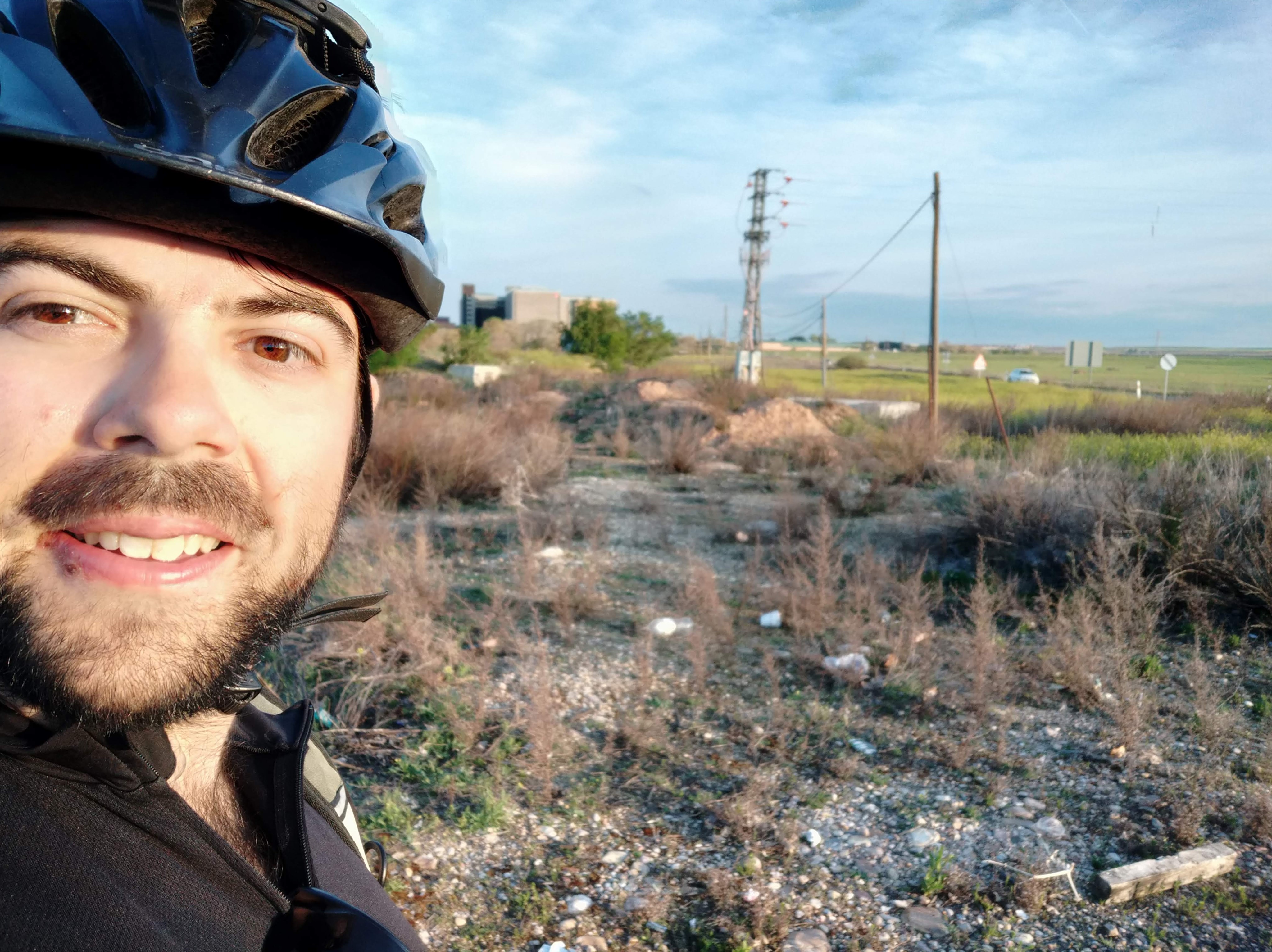
Throughout eastern Extremadura and Castilla-La Mancha, I’ve been seeing scores of rabbits and a few hares. They’re extremely scaredy, though. I’ve finally come across a few I’d thought I’d be able to take a selfie with. I think I didn’t succeed.

There were a few rabbits there. Just… take my word for it. 😦

At this point, I’ve come across the first road without a hard shoulder ever since I’ve entered Spain. The Spanish drivers were respectful as ever, but I’d gotten used to the extra space the shoulder gave me.

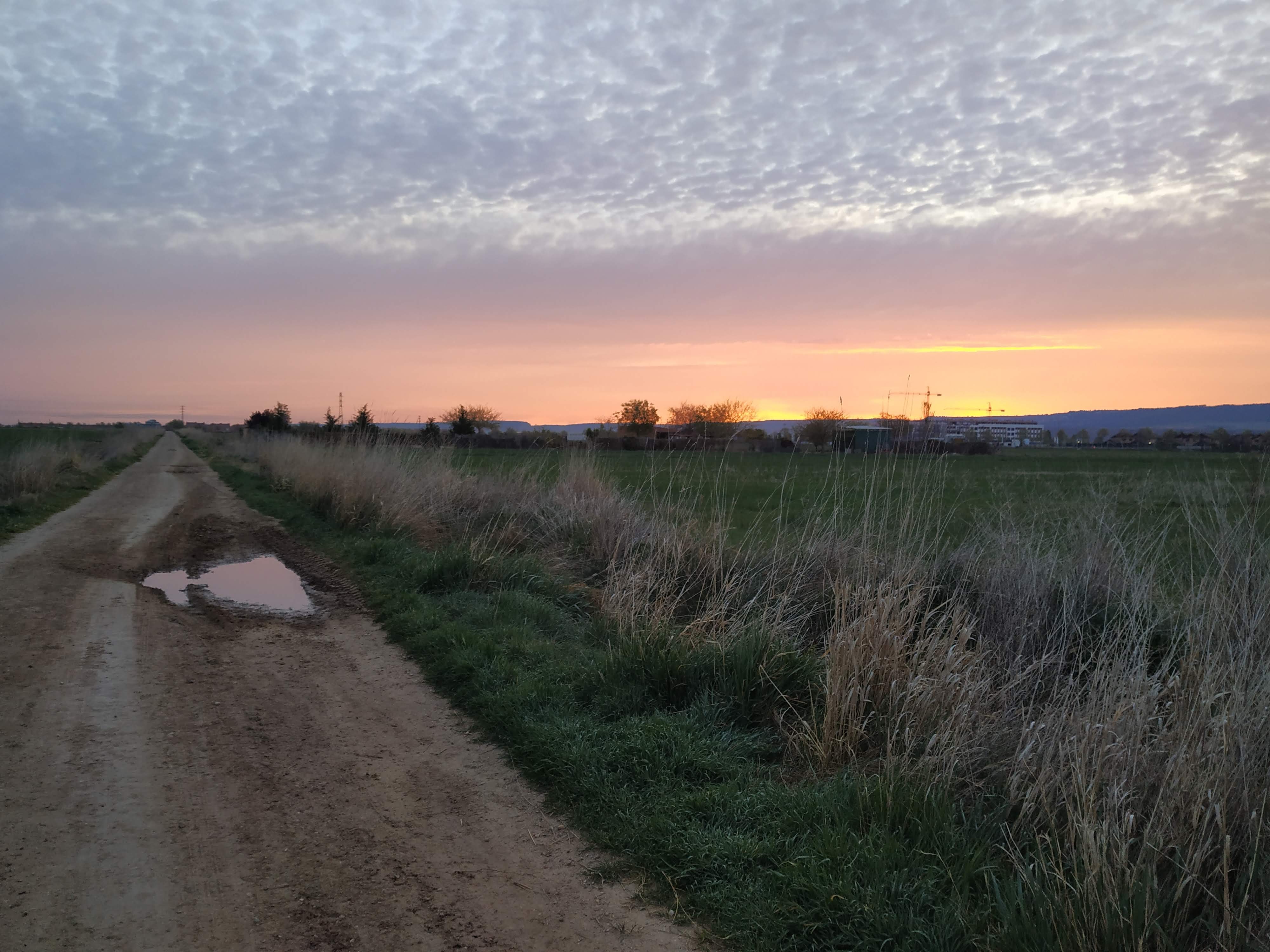
And then I realized… I screwed up. I had scored a really cheap hostel in Guadalajara. The reason it was really cheap, though… was that it was in Guadalajara, Mexico. While I wasted time figuring out what to do, it got pretty late, though, so I went to the nearest place to camp I could find. It was a very visible, not very good place, though, so I woke up really early to get out of there quickly. The bright side is: it got me a good shot just after sunrise.

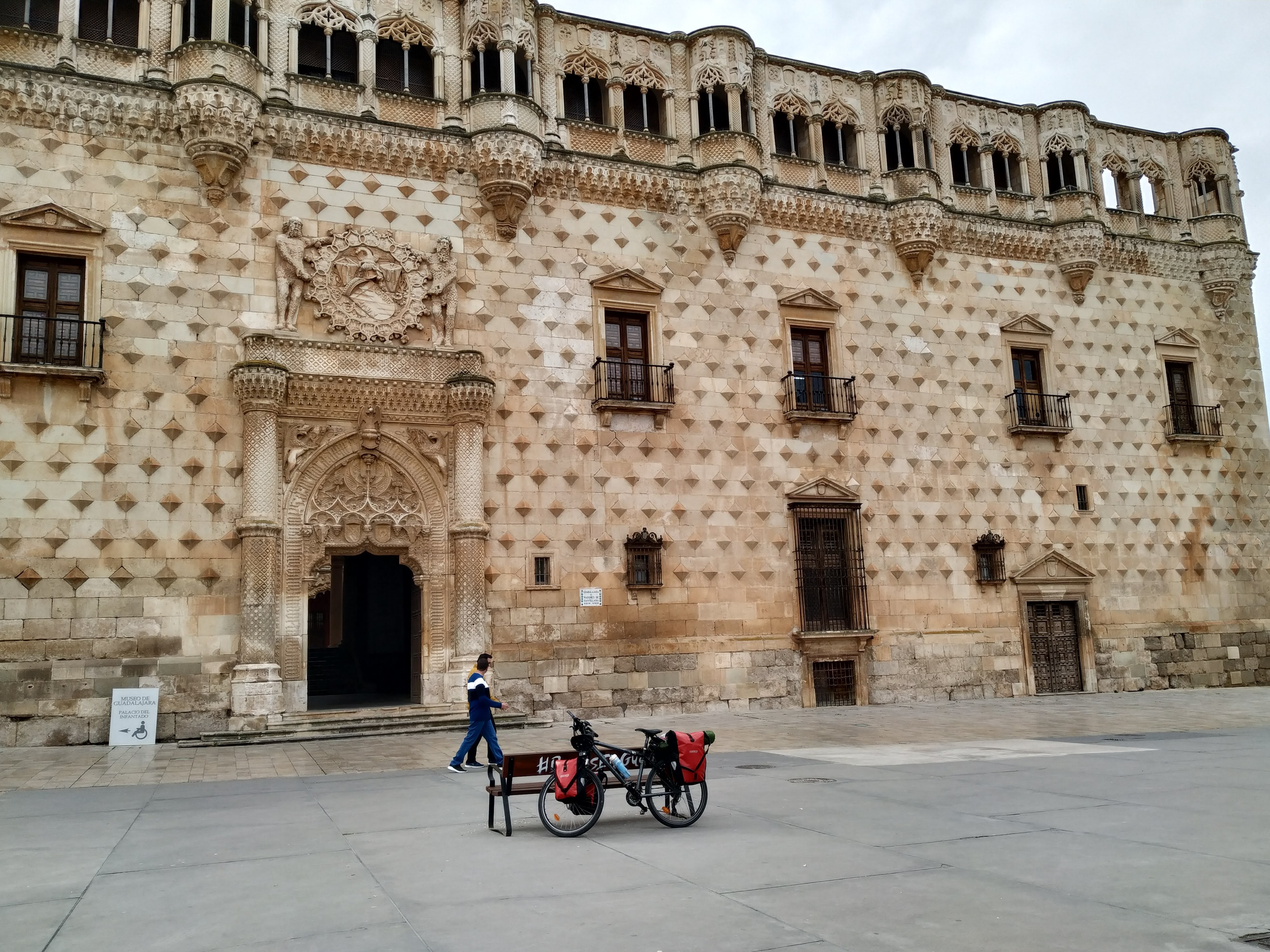
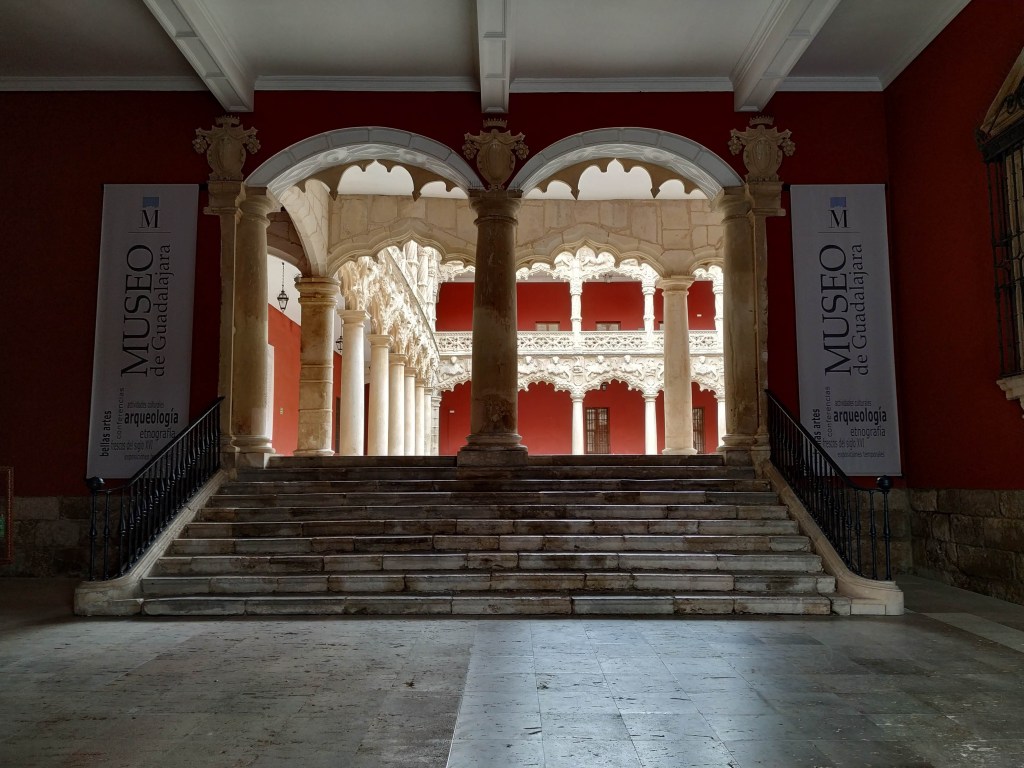
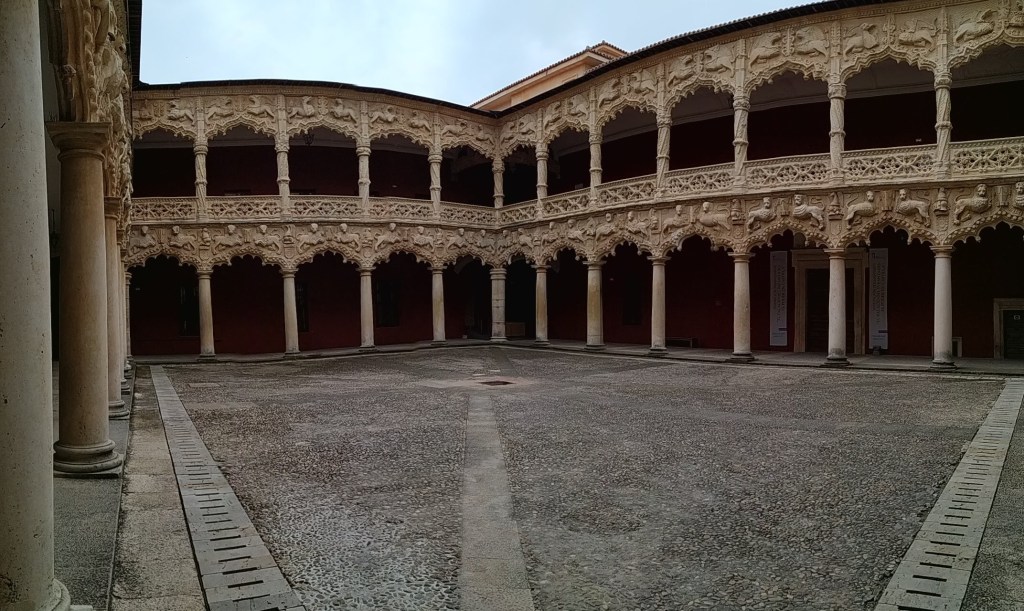
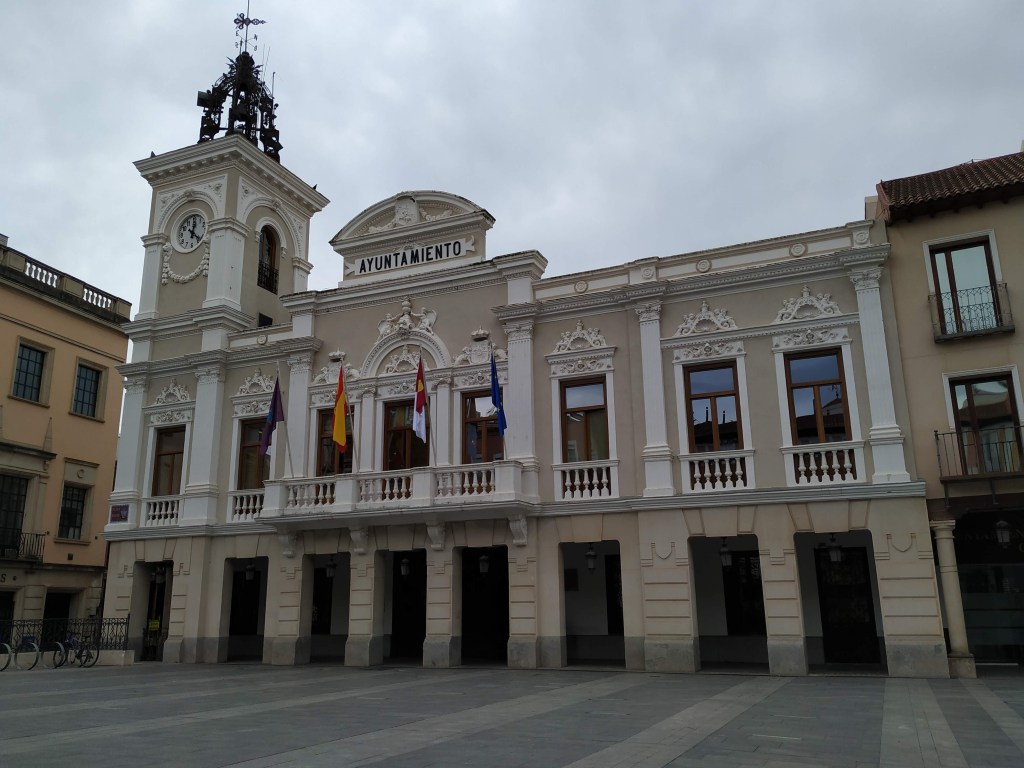
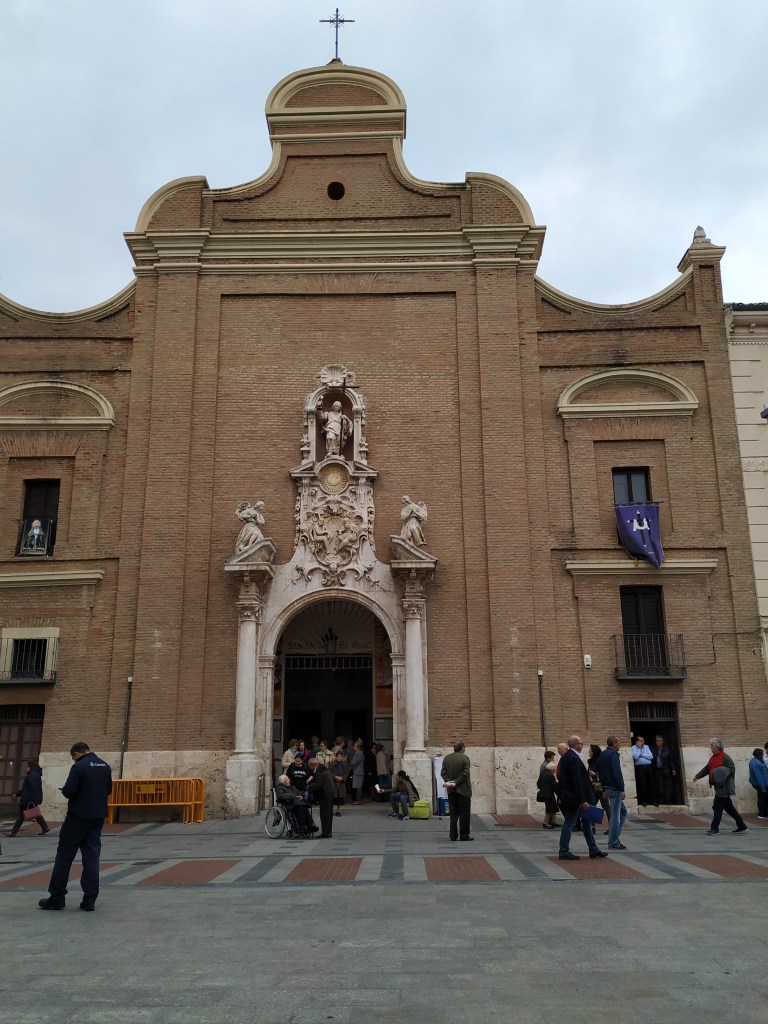
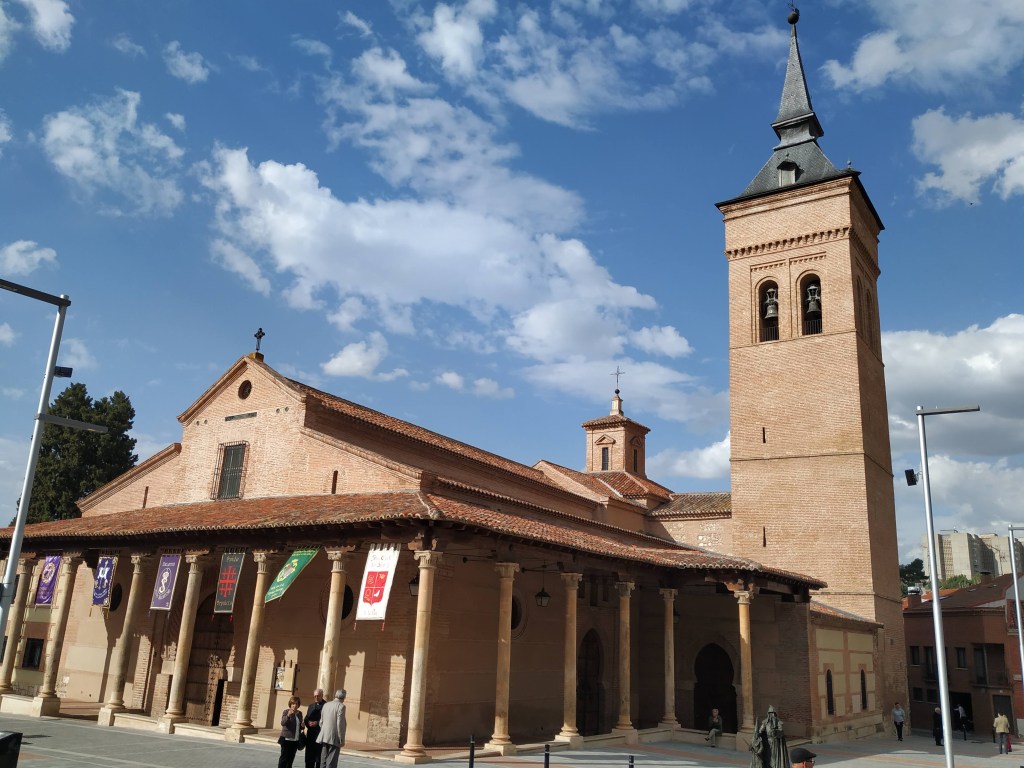
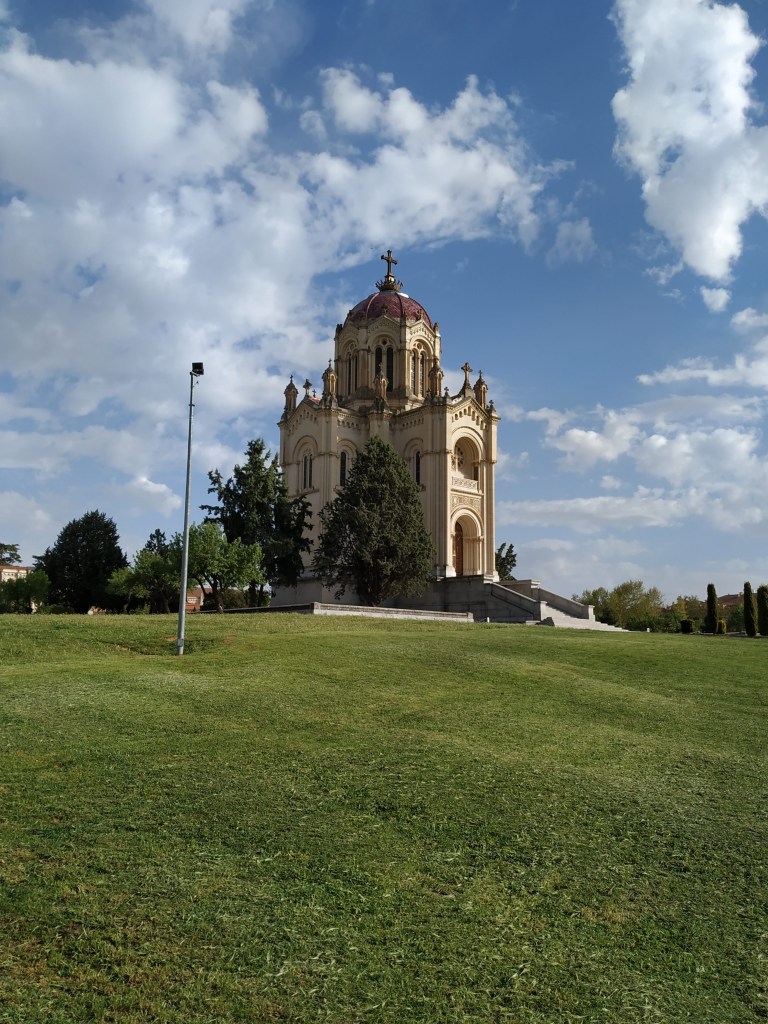
I’d then visit and stock up on Guadalajara. As a short review, it seemed like a decent place to live in, but not very good to visit. I’d give it a day at most.

Palacio del Infantado
Panteón de la Duquesa.
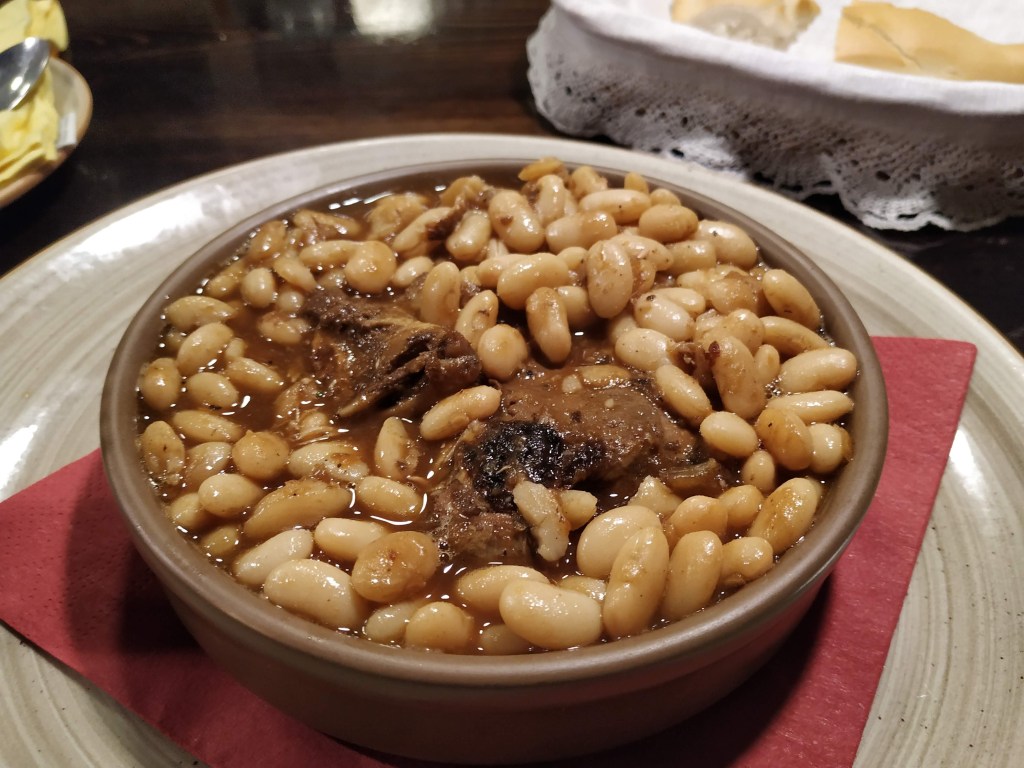
Some partridge and beans.

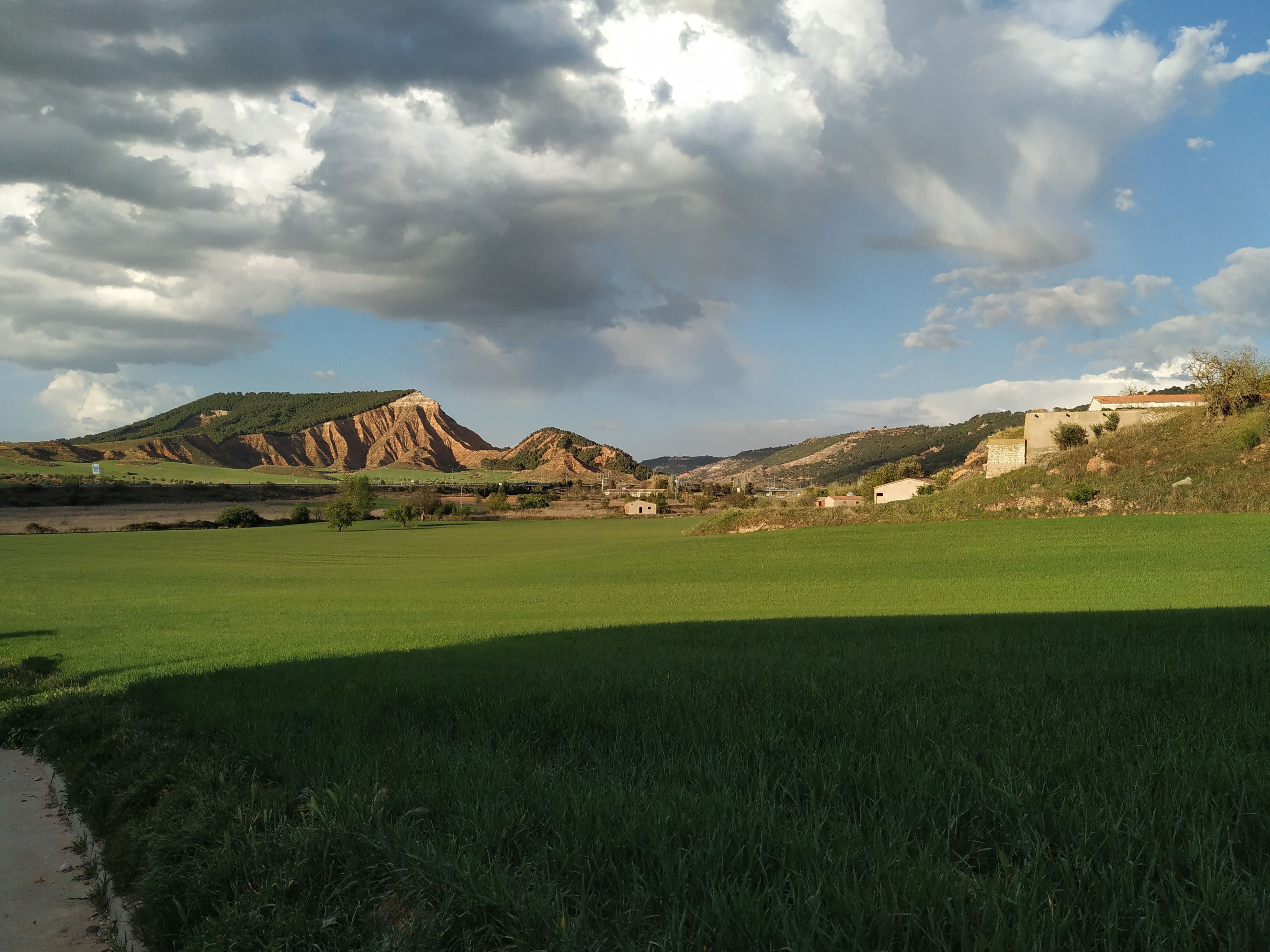
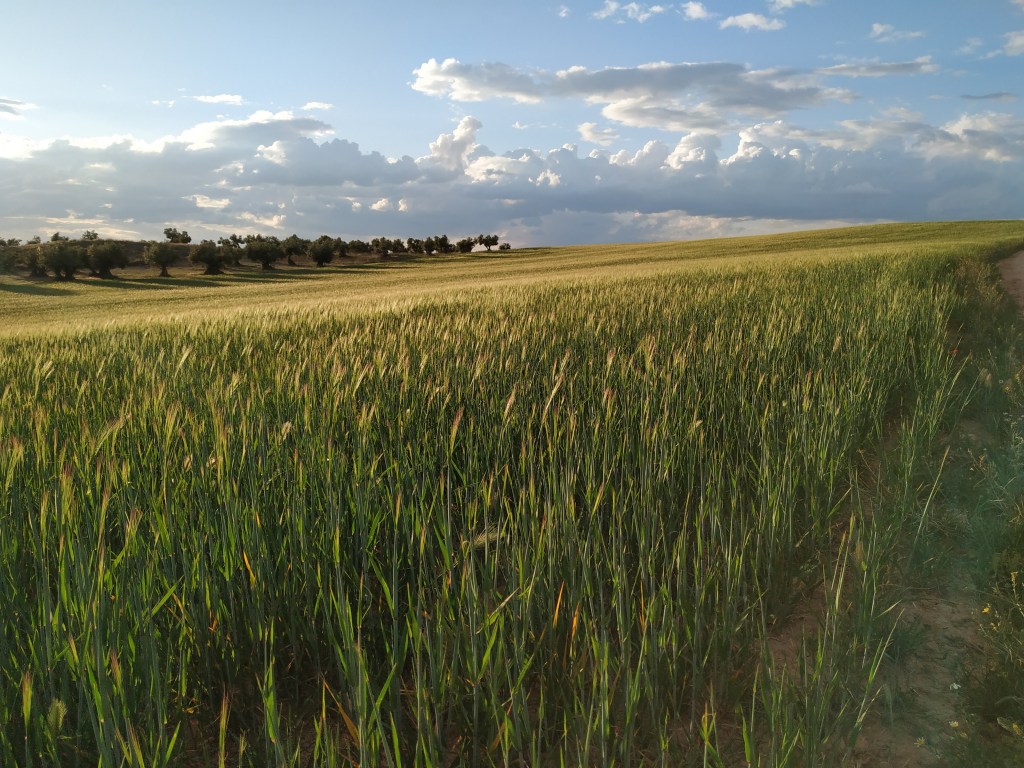
And then it was time to head back to the hills, where there was lots of wheat, olive trees, and a really great campsite, not visible from any road.

And finally, a happy Easter from The Lazy Cyclist. Or happy Passover. Or whatever it is you celebrate.

“But I don’t celebrate anything!”, you might say. In that case, here’s some advice from 1980:

Toledo

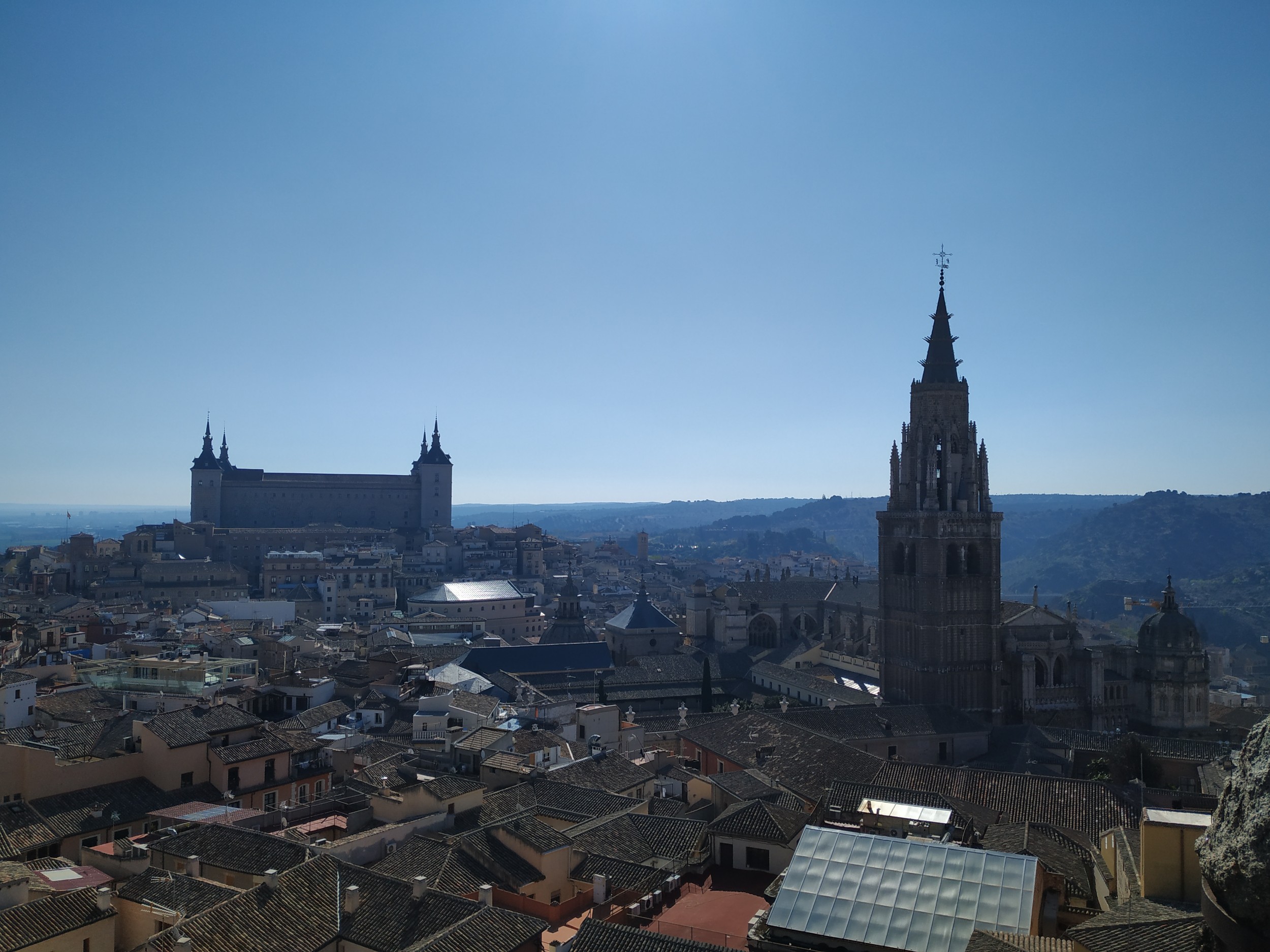
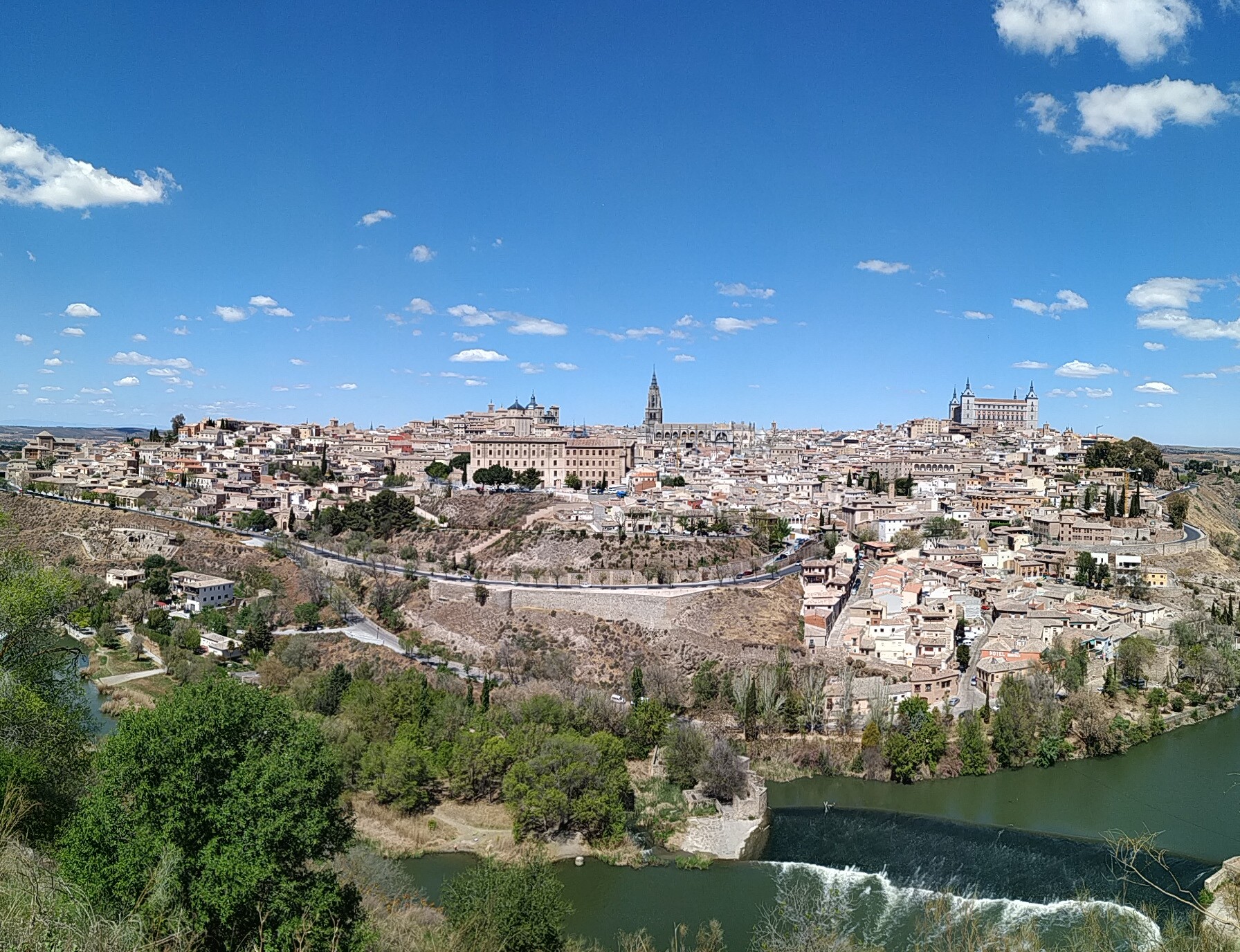
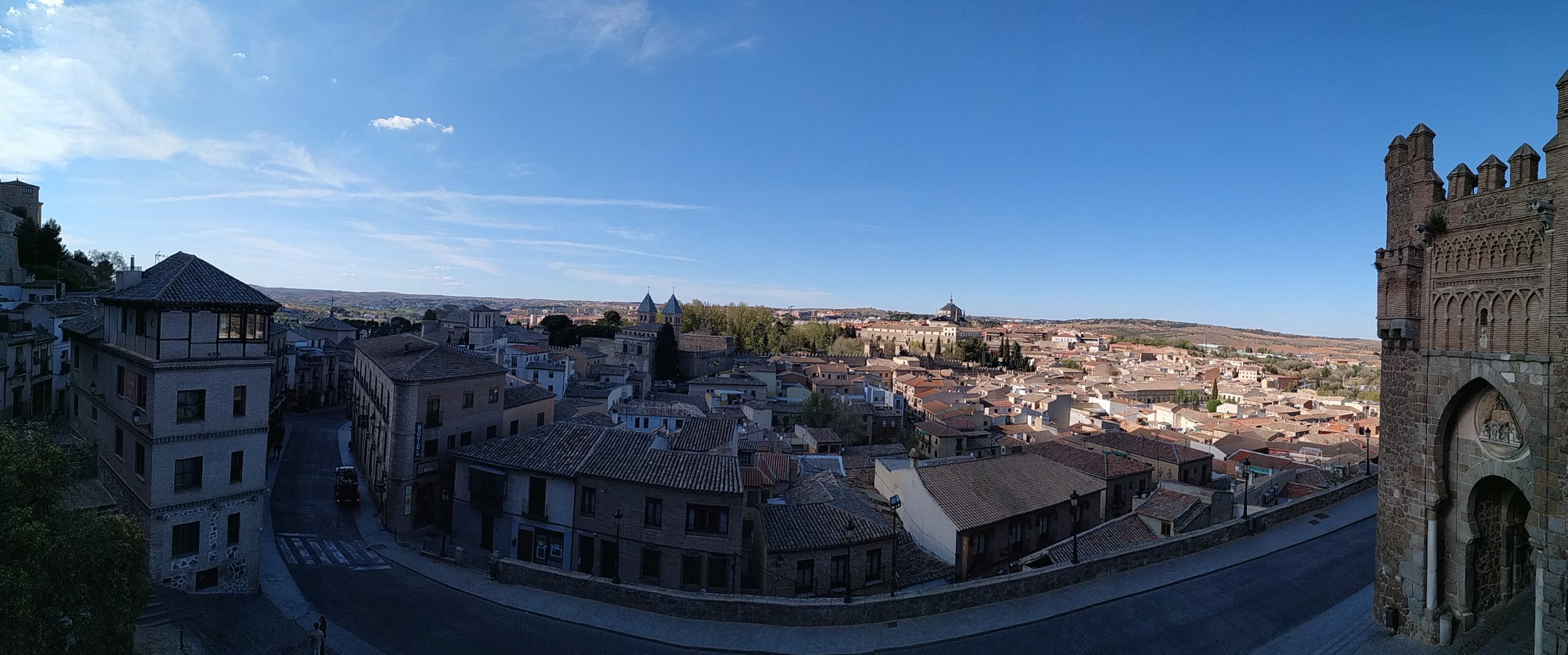
Toledo is a lovely looking city on a hill overlooking the river Tagus.

The first impression, as I headed to my hostel they night was: this place is not bike-friendly, though not really because of its design. It’s just an old city with steep hills and cobbled streets. I’ve also found out that Google Maps’ bicycle routing is pretty bad, not being too shy about sending me through pedestrian streets and steep hills, some even with stairs.

I had a lazy day where I mostly got caught up on my internet and did the previous blog post. I also left to do laundry. Pedaling without all the extra weight felt like I was on a race, compared to normal. This is the only cycling in this post.

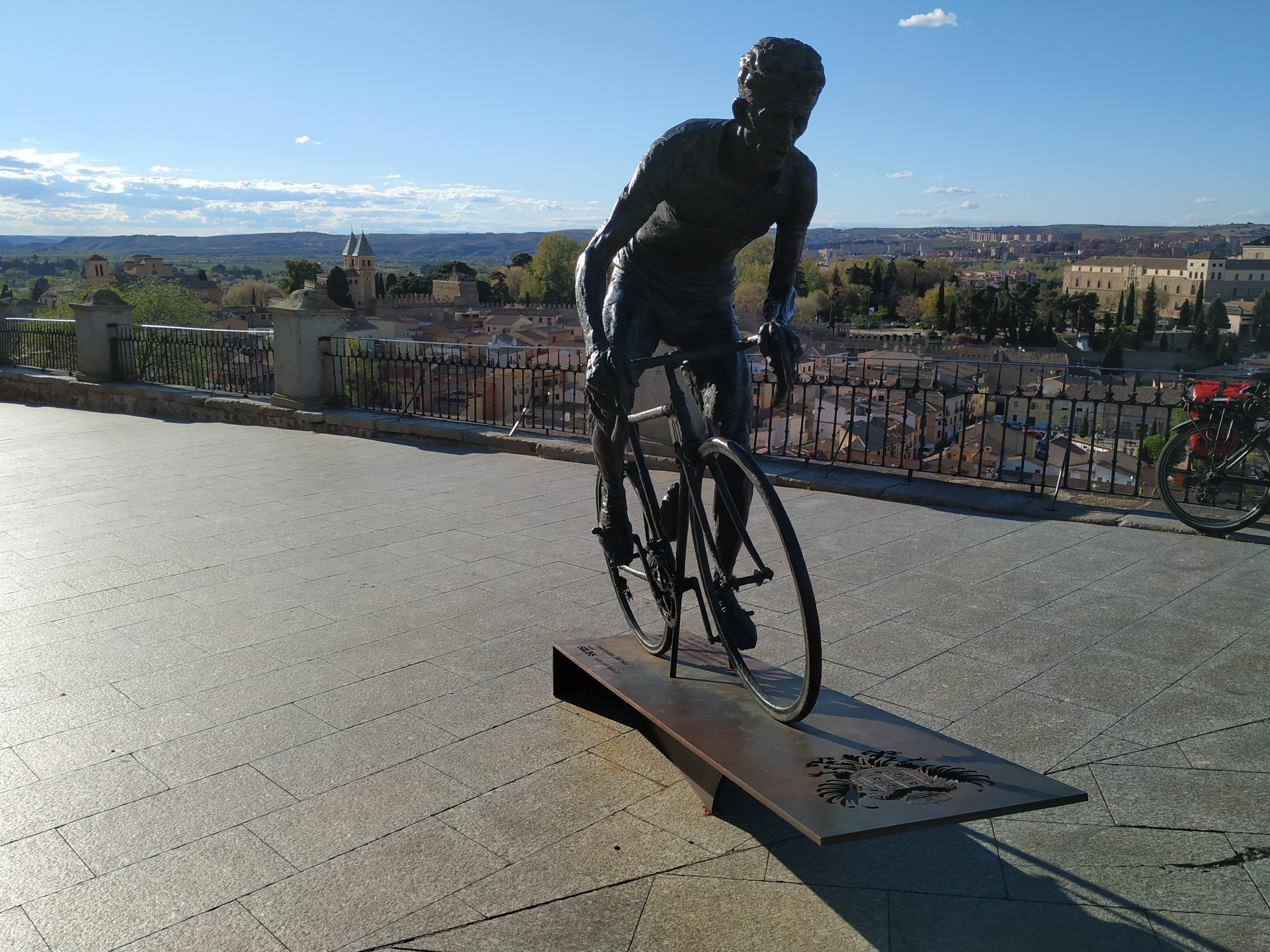
Federico Martín Bajamontes, the first Spanish Tour de France winner

About this city… It’s old. There were people here all the way back to the bronze age. In the middle ages, it was home to jews, muslims and christians alike. Even if those relations were strained or outright hostile — there were your typical jew expulsions and turning places of worship from religion X to religion Y — the heritage from those three cultures persists in the city to this day. It was also the imperial capital of Spain / the Holy Roman Empire for a few decades in the 16th century, before the court moved to Madrid.

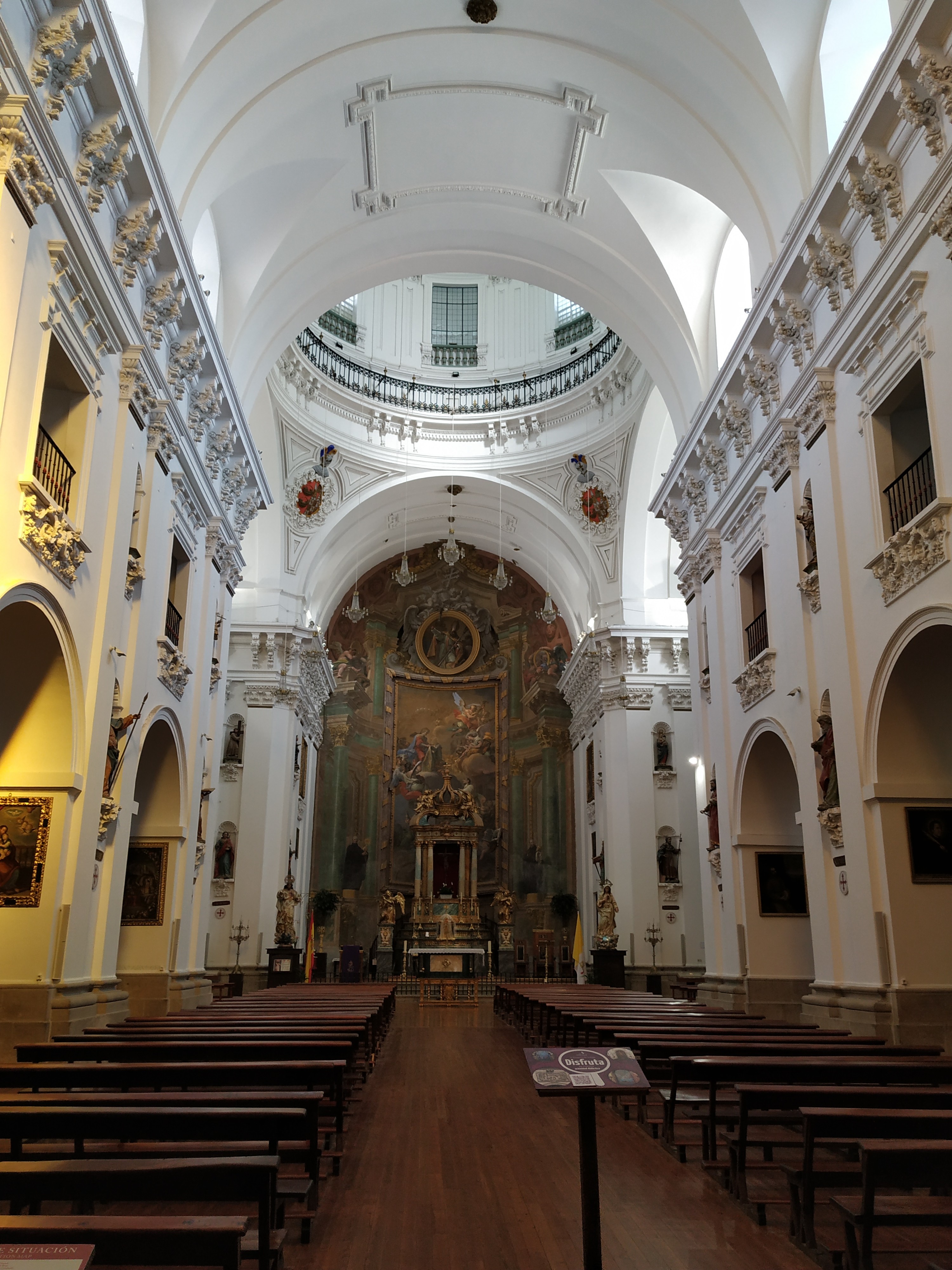
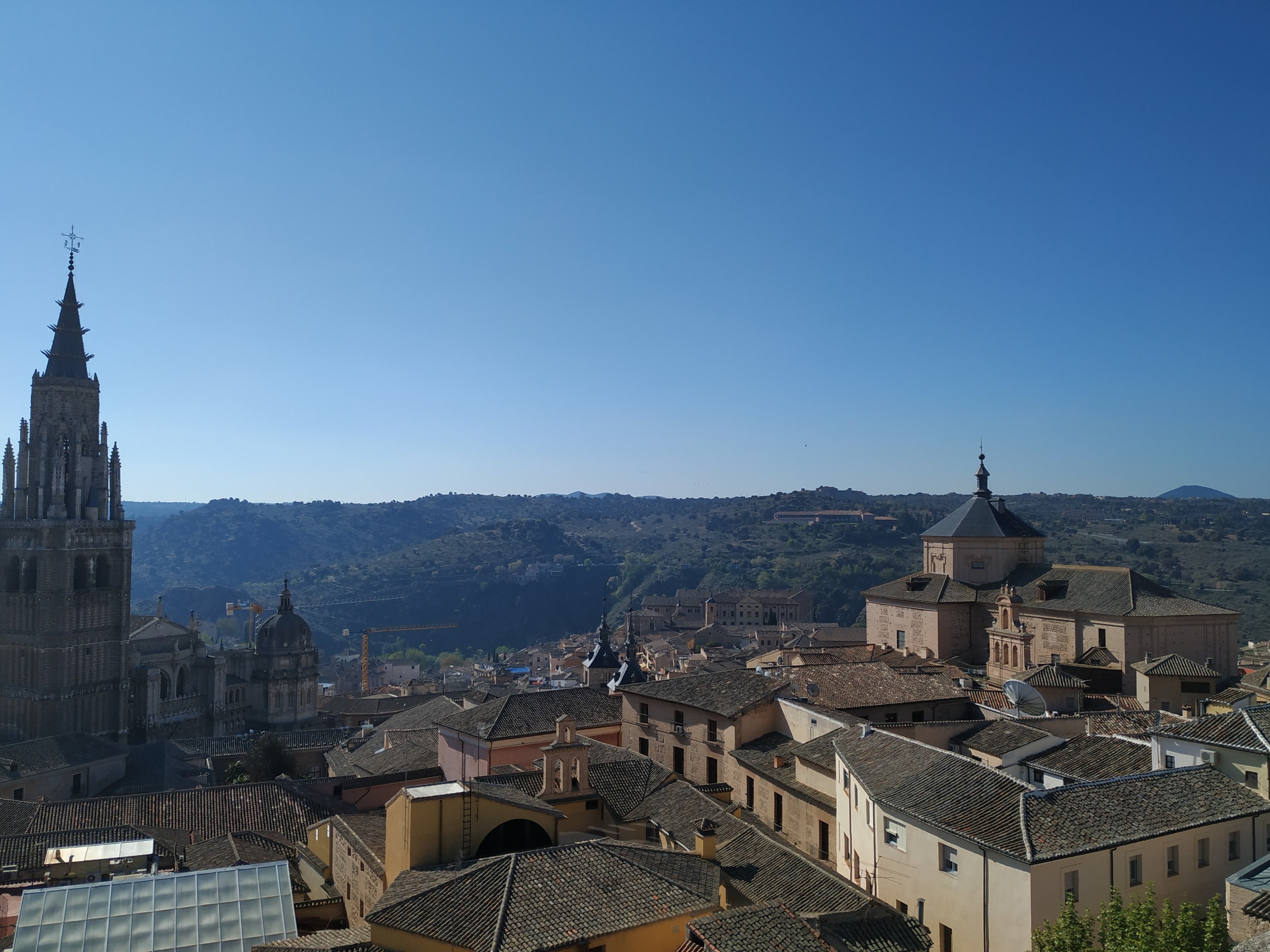
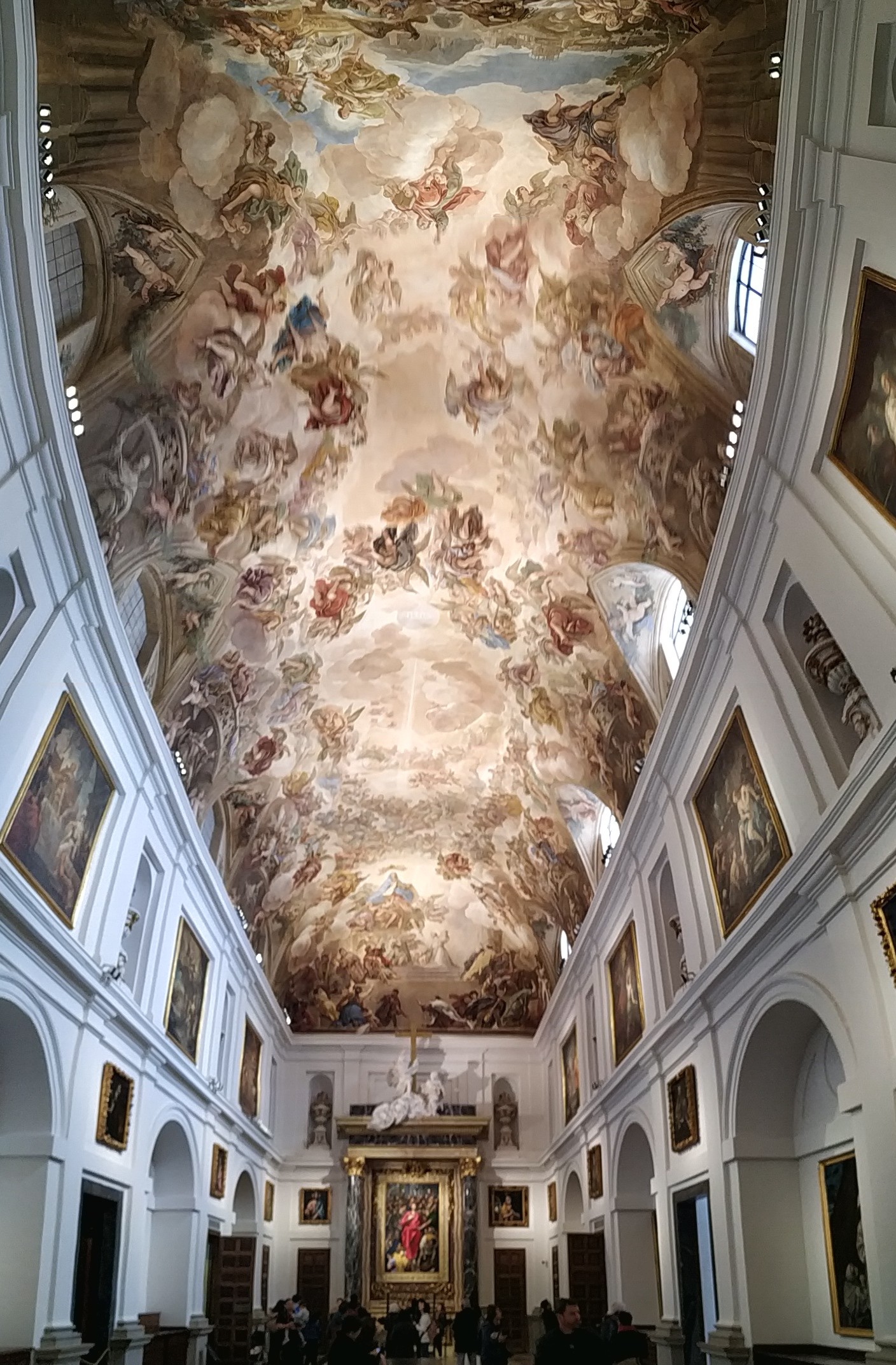
My visit starts at a Jesuit church. The towers promised a nice view into the city, and they delivered. Inside, I found out there’s a tourist bracelet you can buy that gets you into 7 different monuments for 10 Euro, so I got it.

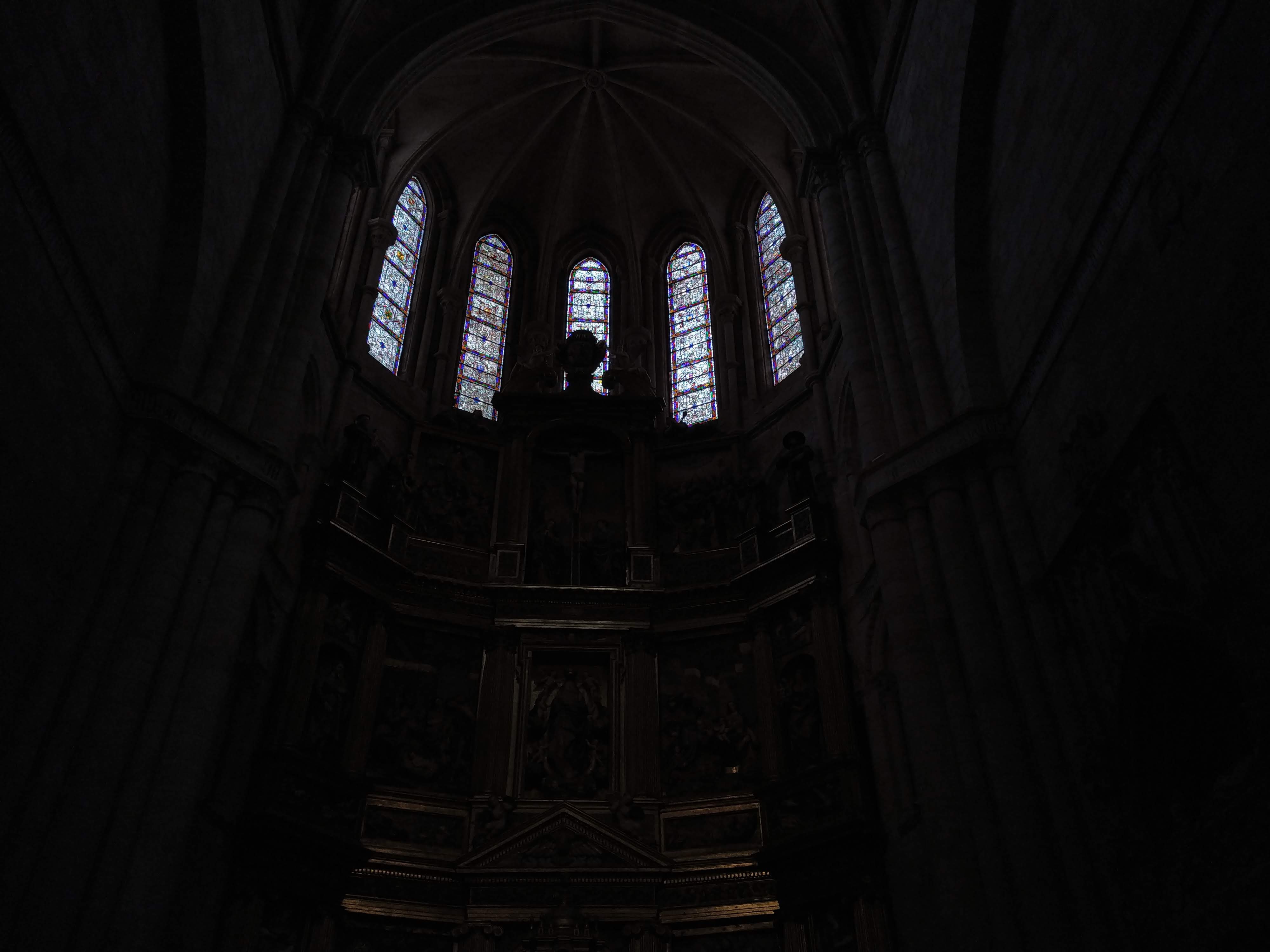
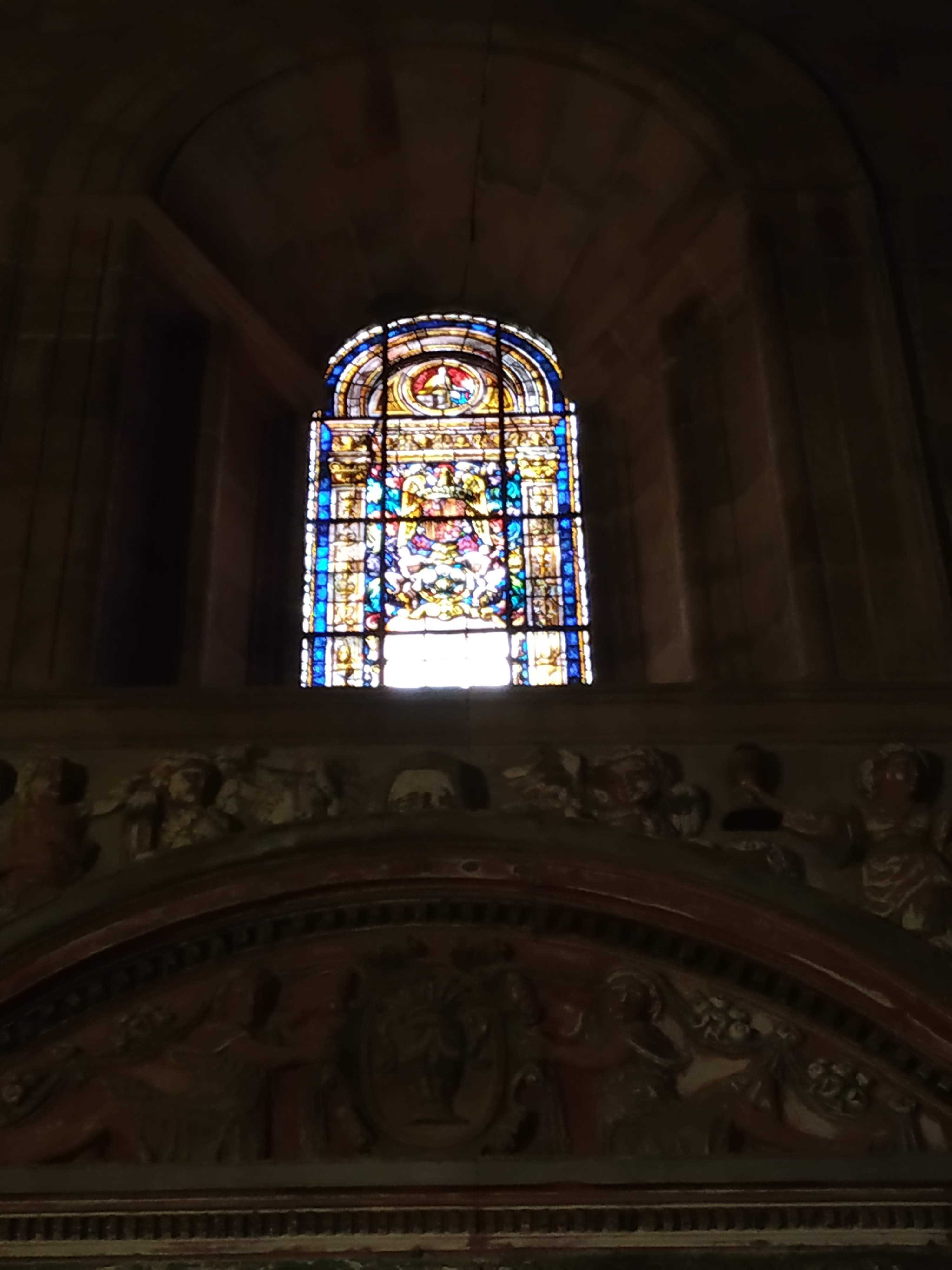
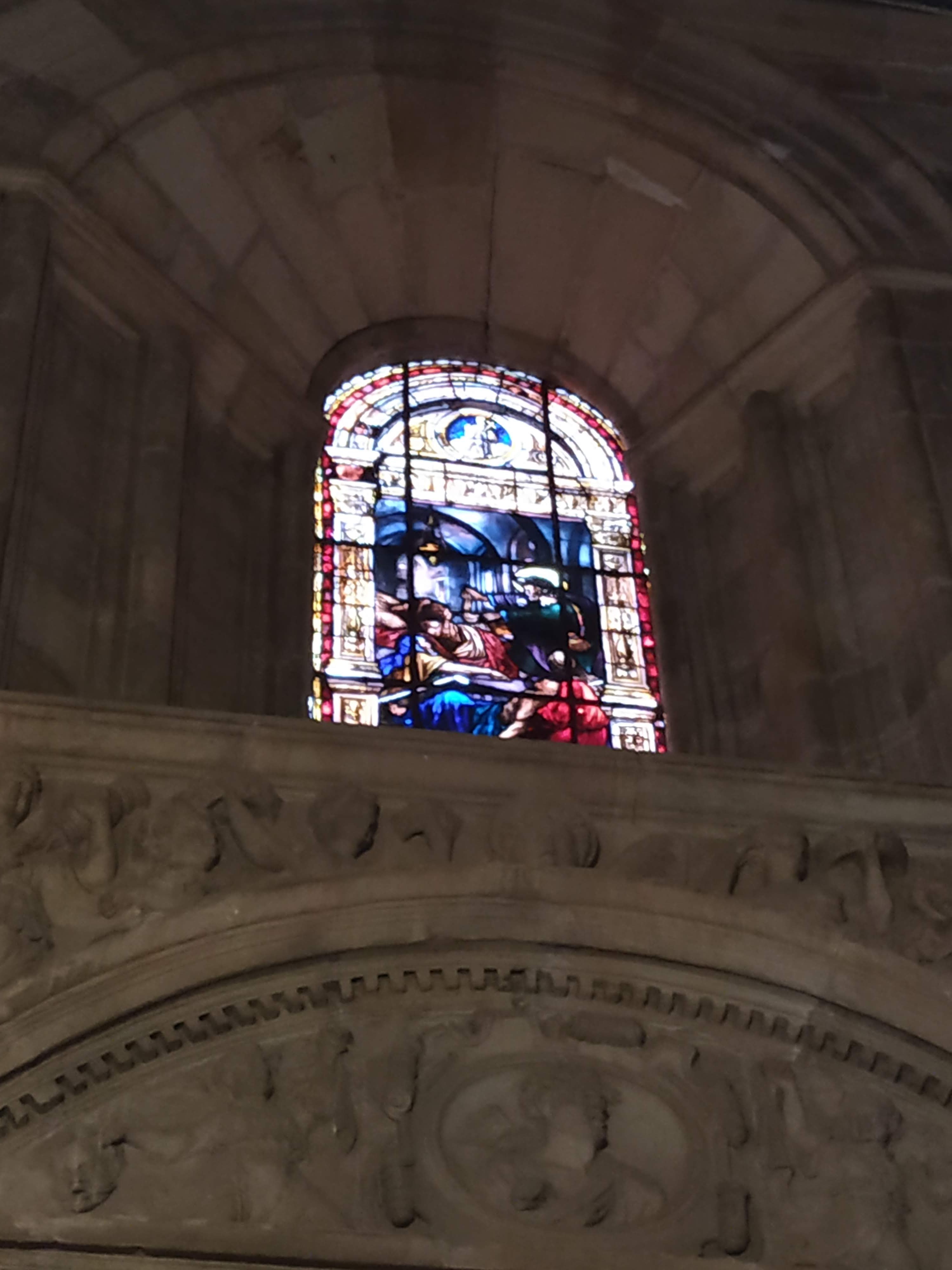
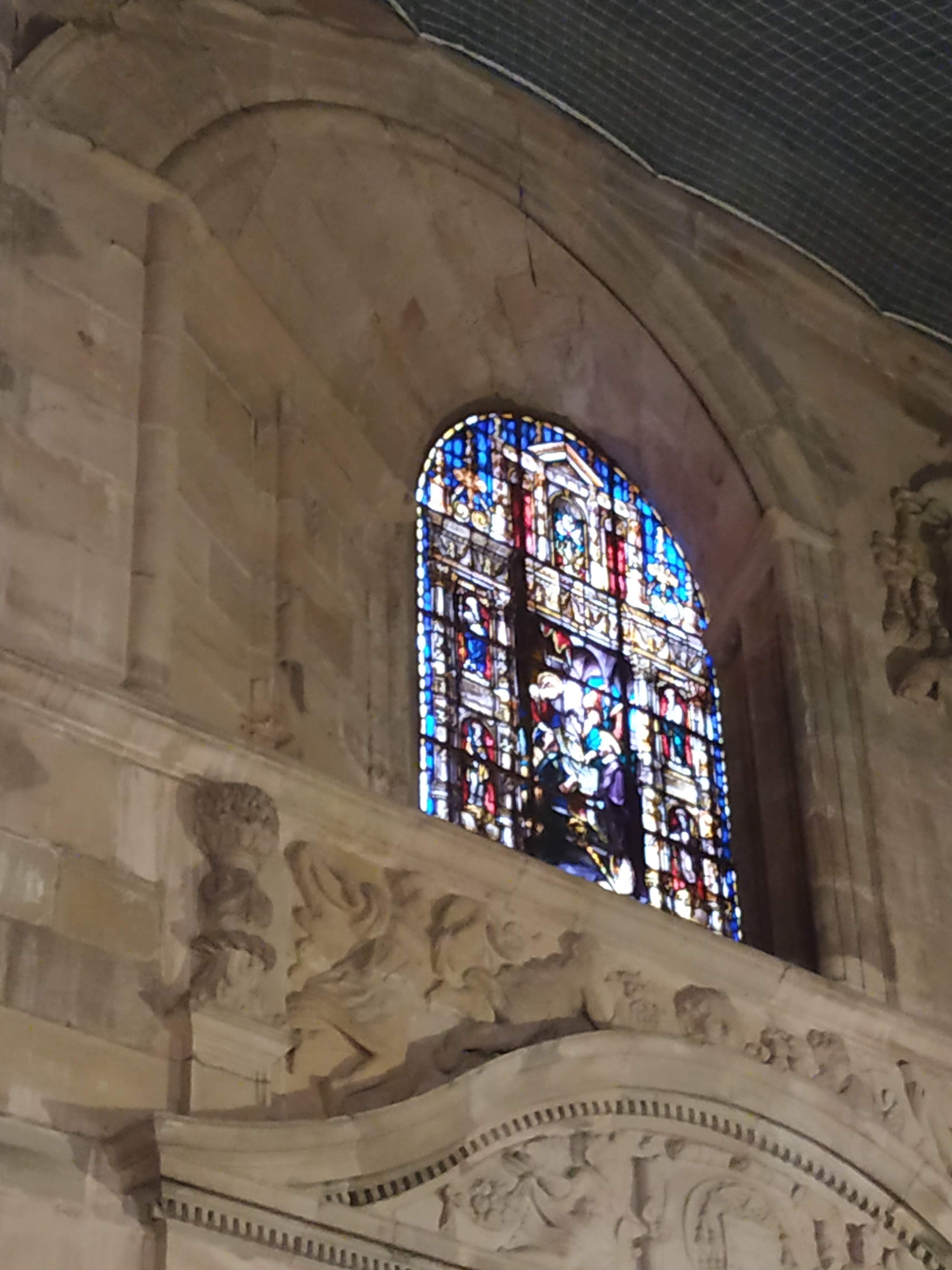
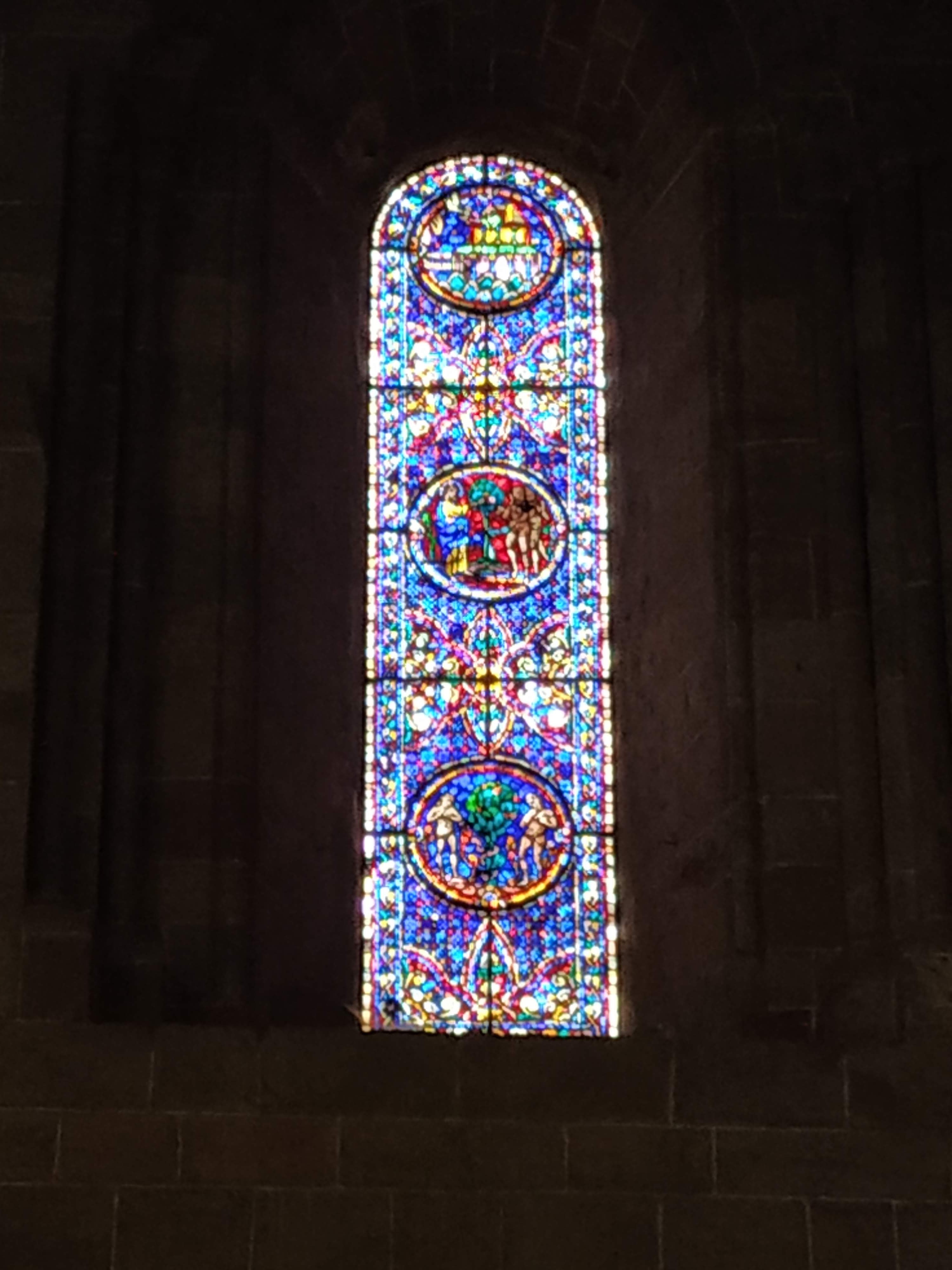
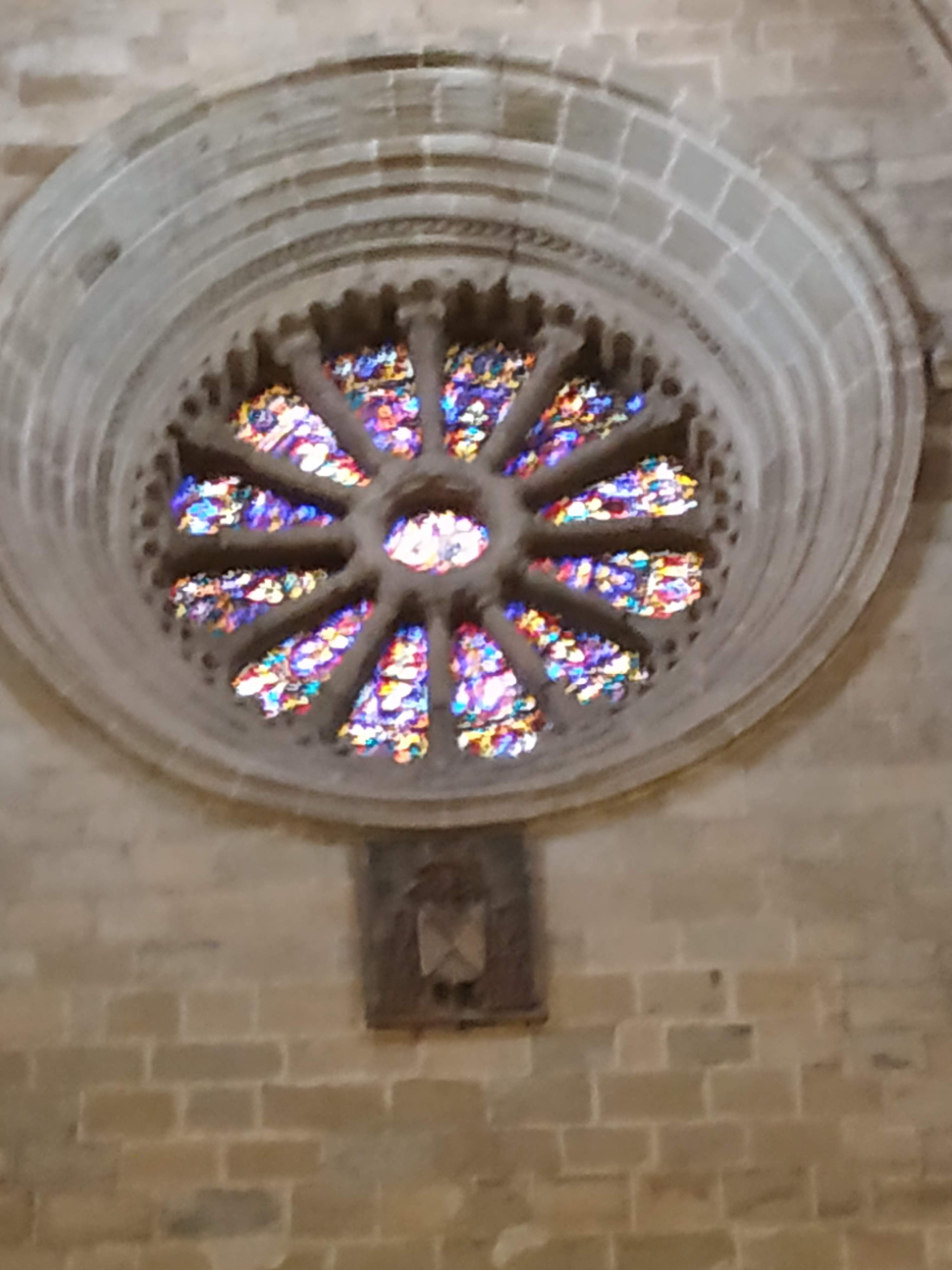
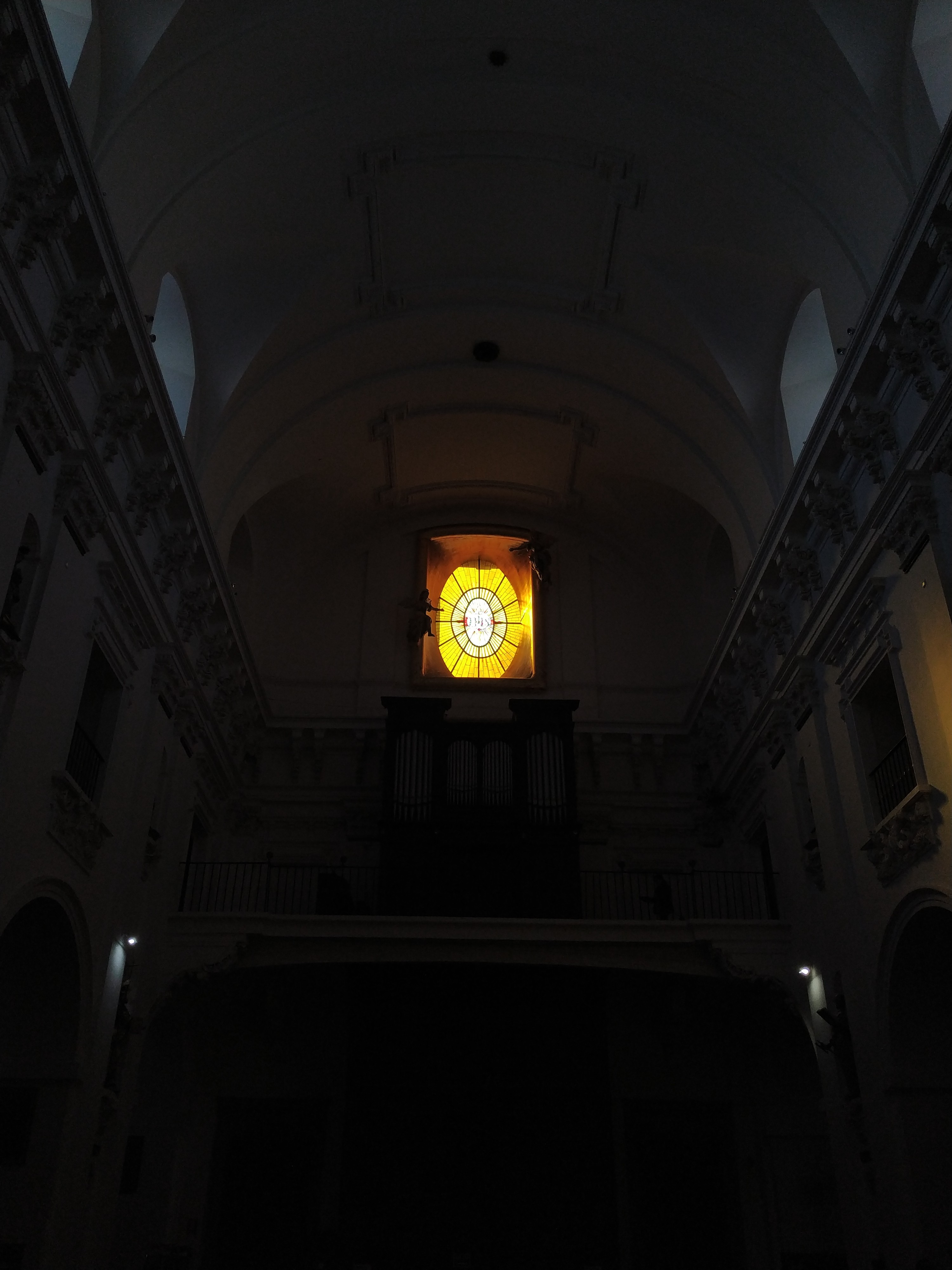
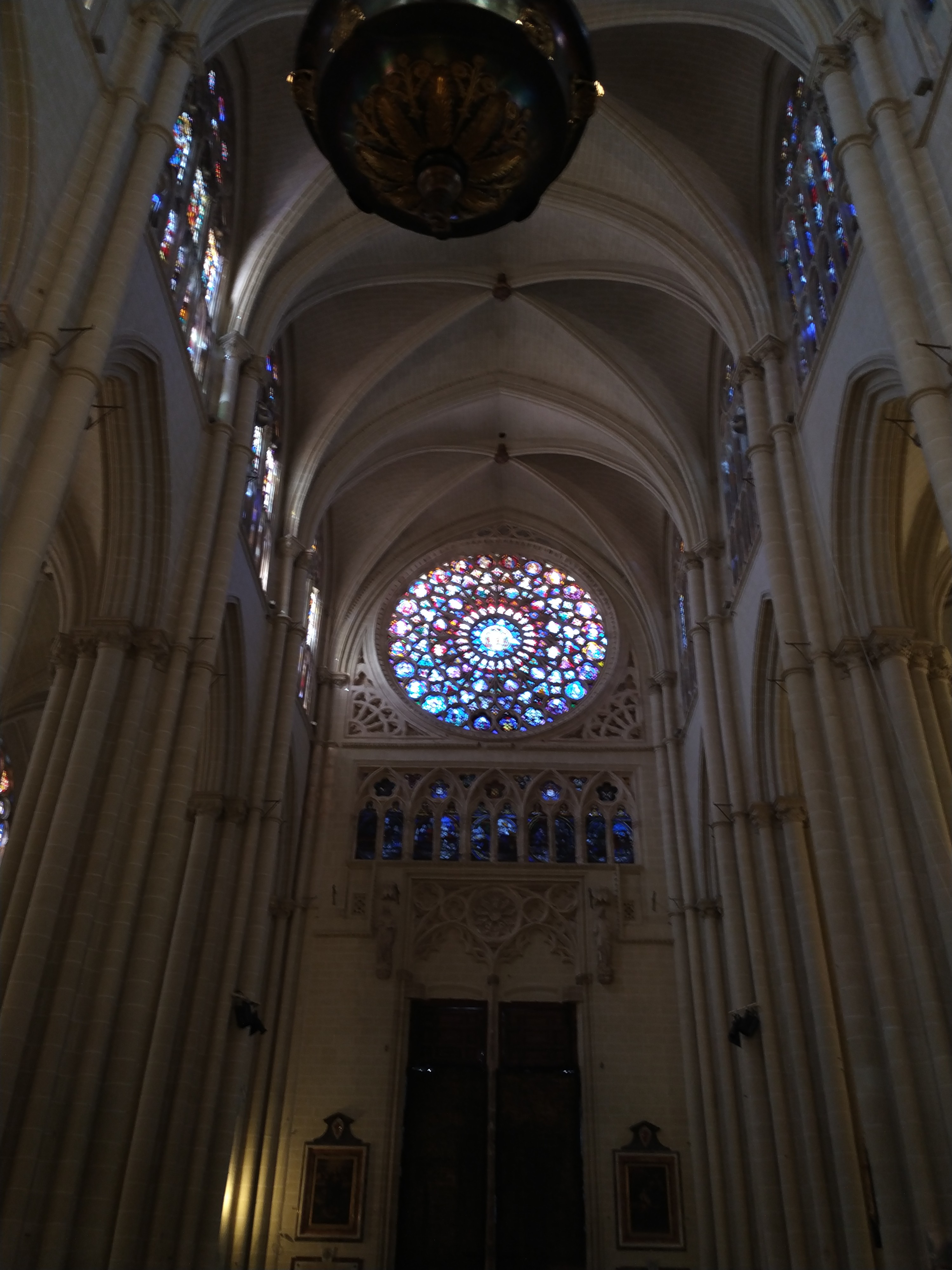
I’ve started experimenting with the camera, to try and capture the stained glass without it becoming a white blob. Of course, it has the side effect of everything else becoming a black blob.

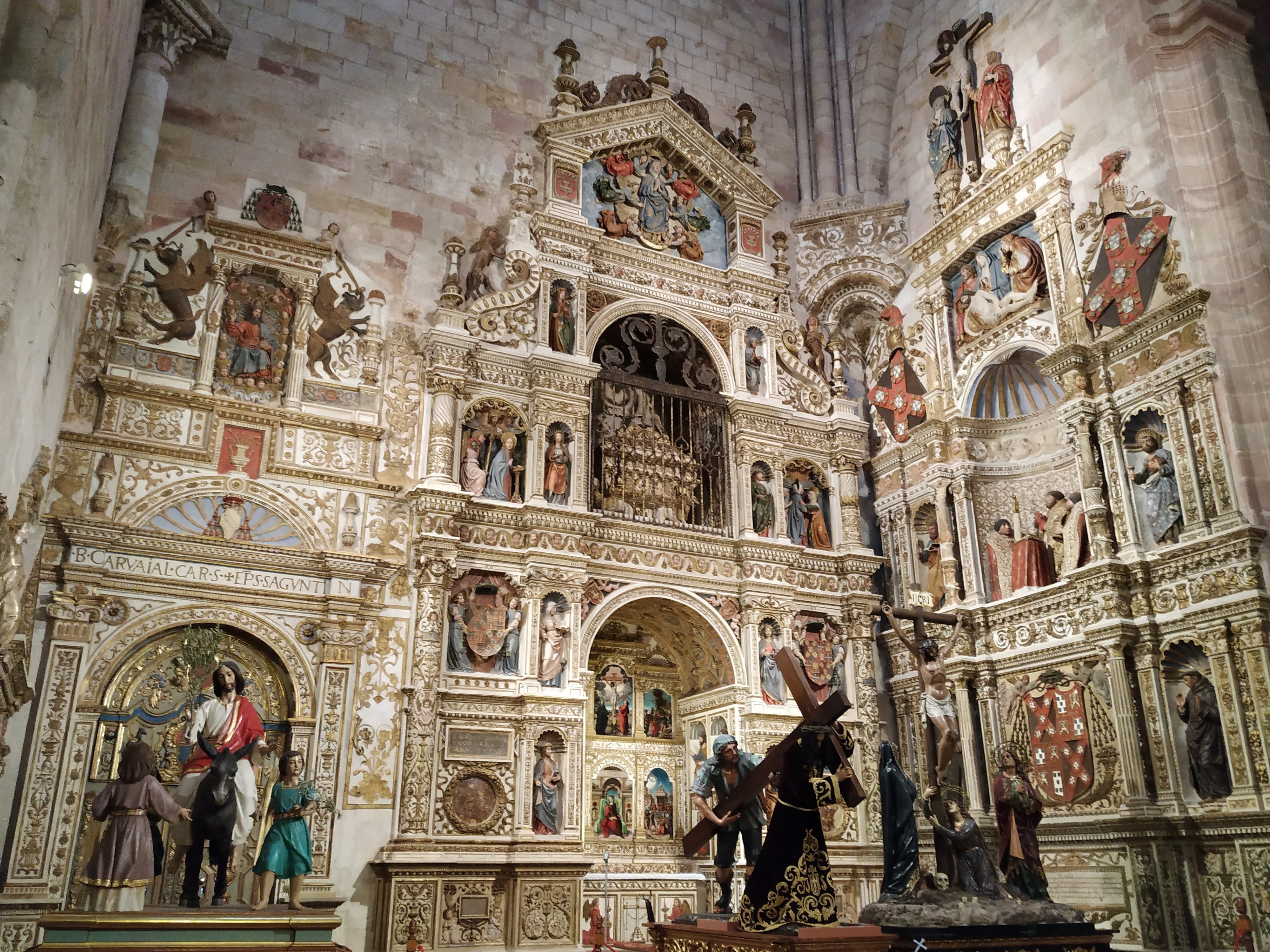
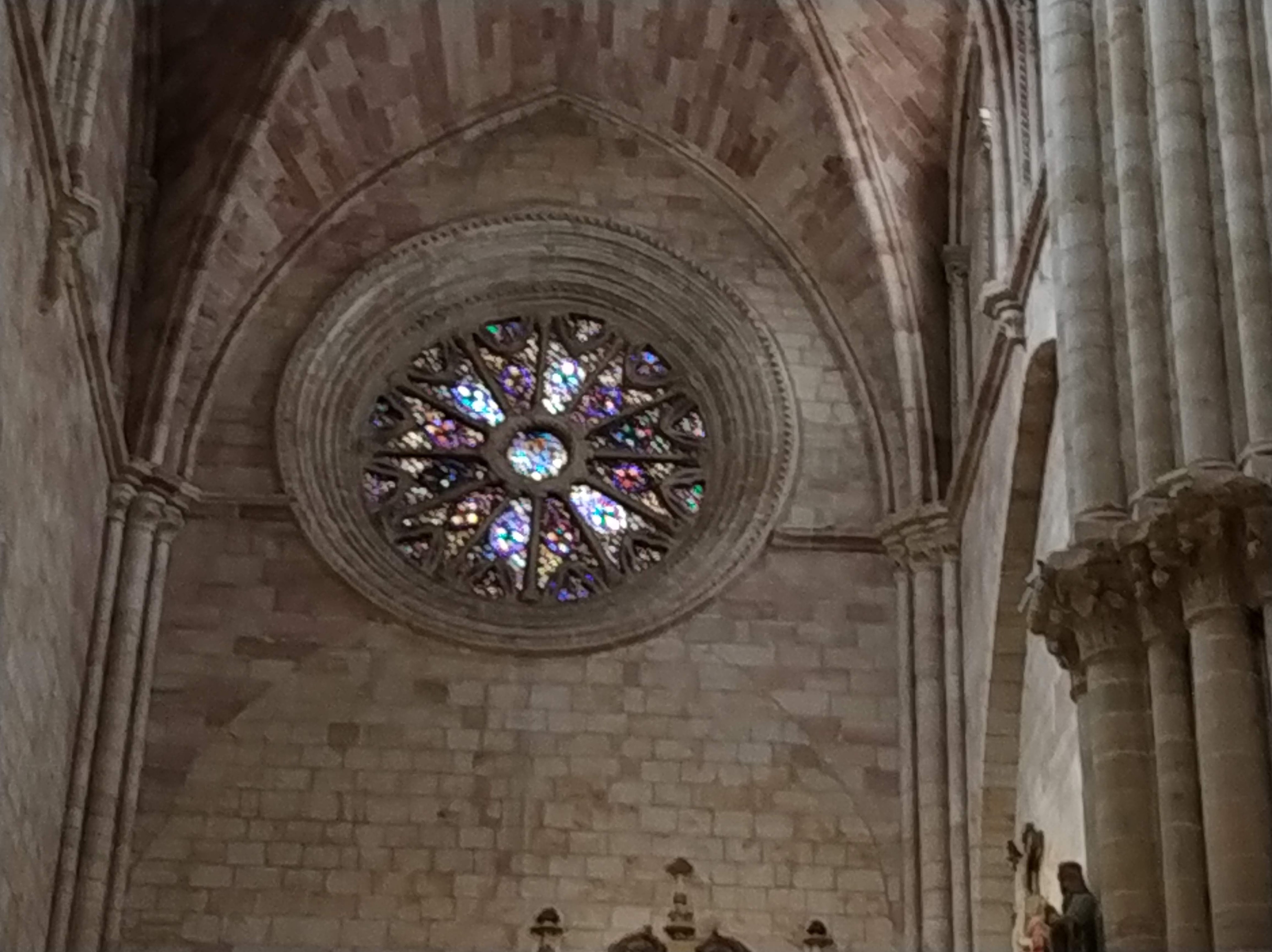
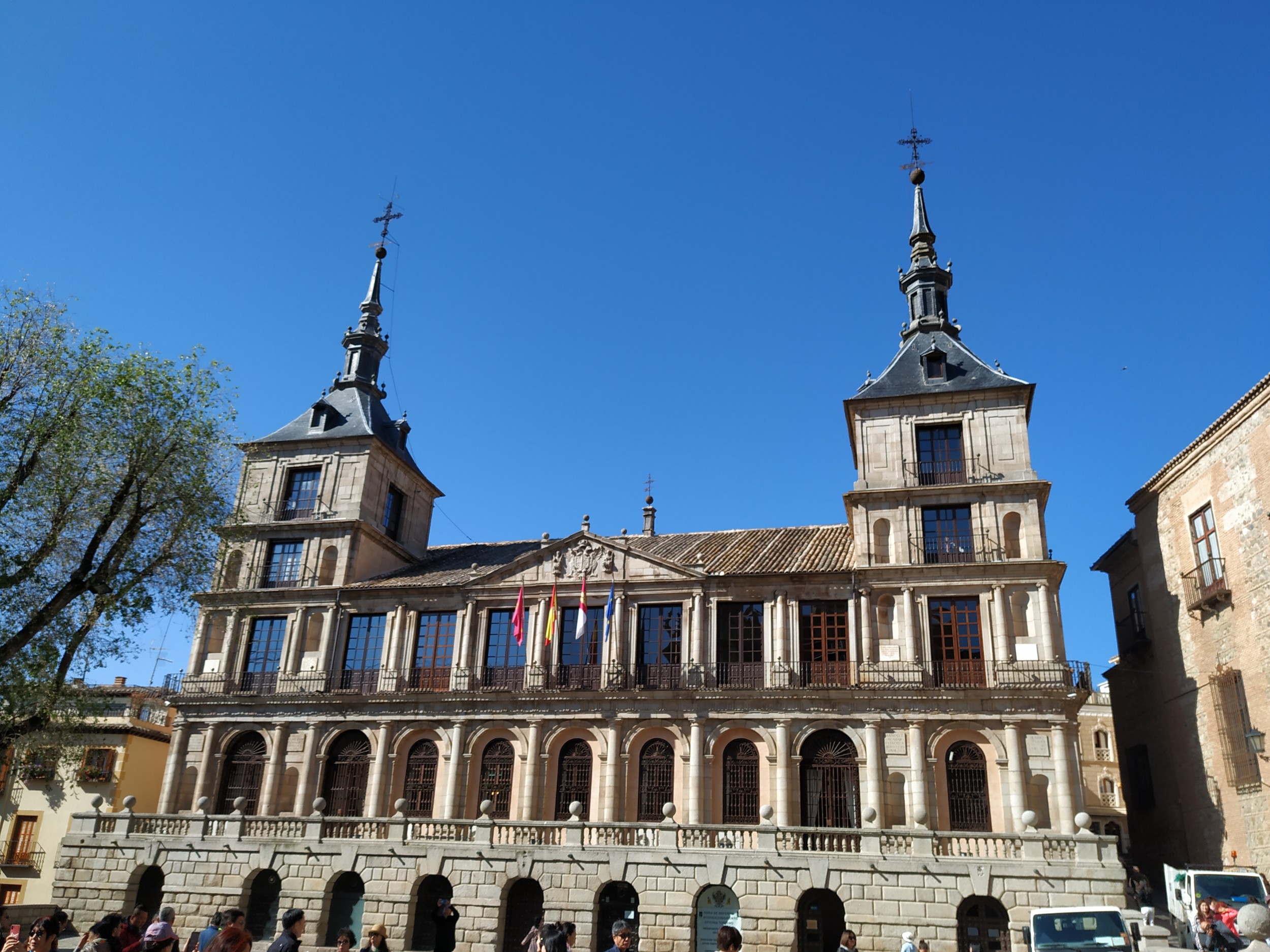
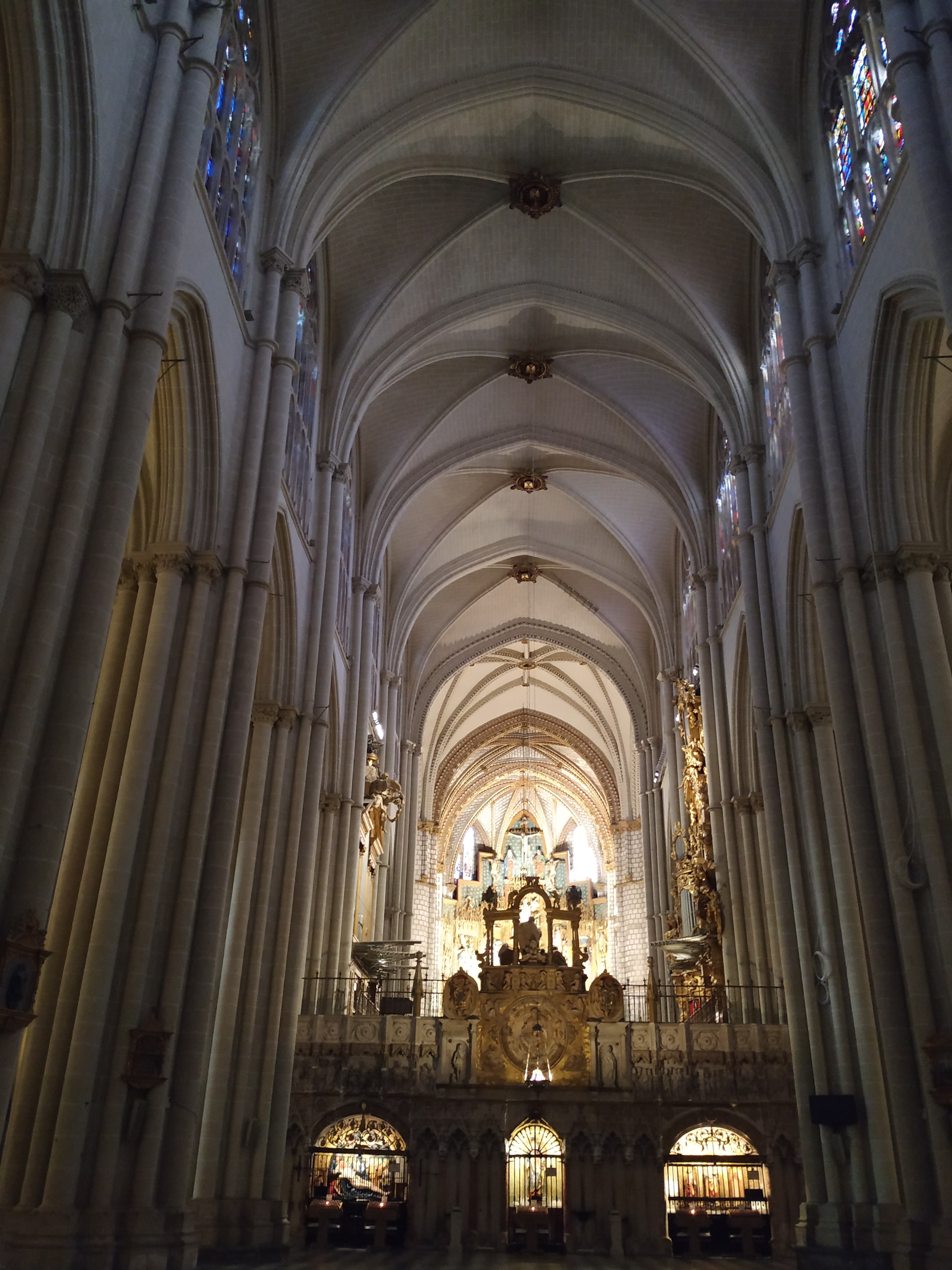
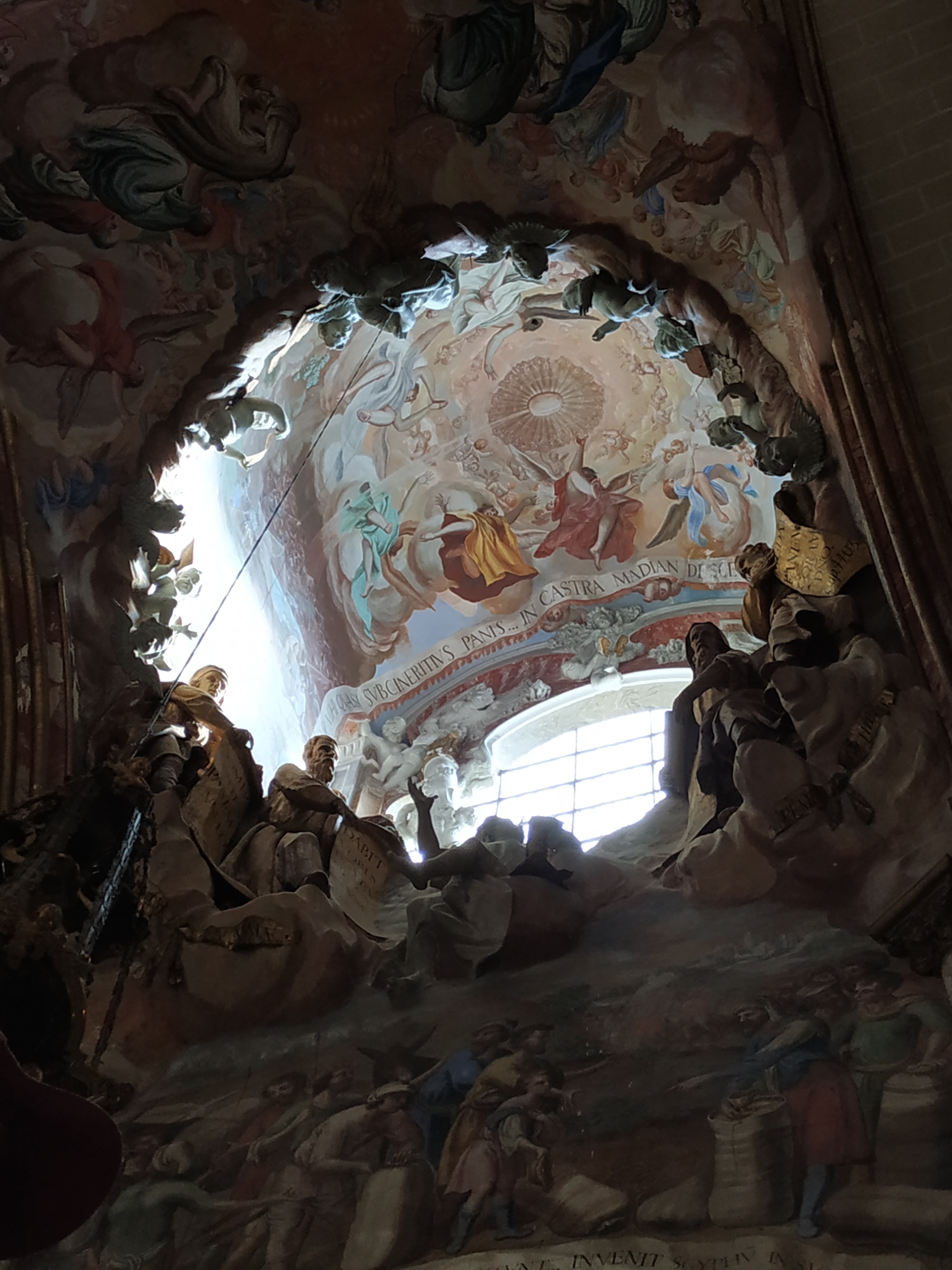
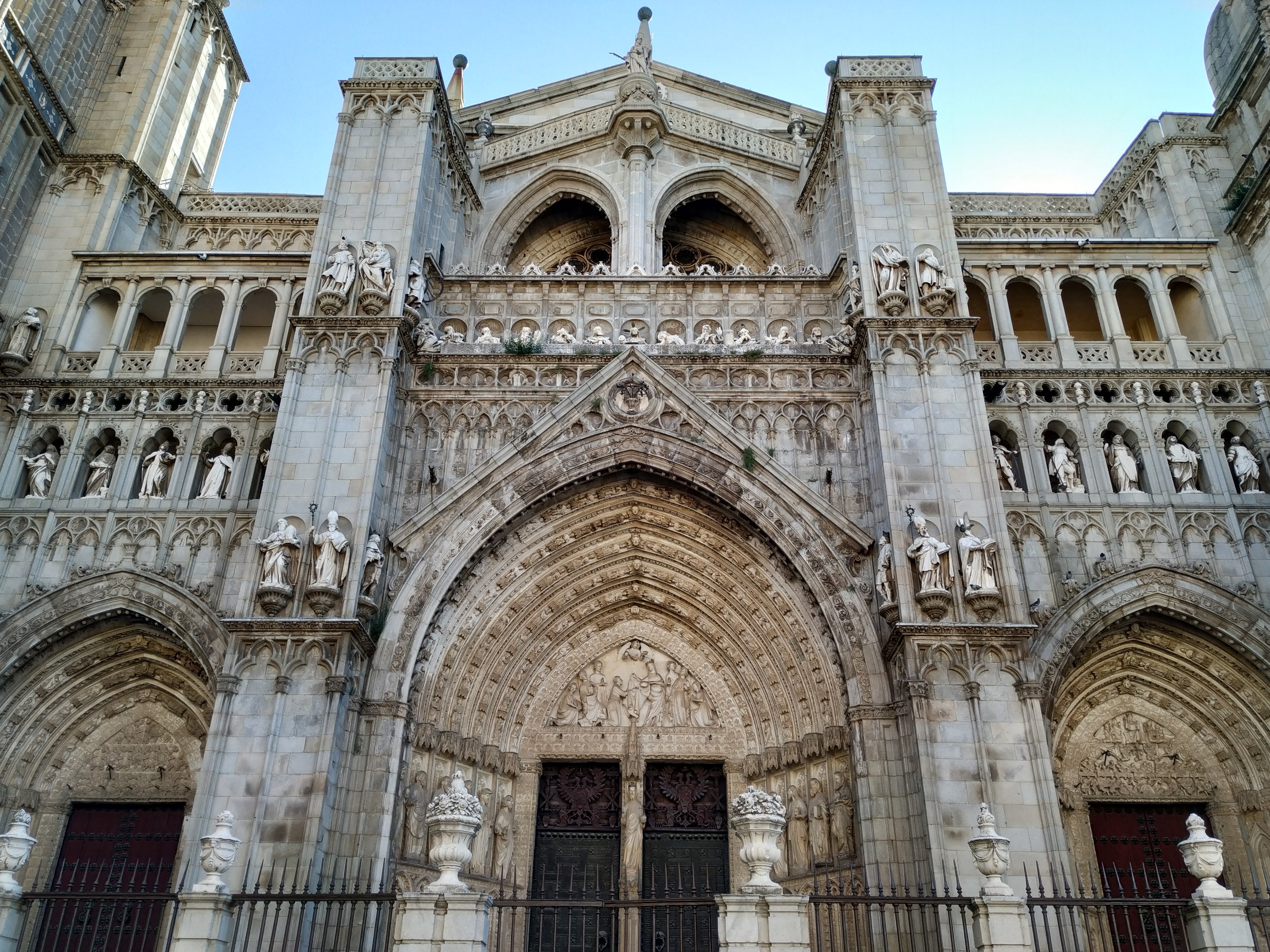
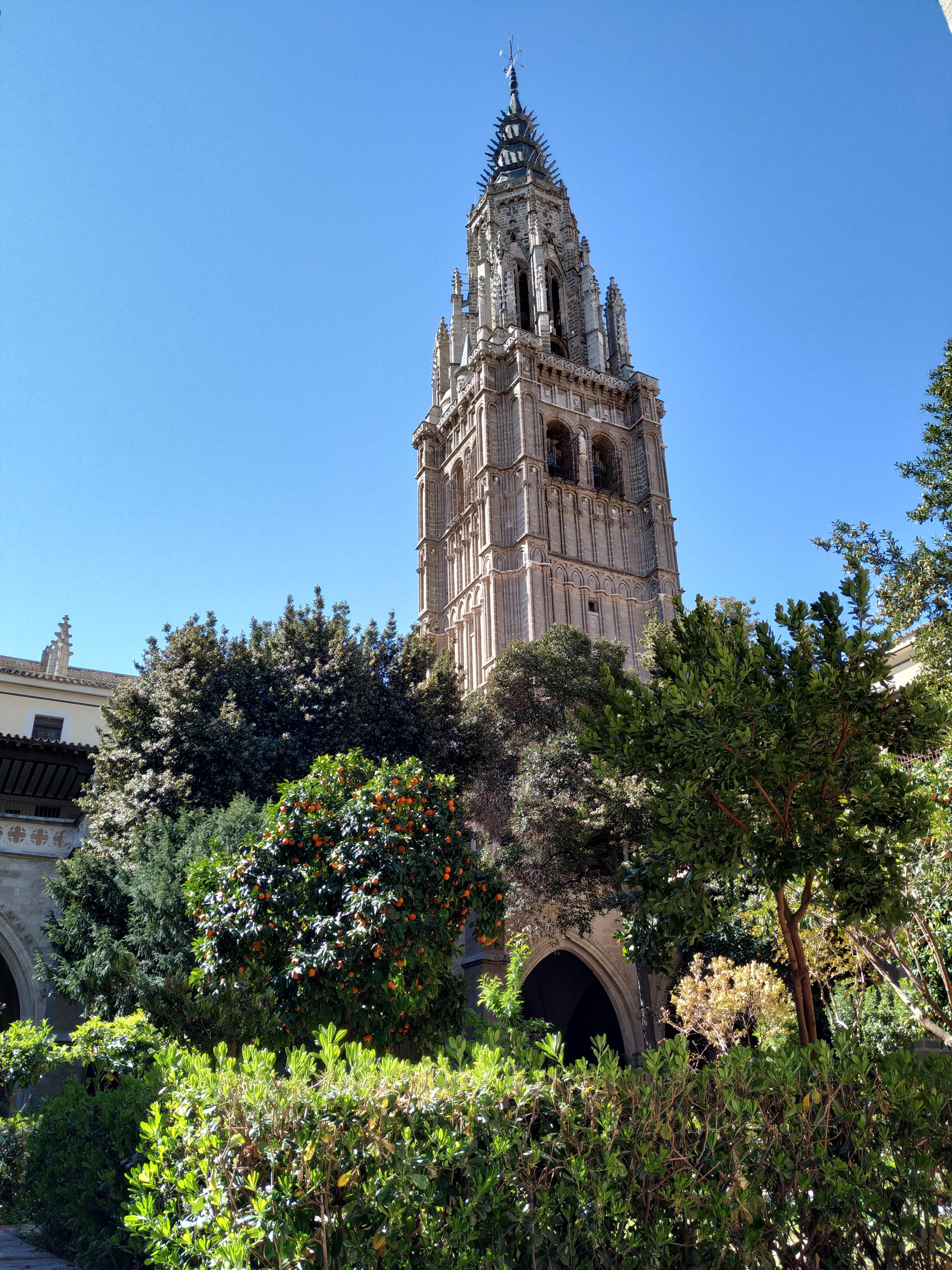
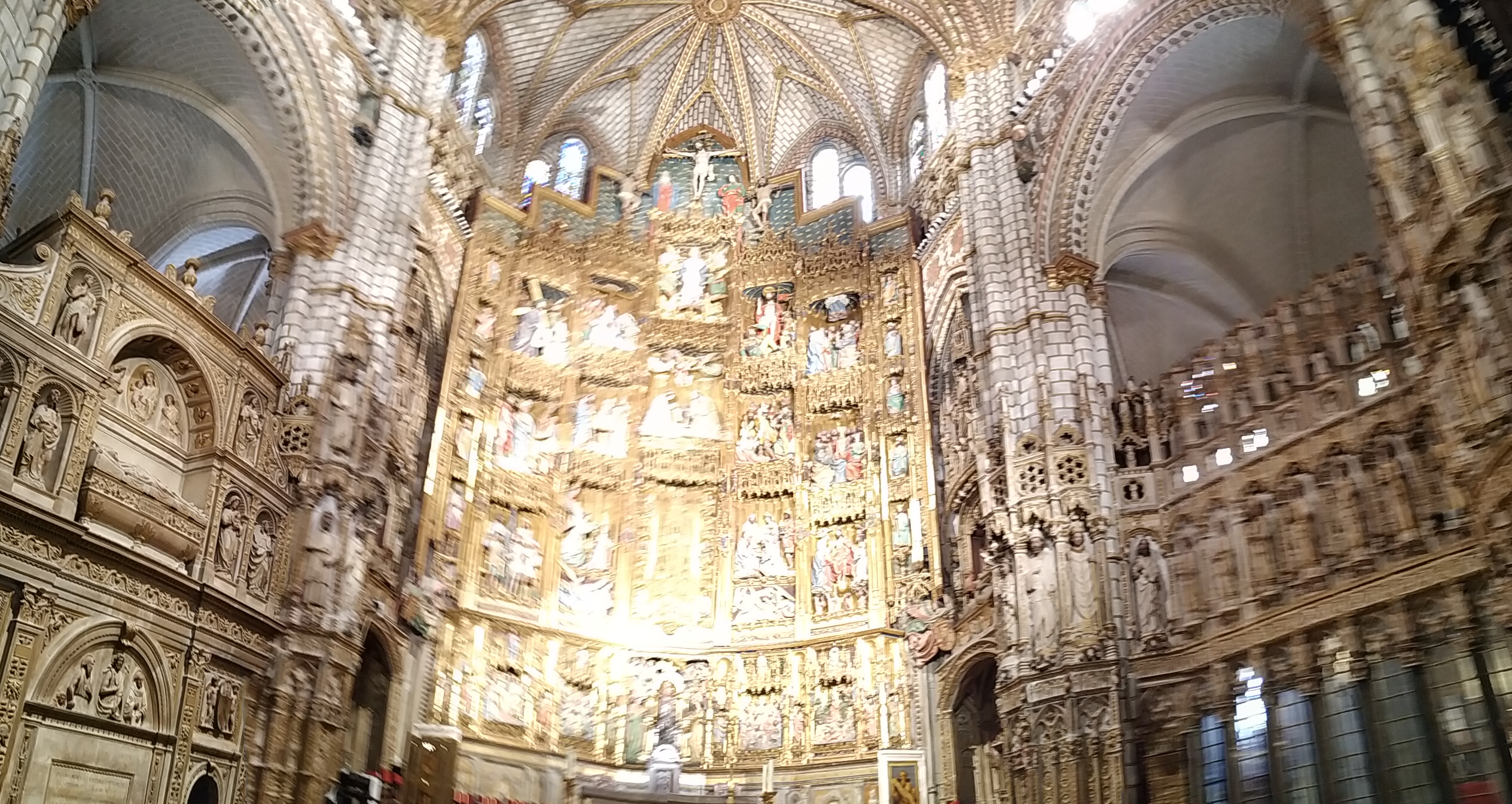
Up next was a visit to the cathedral, which was nearby, as you can see from the large tower in the last picture. It’s a gothic cathedral, built on top of the old mosque from the 13th to the 15th century. The builders enjoyed using light as a “building material”, which is why it features a whole lot of stained glass. City hall was on the way, so there’s a shot of it, too.

Why don’t we ever see this mother and her child looking happy like this?
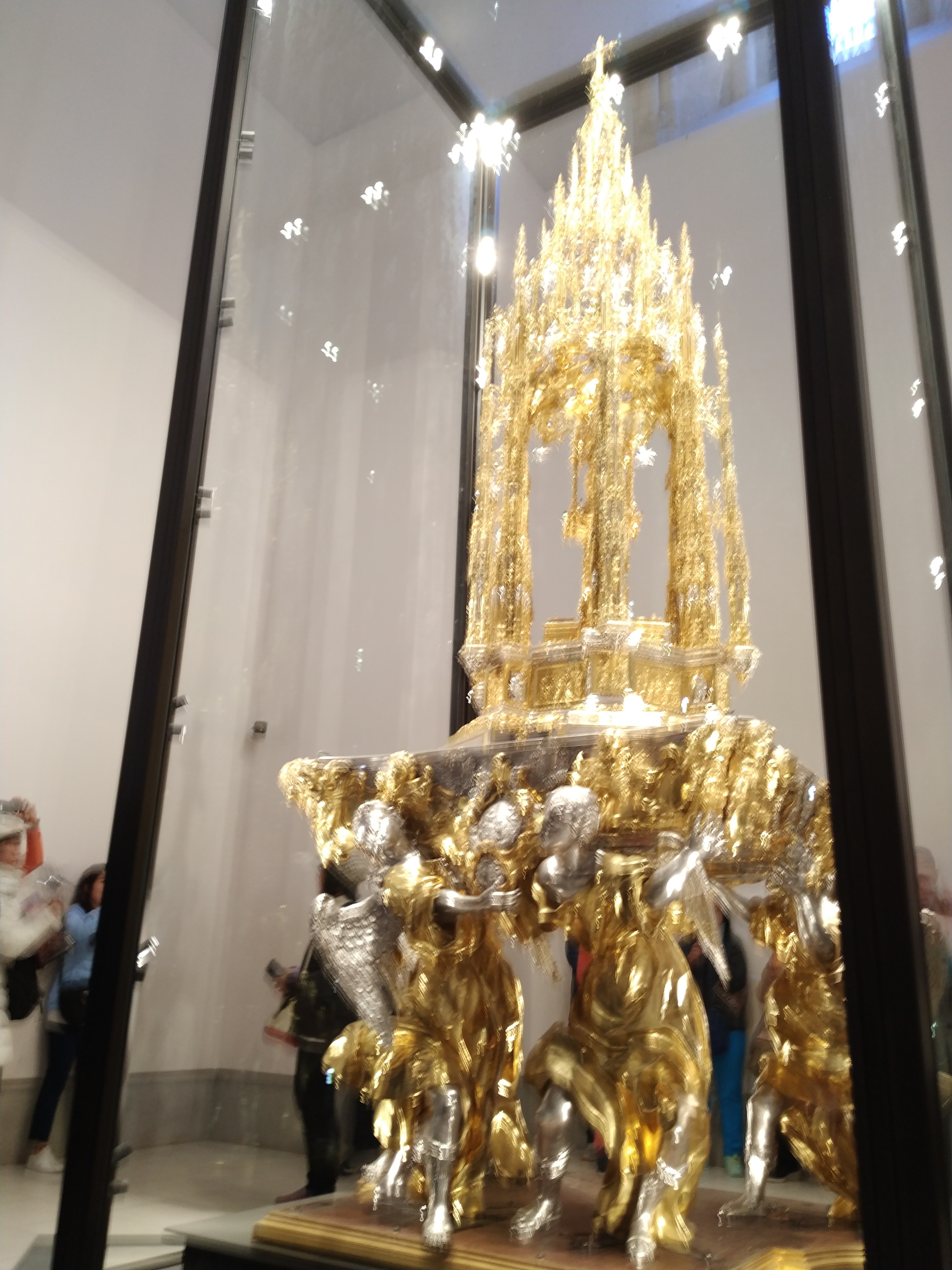
That’s a lot of gold.

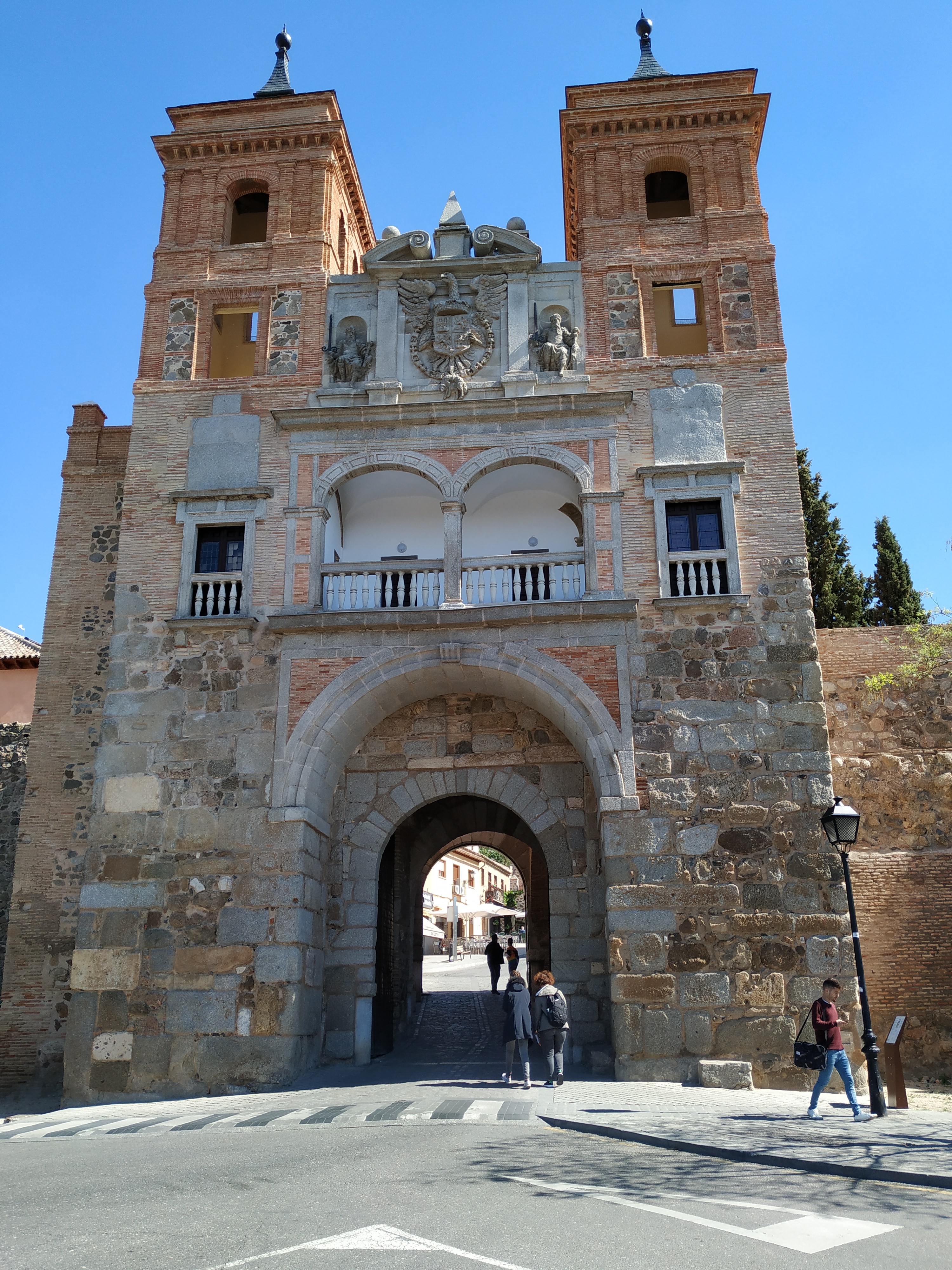
Sadly, you can’t go up the tower, here. Then it was time for my first visit to a synagogue.

The picture is straight. It’s actually the wall that’s slanted.

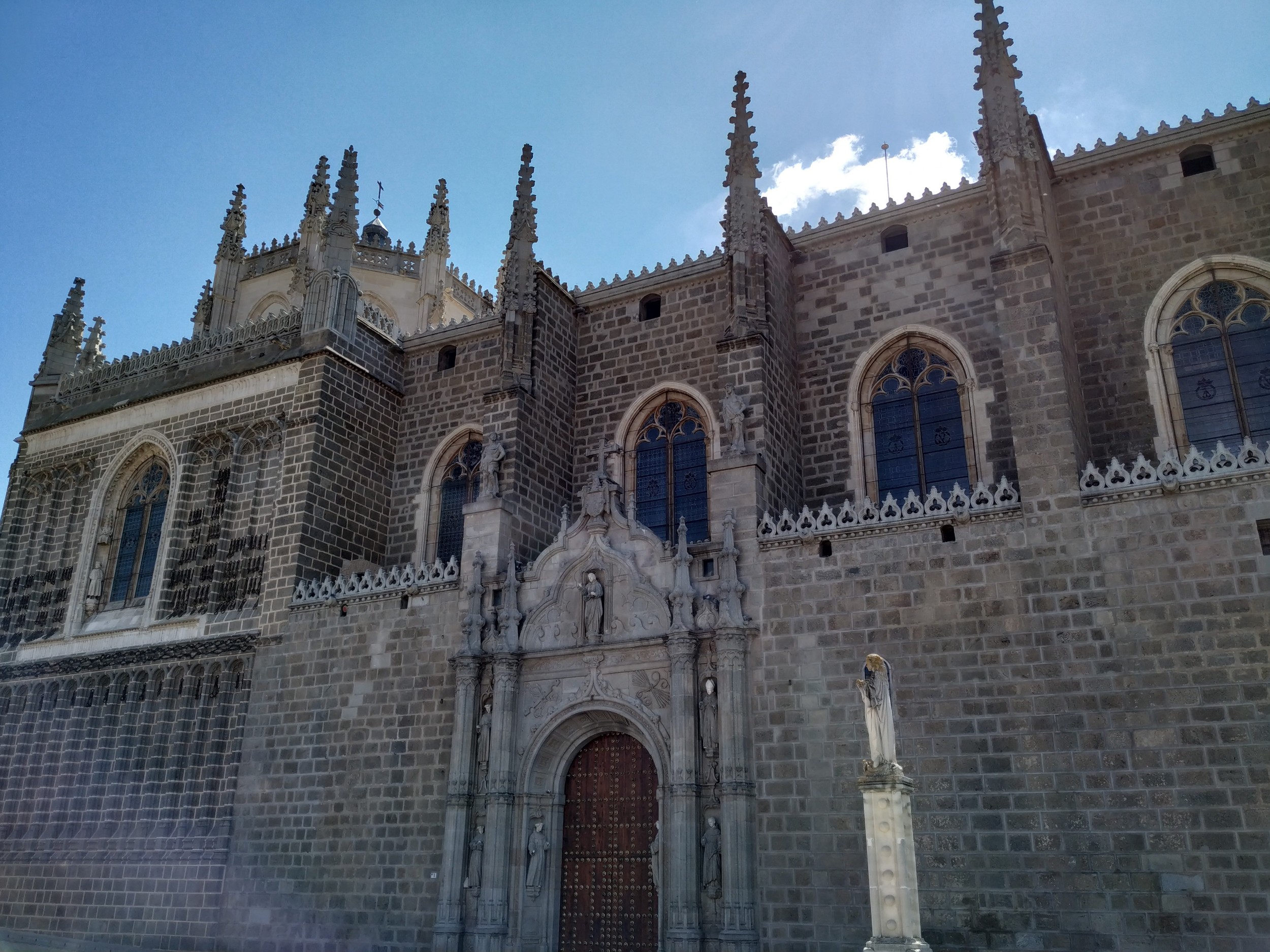
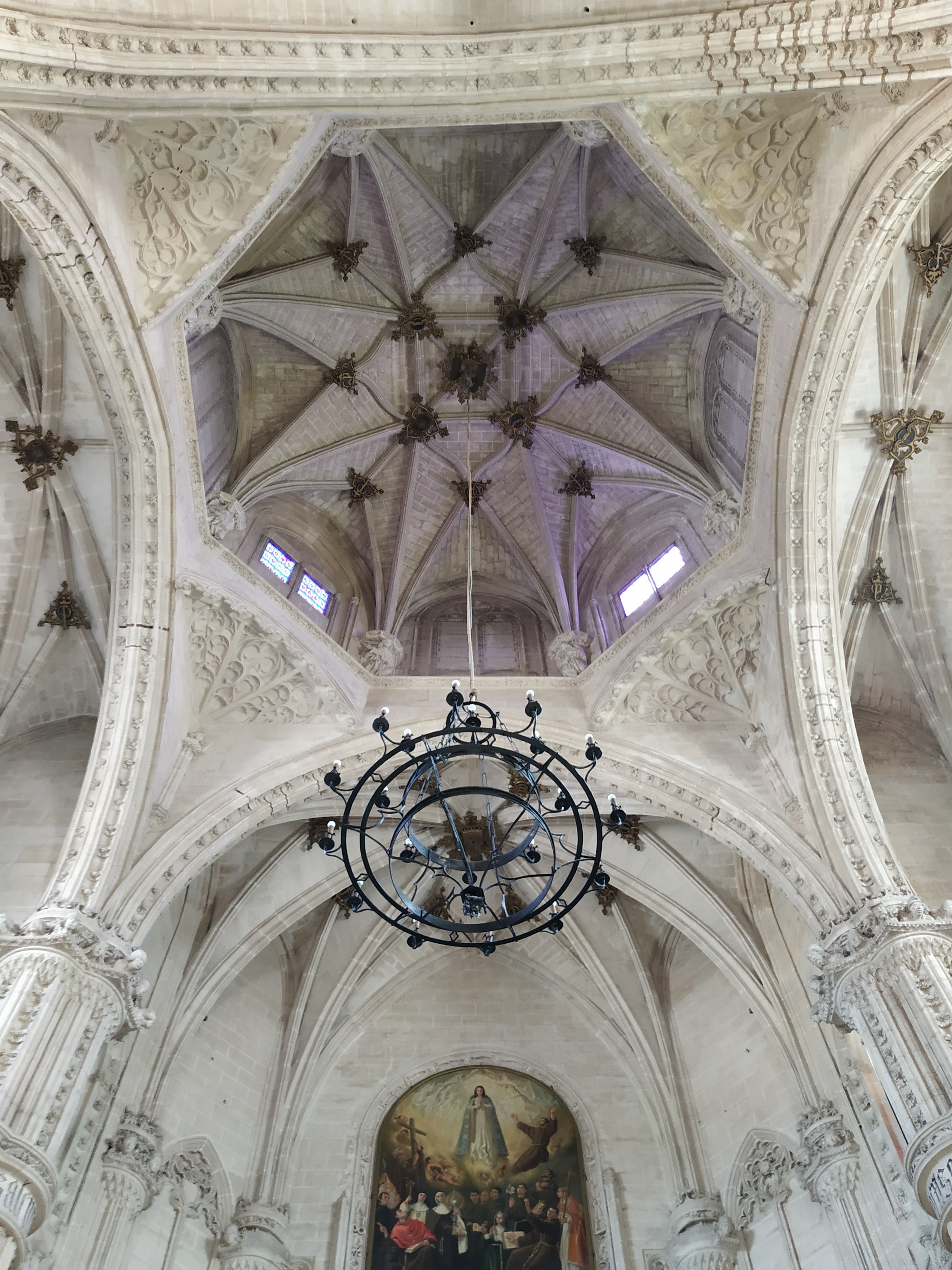
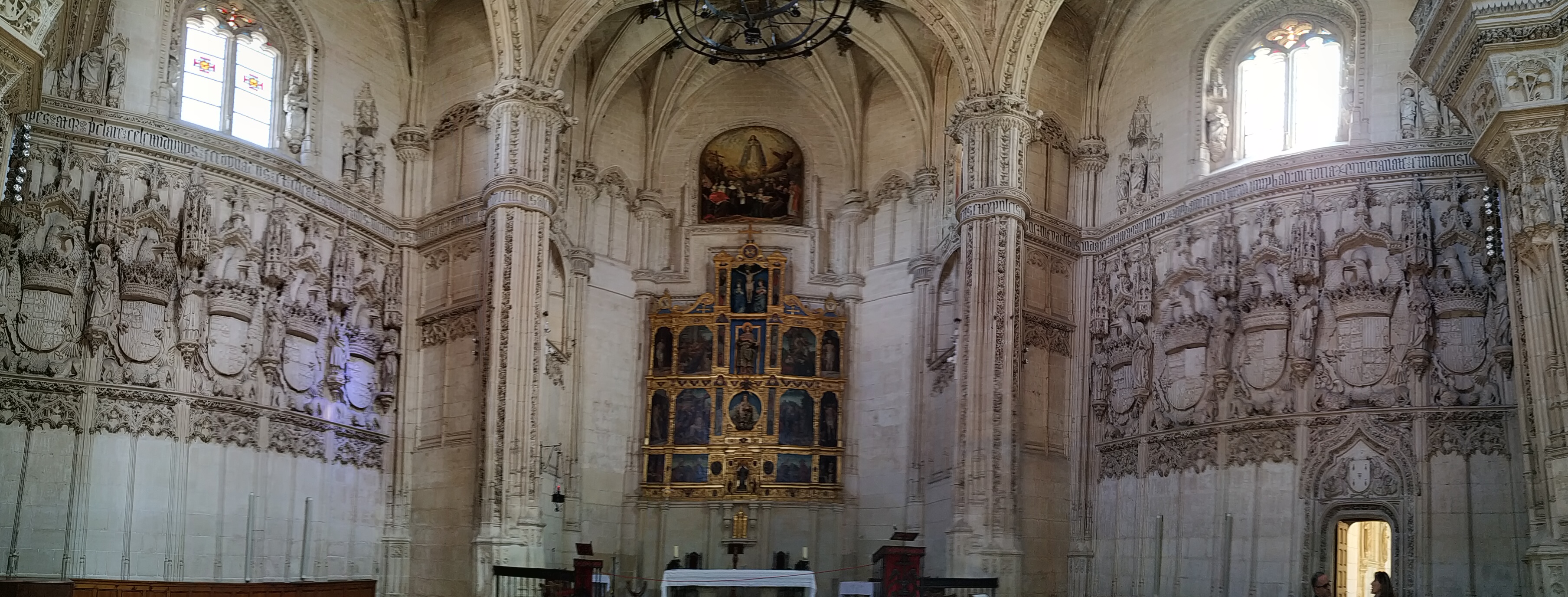
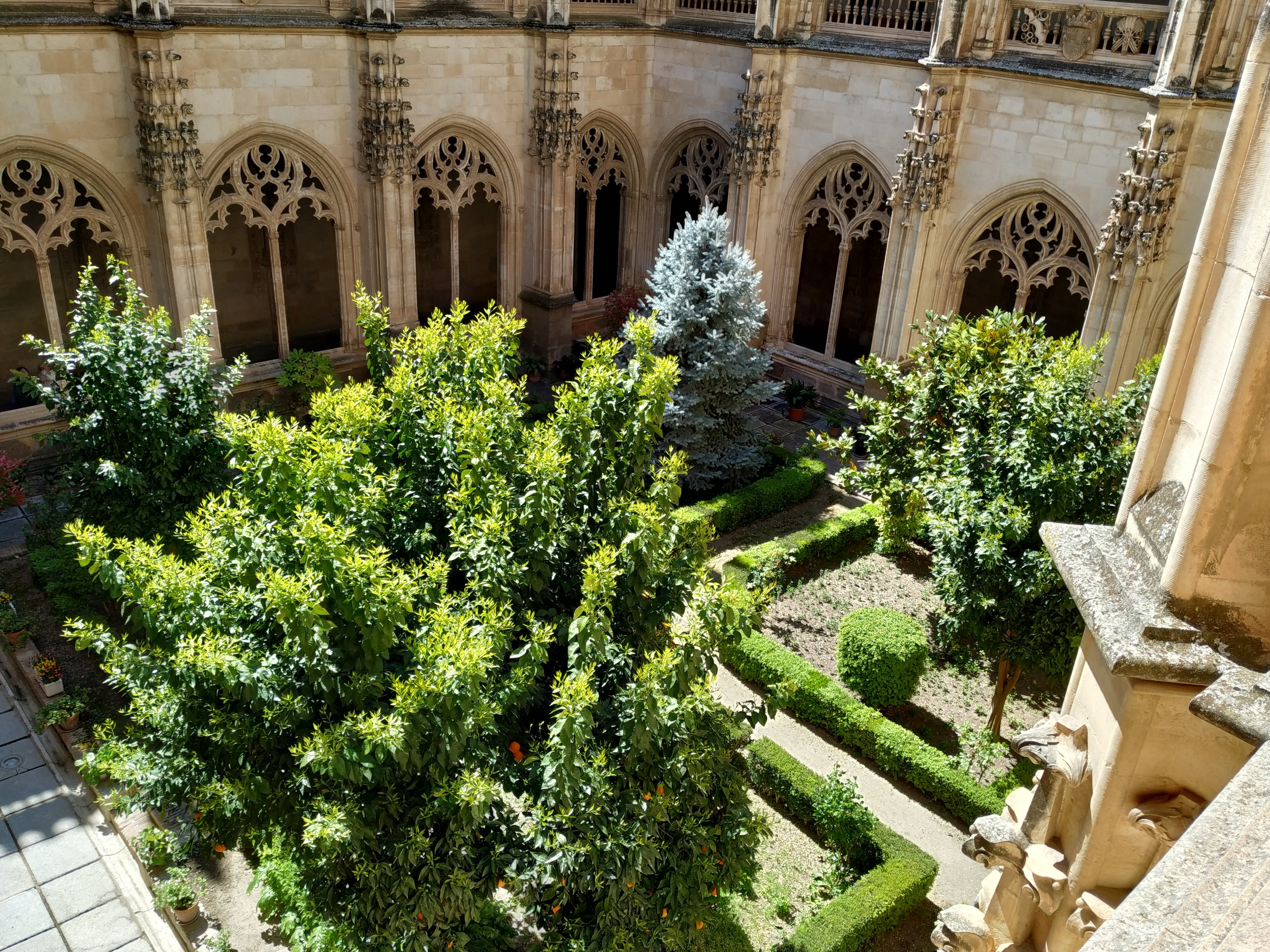
And a monastery — San Juan de los Reyes.

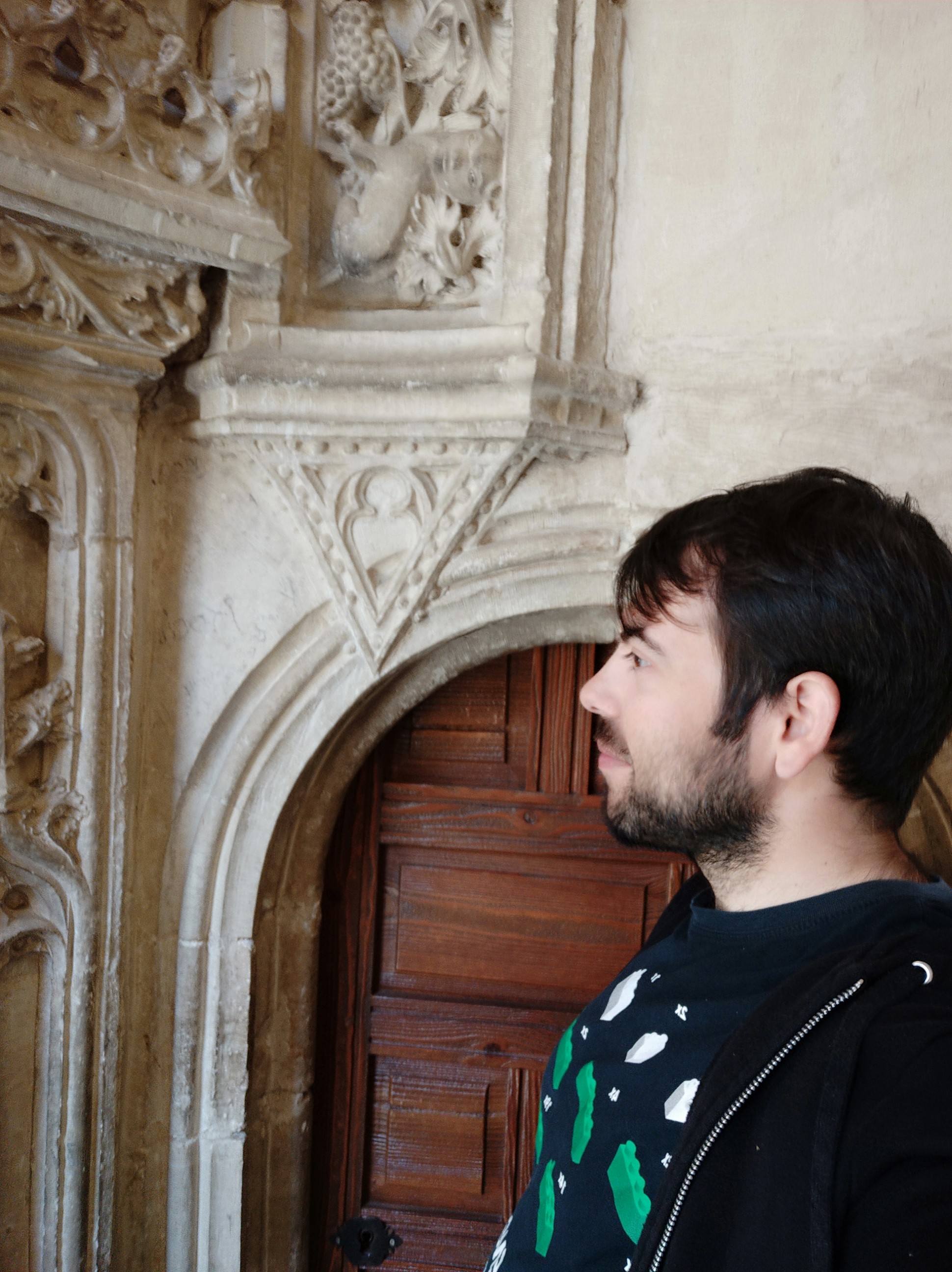
At 1,72m, I am not a tall man. I’m too tall for these doors, though.

A hostel roommate mentioned a mirador where you can see all of the old town. It’s a 40 minute walk from town, but it’s well worth it, I think.

I had a rather basic lunch on a nearby terrace, where I got to sample the local beer, which was quite good.

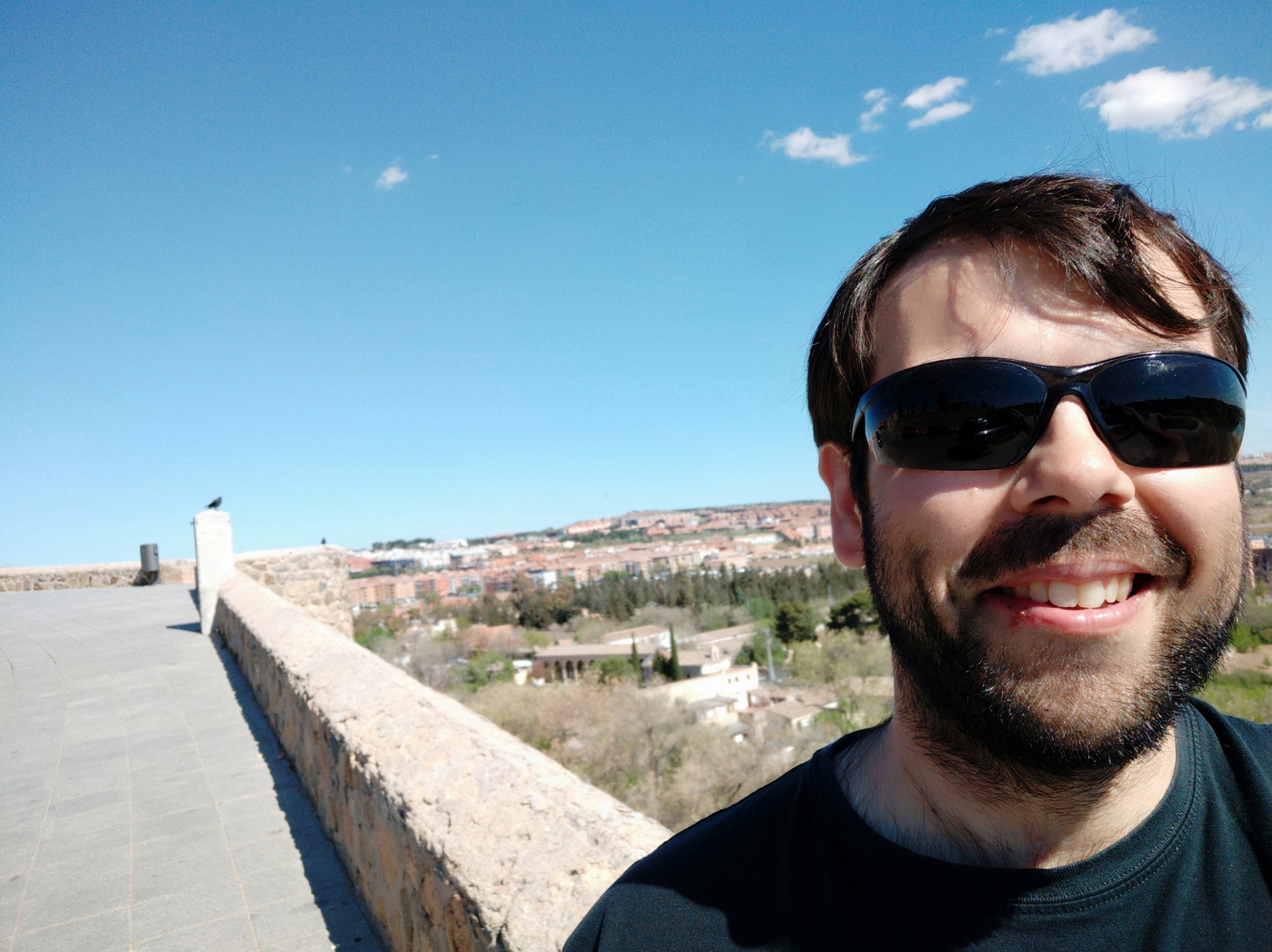
By chance, I met Saresh, another hostel roommate here, so I didn’t have to make the walk back on my own. We parted ways when we got to town and, to have a rest, I took a selfie with a raven:

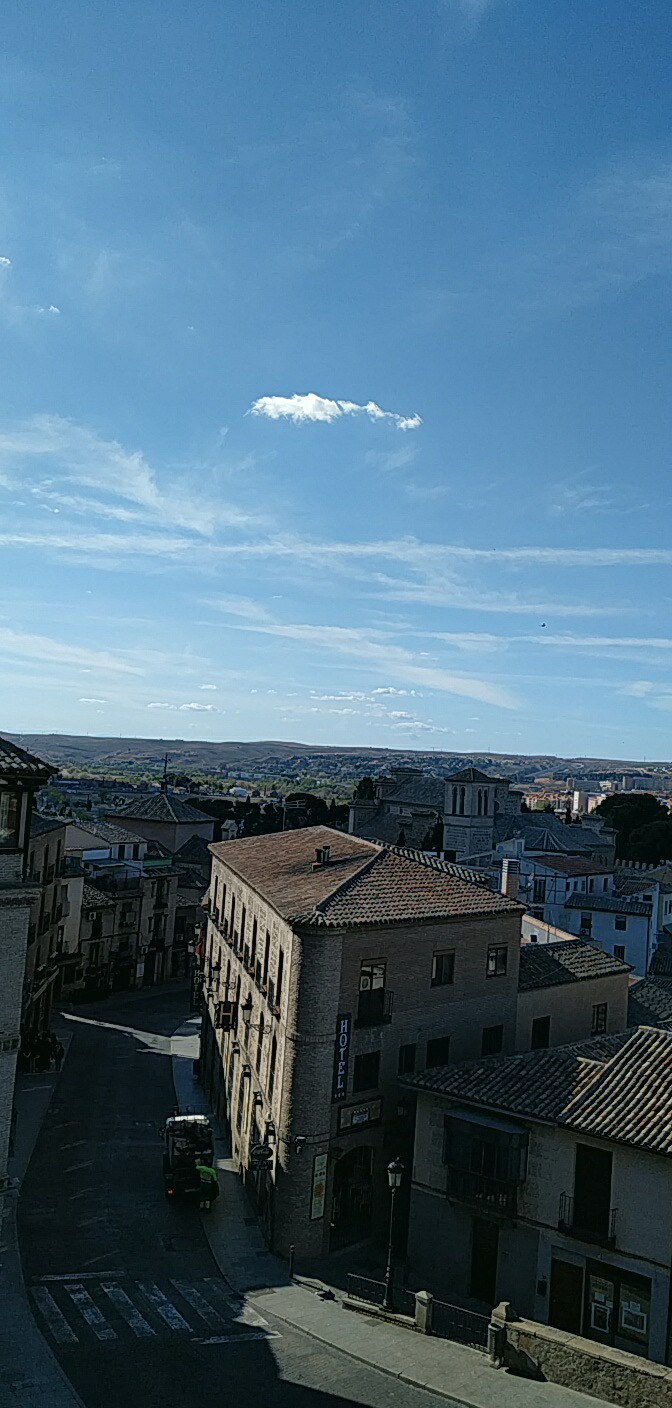
Monumentally speaking, the afternoon wasn’t as interesting. I’ll just leave a few pictures here.
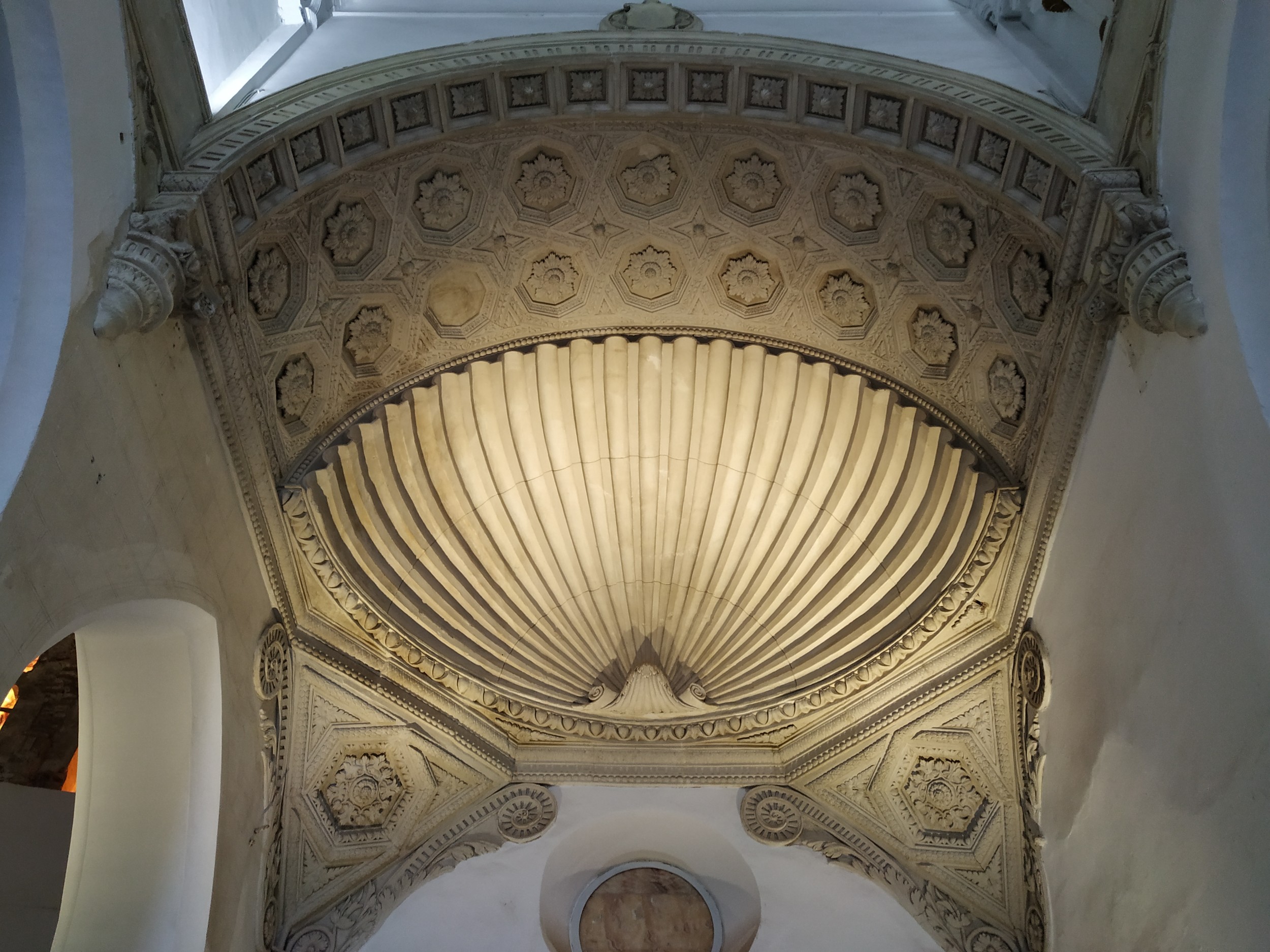
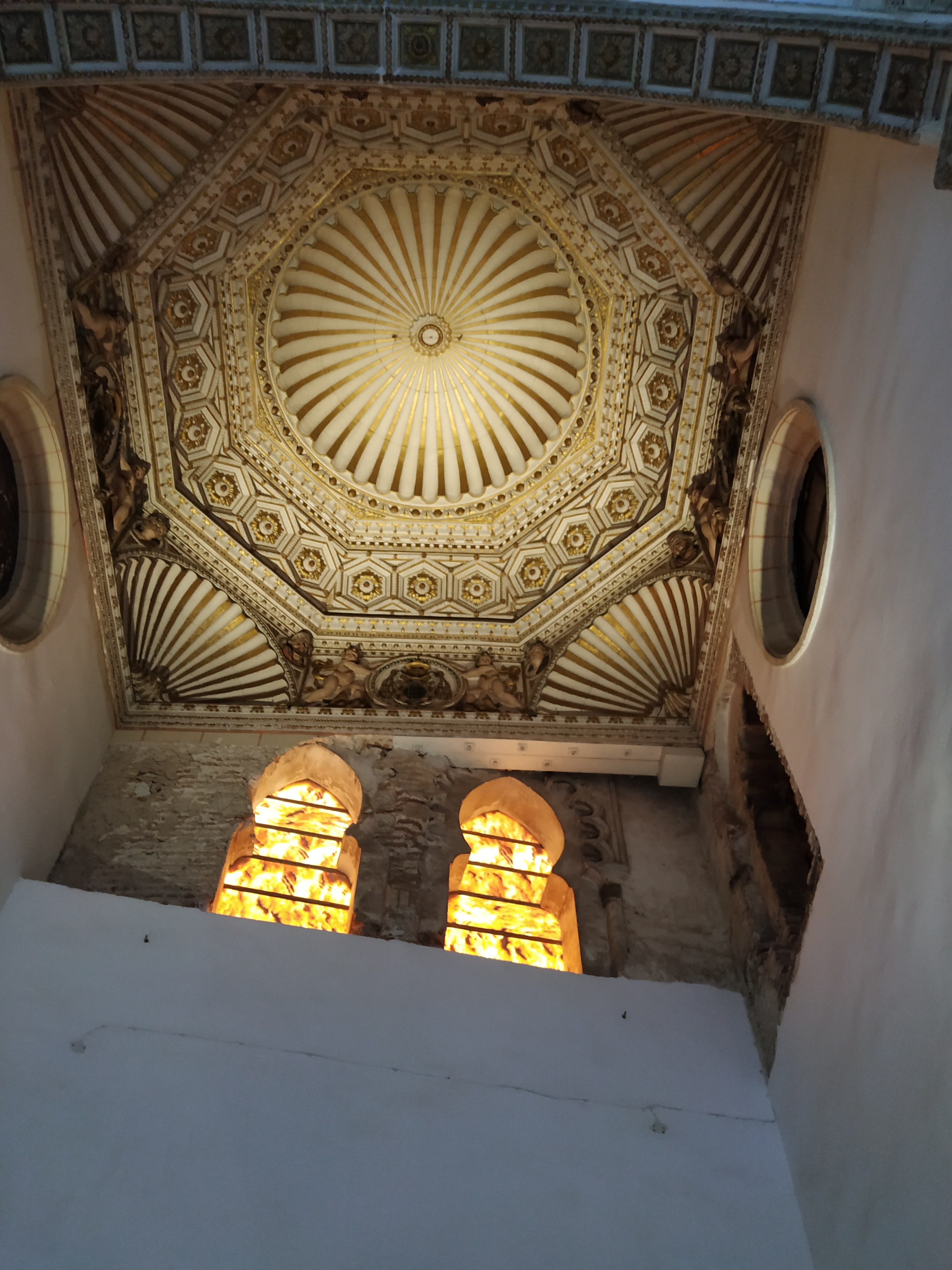
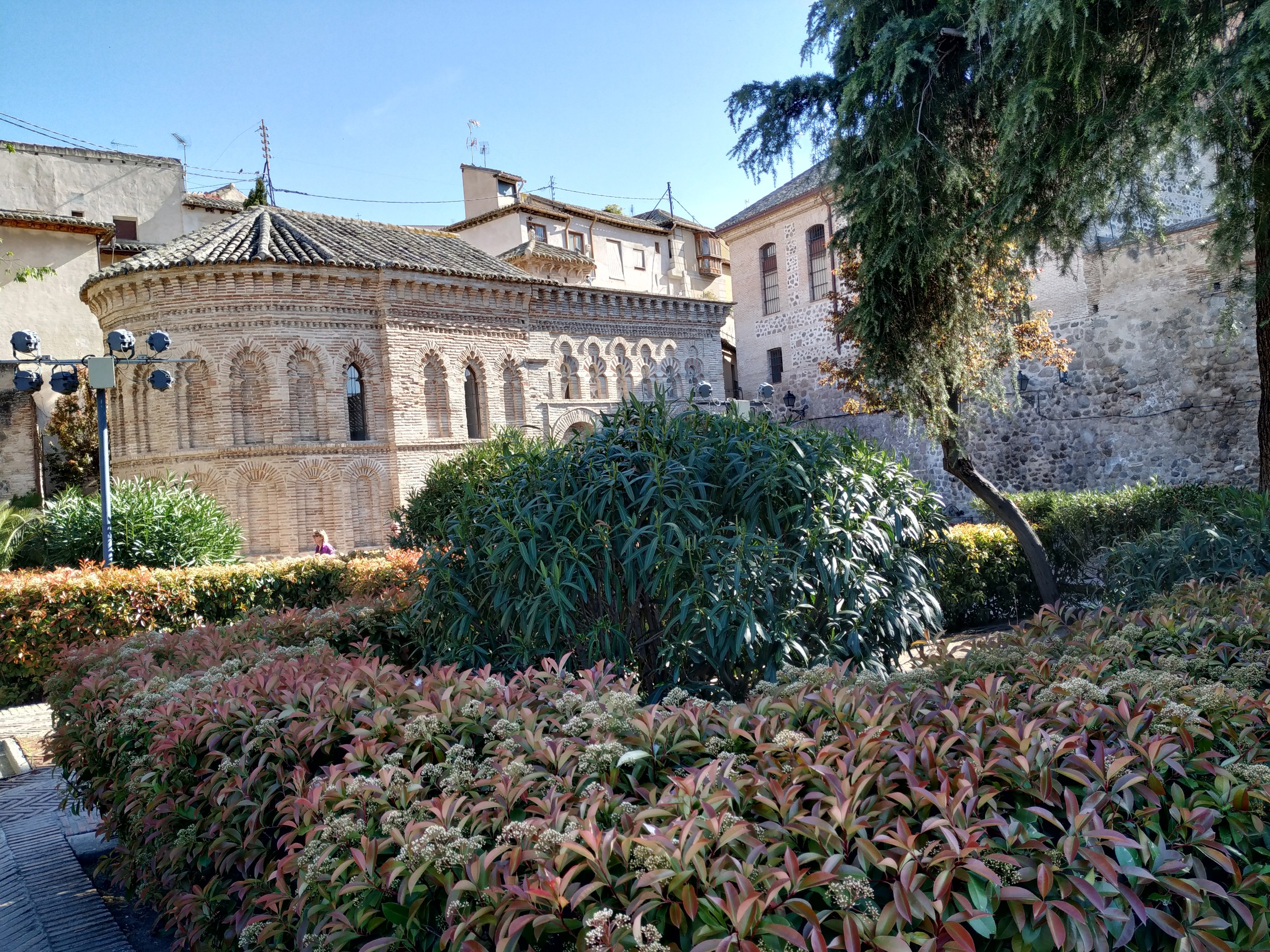
An old mosque’s garden and one of few green spaces in the old town. The inside was converted to a church in medieval times. Also, most of the frescos are missing, so it’s not very interesting.
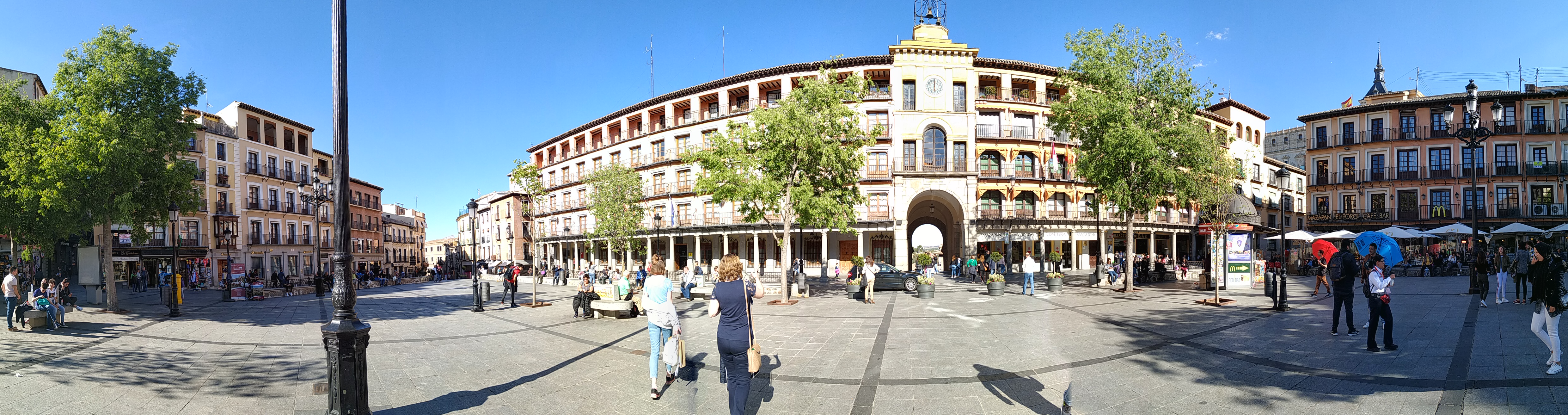
The most important square in town, Plaza Zocodover, is where most of the nightlife is concentrated, nowadays.

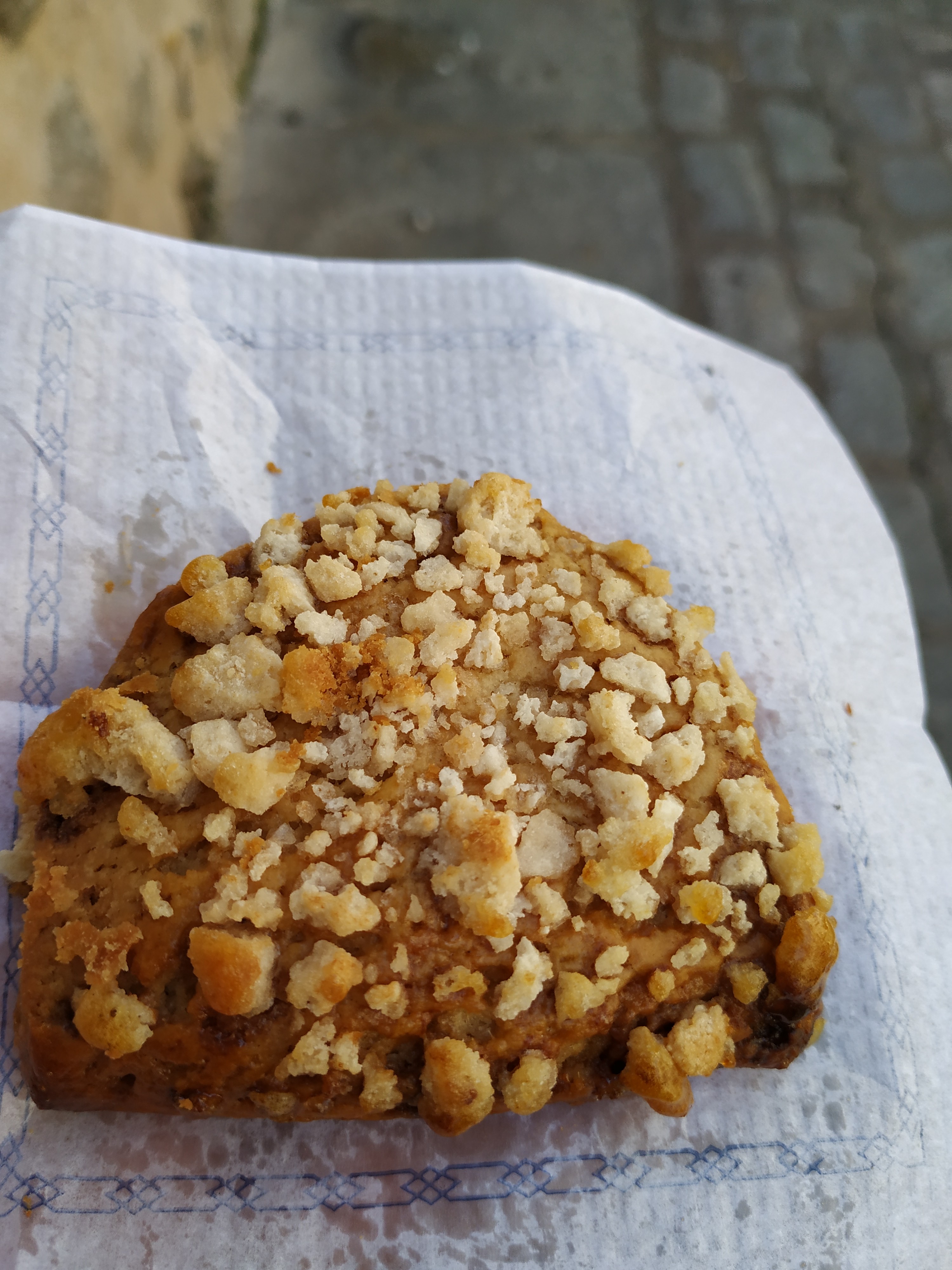
At this square, you can see how much the locals enjoy marzipan. There’s at least three different stores fully dedicated to it. I don’t share that particular taste, however, so I settled for another local delicacy. Toledanas are biscuits made from a crumbly dough, with crispy stuff on top and pumpkin jam inside. They’re decently tasty.

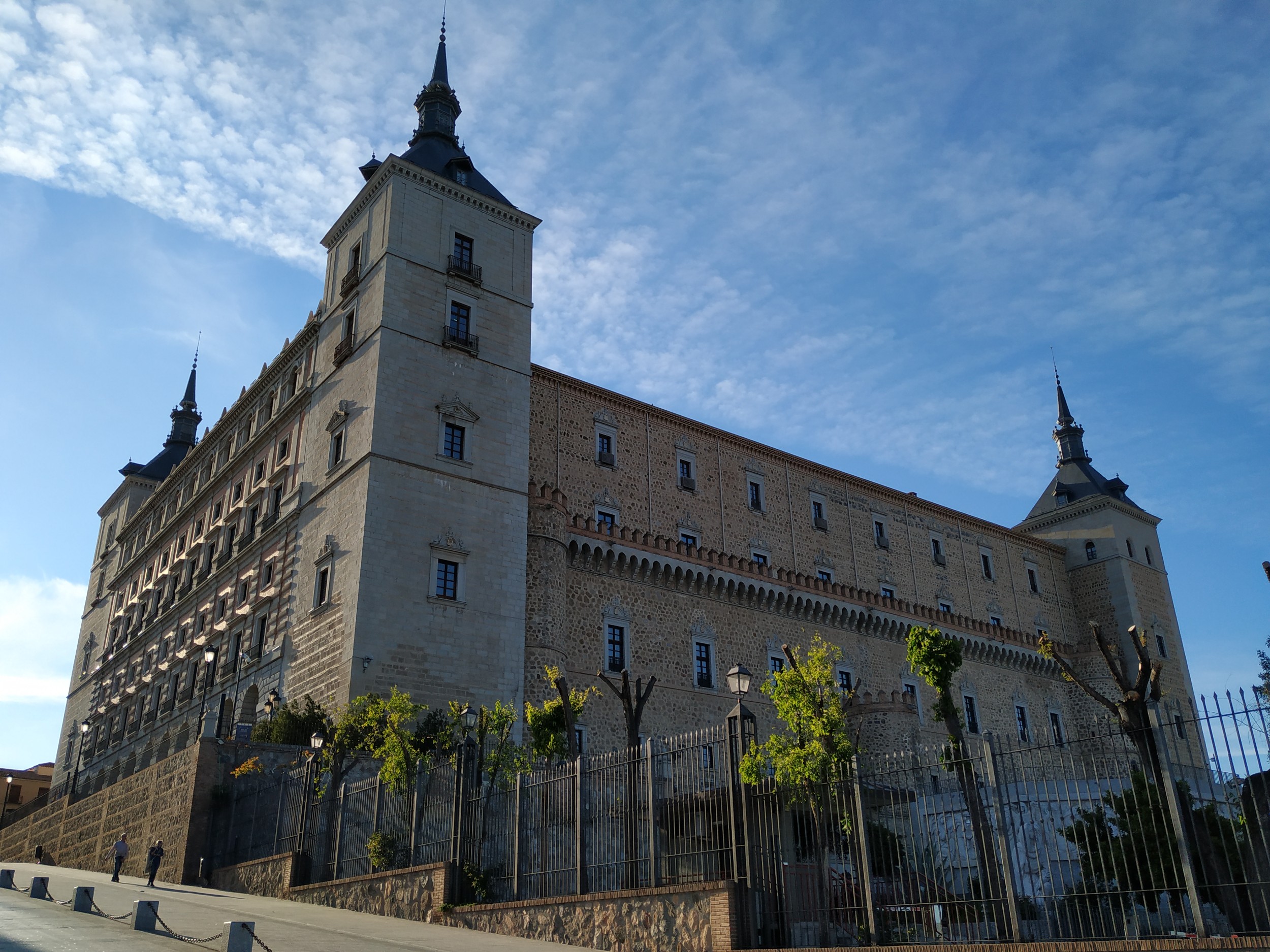
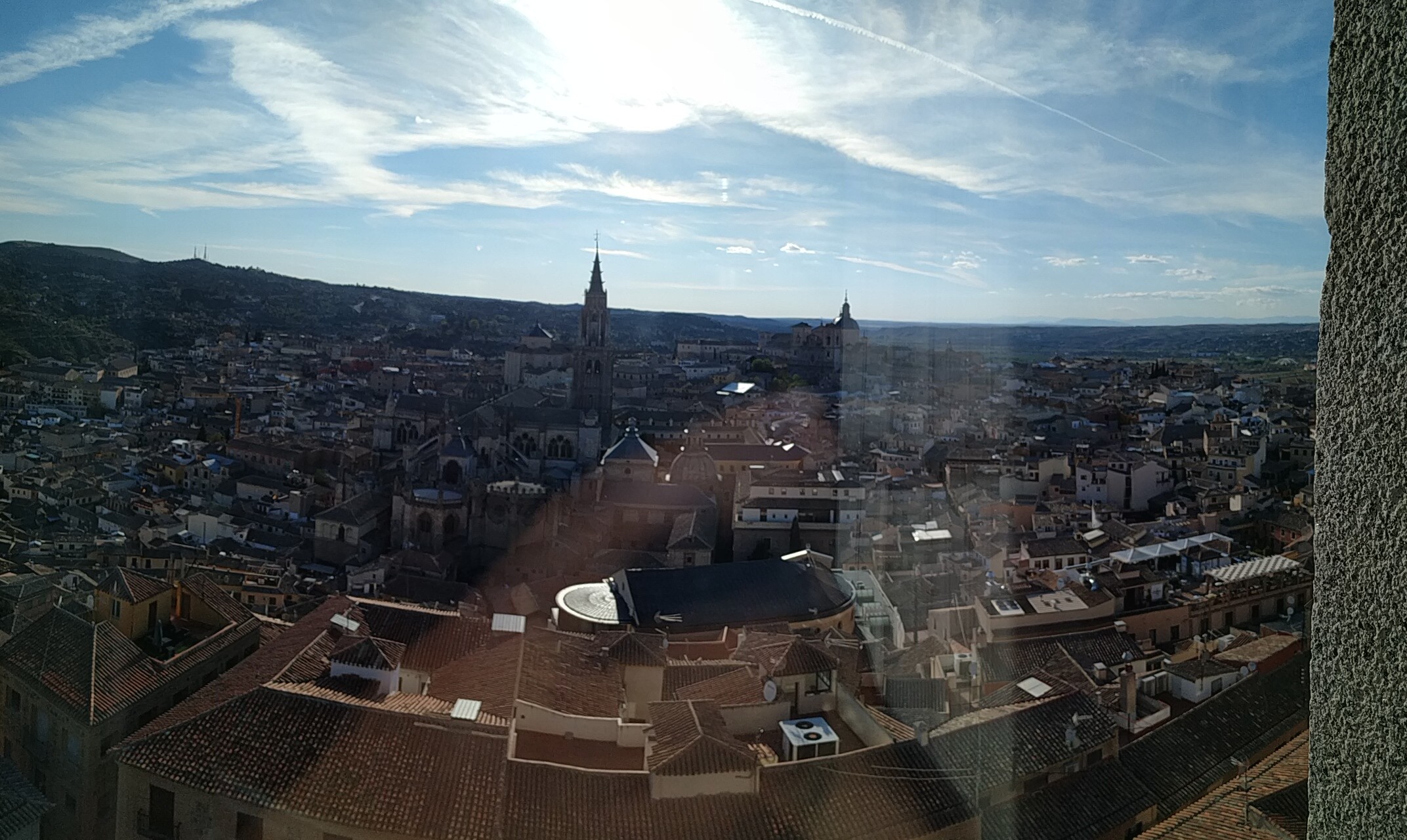
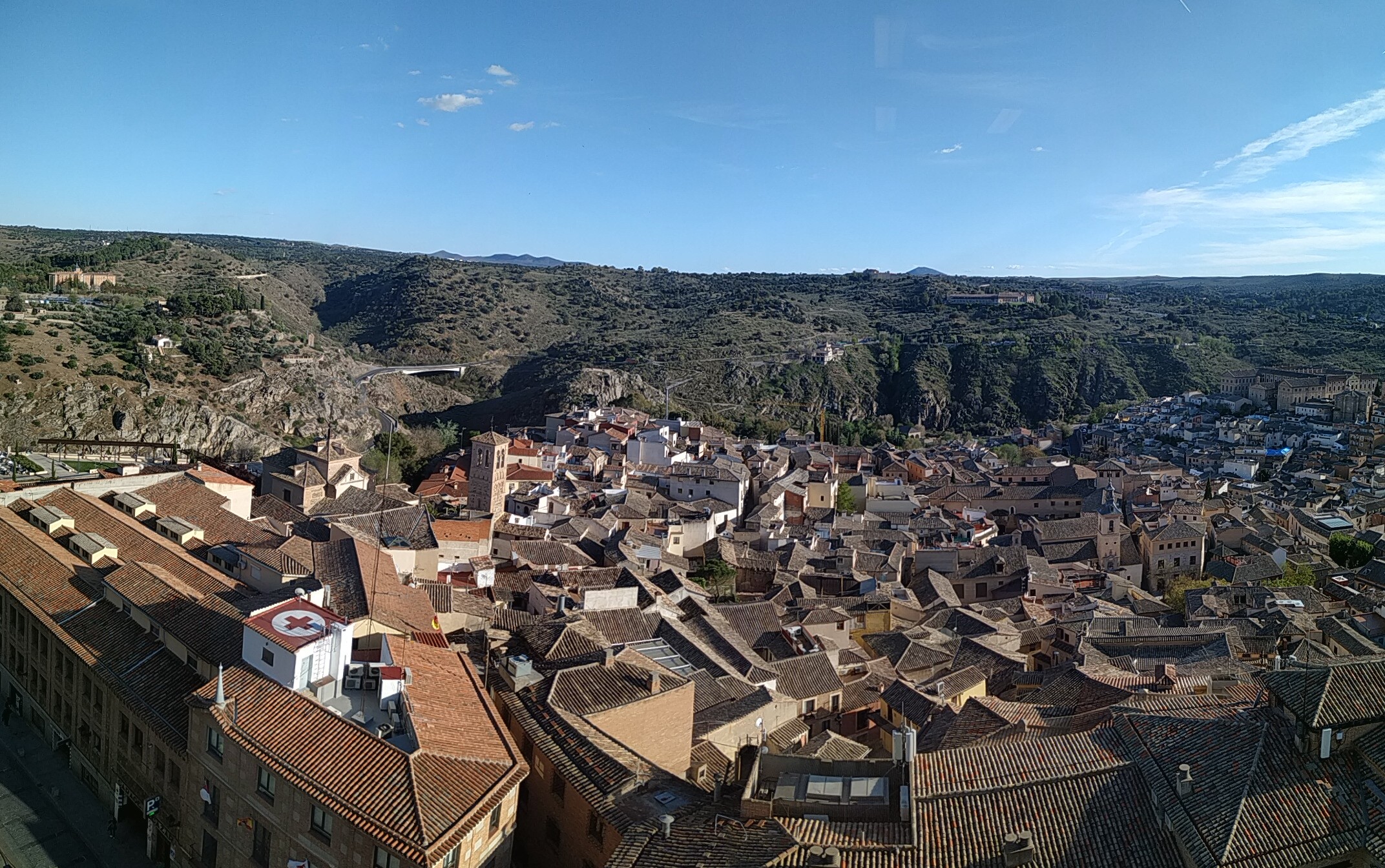
The largest, most imposing building in town is the Alcázar, a fortified palace. Nowadays, it is shared by the military museum, which I didn’t visit, and a library, which I did, because the last floor has a cafeteria, which promised some amazing views. It had them, though only through windows, which is why the pictures don’t do them justice.

By now, I felt I’d seen the main attractions in town, so I went due a walk in a path by the river.

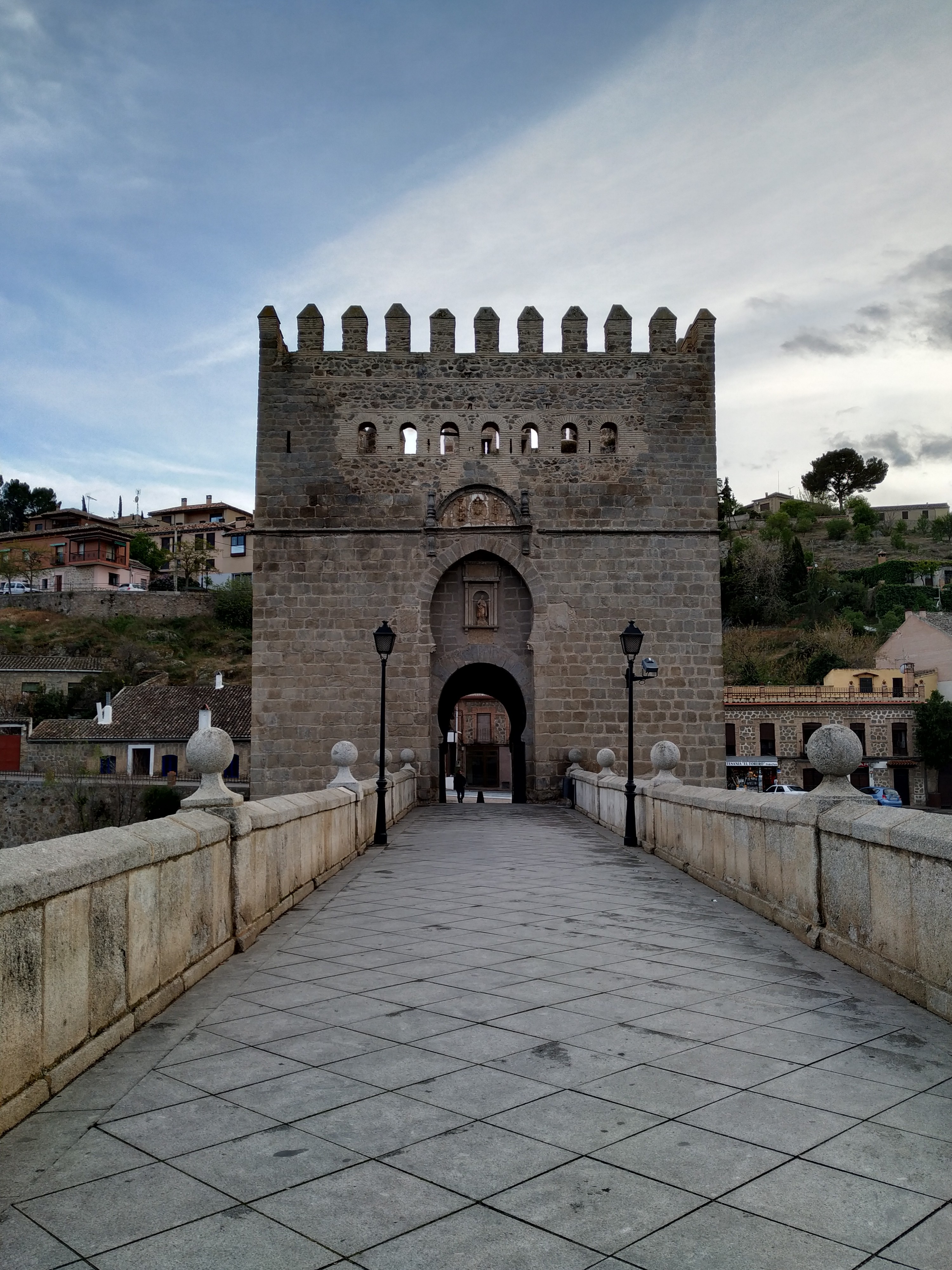
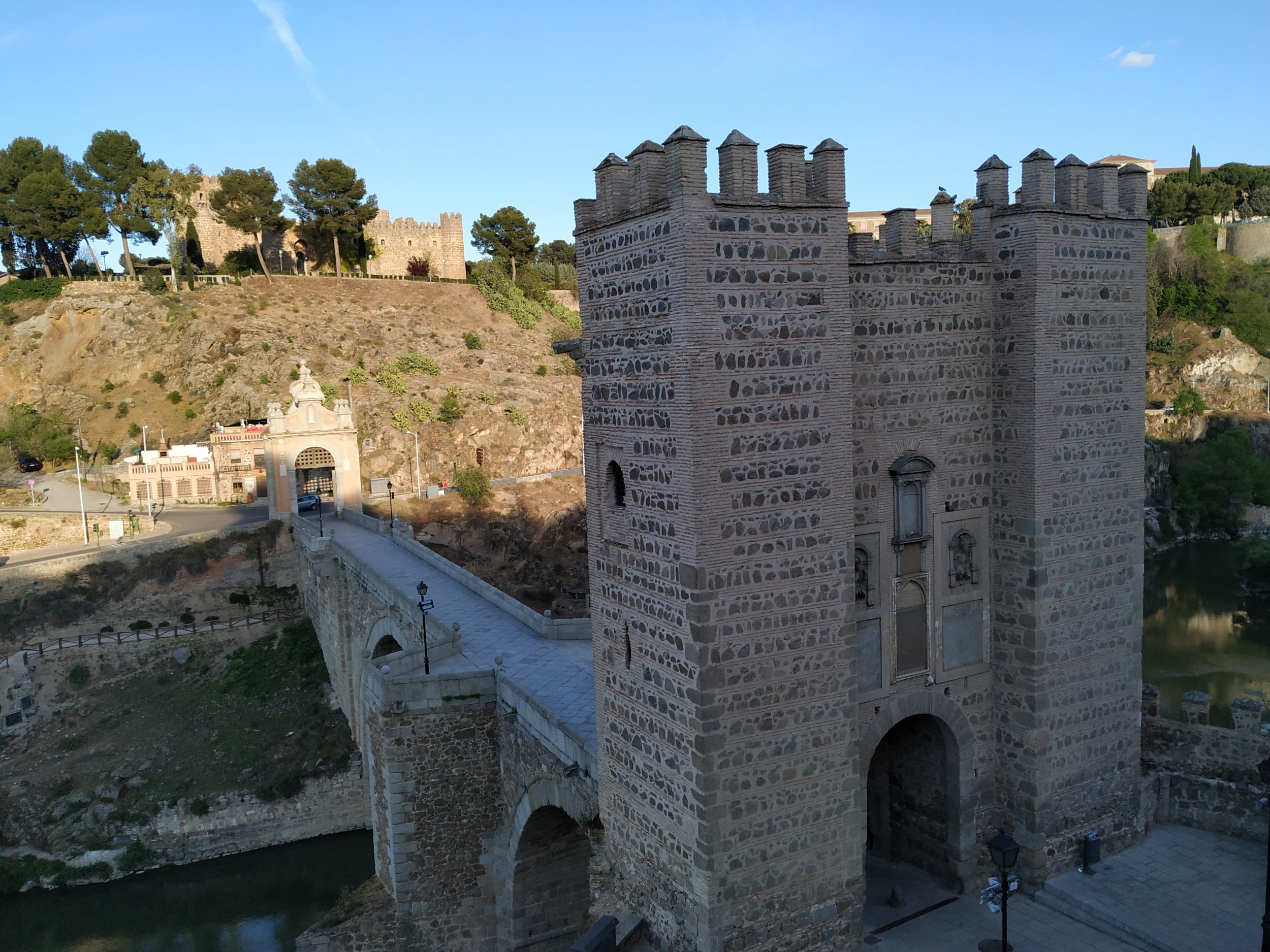
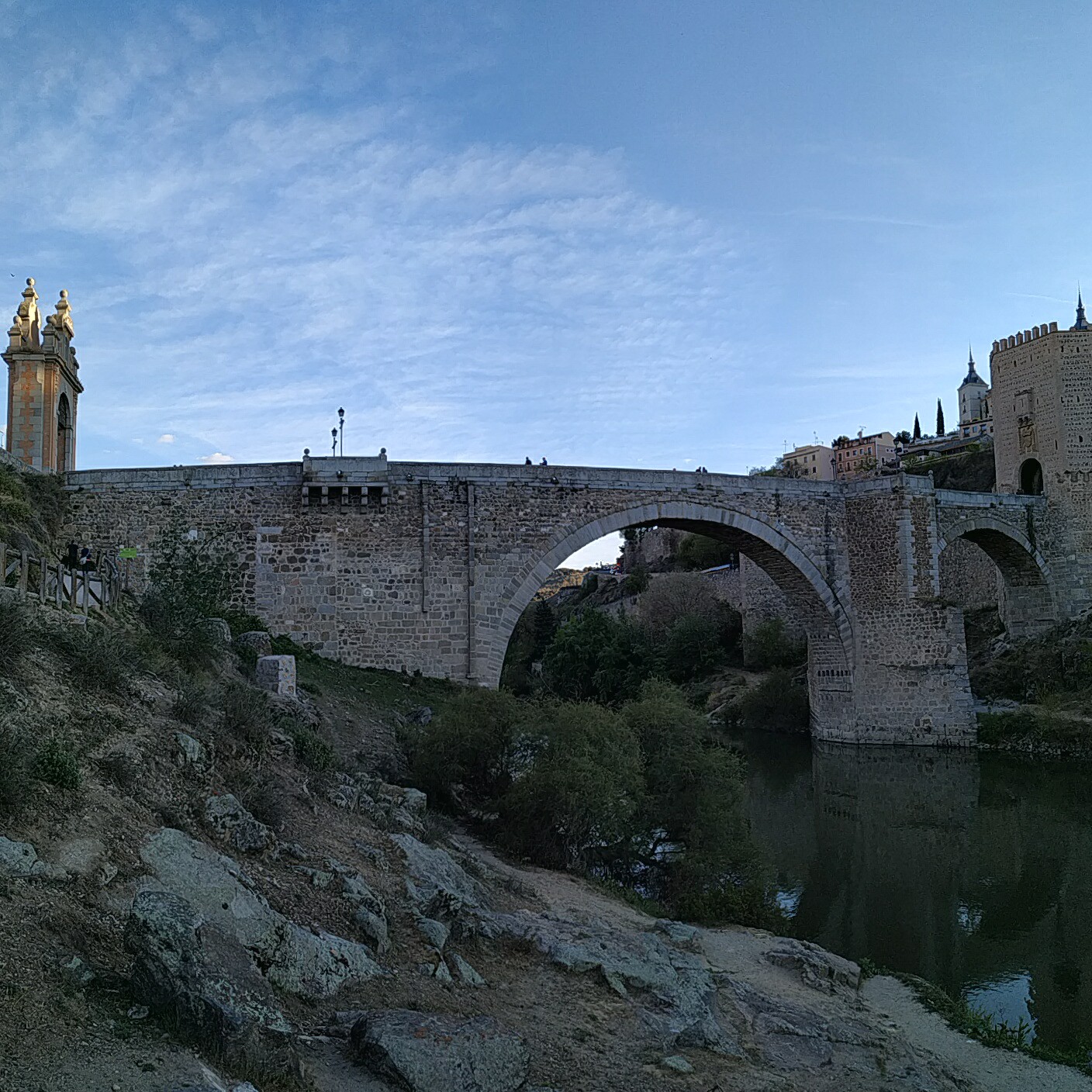
Alcántara bridge
Tequila time?

By this time, I was pretty beat, so I took a bus back up to the hostel. It was great to be off the saddle one day, and Toledo was a great place to do it. It’s also been sunny since I arrived there, so that’s a bonus. I hope you enjoyed this post and that you have a great day!

The rain in Spain…

Just outside Monfragüe, after packing everything up and returning to the road, a bunch of cows invaded what was my campsite. So that was close.

I would end up spending almost the whole day in the middle of nowhere, among pine woods and farmers’ fields, having to make 5km detour to a town in the middle of the day just to stock up on food and water. I also arranged to have a replacement clip for the saddlebags to be delivered the next day to a bike shop in Oropesa. Before the day was up, I would get my first little glimpse of snow.

Despite the ever-present Sierra de Gredos on the horizon, these days have been mostly flat terrain, which isn’t that great tfor photo-ops. However, when I took a rest, I took the opportunity to take a selfie with a stork

Proof with the decent camera, just so you don’t need to take my word for it.

Then I picked a campsite and prepared for what would be my first rainy night while camping. It was predicted there would be up to 2.5mm/h at one point and I’d never camped in the rain before, so I dug a little trench around the tent, to try and keep me dry. I thought the campsite would be great, because no cars passing by would see the tent. And then, some kids on bikes went by and spotted it. And then some guys on foot. It was already nighttime, I was on public land, and they just passed through, so I figured I wouldn’t let my preparation go to waste. I’d chance it. Fortunately, I woke up by myself and I was dry. I was feeling a bit ill, though, so I waited for the rain to pass before getting going. When I went outside, the mountains were quite a bit whiter.
I didn’t miss all of the rain, in fact, at one point, when I stopped to get my rain gear out, it the stopped raining. It felt like I had a personal cloud on top of me:
Dry road, just ahead of where I geared up

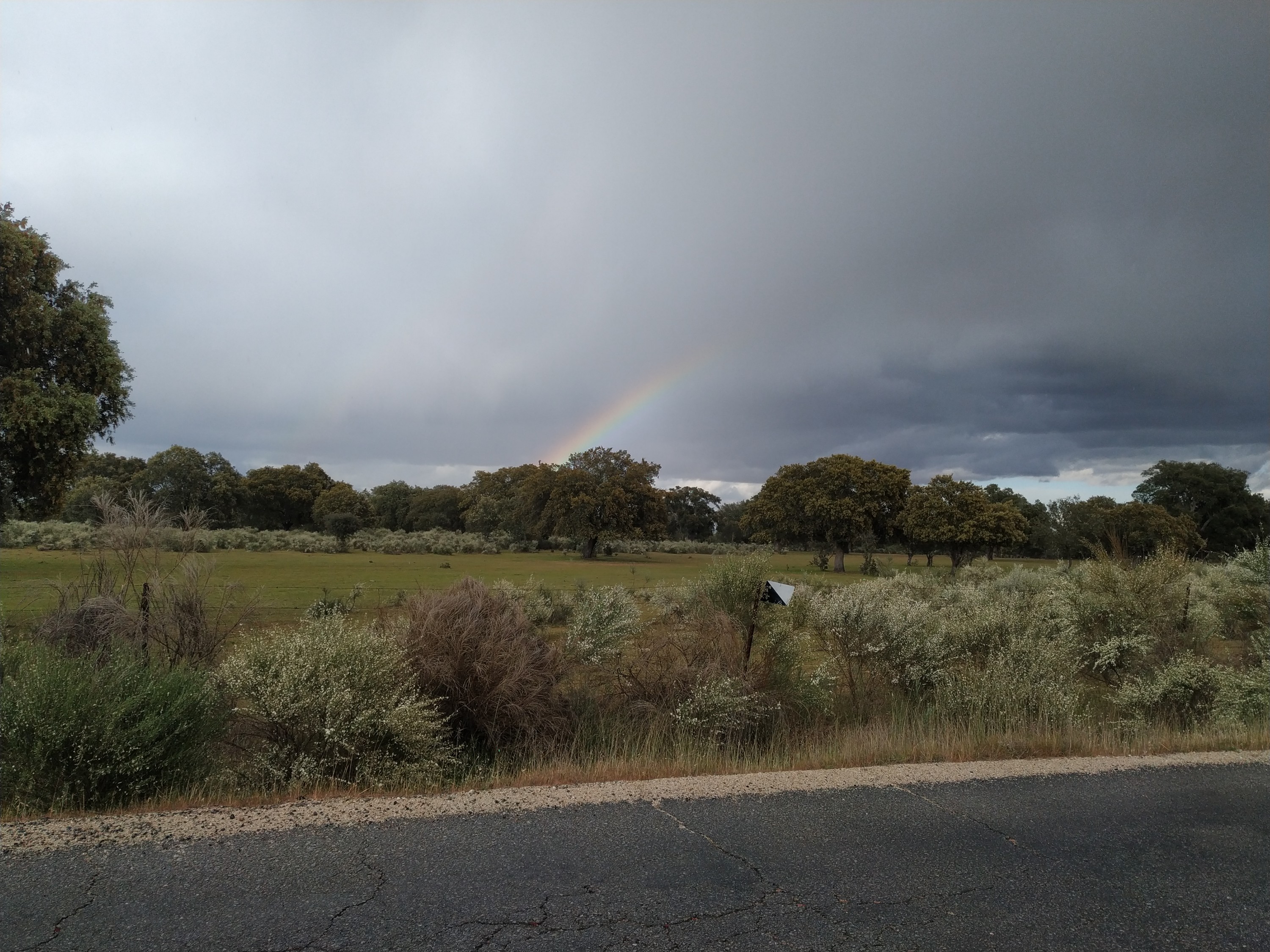
I went through some fields, then saw a rainbow.
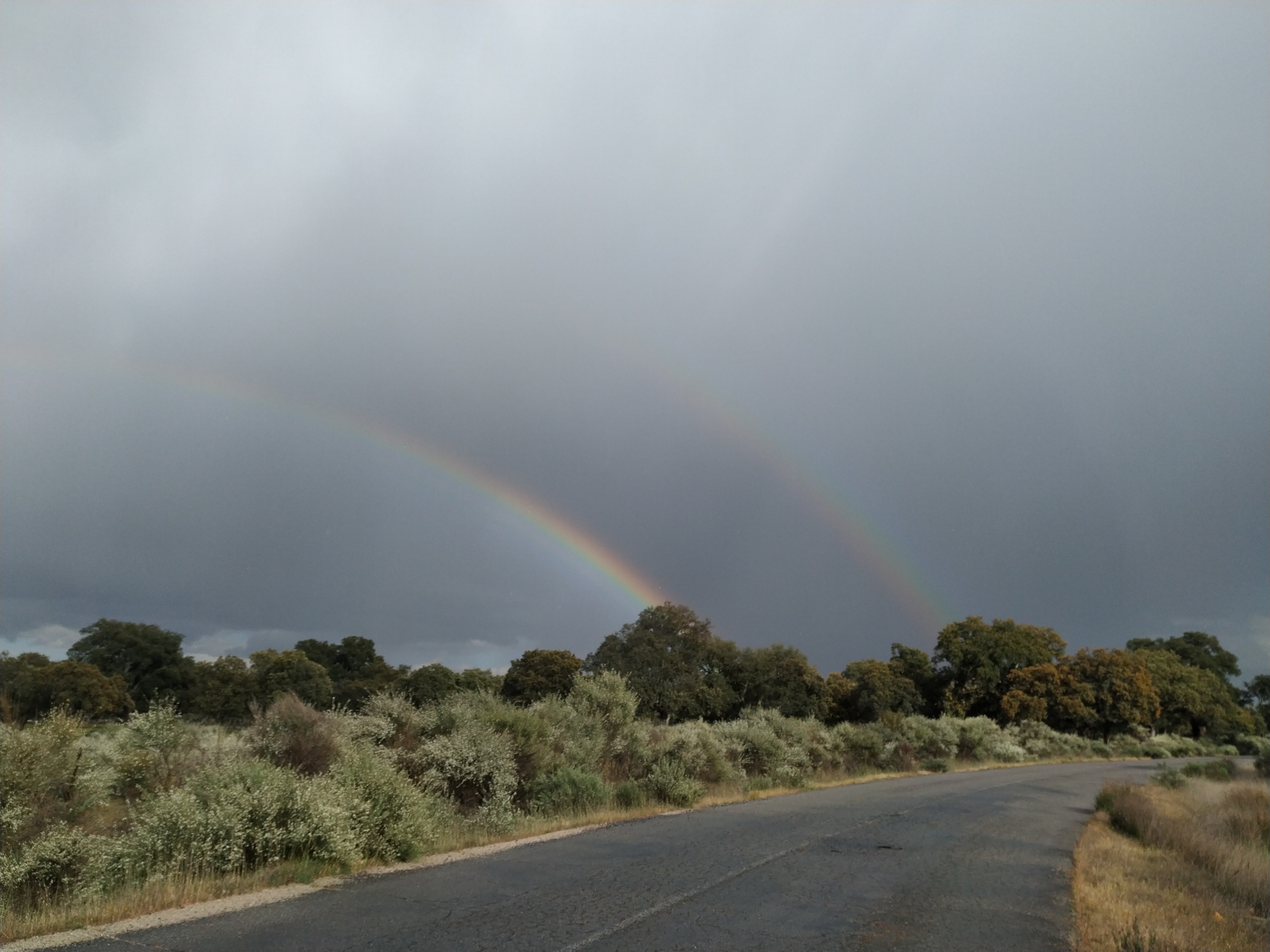
And then a double rainbow:

A double rainbow, though not all the way across the sky. Maybe that’s why it wasn’t a religious experience.

The day would consist mostly of gravel roads, mostly through some sort of shared access farms. Sadly, I didn’t make it through by sundown, so I slept in a really windy meadow, which was visible for many km, so I decided I’d leave before the sun was up. This was the last shot of that day.

I crossed the border into the region of Castilla-La Mancha, which is Spanish for “cold, windy, rainy, miserable place”. It was now Saturday. Now normally, that wouldn’t be a problem. However, it was a town holiday in Oropesa, so the bike shop was closed. Since I felt ill, I really wanted a bed, so I decided I’d speed my way on to Talavera de la Reina, where lodging was much cheaper, and then take some kind of bus back to get the parts I needed. So… I took the highway. “What?!” – I hear you say. It’s actually legal to ride a bike on the shoulder at Spanish autovías. It was pretty jarring after days of hearing mostly crickets and birdsong, but otherwise it felt pretty safe and, with a tailwind, the kilometers went by fast. I then arrived at Talavera, a place much more in line with my expectations of a Spanish town.

I got settled in with Blag in my AirBnB room and got ready to wait for the weekend.

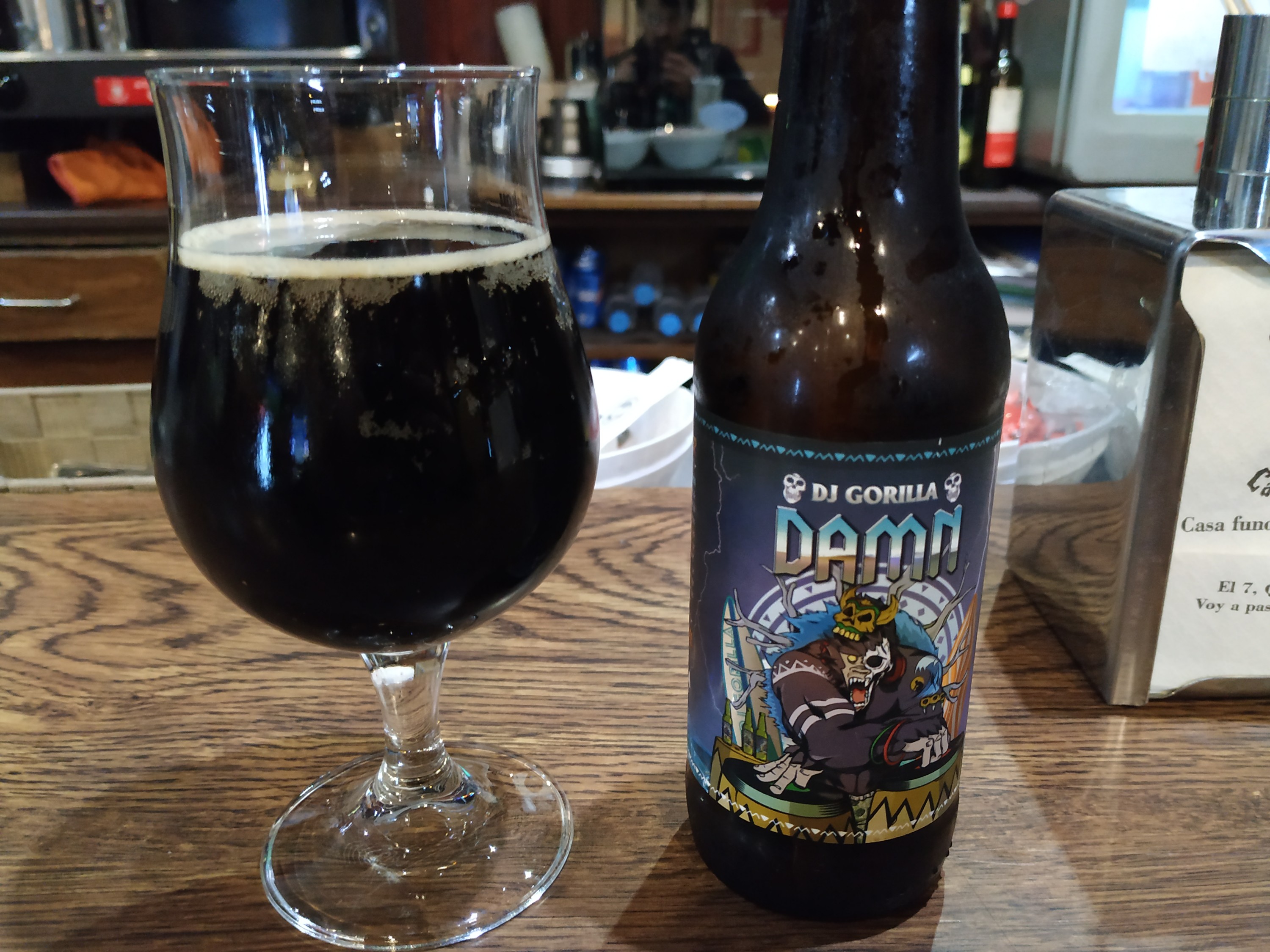
Sunday I was still pretty out of it, so I stayed in most of the day, and went to dinner, and sampled a rather disappointing local beer.

It felt like any old boring industrial stout. Worse than some , in fact.

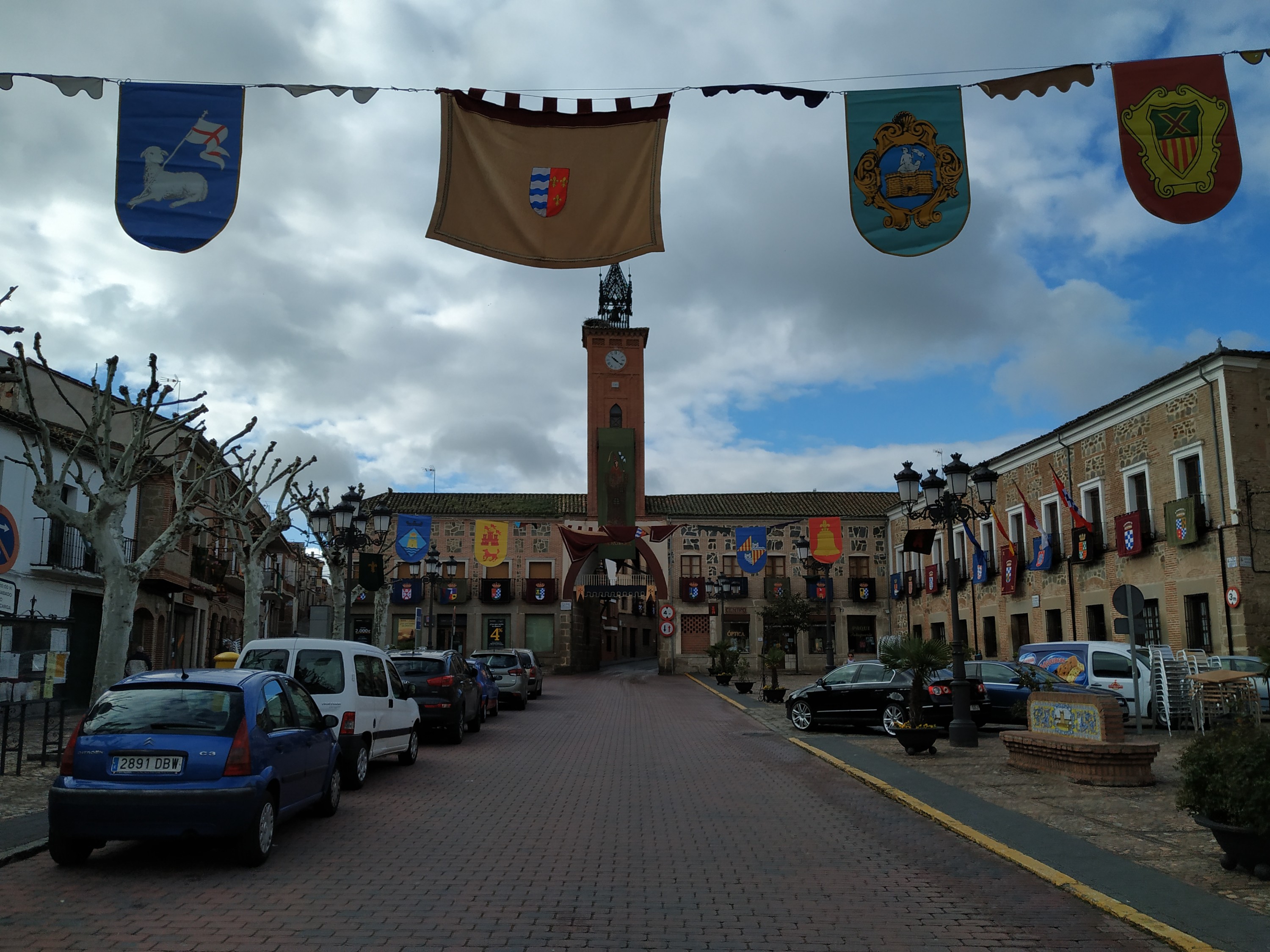
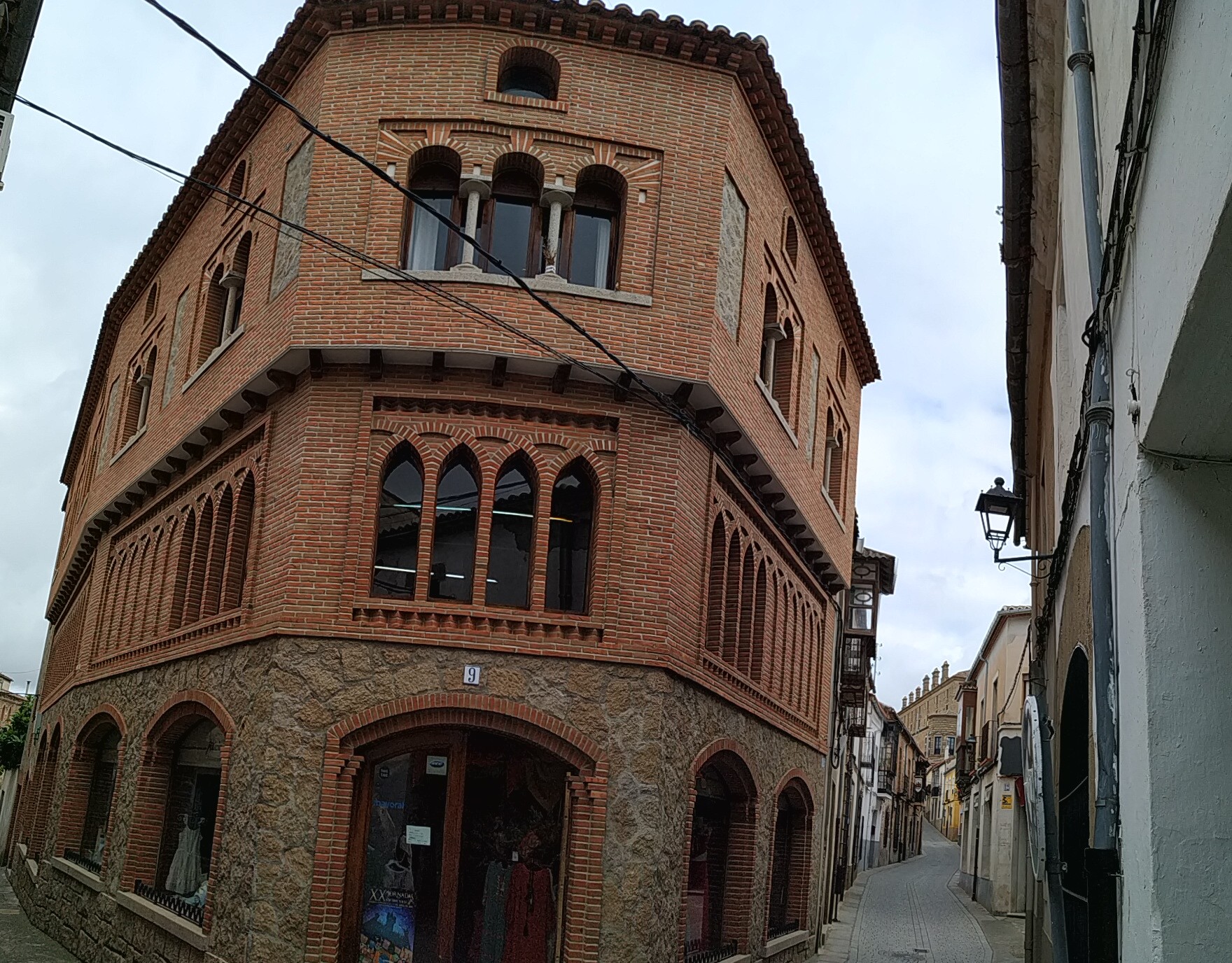
I then took the train to Oropesa, where things were… stressful. The store’s opening time on Google Maps was posted as 10:00. I got there at 10:25, and the opening time on the sign there was 10:30. I thought… “OK, I have a bus at 11:35, I’ll take breakfast, it’ll be fine”. After breakfast, however, there was still no one there. I called the guy, who said he “had an emergency” and would take around a half hour more. This left me with some time to explore the rather lovely town, which still had some decorations from the holiday on display.

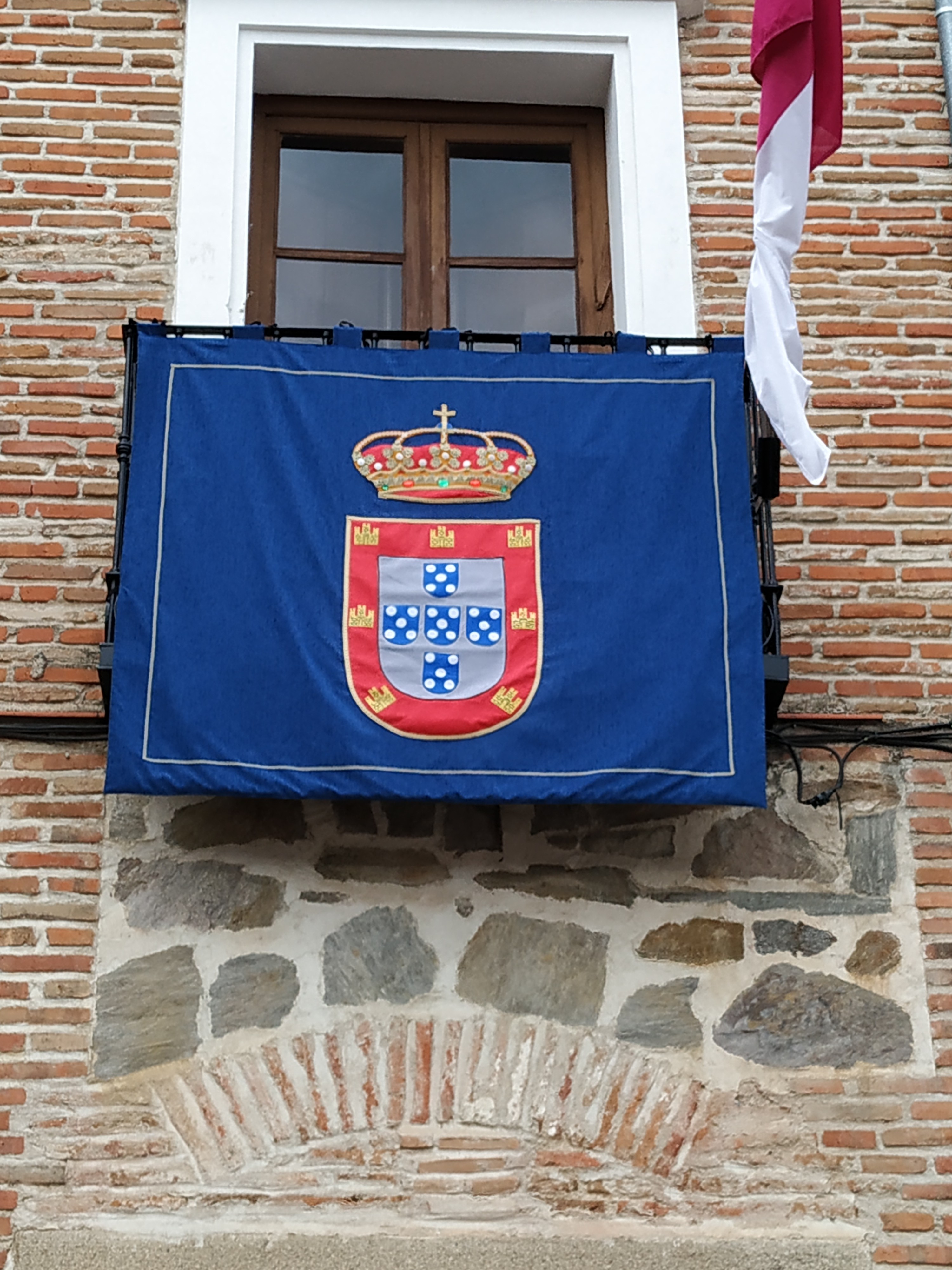
Looks like a Portuguese insignia to me. Not sure what this was doing there. Maybe this is from Ceuta?

Getting back to the bike shop, it was already 11:32, and no sign of the guy. I’d given up, when he told me he’d just arrived. The bus stop was pretty close, and there was no sign of the bus, so I went there, got the part, and got on the bus. It was 11:35. If the bus had been on time, it wouldn’t have been possible.

However, it all went well. I got back and fitted the clips on the saddlebags. It felt good no longer needing to MacGuyver luggage straps to get the saddlebags to stay on.

I thought while I was there, I’d visit Talavera de la Reina and… it was a waste of time. It’s a truly dreadful, samey, not very well though-out city, which makes you feel really unwelcome if you’re not in a car. The coolest thing about it is actually a bridge.

This is a bike path, and I’m not actually on the saddle. If I was and I didn’t duck, I’d hit my head on the ceiling.
Post in the way? No problem

There’s pedestrian crosswalks that make go all the way around the intersection, bike paths where you need to turn 90 degrees on a dime and still look behind you for traffic, and… forget it. I’ll just leave you with the good shots.

That’s four good shots… in quite a big town.

Back on the saddle, it was time to head to Toledo on a good, though somewhat busy, road. I stopped at an olive tree field and stayed for the night… and the next day, ’cause I still wasn’t feeling well. I had food and water, mom! I swear!

The last shot of that day.

The next day would turn out to be the rainiest so far, and the hills were finally back, but it went otherwise smoothly.

I could actually hear this, coming through here.
Theat’s the face of a man who’s been rained on, for a few hours.
Naturally, the road goes not through the immense meadow on the left, but through the hills.

I then arrived in Toledo, a place that seems to have a lot of potential. But that’s a story for another post.

Monfragüe national park

After leaving Cáceres, I met a fellow cyclist. Sebastian was German and was going back home, after doing a bike tour to Morocco. Unfortunately, he was not lazy, so after a quick chat, he disappeared over the horizon. The day was otherwise uneventful, with mostly flat terrain, but a few landscape shots coming from it.

I then slept in a place that would leave my parents wondering why they paid for my education.

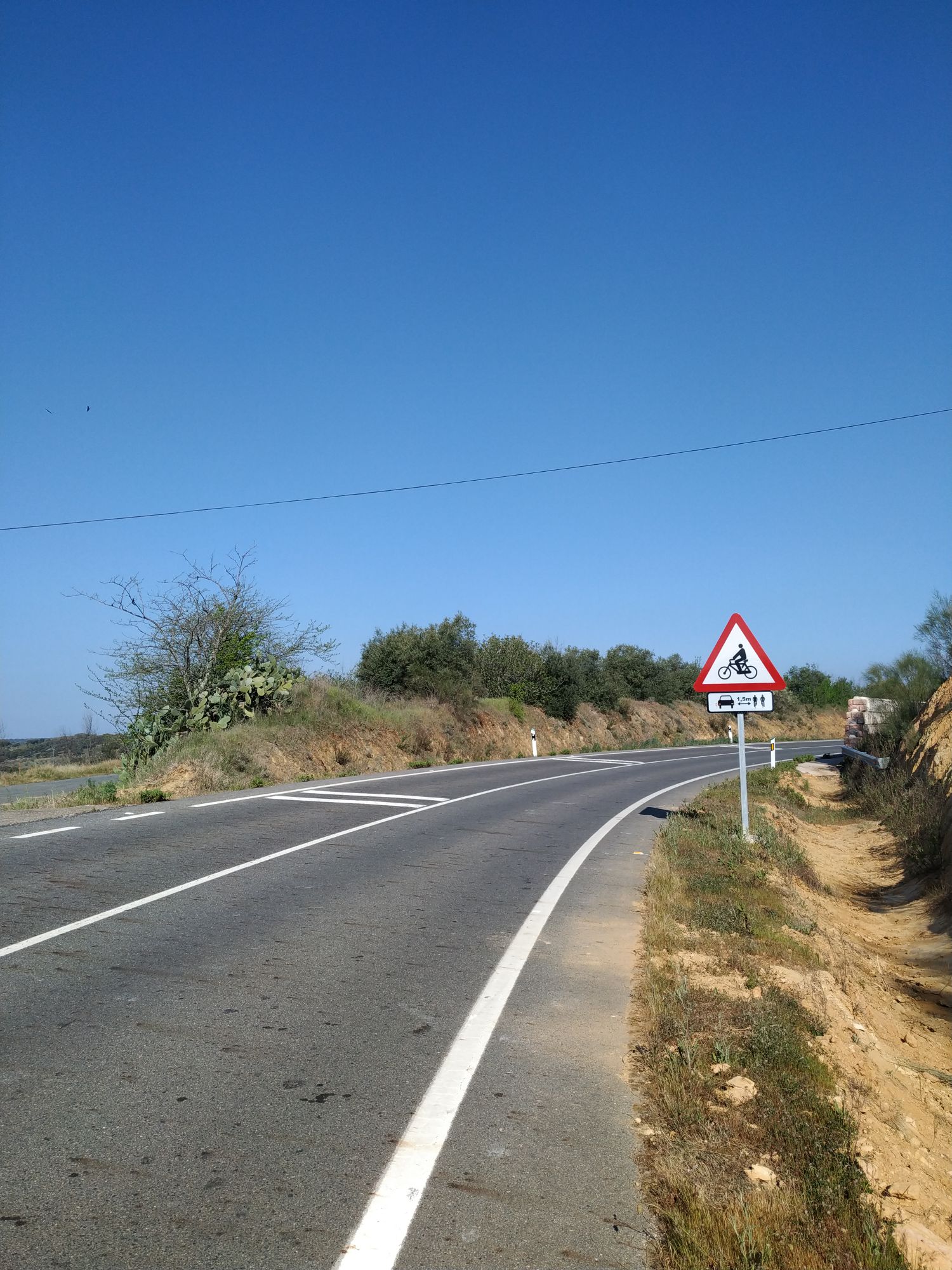
I’ve been finding that the Spaniards are really respectful towards cyclists, always giving me a wide berth, maybe due to signs like this.

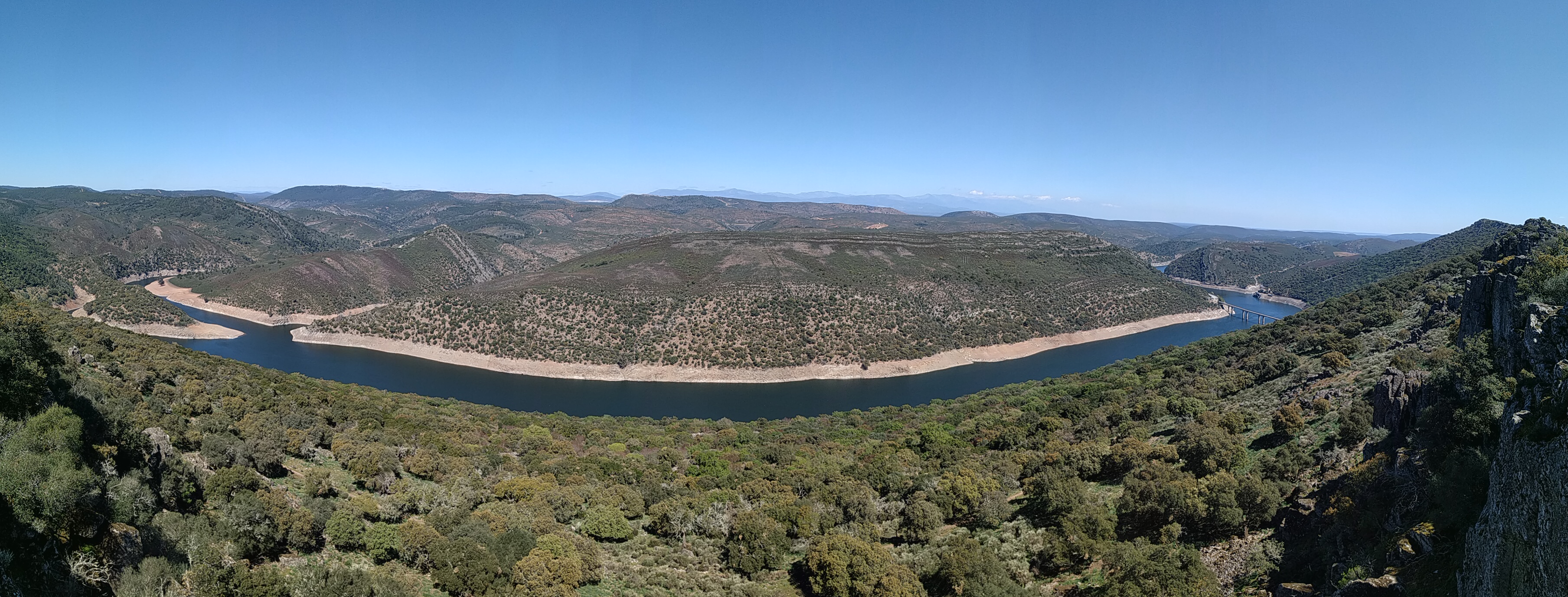
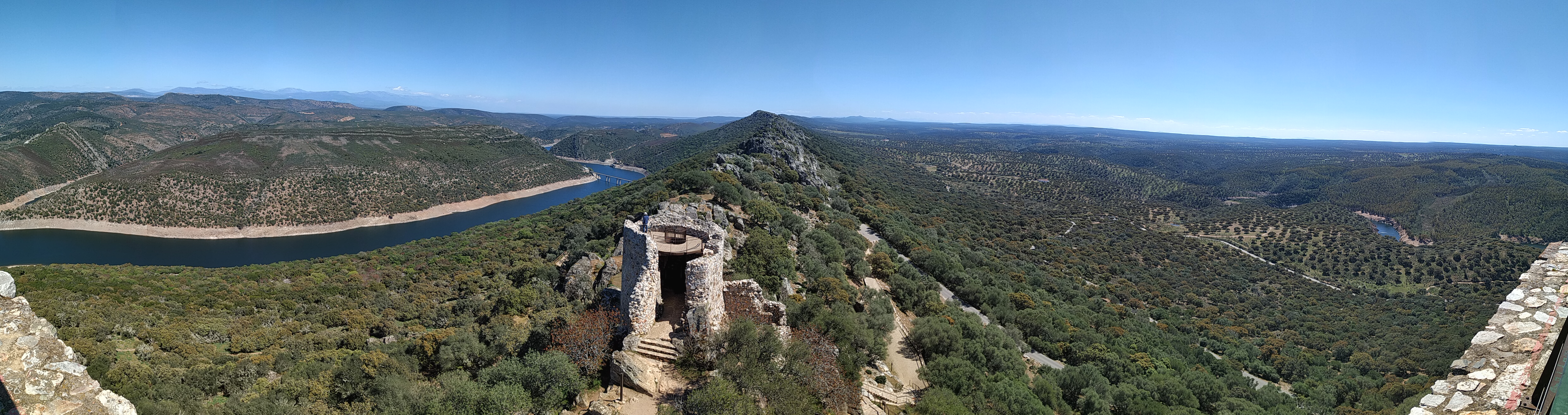
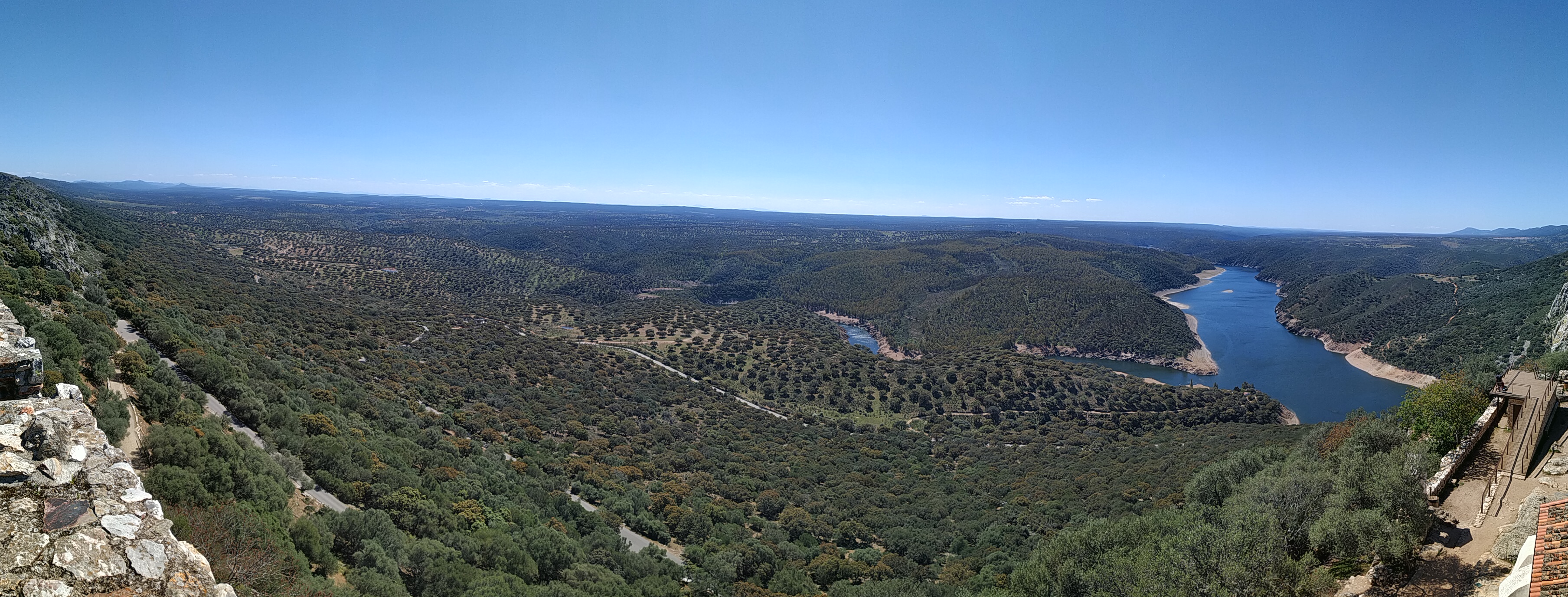
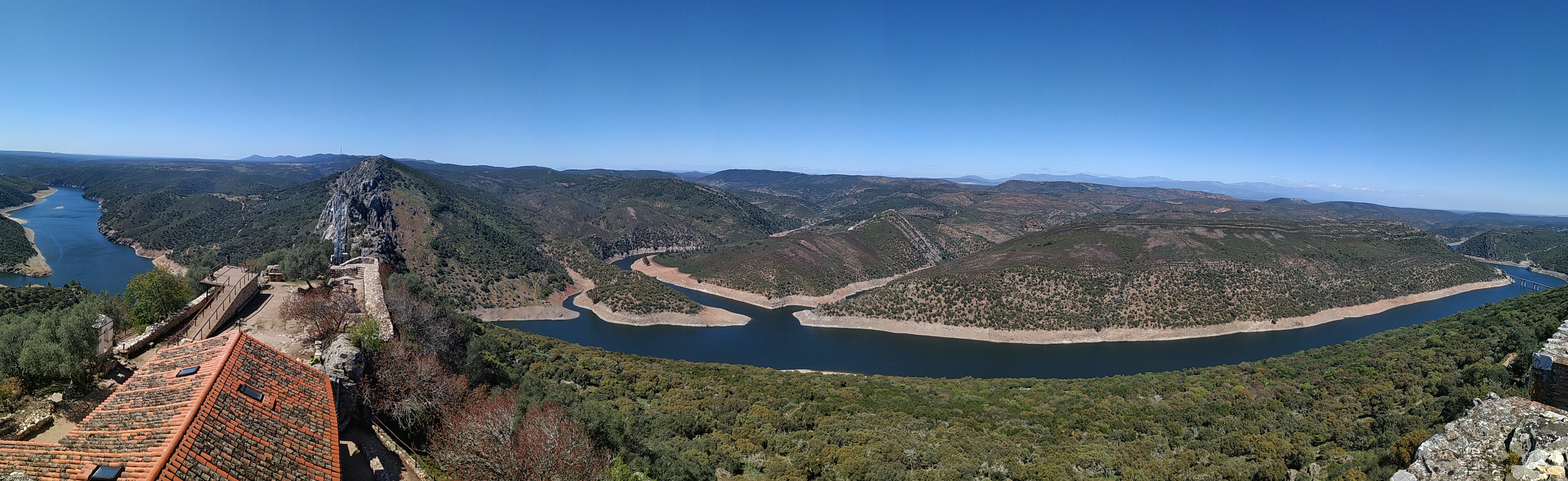
The next day, I would enter Monfragüe national park, a landscape so protected they had to put wood over the guardrails. In case it’s not clear, I’m not actually sure that’s the reason.

I then saw a cool looking castle in the distance, so I decided to have an unscheduled stop there.

It was a bitch to climb, and a lot of it has to be done on foot, which, with a loaded bike, was Not Good ™. On the way up, there was a place with cave paintings:

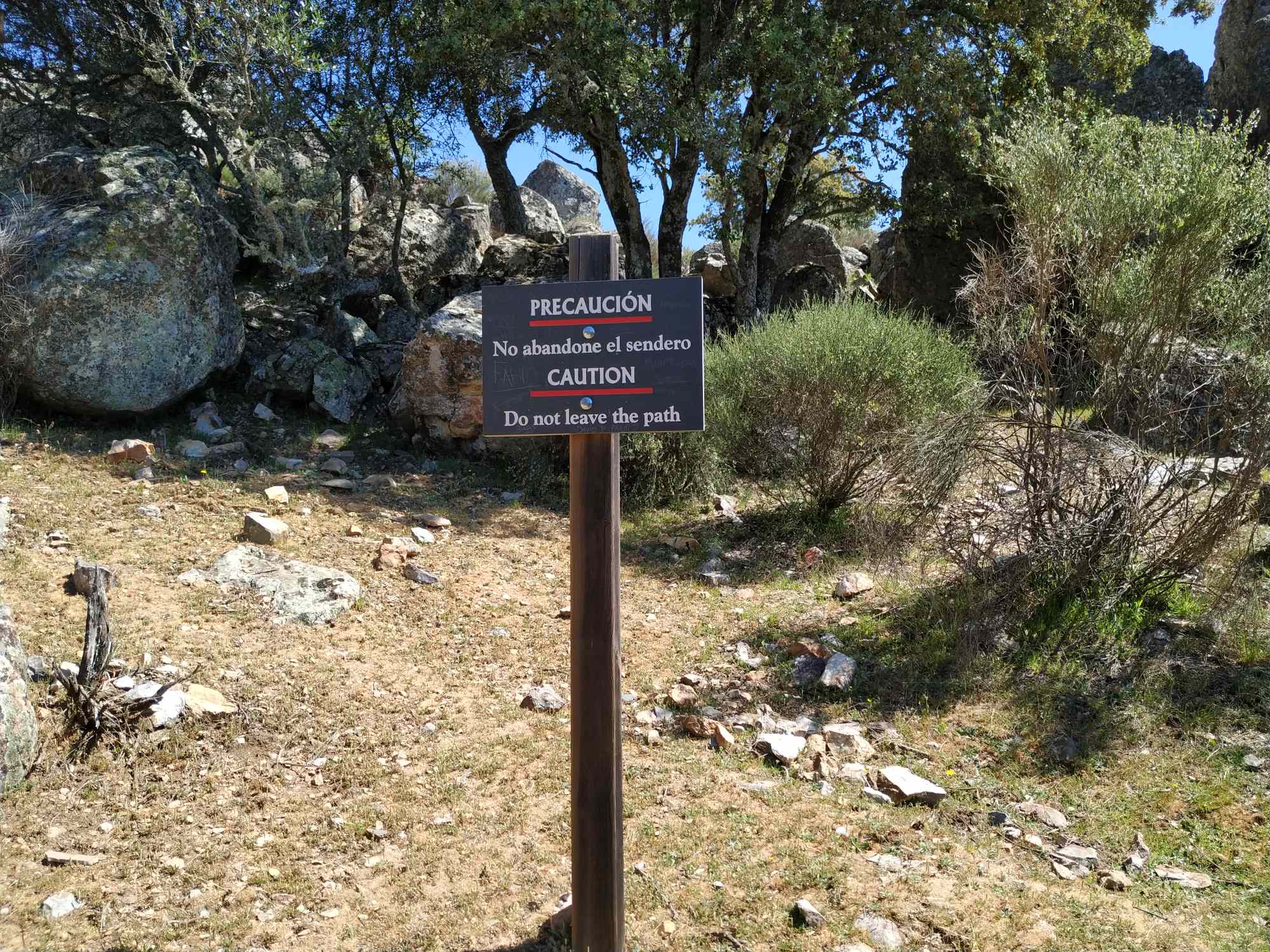
And a place with a sign not to leave the path.

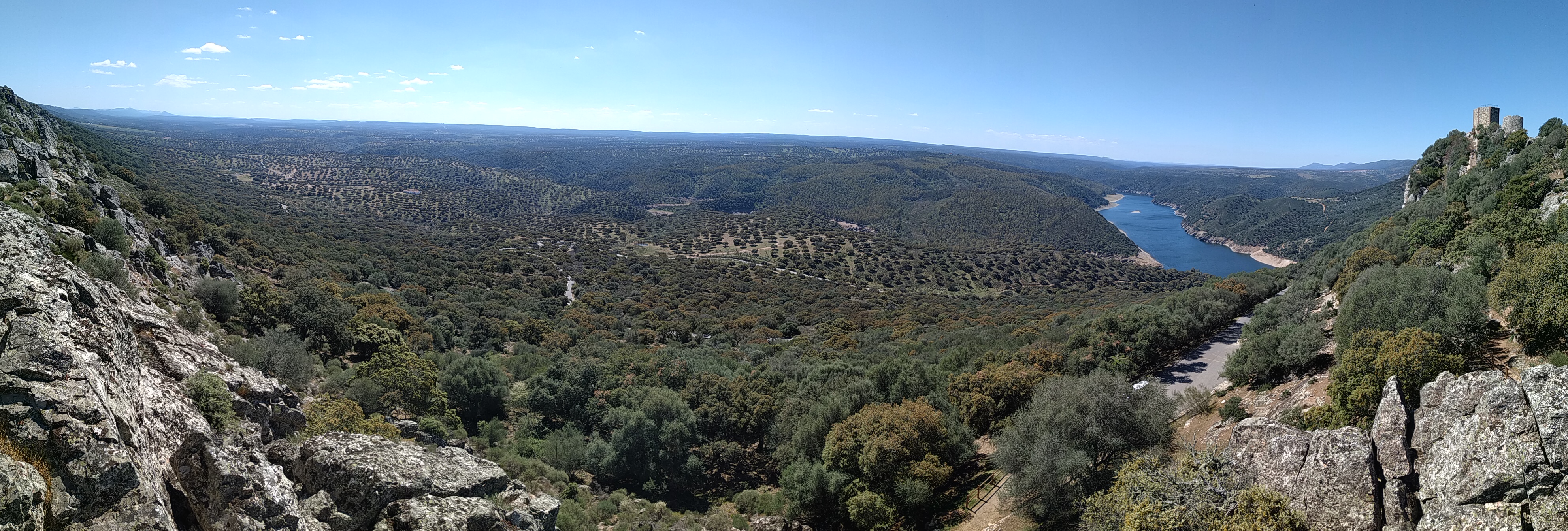
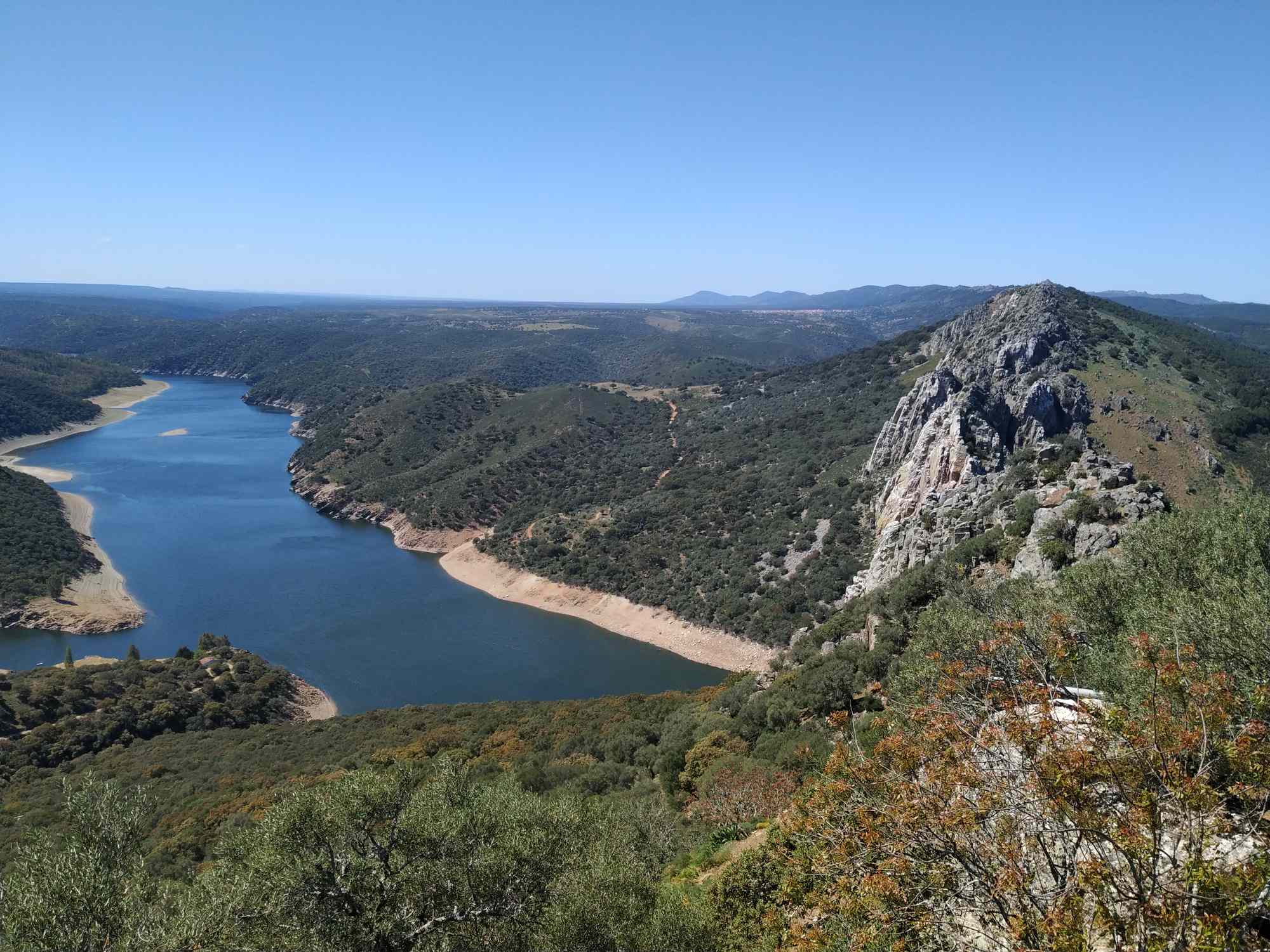
But if I did that, I wouldn’t be able to take shots like this:

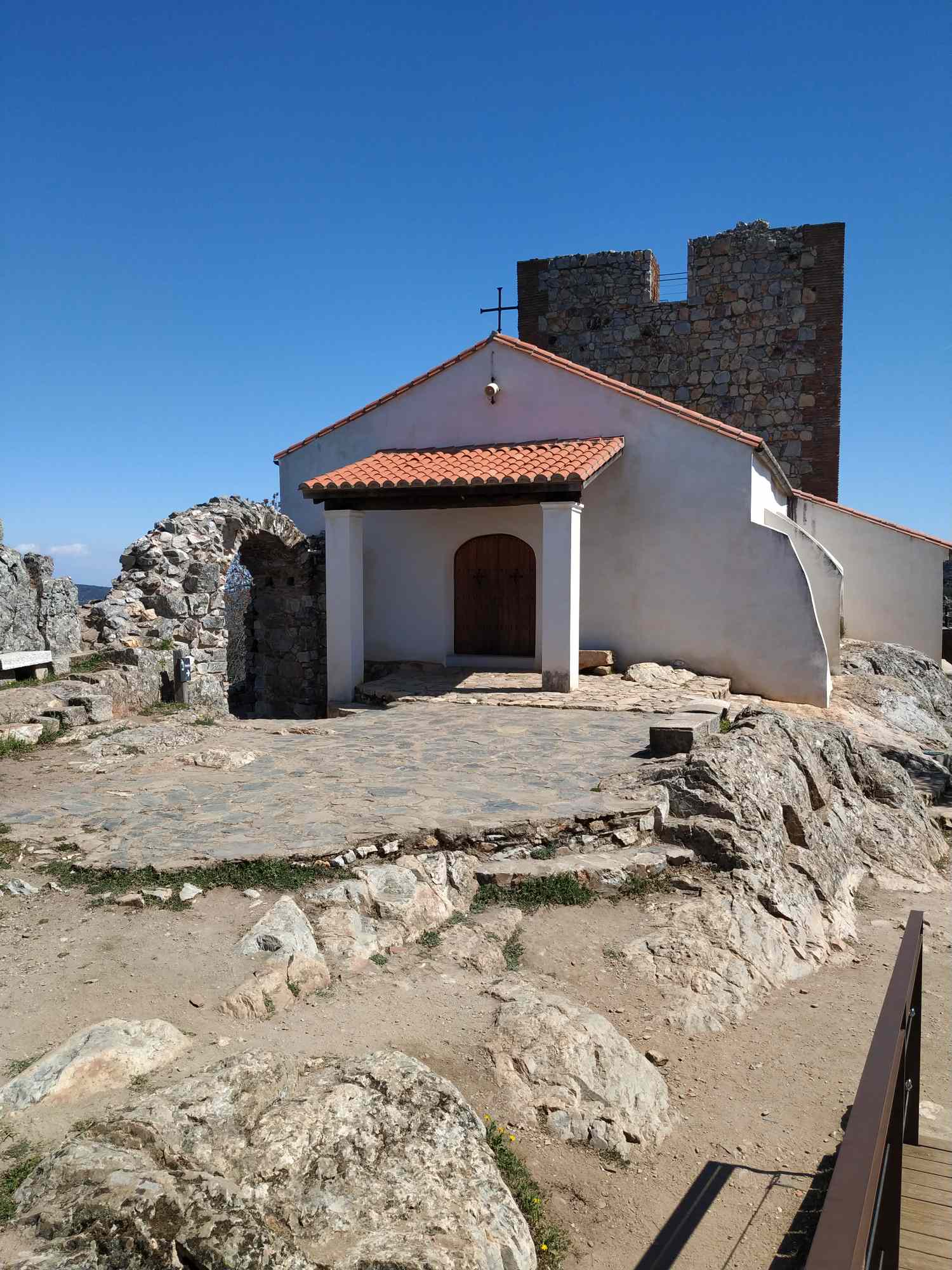
I finally reached the top, where there was a castle and a small chapel.

Pictured on the right: El Salto de lo Gitano, the only mountain pass around, where the locals would, in ancient times, charge a toll.

It was then time to go down. On foot. on a narrow path. With a loaded bike. It was a slog. Sometime in the middle, I stopped for a rest, where I took a selfie with a Spanish imperial eagle:

If you like birdwatching, this is the place to be.

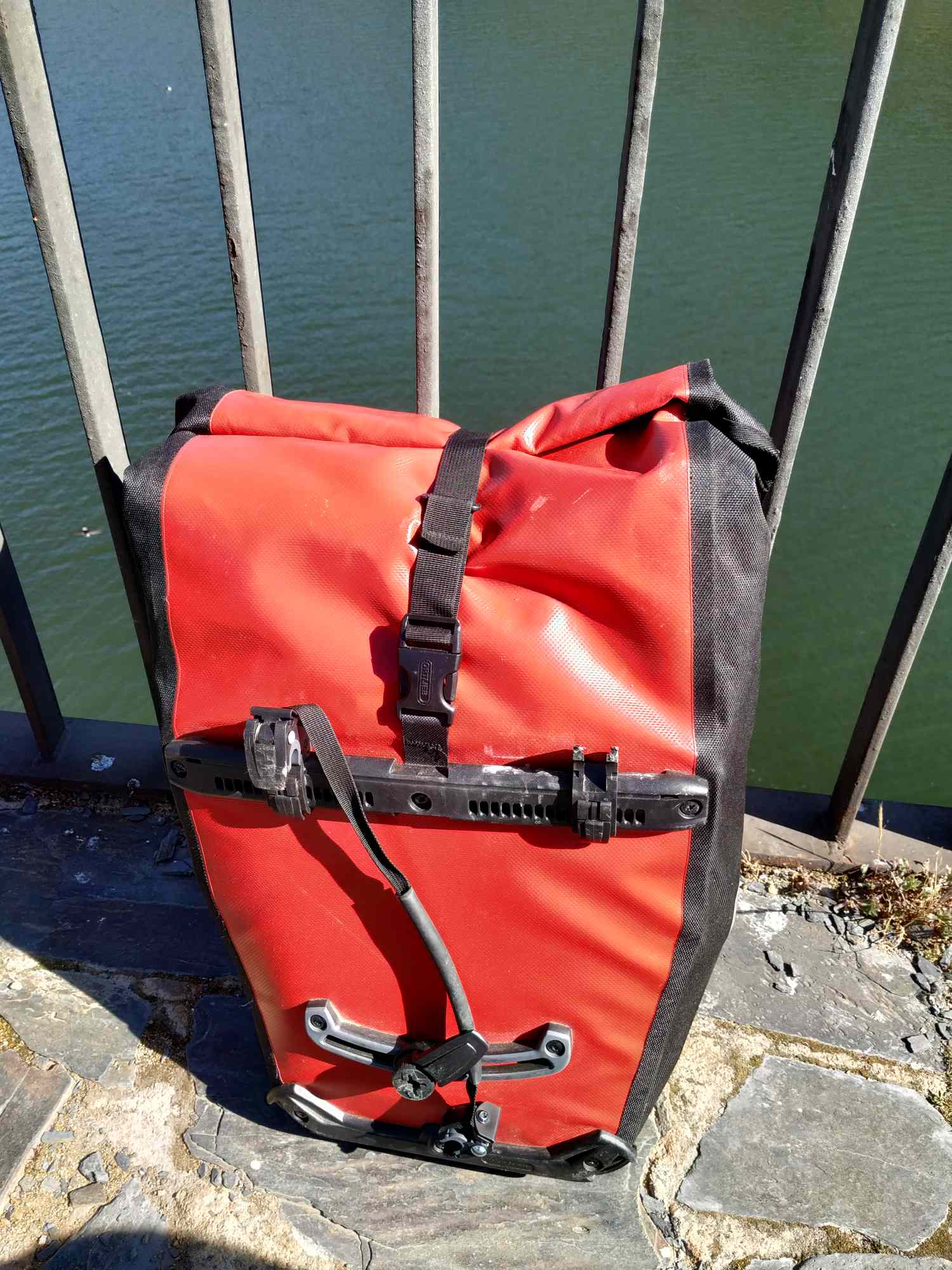
After getting to the bottom, while crossing a bridge, a tiny nudge to a saddlebag broke a clip.Luckily, I’m trained as an engineer!That mostly held up, and at least never failed catastrophically. A few landscape shots and a climb later, I finally saw a place that had a salad, and took advantage of that.A few glamour shots later, it was time to turn in for the night.Then I learned that you can actually do night shots with a phone now!Let me say I’m sorry for the lack of updates, but I’ve been in the middle of nowhere for four days, now. This was two days ago and I’ll have another post for the last two days. Hopefully, I’ll sleep on a bed, today. See you next time!

Getting lost, breakdowns, house and city visits

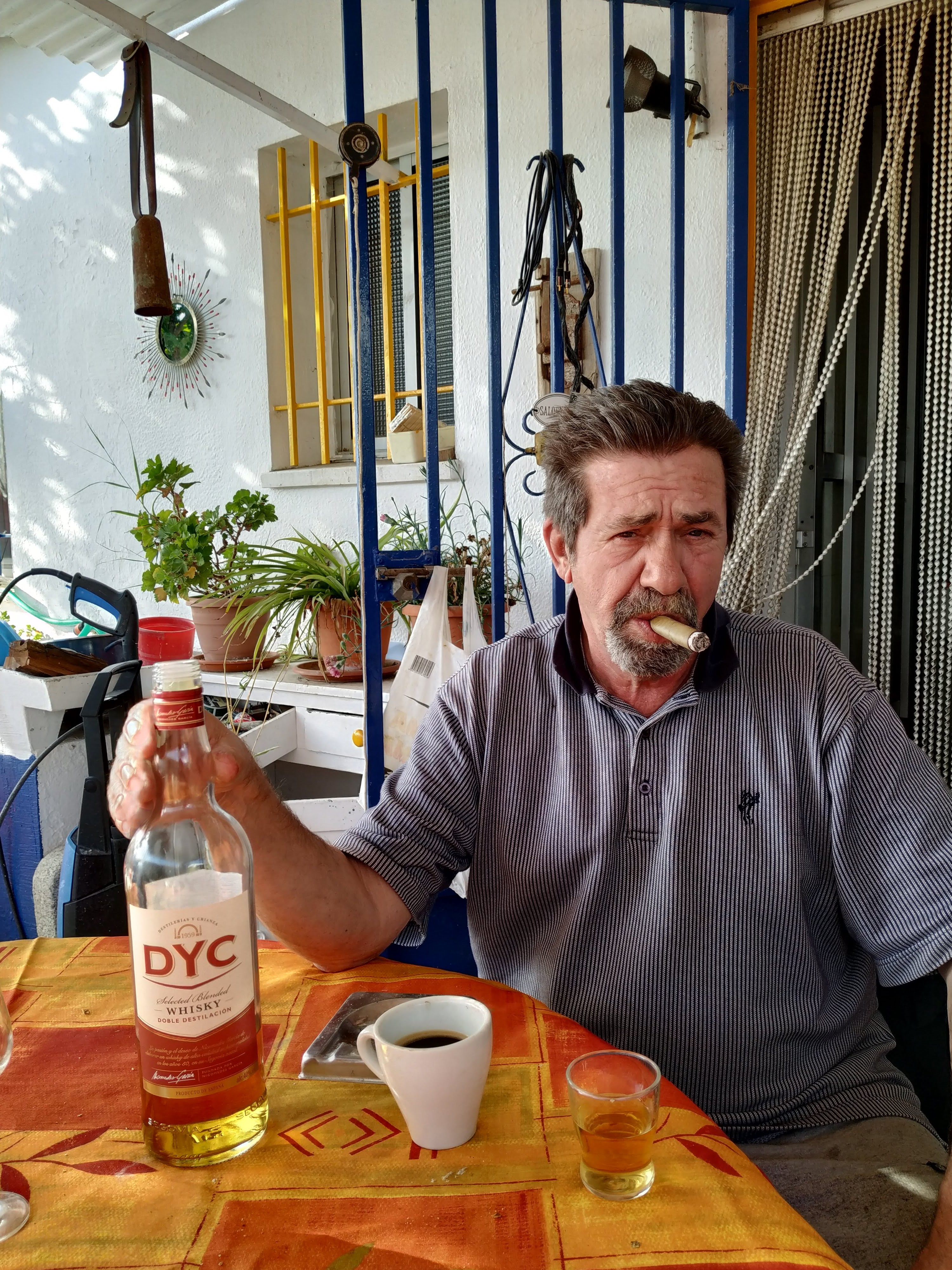
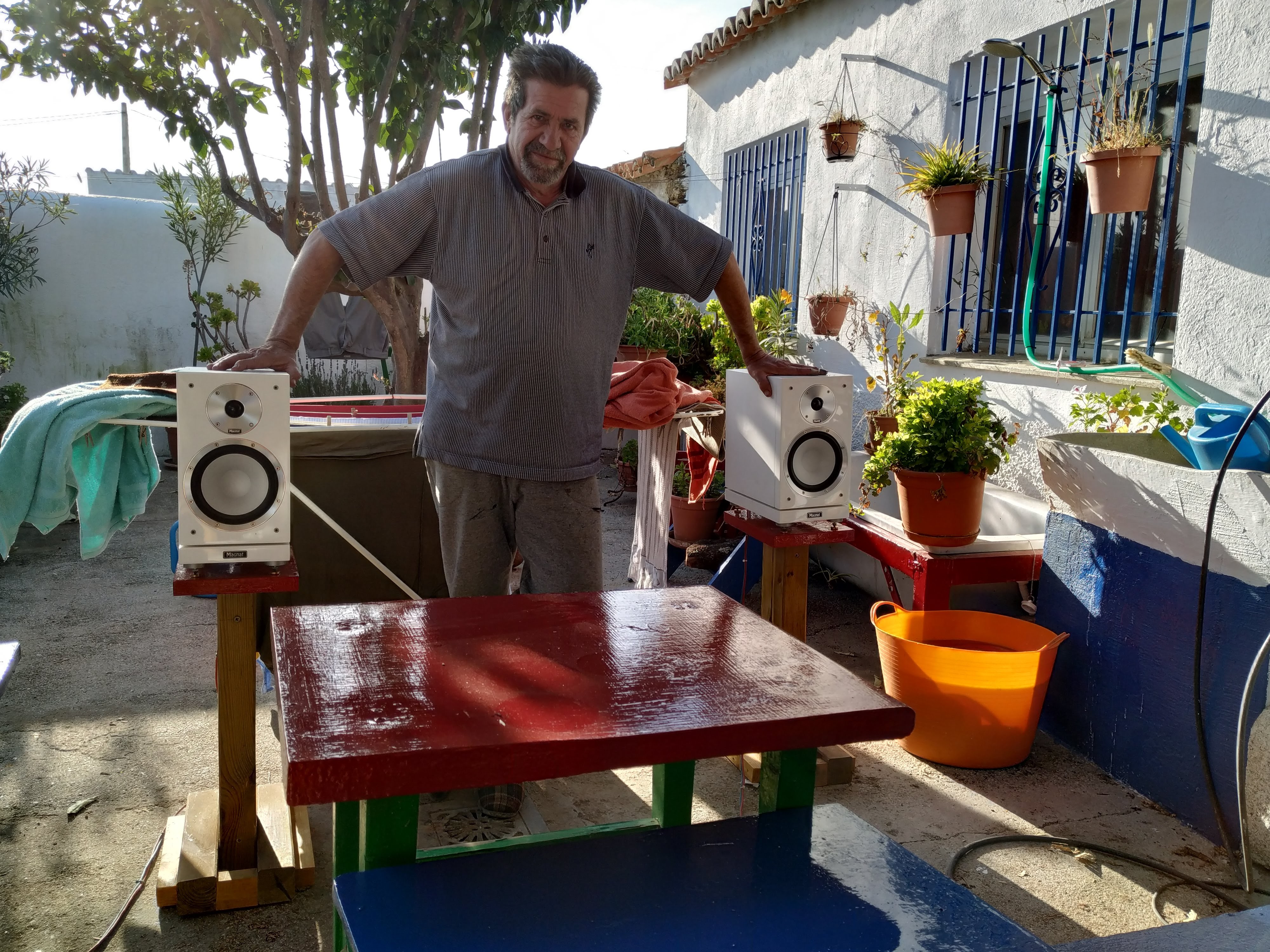
I’ll just start this post with its rightful protagonist: this is Lorenzo in his inner (outer?) sanctum.

You can tell how much of a character he is just by looking at the picture. Lorenzo is not exactly his given name, but it’s the one he adopted after trading life in the bustling streets of Paris for the quietness of the Extremadura countryside. The story of how we came to meet is quite simple: he offered lodging right smack in the middle of my route, at a convenient stopping point for the day, through Warmshowers, a site you can think of as Couchsurfing for bike tours. It would have been as simple as that… but life got in the way.

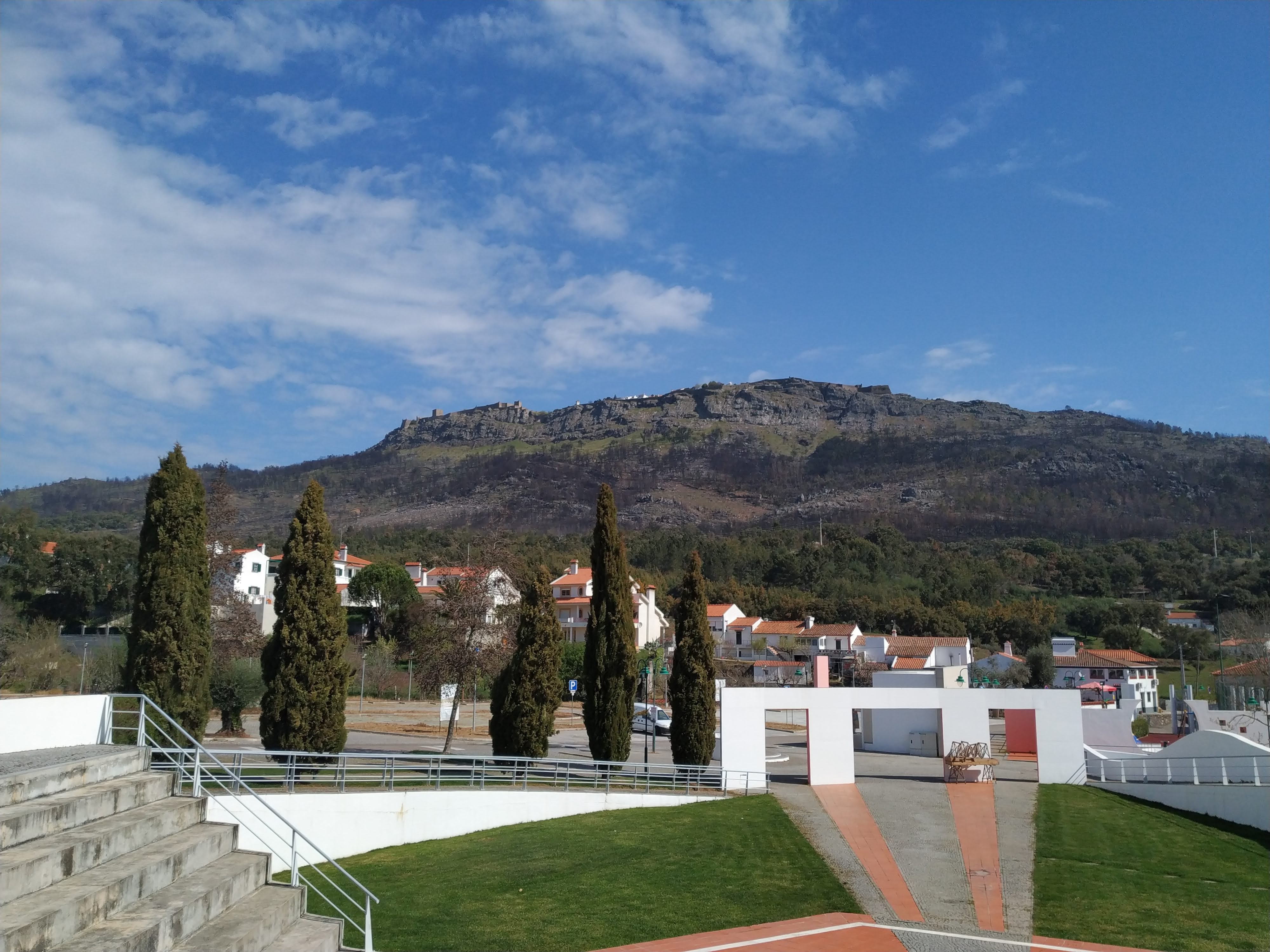
Last Friday, I left Portalegre quite late, qjust for a short (and uphill) 20km ride to Marvão, the oldest settlement around and an UNESCO world heritage site. Everything was going well, as evidenced by these glamour shots and a selfie I took with some barely visible goats.

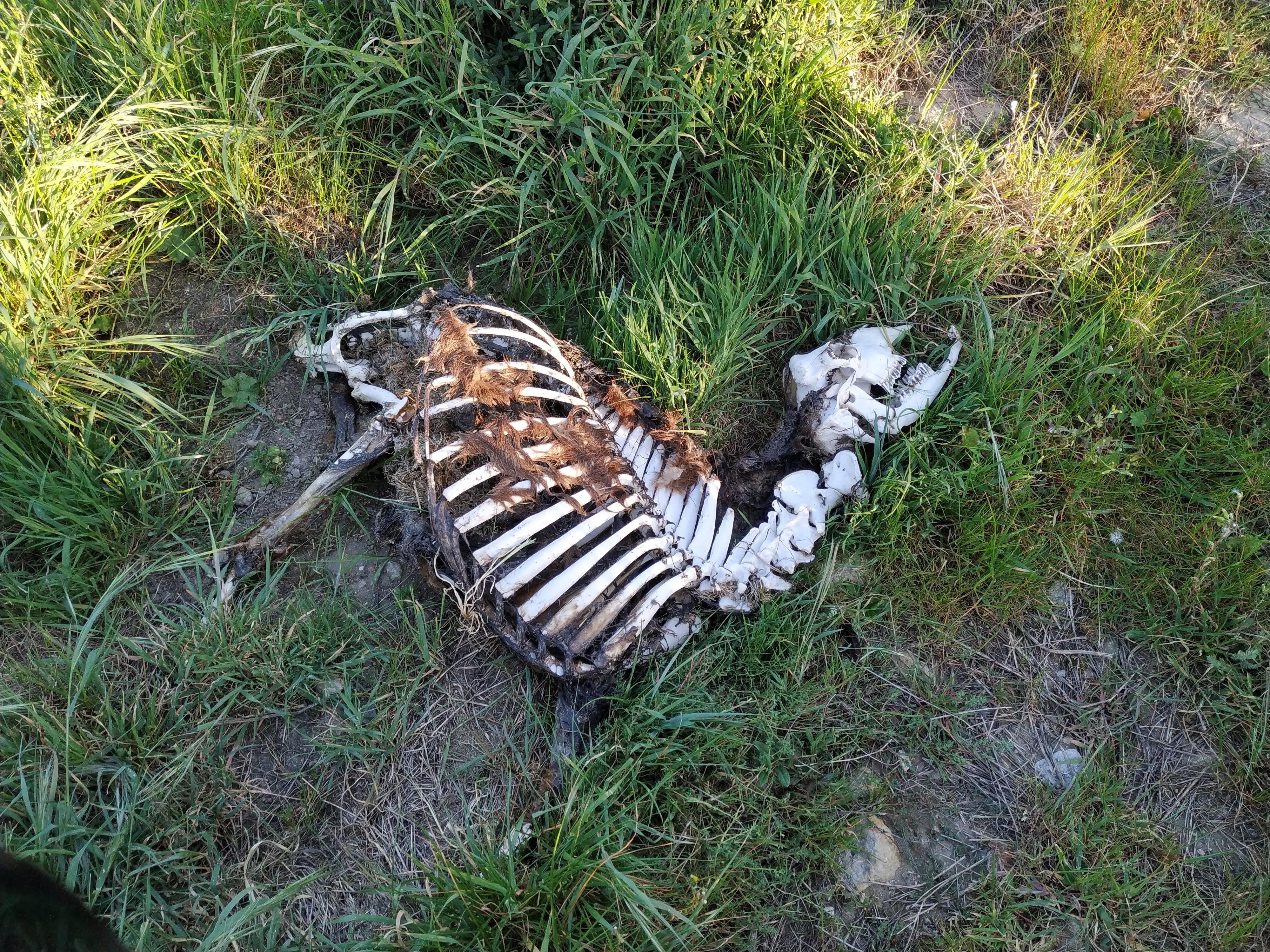
A while after seeing those goats, I got to see a very dead one. If I was superstitious, I’d say that’s where my bad luck started, but the fact is: I got lost. No blaming the route this time: this one’s on me. I got to a point where it was getting late and getting back to the correct road meant going back uphill quite a bit, but wait! Someone cleared a lot of bush around here, and I see the correct road it in the distance!
It “just” meant crossing a chasm with a loaded bike. I determined it was possible, and did it in two passes, one for the bike, the other for the cargo. At the end of all this, I had lost daylight and got settled in for a cold night on the hills.

The next day, it turned out I wouldn’t cycle much, because just 15 minutes after beginning, this happened.

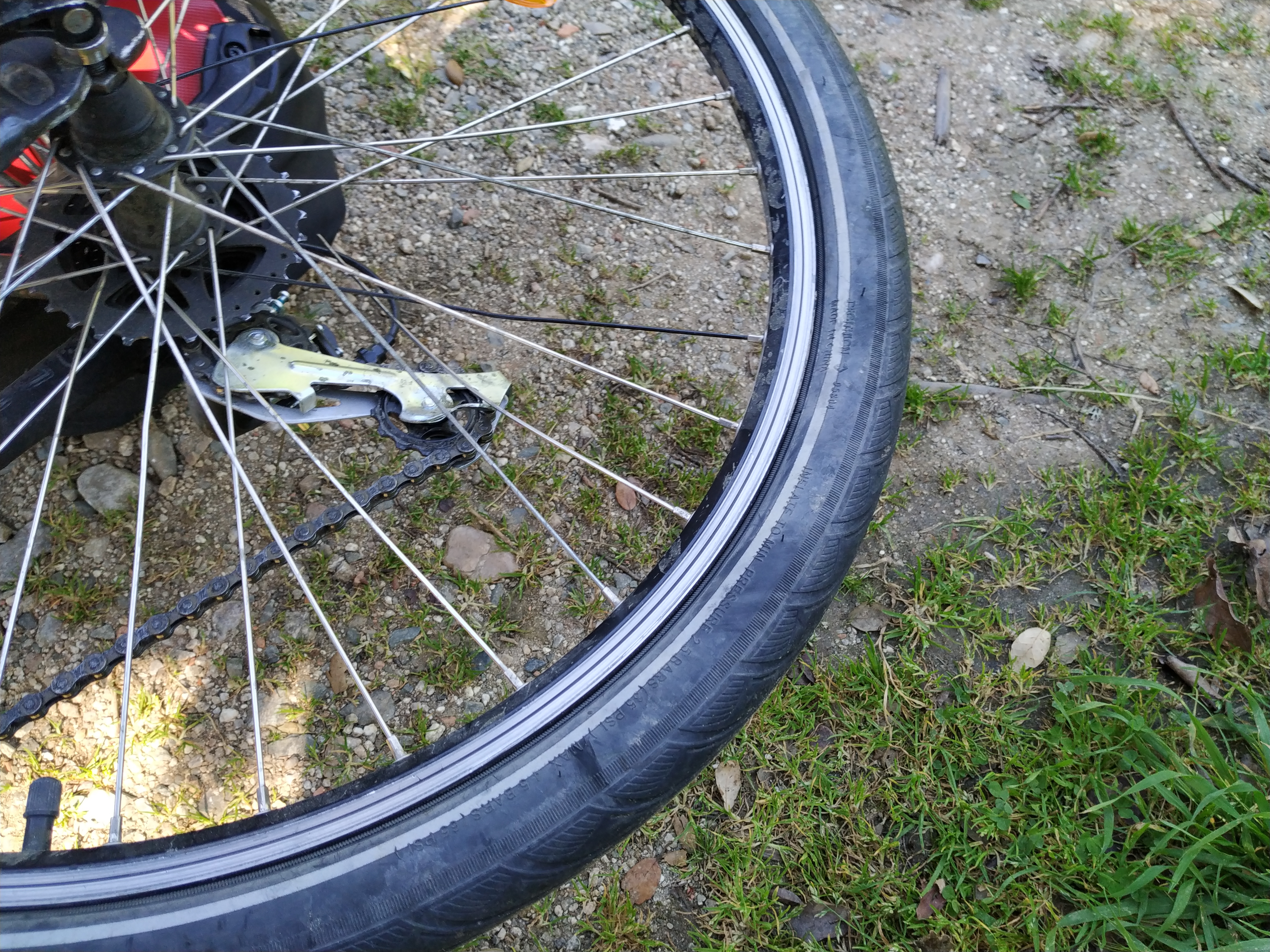
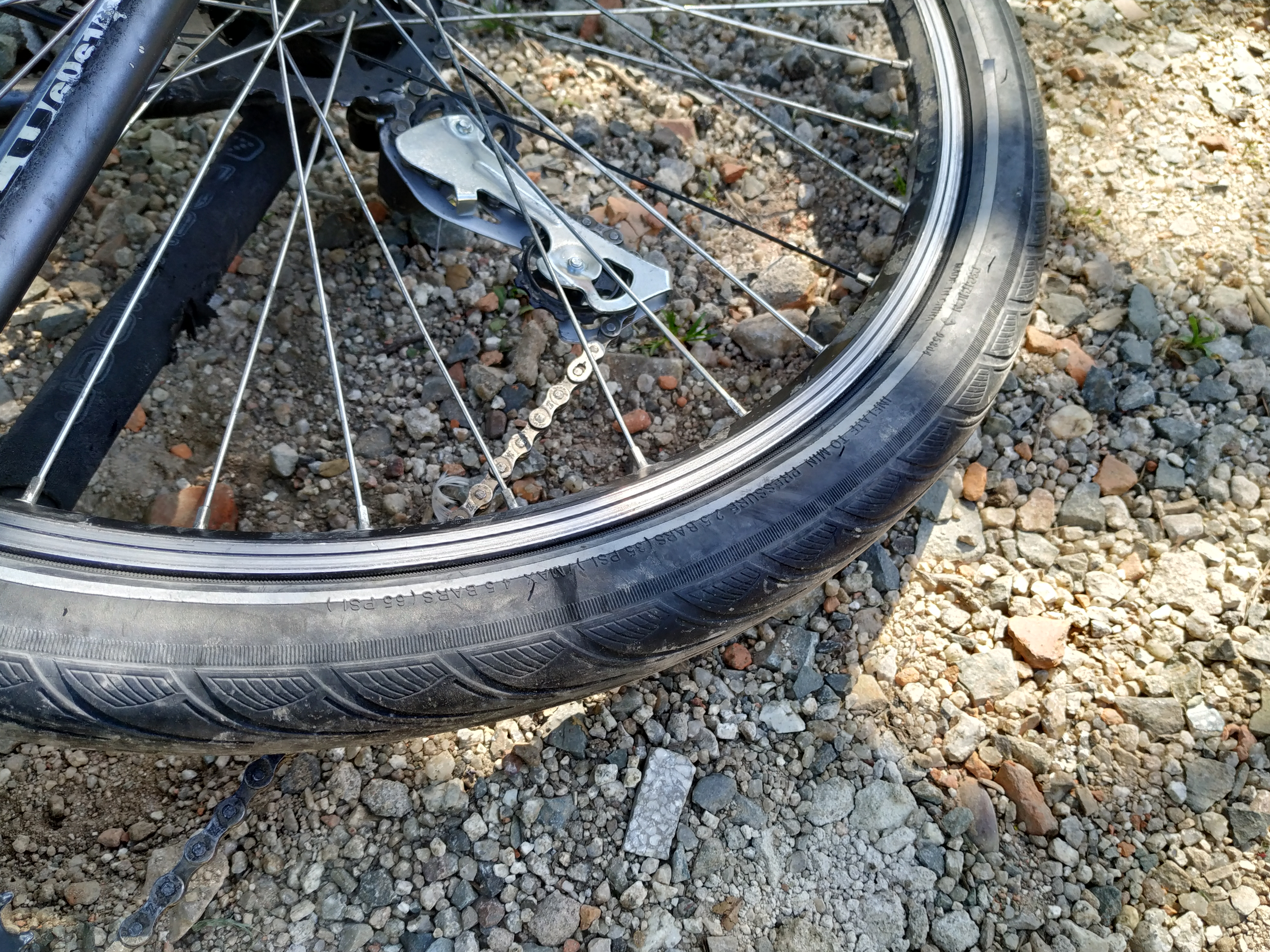
BIKE NERD PARAGRAPH: I think one of the pins holding the fixed part of the derailer to the mobile part got weakened in my previous repair and now failed, allowing the derailer to spin and get caught between the spokes.

Luckily, I was approaching a junction and going slowly while this happened so I didn’t even fall and no spokes got broken. After taking the derailer and the bent chain links out of there, I managed to get it going single speed. This is when I found out my insurance doesn’t include road assistance and texted Lorenzo to say I wouldn’t make it. At this point, a trio of spanish bikers stopped by to see if they could help. They lent me some metal paste to fix the broken luggage rack and took my luggage to the next town while the paste set in.

After having breakfast in Portagem, Lorenzo calls me telling me “hey, wait! I’m coming to get you!” The man just offered to drive 60km each way to take my bike to a shop. While I was waiting, I took a few shots of Portagem, which turned out to be a rather nice little town.

The closest to Marvão I would get.

Lorenzo has then arrived on an old car you’d be surprised to learn still runs
— his good one is in the shop. After struggling a bit to get the bike in, he’d take me to a place where there was a bike shop, but it’s now gone. It’s now Saturday afternoon and the shops are closed anyway, so he immediately offered to take me another 50km to Cáceres on Monday. That meant I’d get to spend two days at his house.

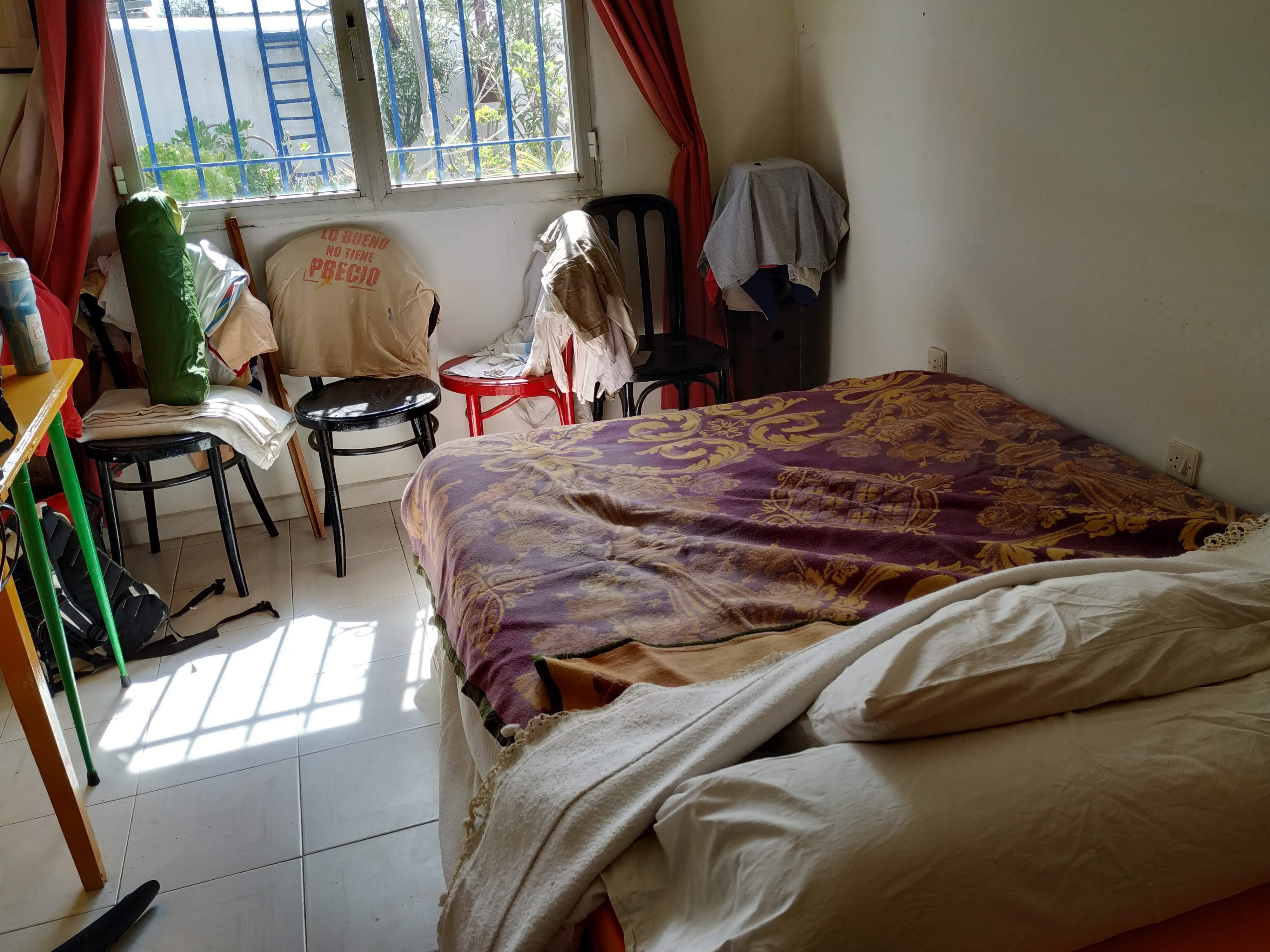
After the cold night, a bed was more than welcome.

I then spent the weekend with Lorenzo, getting to know each other and learning about his passion for Hi-Fi equipment, jazz and blues, which we got to experience extensively, both in the backyard, as pictured, and in his living room where he had even better gear.

A rare shot of Lorenzo without a cigar.

The man also has the biggest music collection I’ve ever seen, including music from every genre and every country you can imagine. Everything in uncompressed formats (of course!).

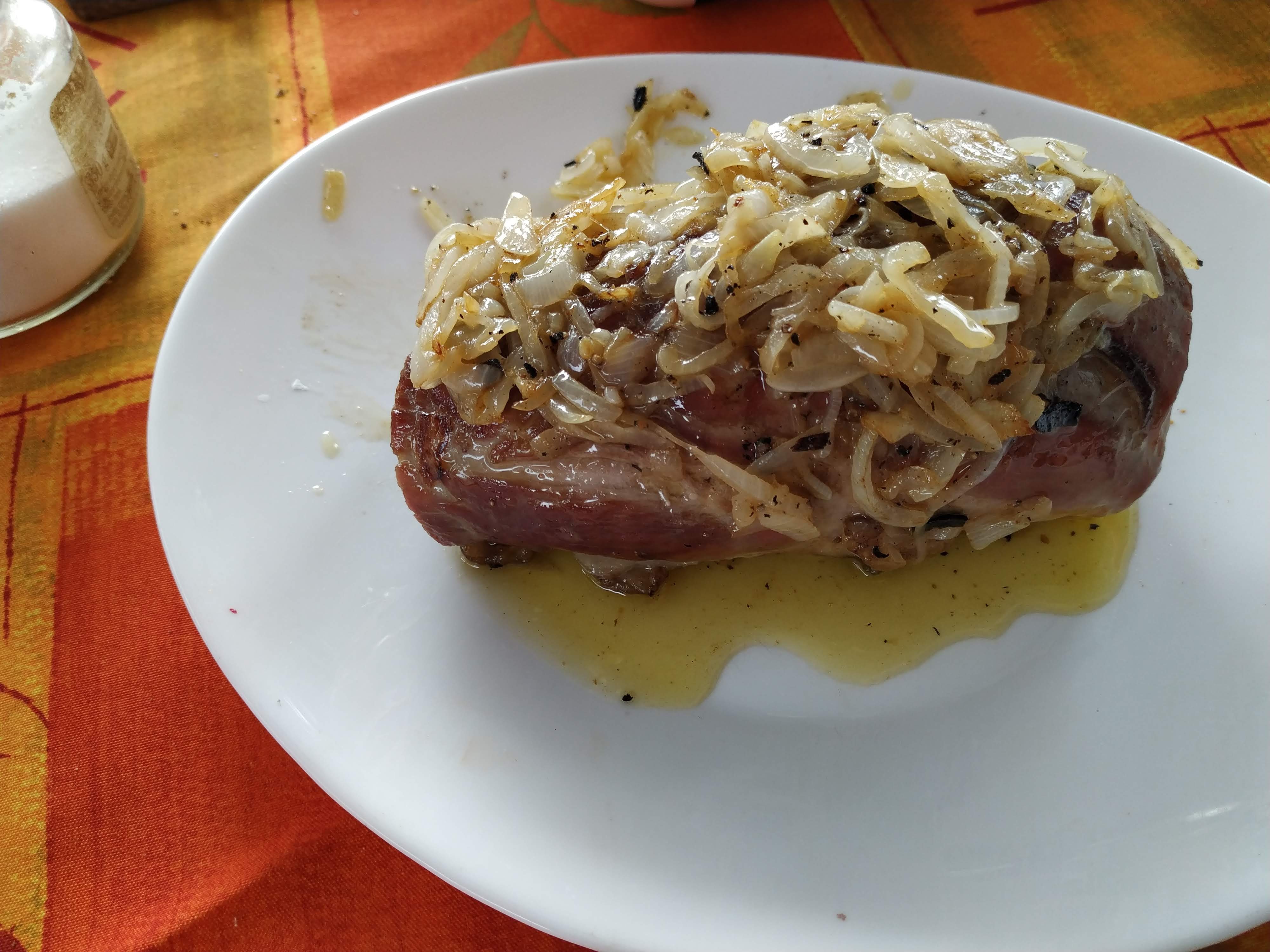
He kept me well fed, too.

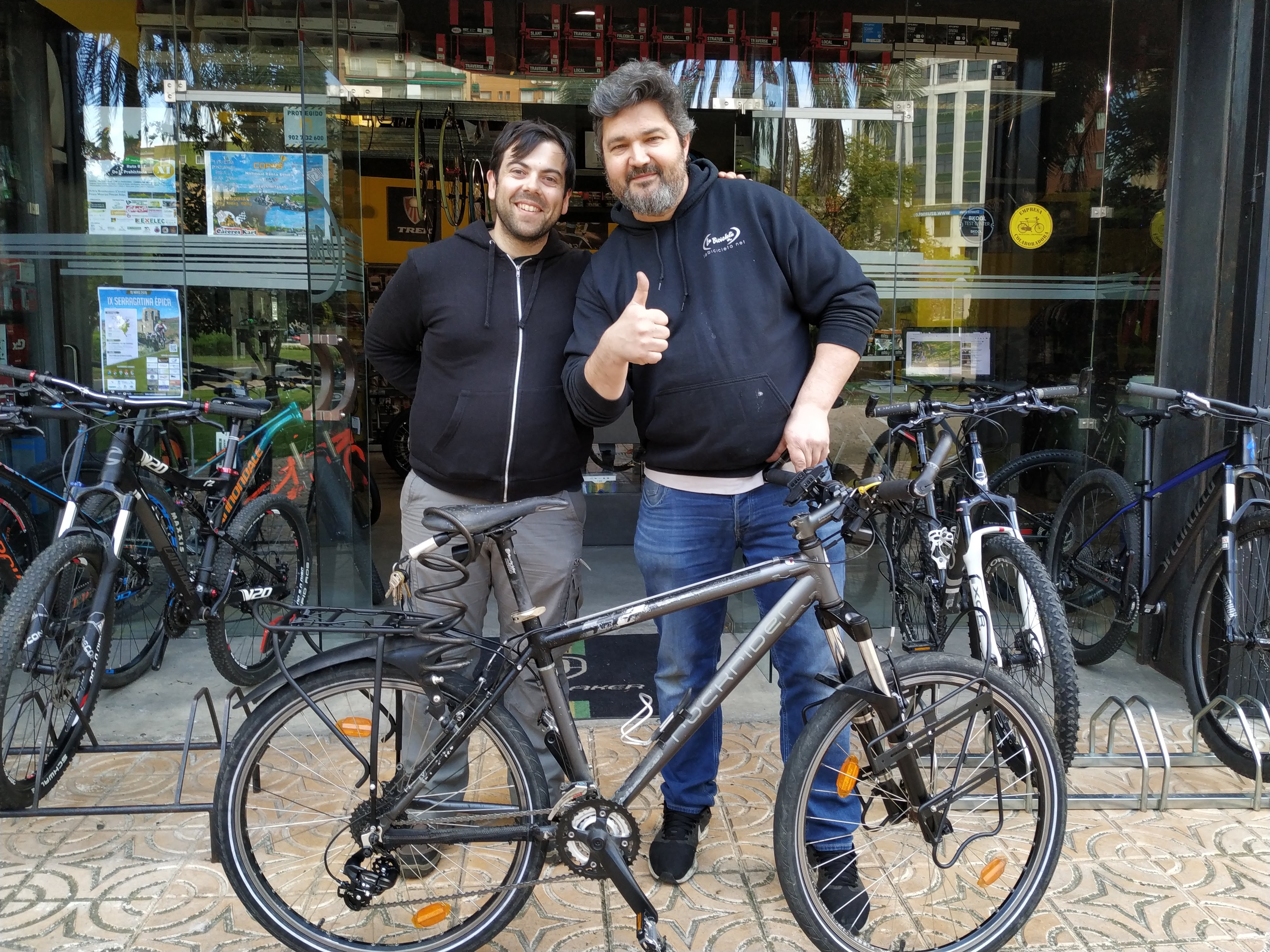
Lots of conversation and musical tastes shared later, it was finally Monday and time to head to Cáceres, where we got my bike fixed by Rafa at La Bicicleta, for a very reasonable price.

Ready to go.

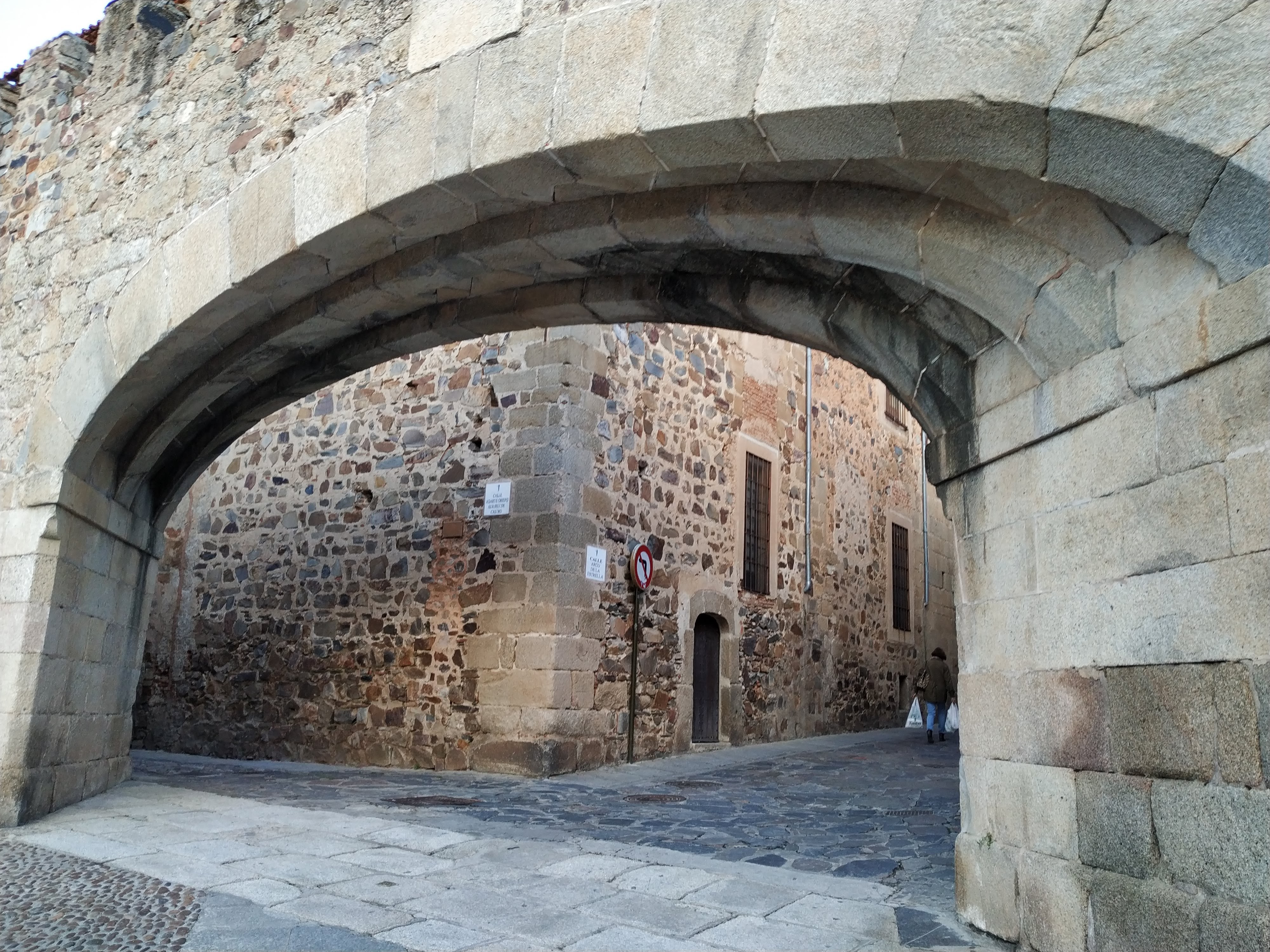
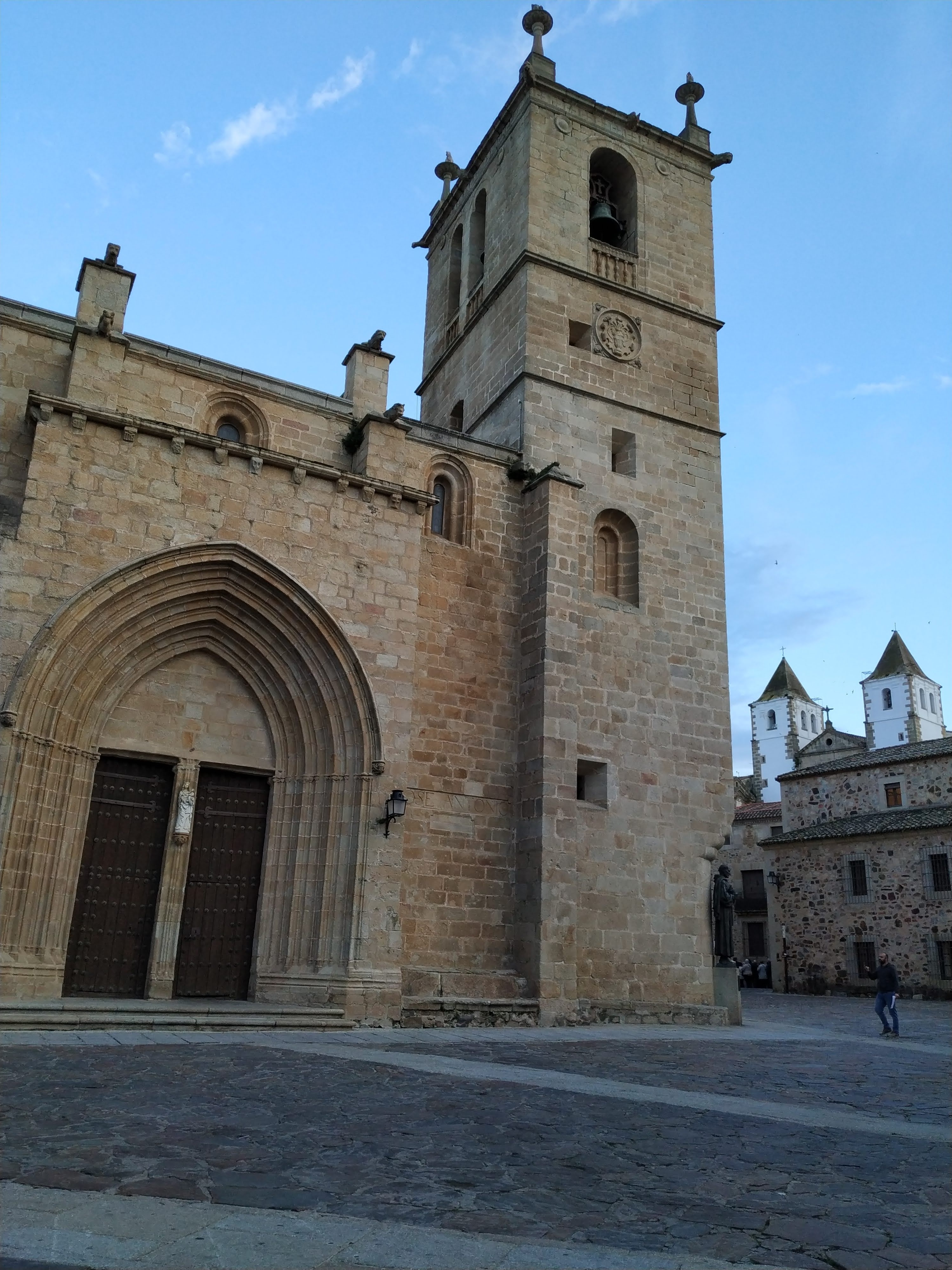
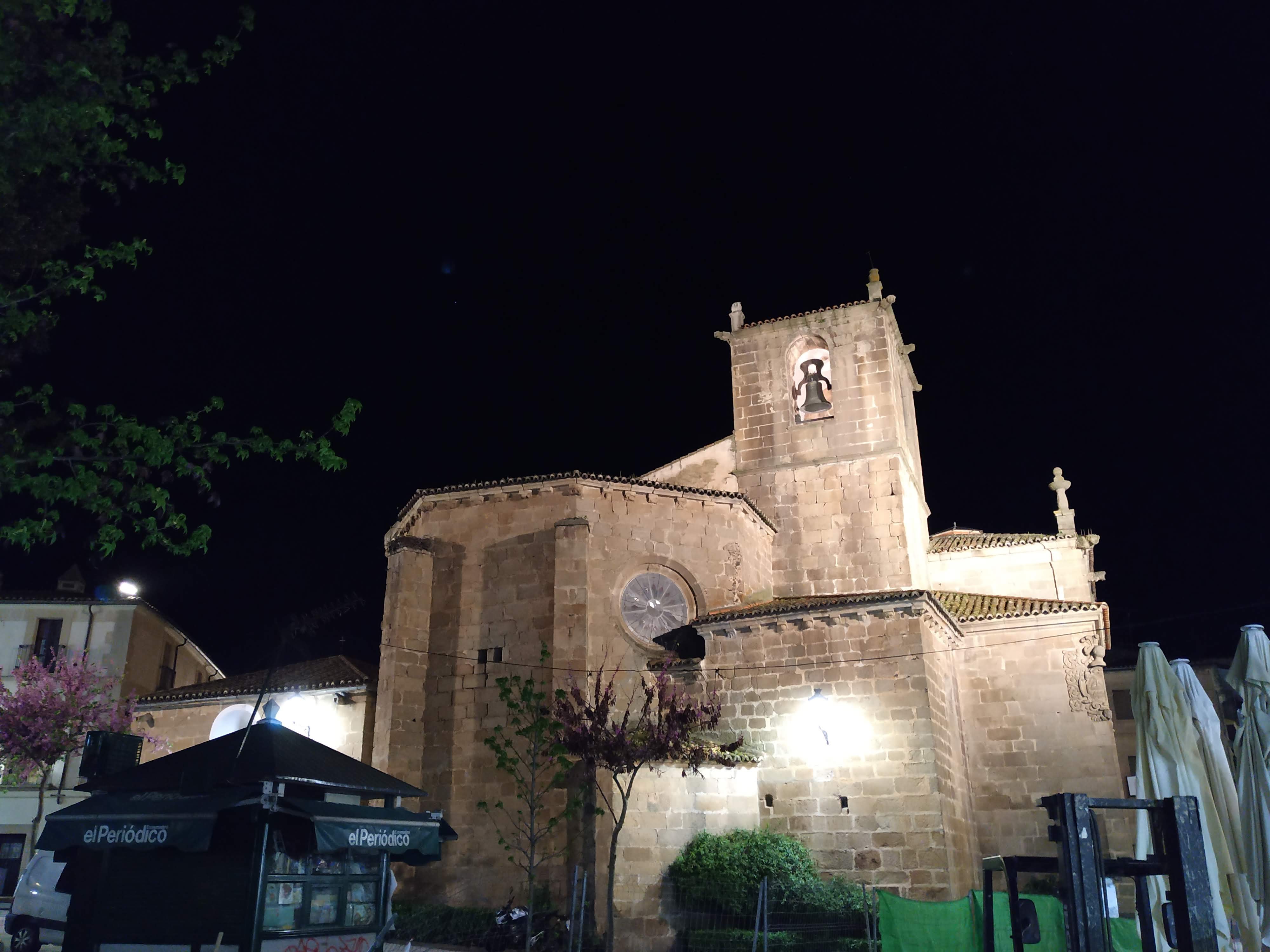
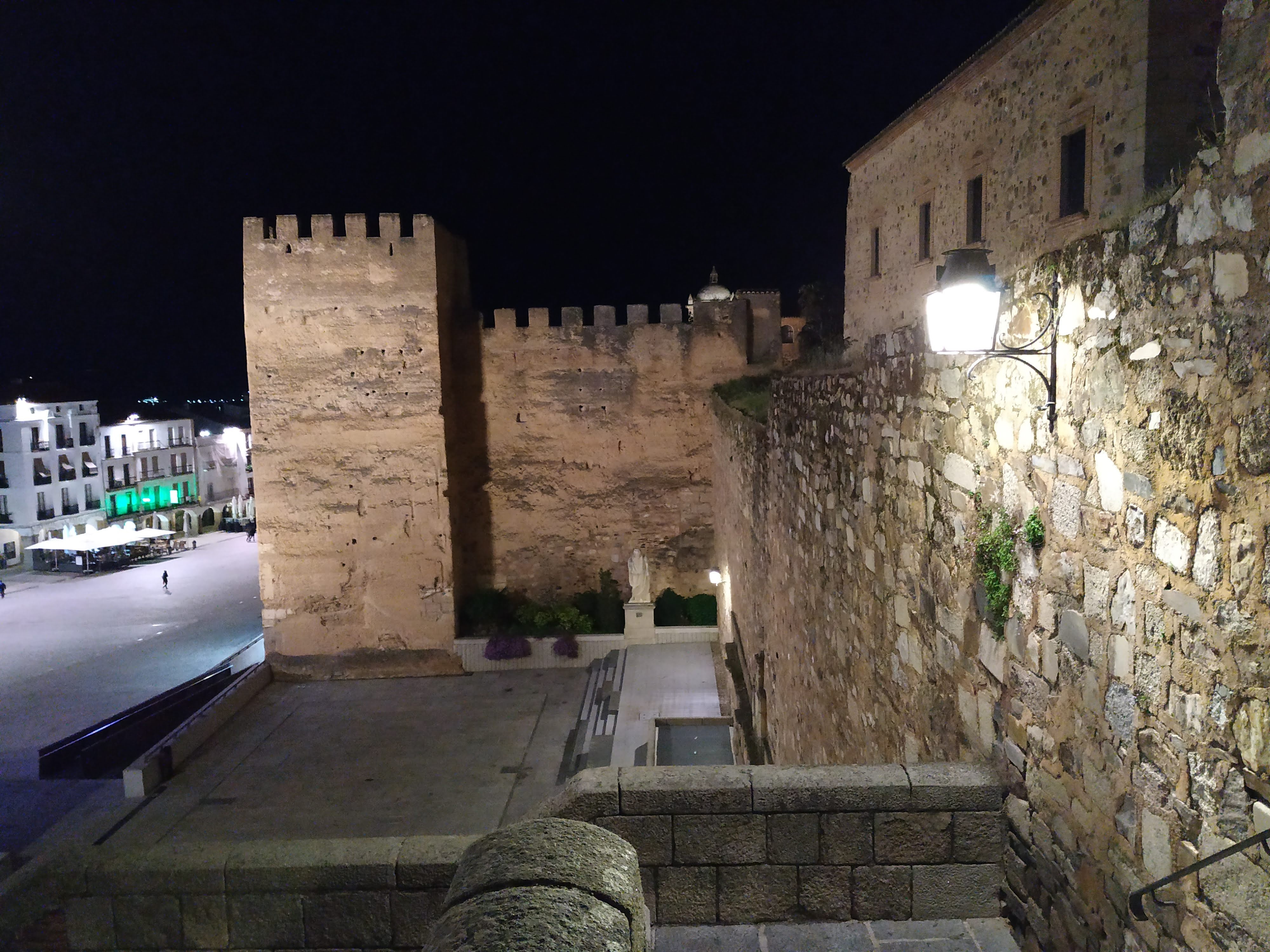
After checking in to a hostel, in which I had a room all to myself, it was time to visit Cáceres, the first big(ger) city in this tour. It is the current capital of Extremadura, but it started its life as the Roman settlement of Norba Caesarina, in the 1st century BC. The visigoths razed that settlement six centuries later and, since then, it has been in control of muslims, the Portuguese, the Leonese, and the Castilians. Most of the architecture you’ll see in the old town is medieval and beyond, the walls having a patchwork of repairs with different materials, depending on the era they were made.


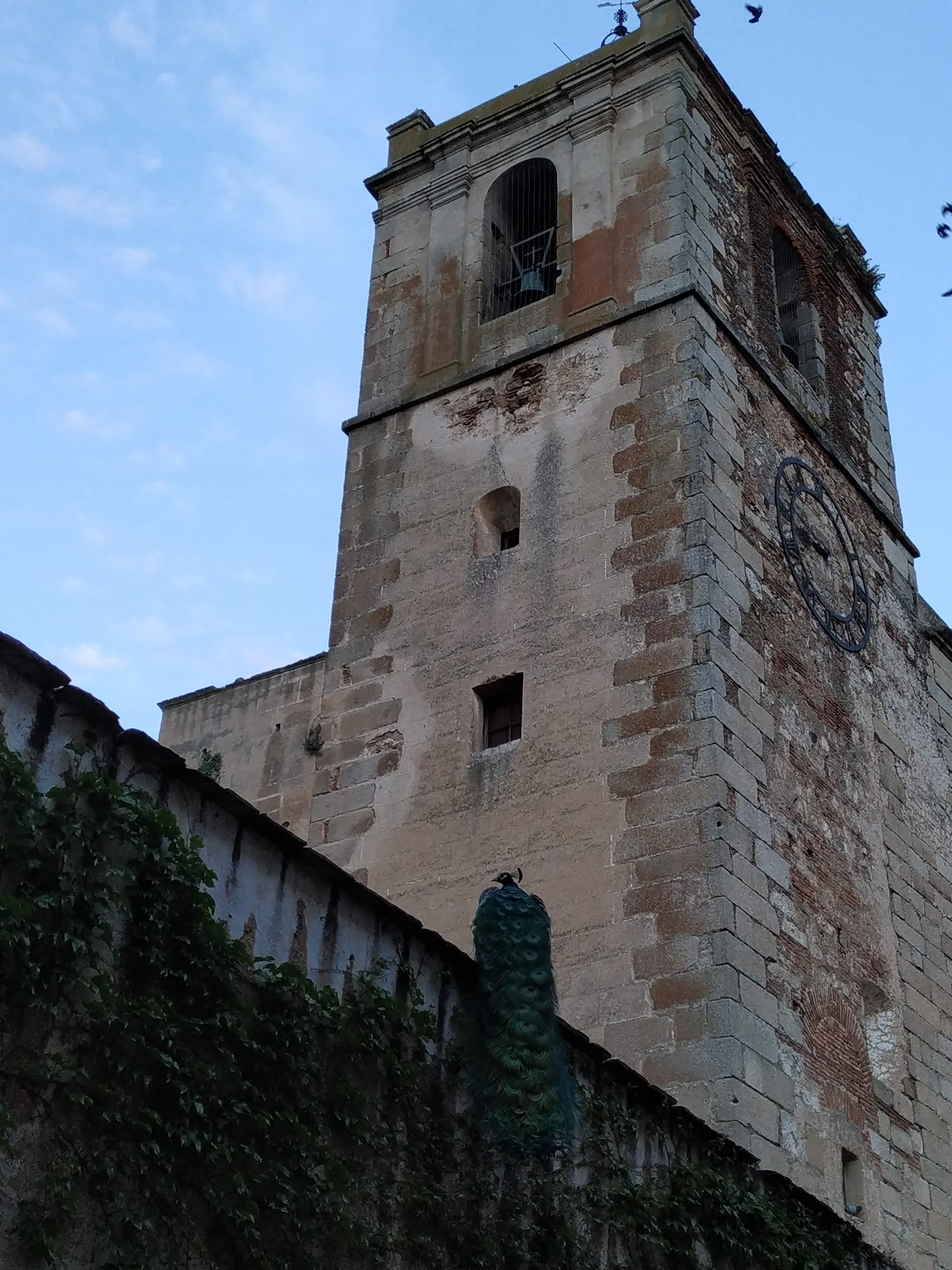
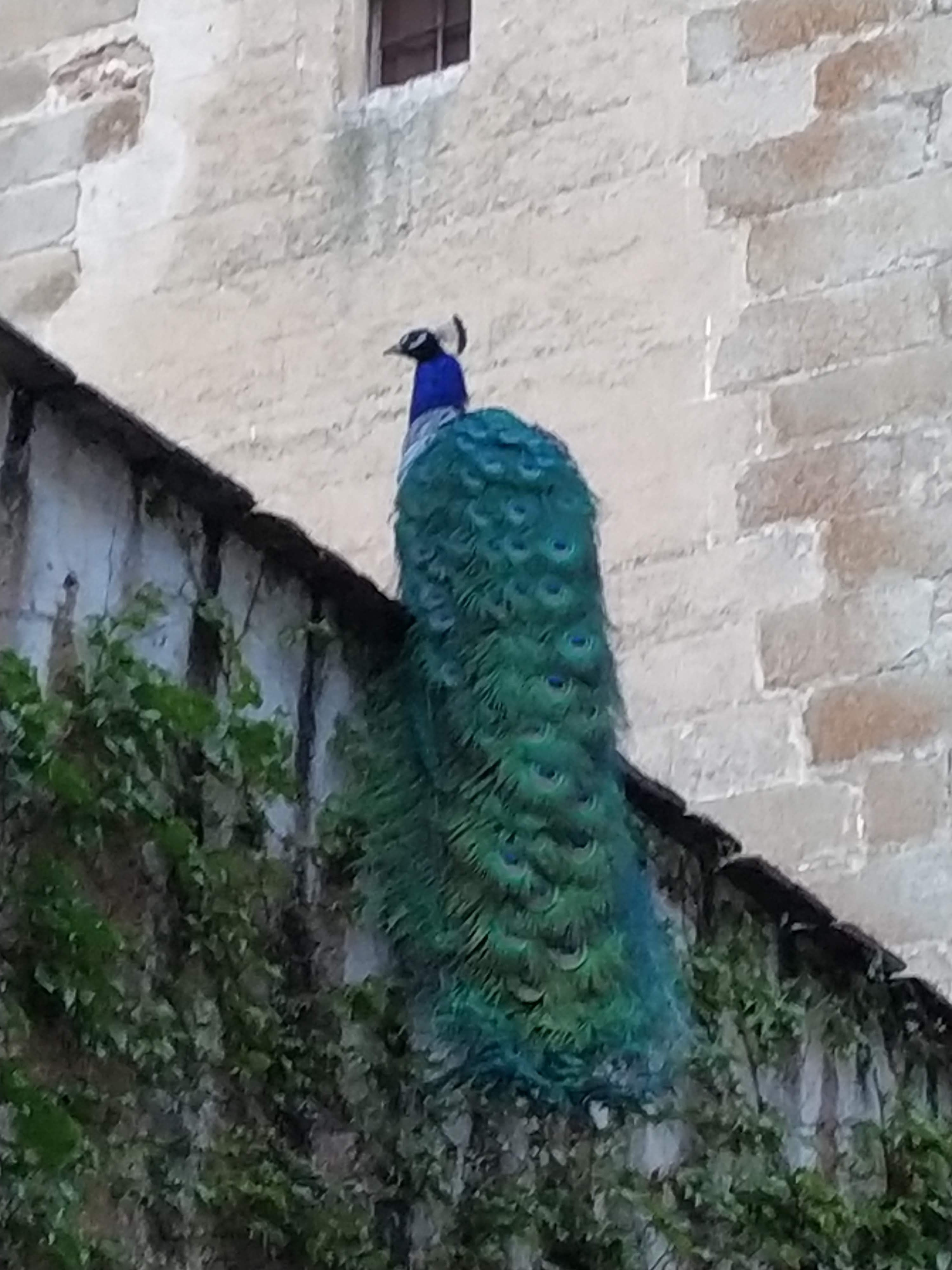
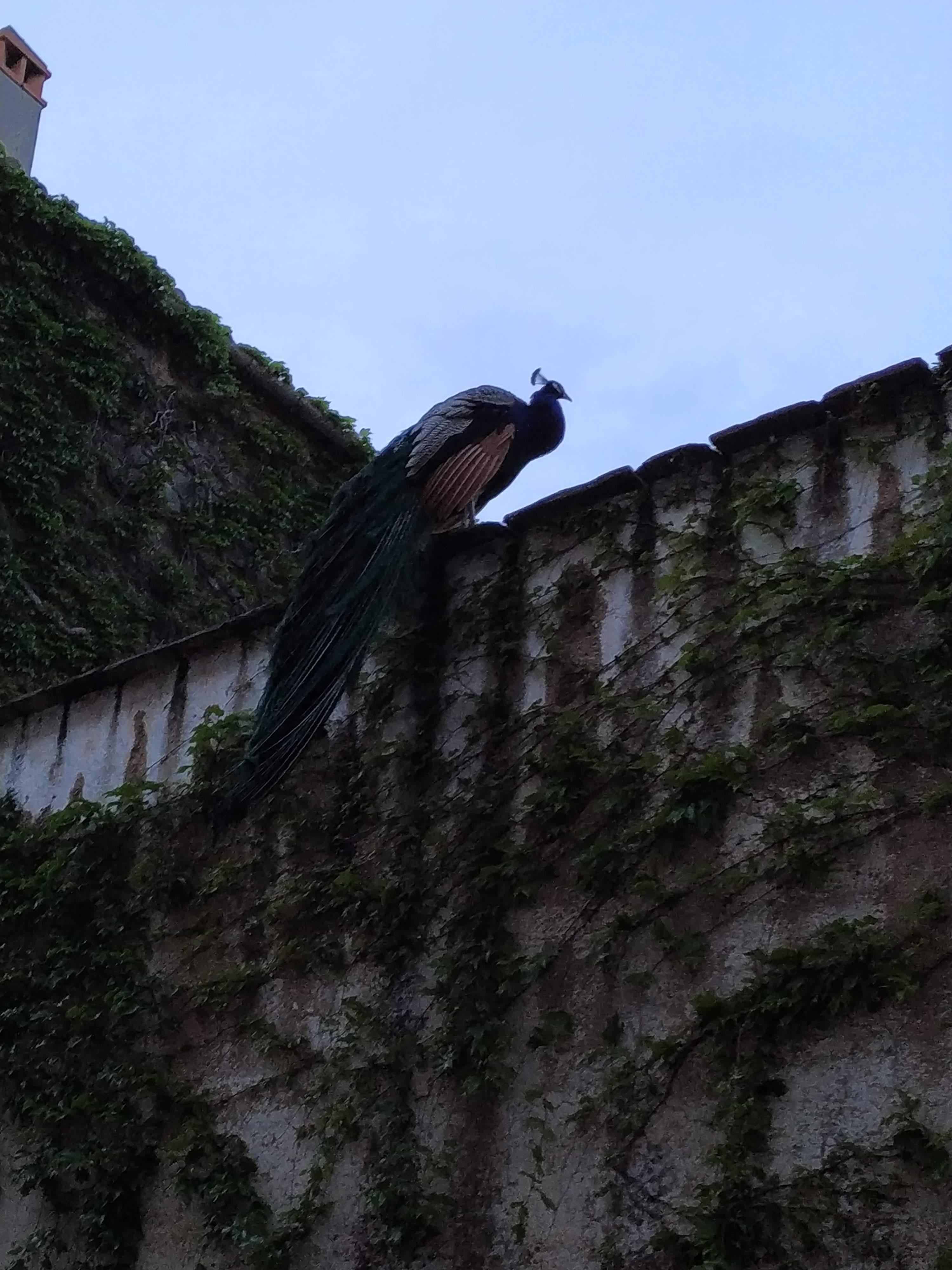
There was also some interesting wildlife:

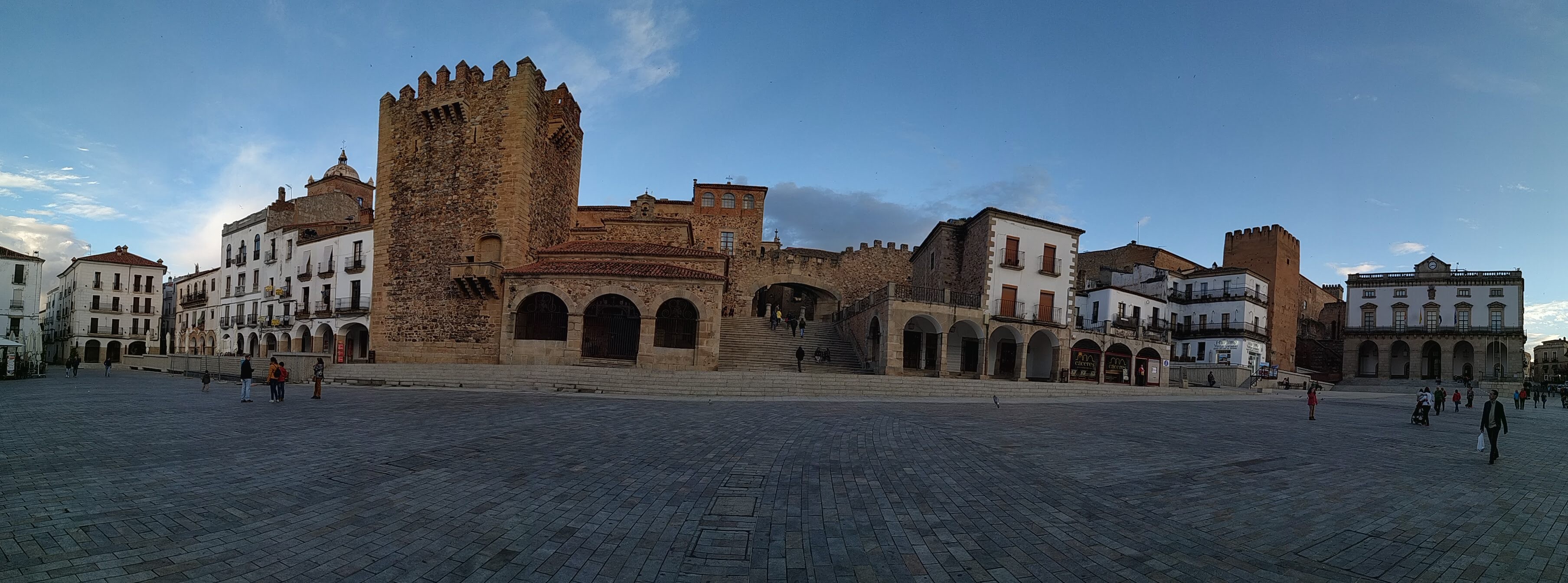
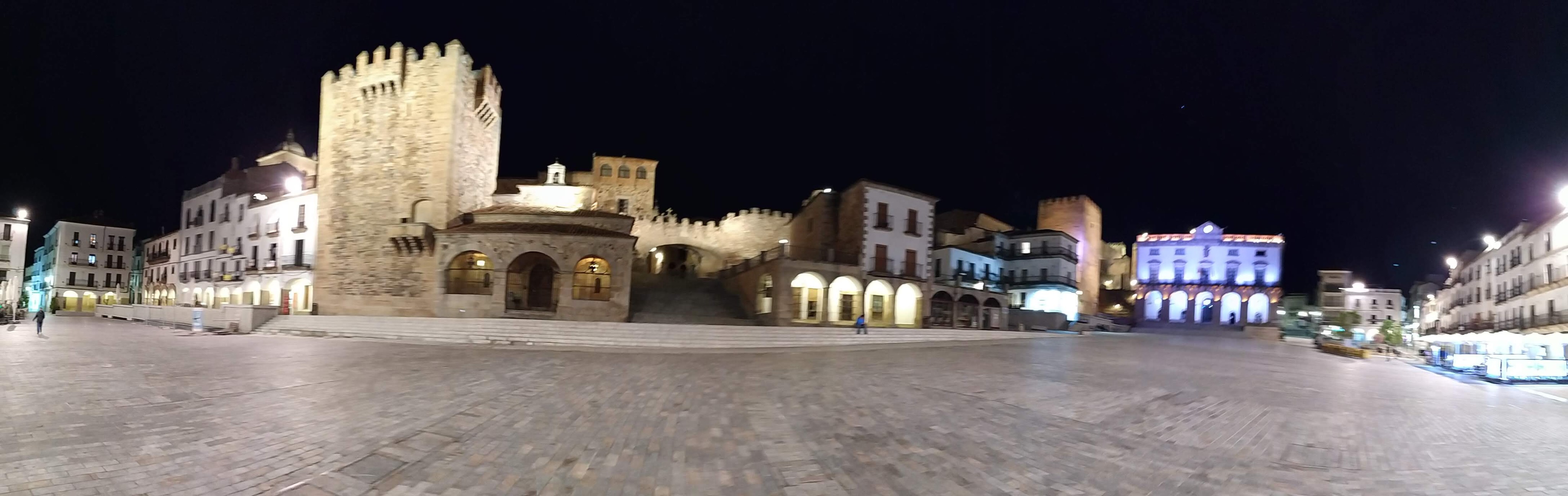
Outside the walls, the most prominent place in the city is definitely the Plaza Mayor, a beautiful, large square, featuring a host of commerce and government buildings.

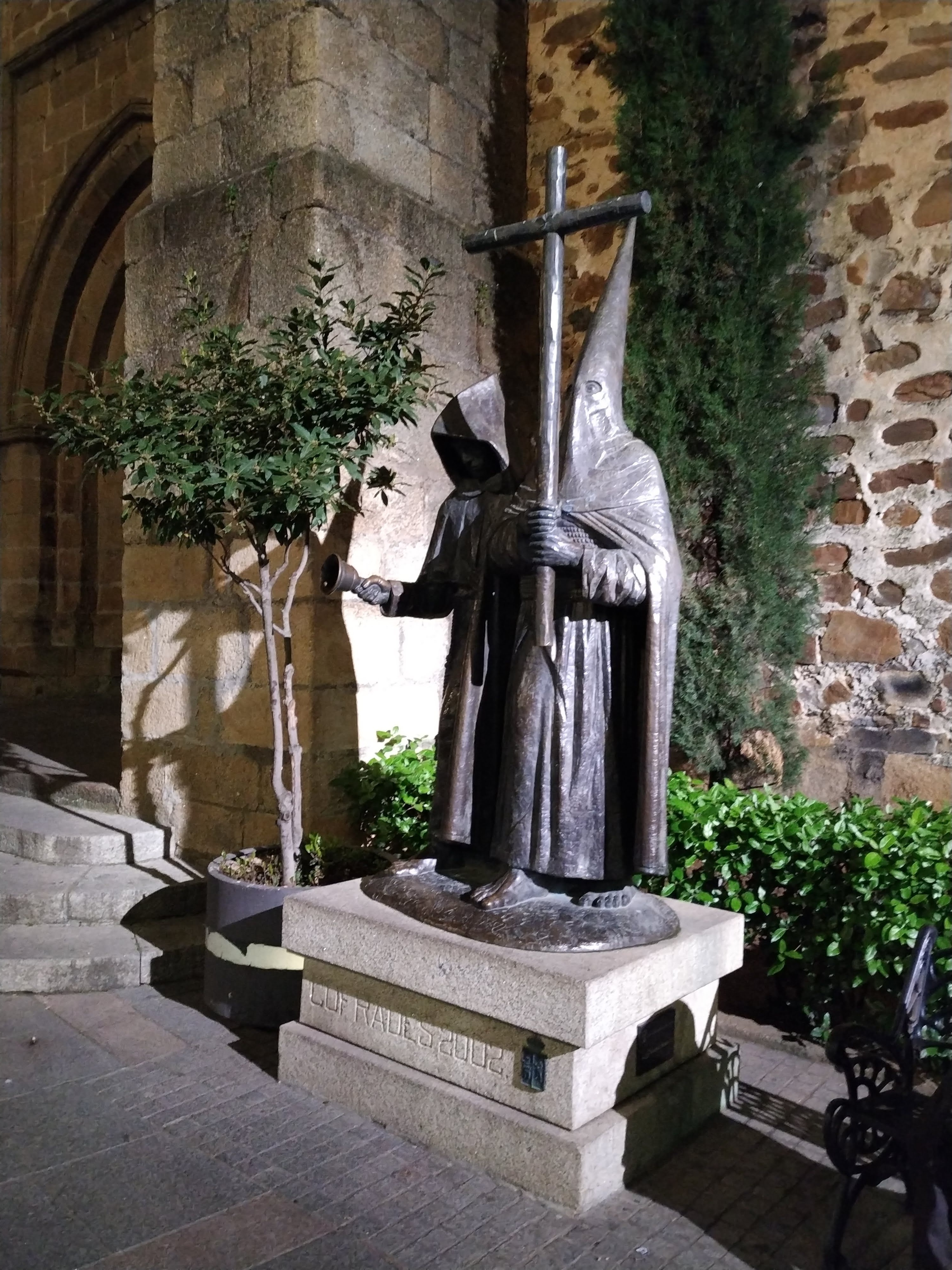
Outside the historical center, there’s a quite large, modern town, which is, apart from all the samey apartment blocks, quite interesting, with wide boulevards featuring gardens in the middle. Unfortunately, I don’t have any pictures of that, so here’s some shots I wanted to share, but couldn’t fit anywhere else:

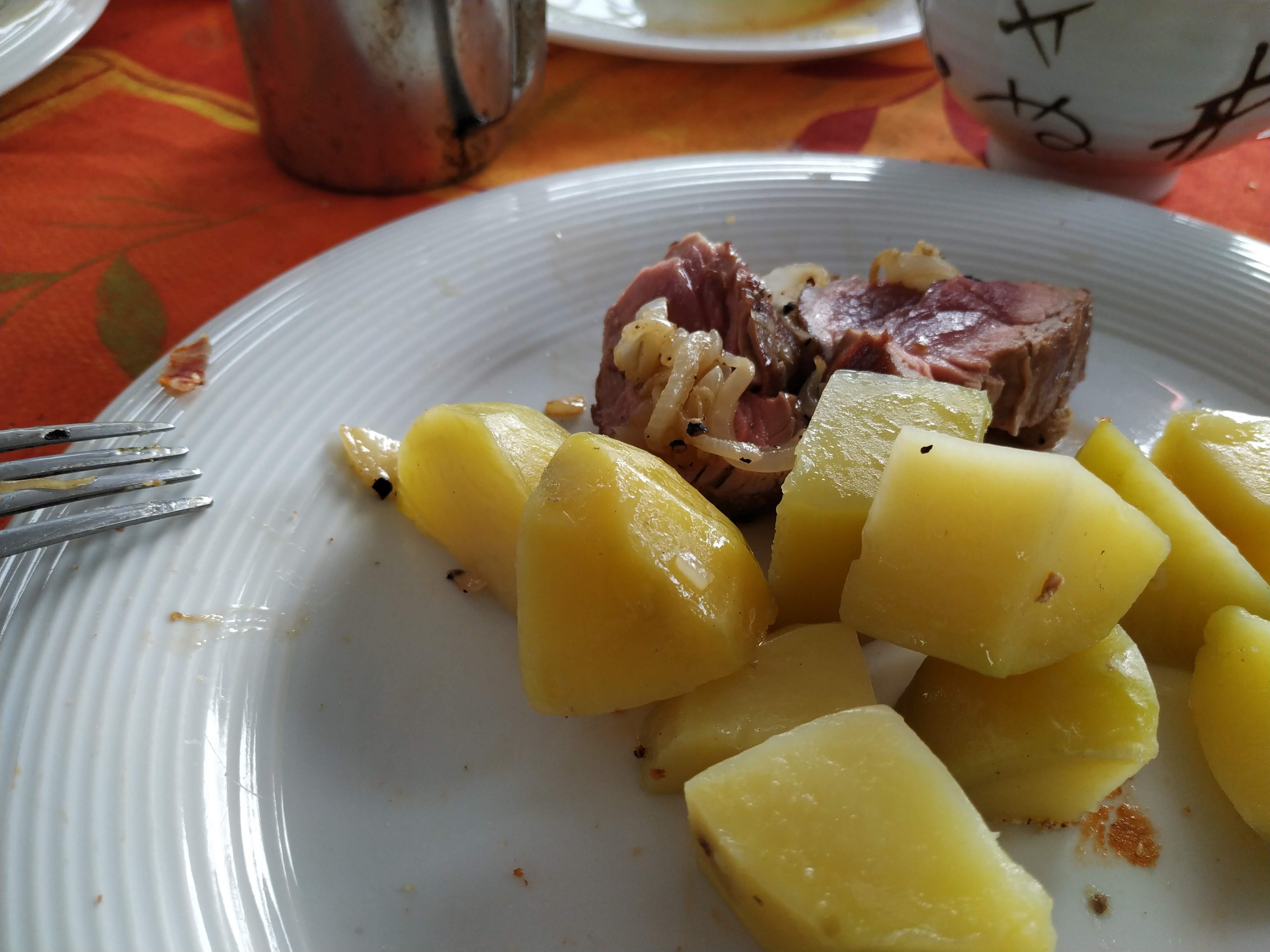
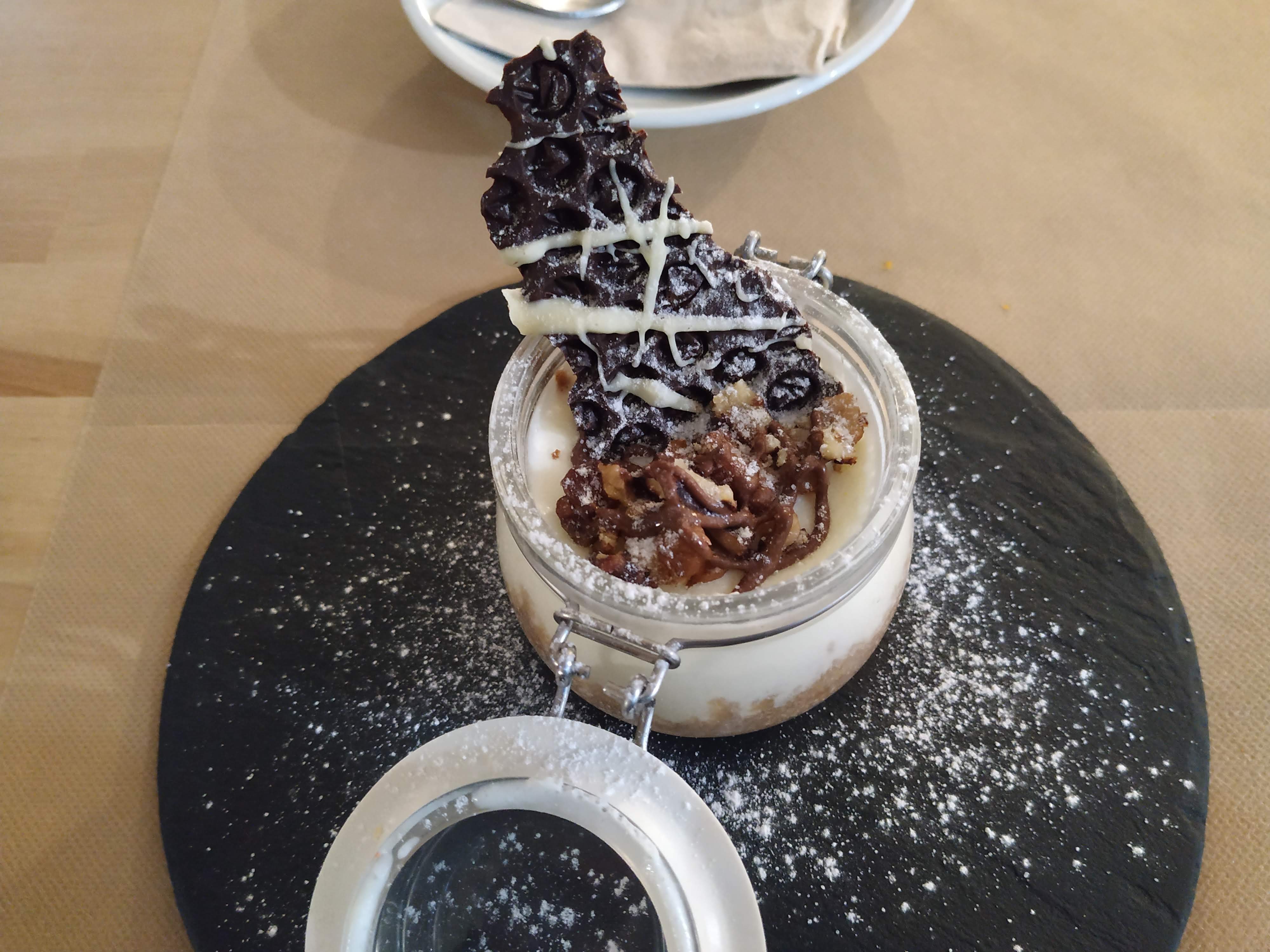
I managed to find out a good, cheap restaurant, too. It’s where I learned the Spanish also do migas, but the star was really the dessert. I assure you that while it looks great, it tastes even better.

And now, it’s time to get going, ’cause I don’t even know where I’m gonna sleep today. See you next time, and have a nice day.

A nice old lady made me care about tapestries

But I’m getting ahead of myself.

The day I left Avis was, indeed, short, with me doing little more than 20 km and then trespassingsleeping on a field that had the gate open. The pic haul was still pretty decent, though.

The next day, I was up bright and early, and soon reached Alter do Chão, where I had breakfast in a place with a rather… odd… decor.

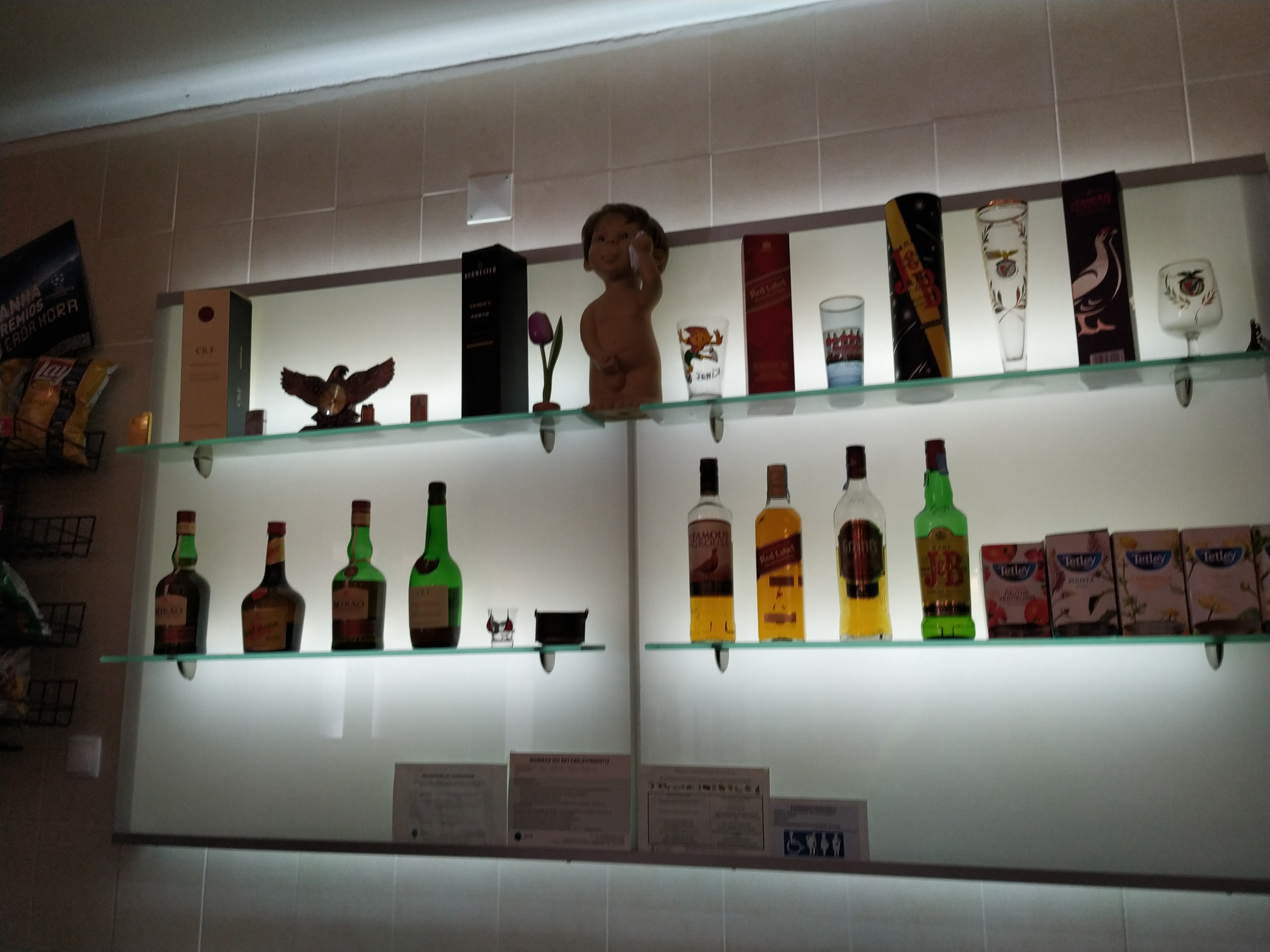
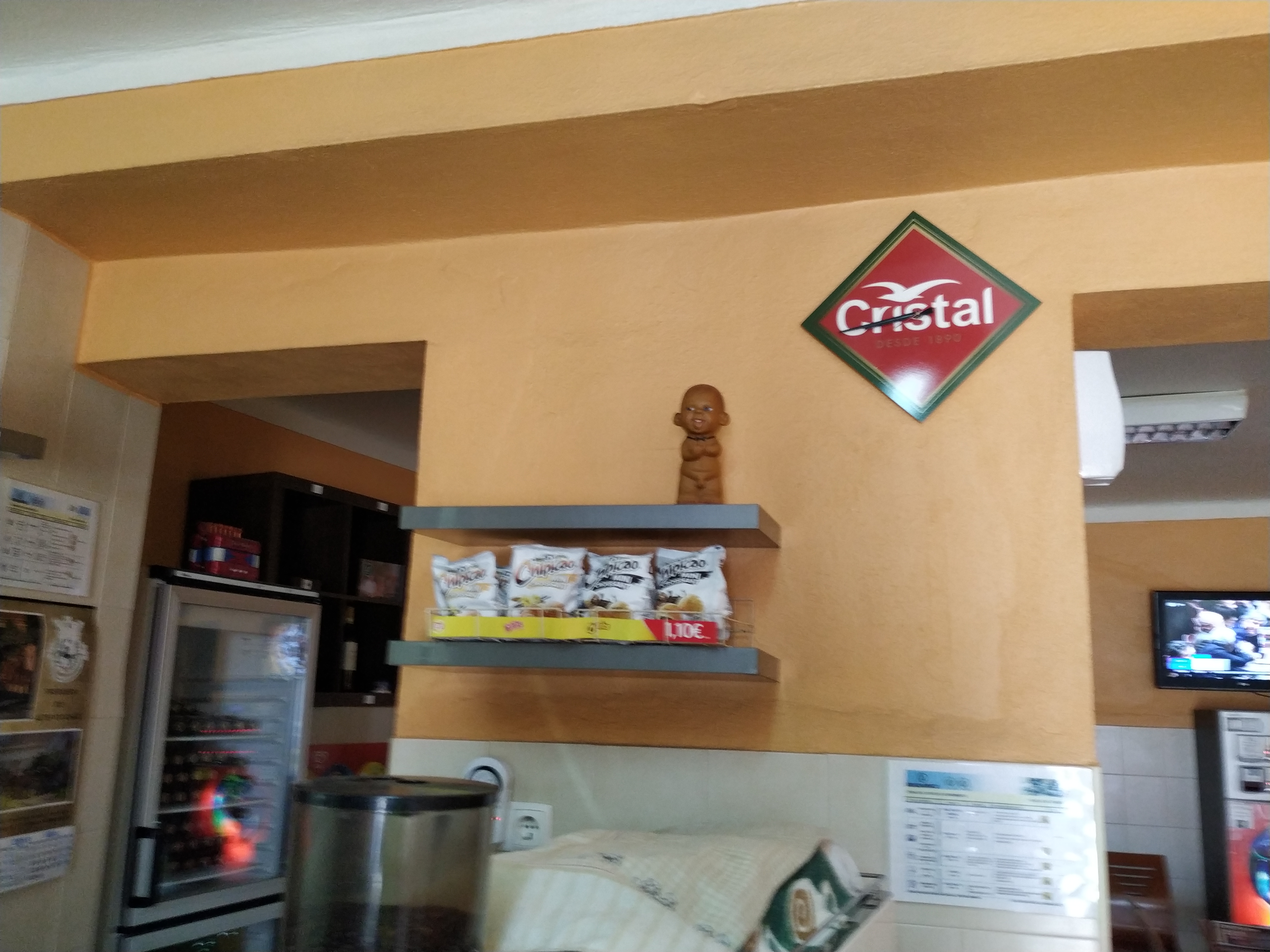
So… Benfica and babies with their dicks out… that’s not weird, or anything.

And then things started going wrong. In the route I had saved, the route planner just gave up at some point, just plotting a straight line between where I was and where I ought to be.

I guess I’d have to draw the owl. The tool I used to generate most of these paths really likes avoiding roads, so I figured the left path would be the intended one. In hindsight, this is where I should have turned back.

But I kept going. And it got worse than that. And then, 1 or 2 km up ahead… there was a gate. So I had to turn back. On the way back, though, my rear derailer hit a rock and it got bent out of shape, breaking a spoke in the process.

I disassembled the derailer and banged on metal piece a bit, replaced the spoke with one of the spares I brought along and it… worked pretty well! I fully expected not to be able to use the rear first gear afterwards, but it all still works.

All in, it was probably a waste of around three hours.

The terrain here is littered with what I like to call Windows XP hills, but since the end point of the ride was 300m higher than the start, there was quite a bit of climbing. I arrived at Portalegre pretty beat, already at nighttime, sometime after taking a selfie with a horse.

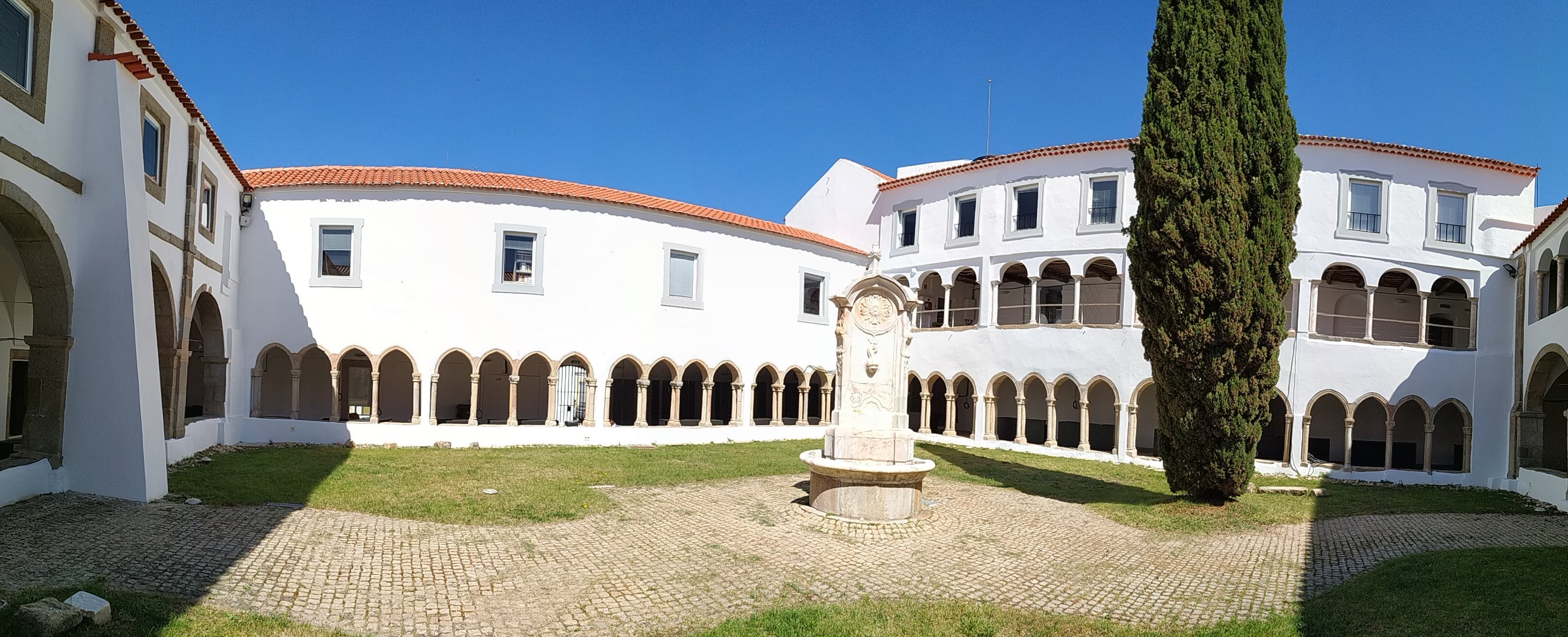
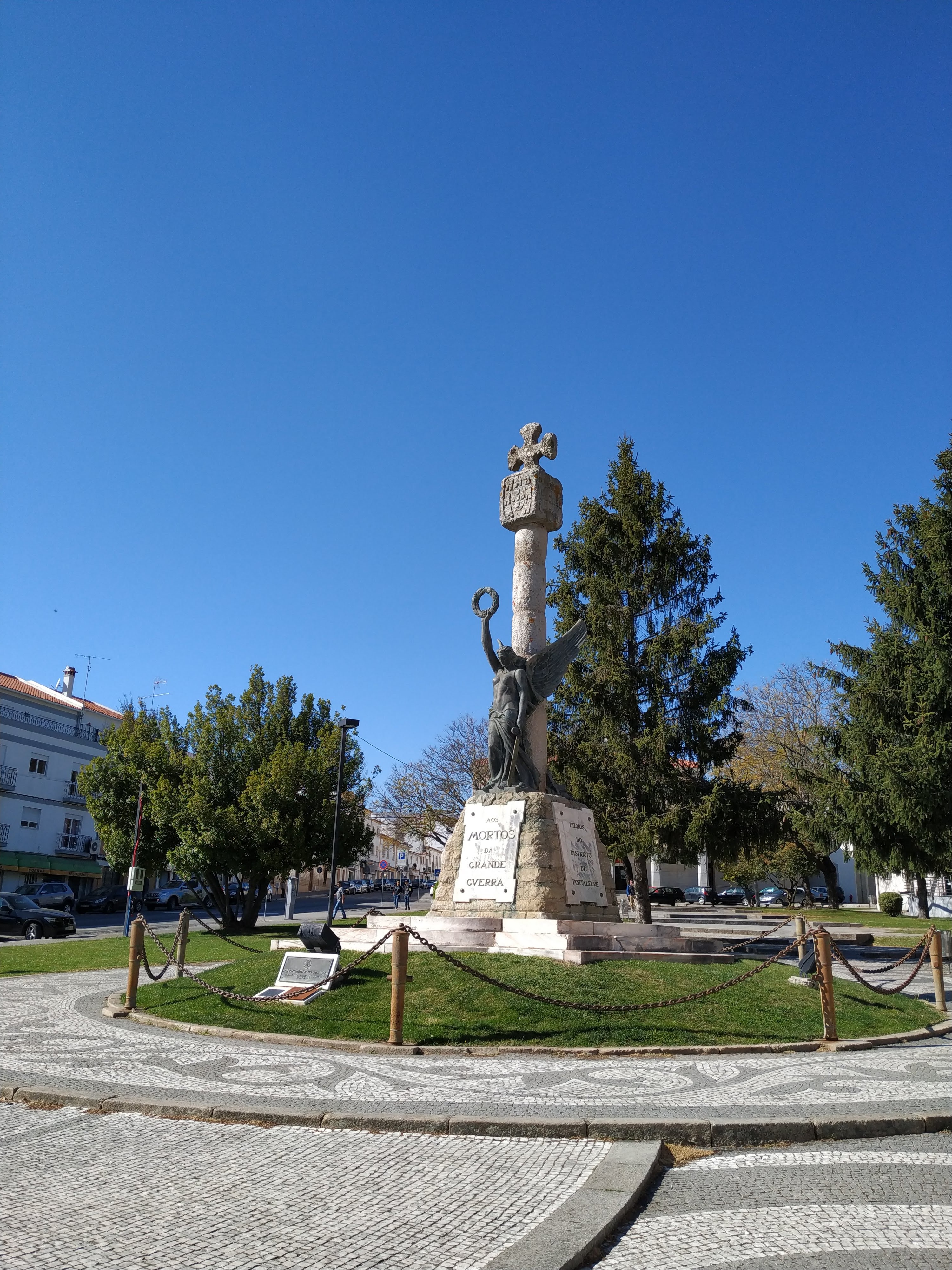
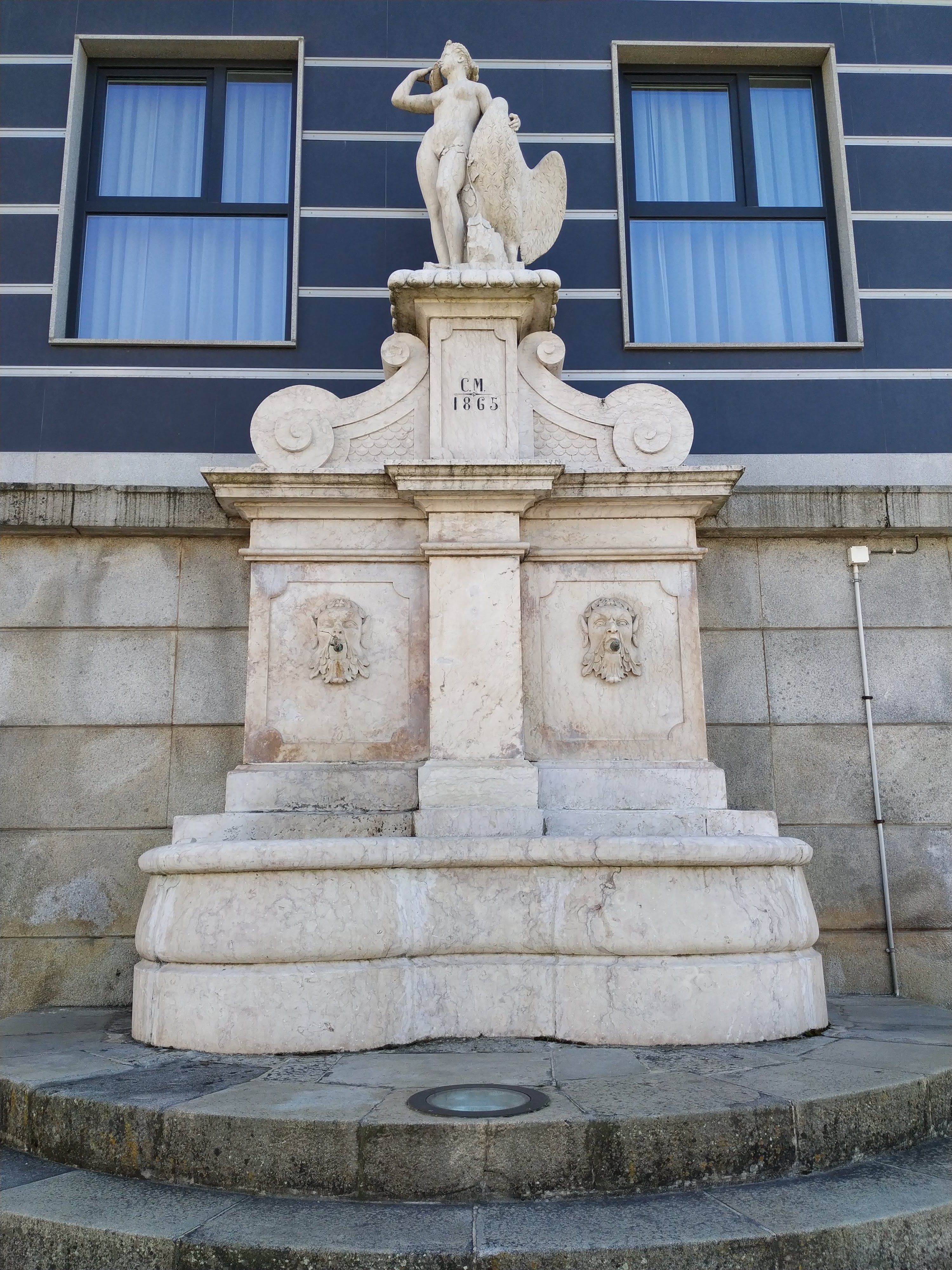
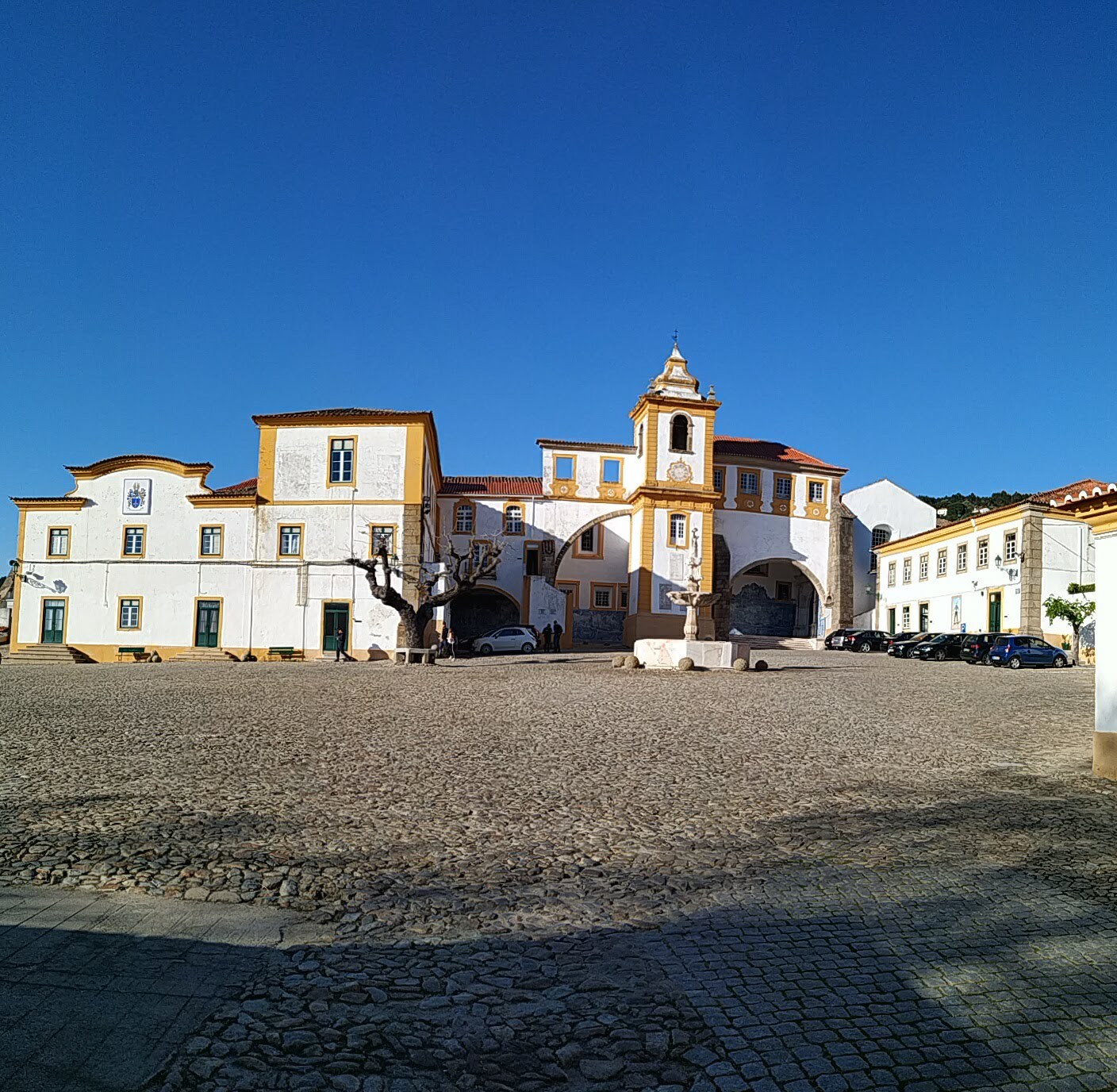
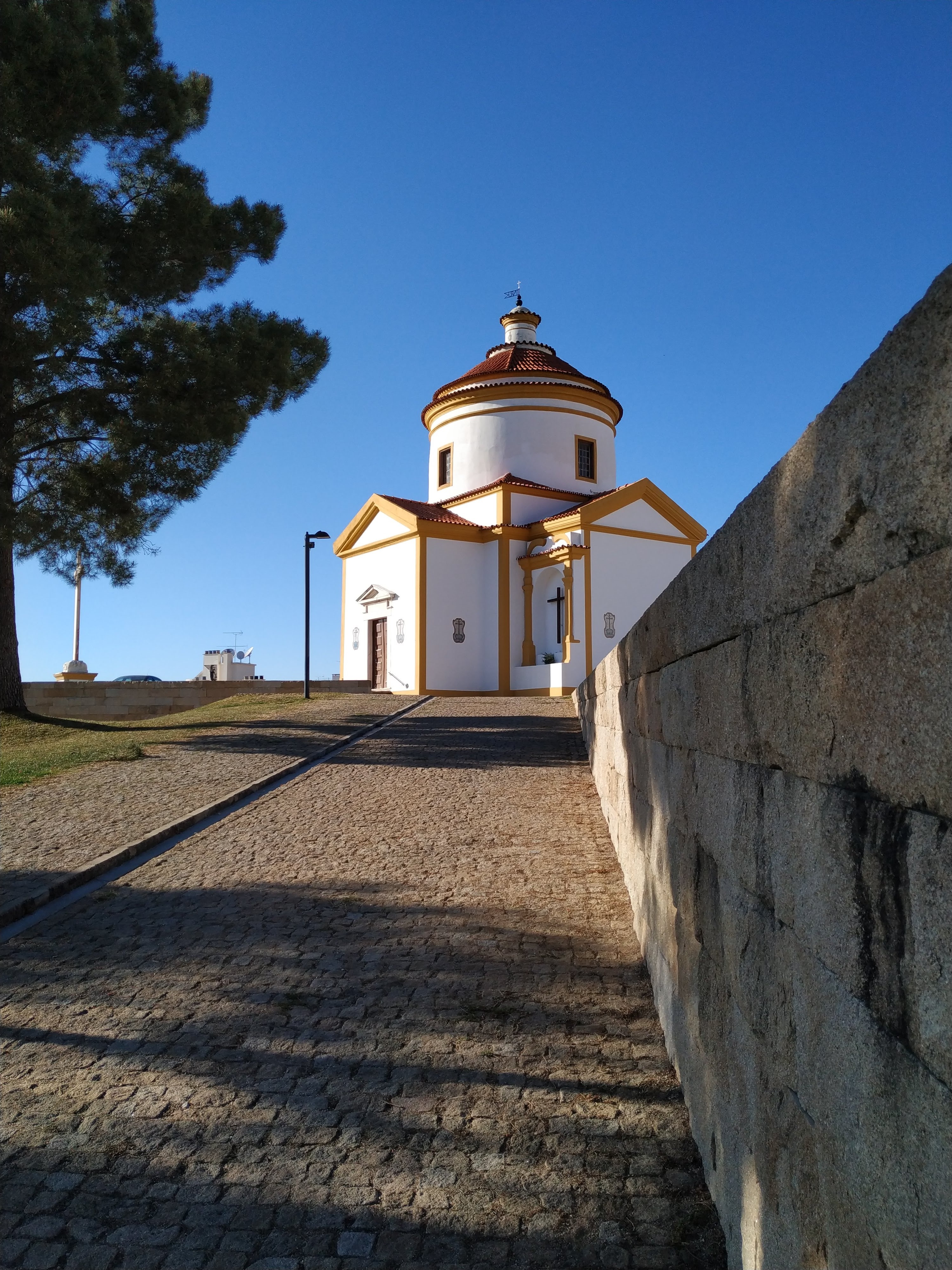
Which leads us to yesterday, which I took to tour around town. Portalegre is a medieval town and it shows. It’s on a hill, it has a castle, and lots of narrow, haphazardly laid out streets. It has, at times, a great contrast of old vs new.

At other times, this contrast isn’t so positive. It reminds me a bit of Lisbon when I was a kid, where every square meter of public space needed to have a car, like the city’s purpose was to be a big parking lot.

A visit to the castle leaves us with just one question: why? Or maybe also: WHAT WERE THEY THINKING?!

Bonus: The exhibition space is completely empty and the top floor is sealed off. At the other end of it, there was another tower from the castle, with an empty room and no way to climb it, and this safety feature on the windows:

Yep! No one can open that now! Now, I came to see a castle, not this. I turned back to the main courtyard in disappointment, and then realized that while they’re not giving me a castle experience, the lady downstairs’ eyes were all on her computer when I came in, and I’m not shy about jumping a fence, so I did, and I climbed a wall, and then I climbed a tower after climbing that wall.

Yep! That was worth it! And not a peep from her at the exit!

This leads us, then, to the old lady in the posts’ title. Now, any one who knows me will tell you I’m not an artsy person. In fact, I was in front of the former home–now museum–of the late José Régio, a somewhat famous writer / poet who reportedly had an extensive religious art collection, thinking: “no, I can’t imagine that being interesting”.

This building across the street had a sign on the door to the effect of “Guided tours: <phone number>”. I didn’t really have an idea what it was, but I saw an old lady come out with a broom on her hand and said:
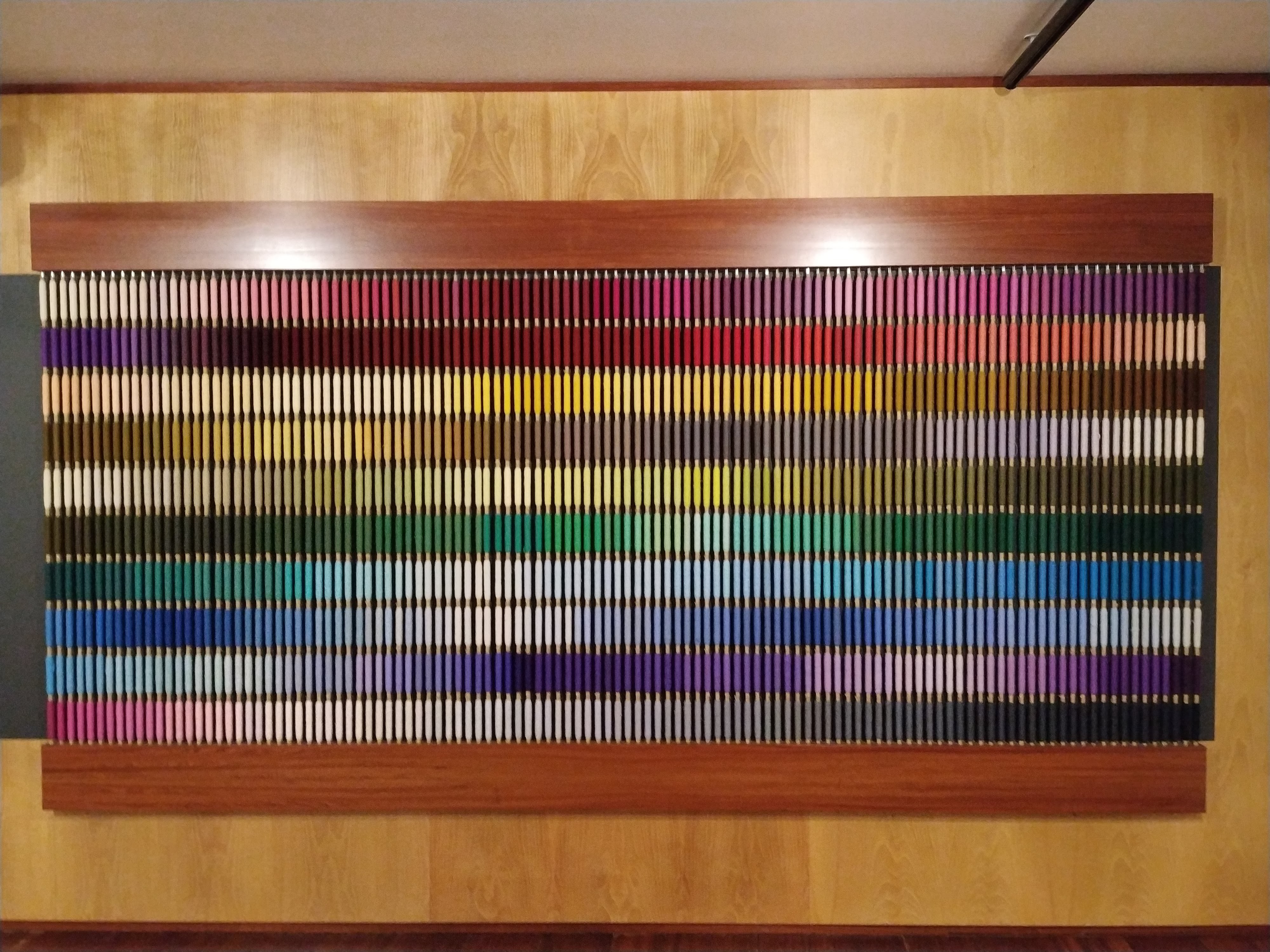
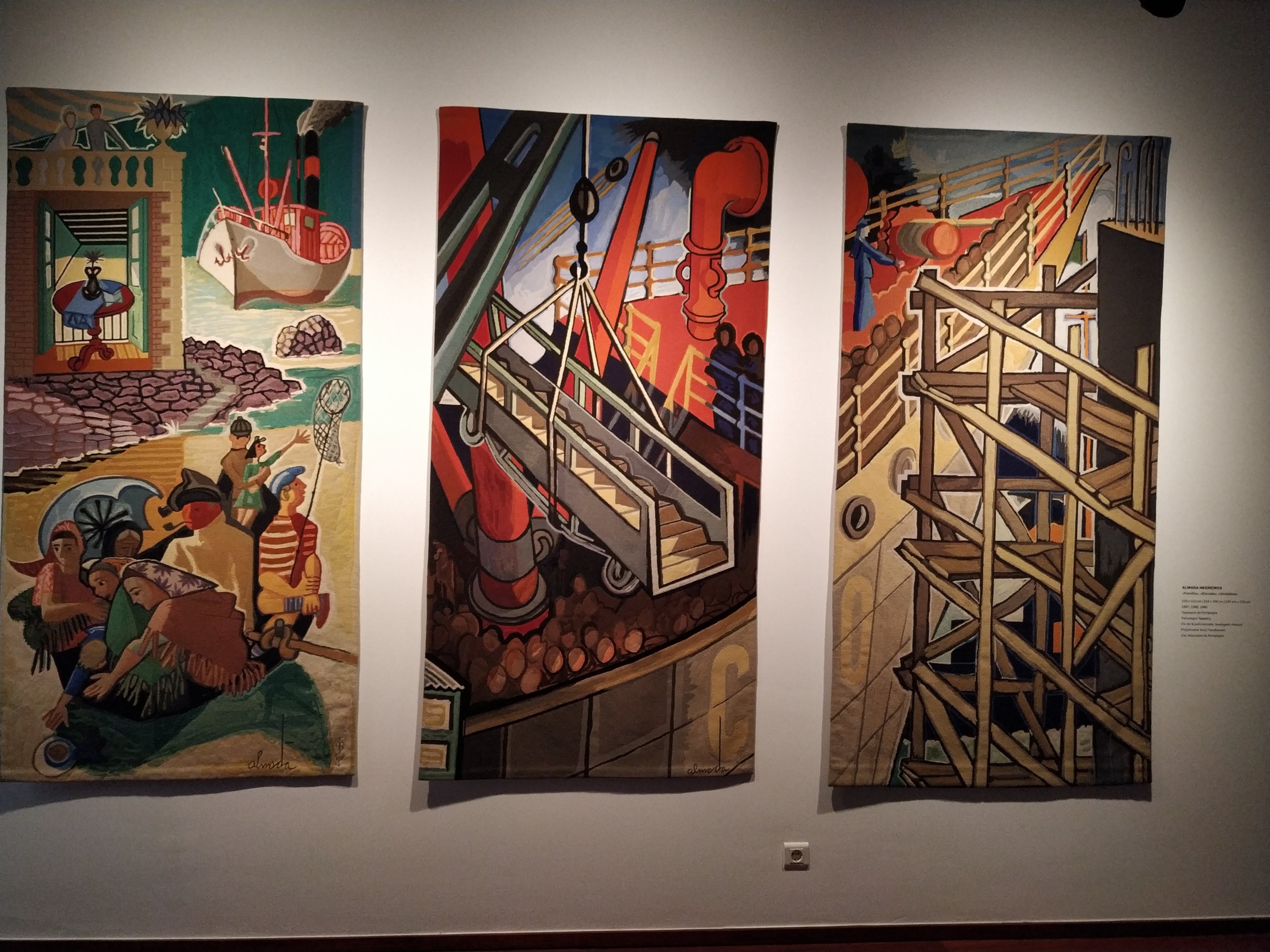
“Good morning, can I have a guided tour?” And she was like, “Sure!” This was my introduction to D. Fernanda and to Manufactura de Tapeçarias de Portalegre, an internationally renown tapestry manufacturer, who use a kind of stitching they devised, which allows flat tapestries with smooth curves and gradients. She proceeded to show me around the building, where they use vertical looms to turn a painting into a tapestry and do every single thing by hand.

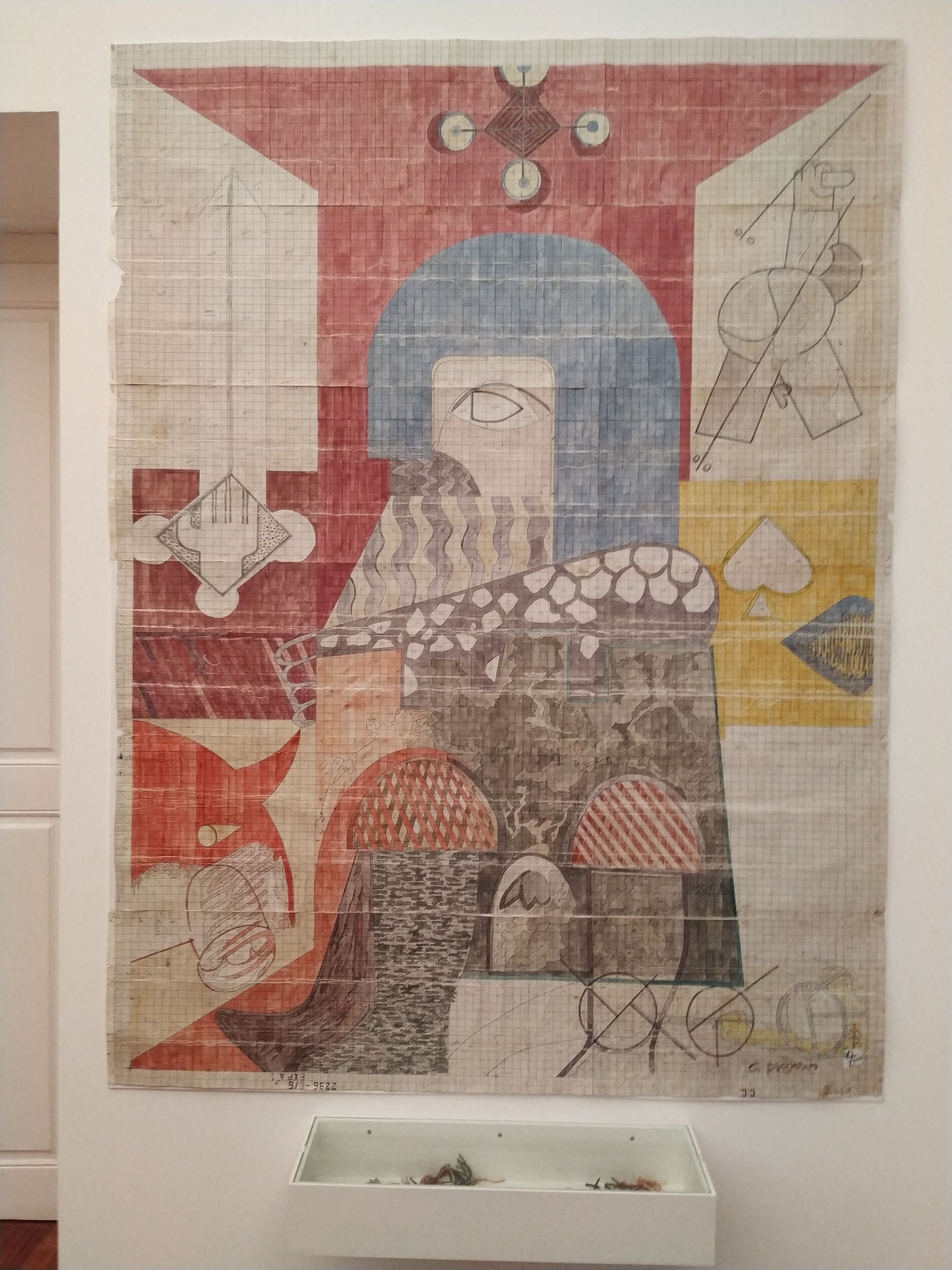
I’ve found it interesting, so then I visited the tapestry museum (of course!). The process starts with tracing the painting into millimeter paper and assigning colors to each section.

They then have the milimeter paper at eye level, and, moving up a line at a time, weave each stitch in place. Since each stitch is made of eight strands, they can mix them to form smooth transitions between colors, creating tapestries that look a lot like their original paintings, really.

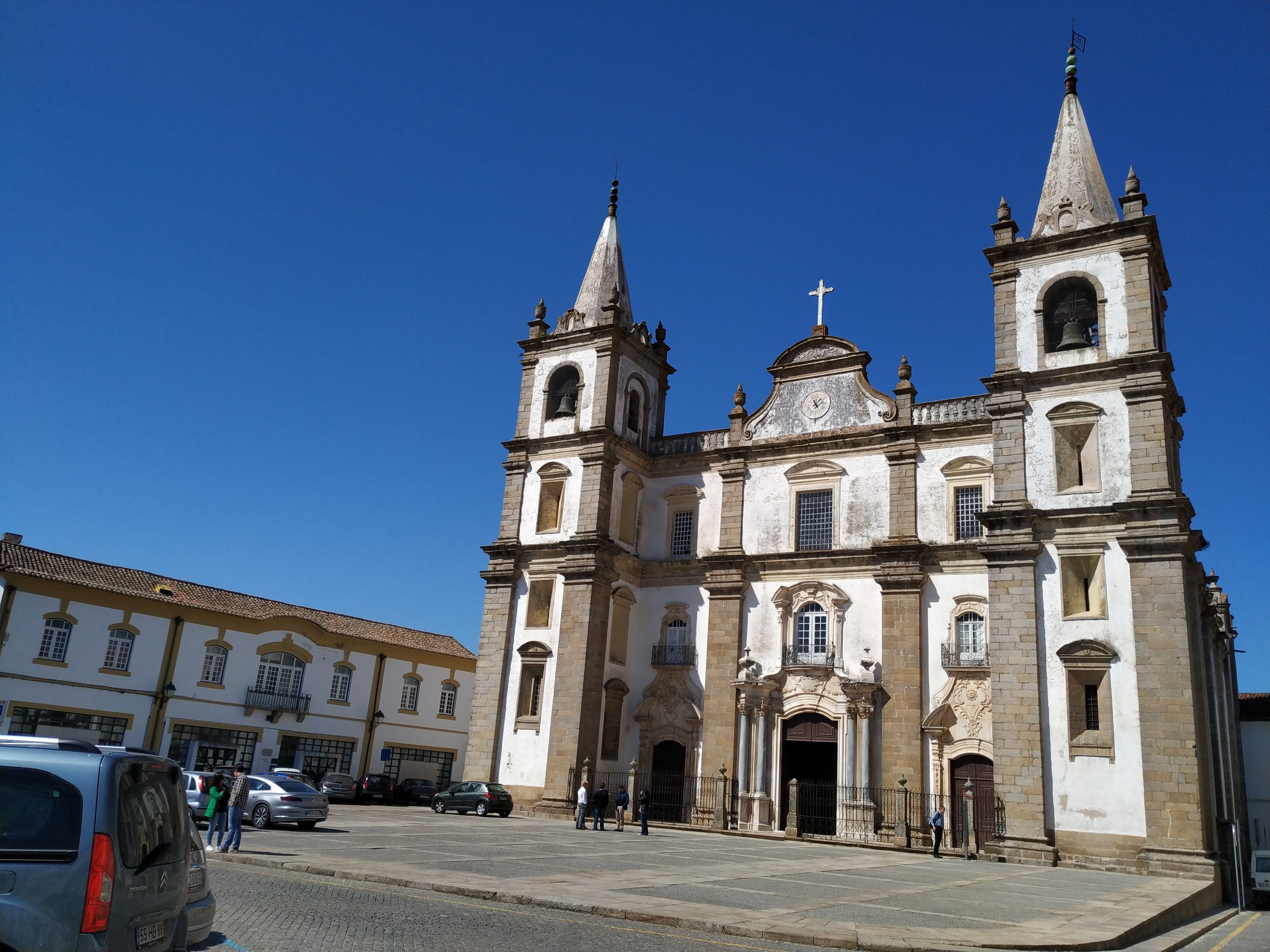
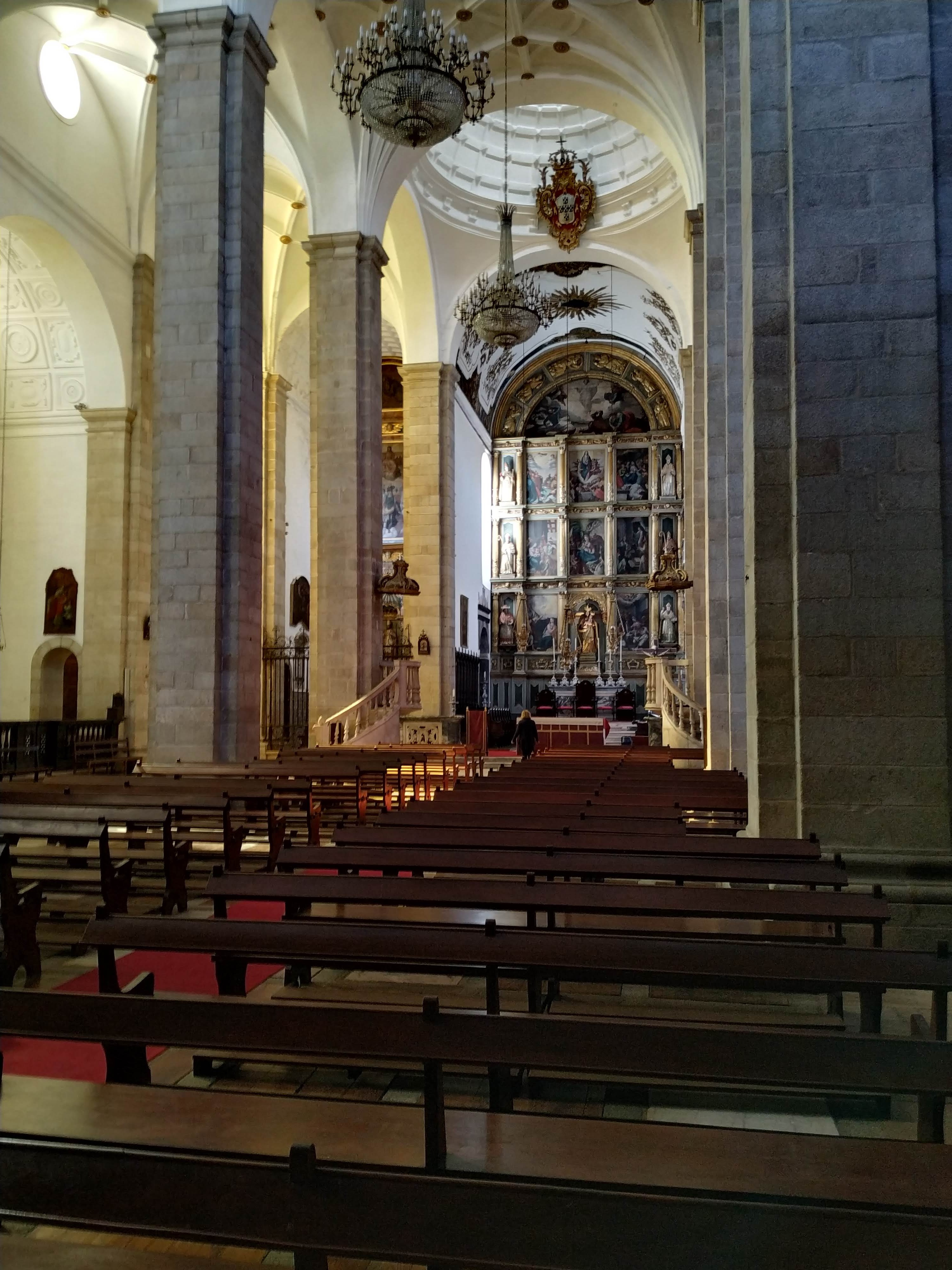
I also visited the cathedral, where it was absolutely forbidden to take pictures inside. You know where this is going.

It’s… a cathedral. Not a very well preserved one, though the inside is, at least, a bit better than the outside. The (mildly visible) ceiling has an interesting pattern, too.

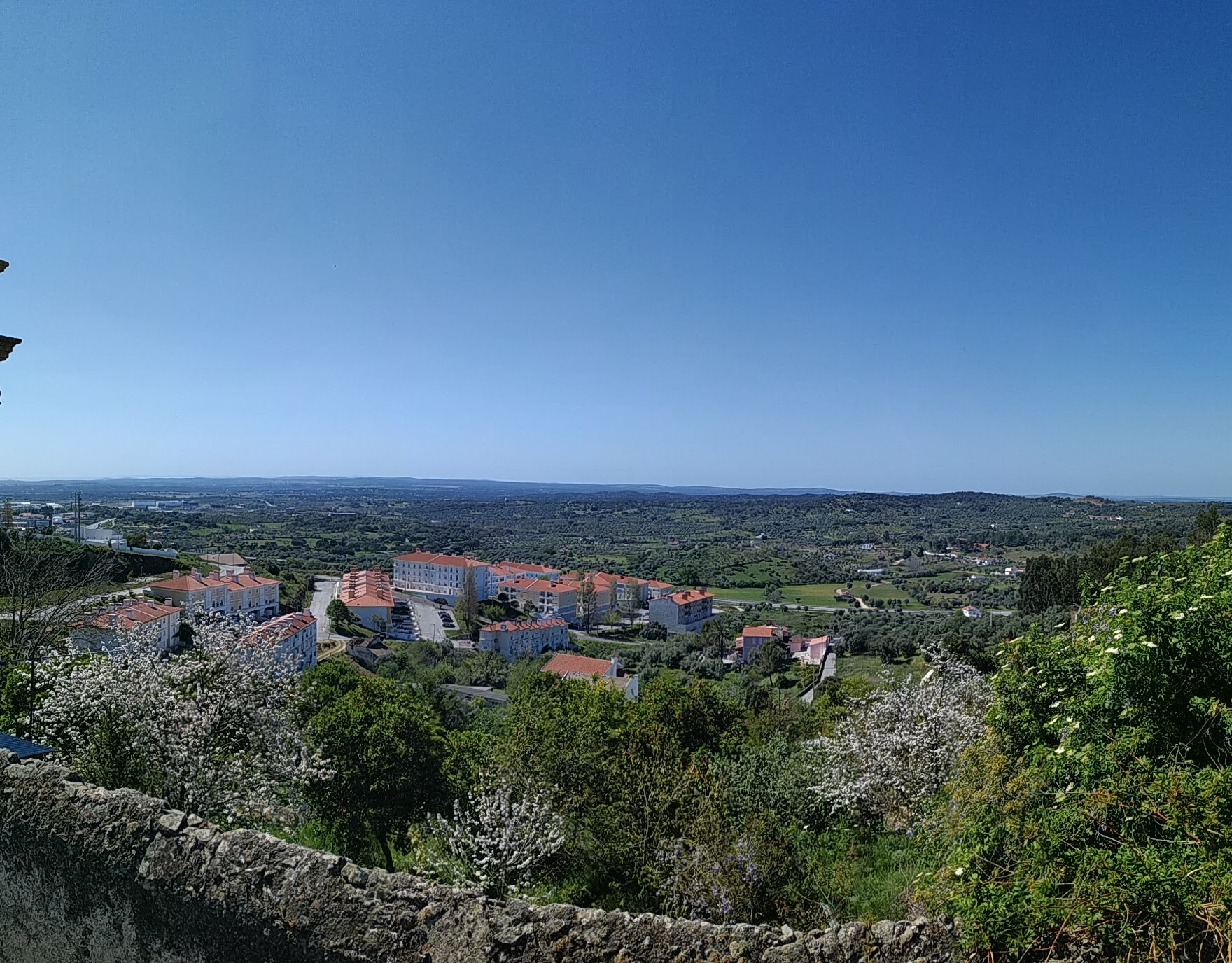
There were still more pretty places to be seen:

This is a police facility, believe it or not.

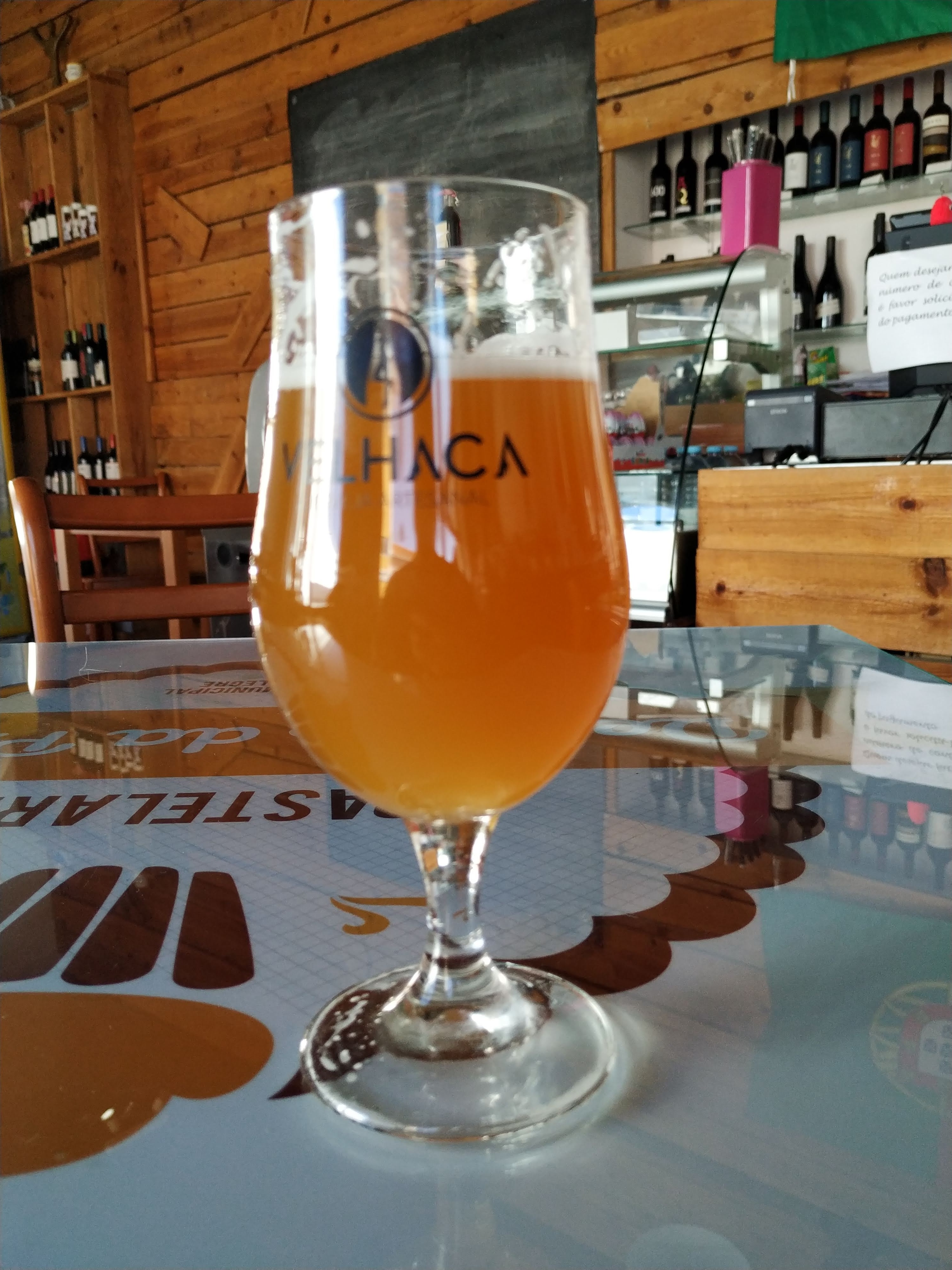
There’s also a local craft brewery, from which I got to sample their “American wheat beer”. It tastes like wheat beer but it also tastes a bit… fruity, like it has a hint of peach. I can’t believe it, but the flavor actually works! It’s pretty delicious.

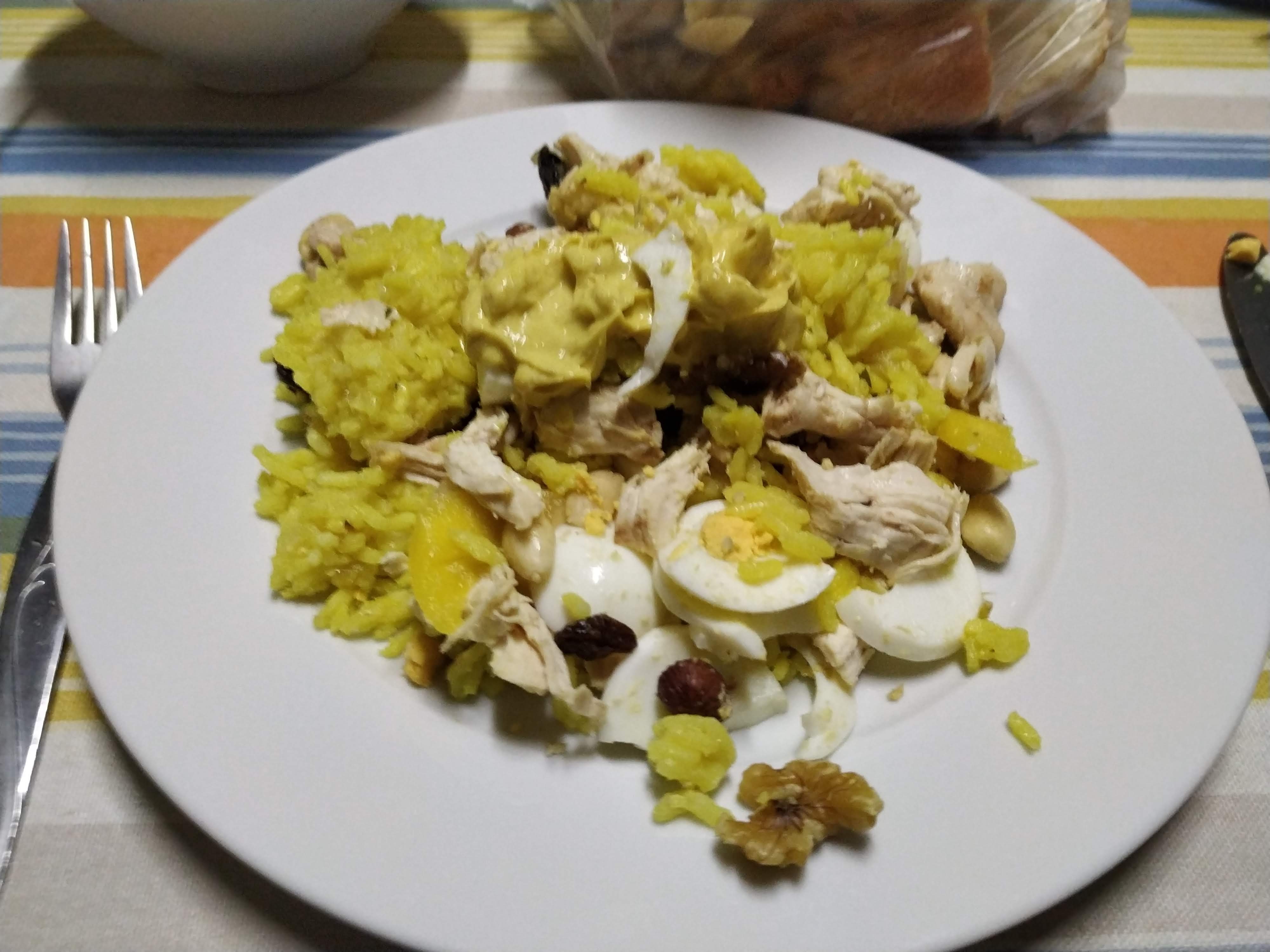
Back at the hostel, a group of nursing master’s students had arrived and were kind enough to offer me dinner. If you had told me you’d put mayo, banana and mango on a chicken curry before today, I would told have told you to shove it. However, the prospect of a free meal made me try it, and I’ll be damned if it wasn’t great! Thanks to Diana for cooking and the rest for the company.

Yeah, it doesn’t look great. Don’t care.

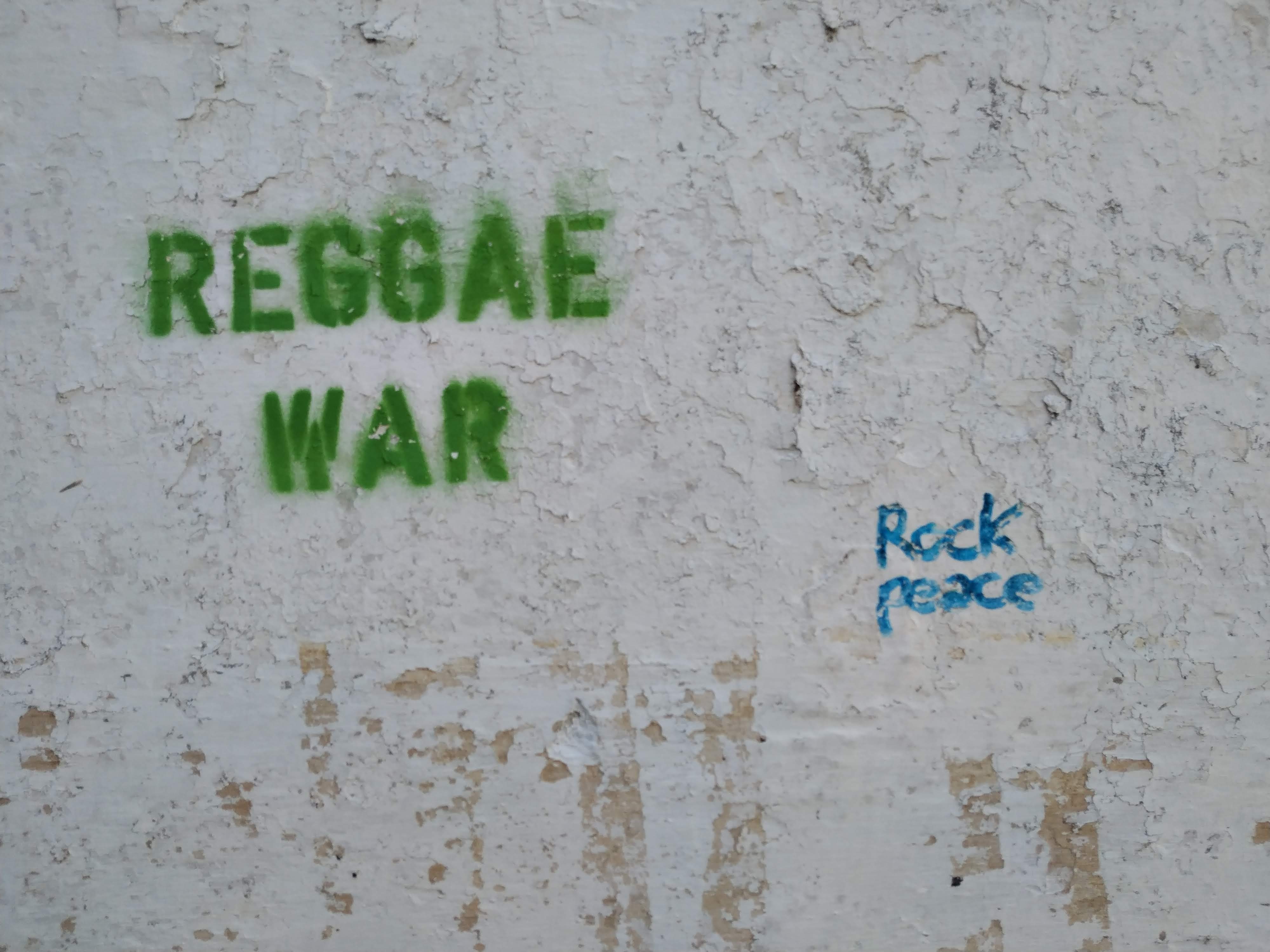
And that was it for Portalegre. Thanks for reading, but I have one last request, for now. So far, you’ve been content with just reading the blog, but now something I saw here in town tells me it is time to take action. A conflict is on the horizon. Tensions are rising. Intentions have been declared and statements have been made. So my question for you is…

Whose side are you on?